
Game Review
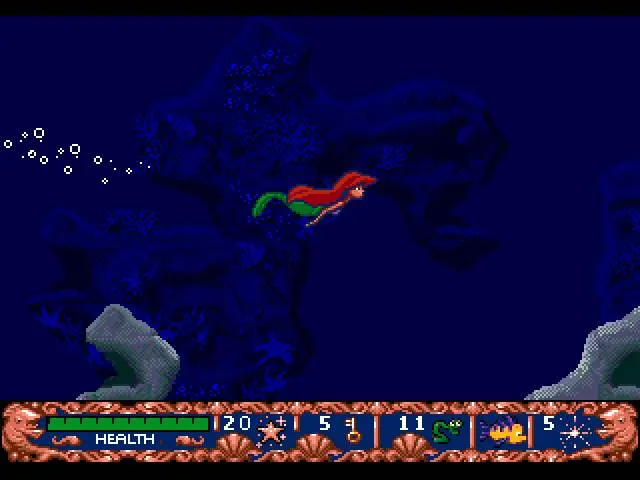
People who were fortunate enough to experience the Sega Mega Drive may remember the game based on Disney's "The Little Mermaid." The one where we, as Ariel, explored the underwater world and fought enemies, blah blah blah... The game wasn’t exactly groundbreaking, but it exerted a potent influence on the undiscriminating minds of children. Perhaps that’s how a ten-year-old Derek Yu got hooked, who would create his own little masterpiece about the adventures of a mermaid in the endless ocean fifteen years later...
Aquaria is a 2D side-scroller focusing on world exploration and puzzles, which include, oddly enough, musical puzzles. Although various enemies and bosses are also present, but more on that later. Everything begins in a quiet underwater cave, where a mermaid named Naia suddenly has the thought that she might not be the only intelligent being in Aquaria. She decides to set off in search of others like her, during which she uncovers the secrets of lost civilizations, gains new powers, battles ancient monsters, and also gathers a pile of random junk in her cave, and even, God forbid, finds her love... Oddly enough, the plot isn’t the weakest aspect of the game: it has its own intrigue and unexpected twists. Although there are plenty of clichés as well, and an attentive player can solve Aquaria's main mystery long before the game's conclusion. But we didn't come here for the plot. We came for the gameplay and atmosphere. This is what the game developers managed to execute at the highest level.
In "Aquaria," things are often not what they seem. This suspicious giant, for example, is quite the harmless creature.
Naia's main tools in the challenging task of exploring Aquaria are her songs and shape-shifting abilities. The songs are somewhat like spells. To use them, you literally have to draw specific sequences of note symbols in the air with the mouse. There are 8 in total, but usually no more than three are used at the same time. However, you will probably only think about the songs during story moments since there aren’t many unique ones, and for changing forms, like in any shooter, you can use shortcut keys. Speaking of forms, they are significantly more interesting. There are 7 of them, and each grants the heroine specific abilities — swimming fast, consuming enemies, slipping through small gaps, or, for instance, roasting live beings with fireballs. All of them are unlocked throughout the story after defeating bosses and allow you to swim to previously inaccessible locations to... you guessed it, defeat another boss and unlock another form. Such is the peculiar recursion.
SUDDENLY!
The bosses themselves deserve a special mention. Each one — from the animated idol to the giant octopus — requires a particular approach and often significant effort to defeat. The feelings from battling them often resemble the experience of solving puzzles from Braid — at first, nothing makes sense, the boss seems invulnerable, Naia keeps losing lives, and the player begins to regret the time lost to the game, but then the brain notices some strange detail (seems like this immortal poisonous toad is here for a reason...), and everything becomes clear — the boss is defeated, the player joyfully watches a cutscene, and Naia receives a new form... However, it’s not always necessary — besides story bosses, there are a whole bunch of extra ones in the game, for which defeating them grants rewards like a new pet (they can accompany the heroine and assist her in various ways) or costumes that provide additional characteristics such as protection or regeneration. Regular enemies far exceed the bosses in variety, approaches to defeating them, and indeed the sheer number — you’ll encounter squid that spit blinding ink, piranhas, invisible octopuses, and even sea spiders — the local fauna won’t let the player rest. Oh, and also — in every location, the enemies are unique and unrepeatable.
The toughest boss in the game isn’t a giant octopus, but this nonsense that you don’t really need to fight...
One could talk infinitely about the local locations. But briefly — they are stunning. All of them — the ruined underwater cities, the toxic-hued underwater forest, the sunny Veil, and the grim Abyss. Each is crafted meticulously and with love, and the voice acting... The soundtrack of Aquaria was released on a separate disc in 2009 — and there, damn it, is indeed something worth listening to. Dark and mysterious themes of the ocean depths alternate with sunny melodies of the coast, and Naia's home theme is simply a masterpiece. Slow, unhurried swimming to it through her native cave while observing the treasures collected there has a calming effect comparable to tending to your own garden in Plants versus Zombies. If not more so.
Did I mention that the game is simply stunning in its visuals?
By the way, regarding treasures — in "Aquaria," like in many old 2D games, the collecting element is quite strong. Scattered throughout the underwater world are heaps of abandoned goodies — plant seeds, chests, old banners, and just unusual stones — Naia carries home everything that’s poorly placed. The items collected in explorations and battles usually serve to decorate both the heroine and her home, but there are also items that grant additional abilities — the same outfits, for instance. And that doesn’t even mention the plethora of recipes and full-fledged cooking — the variety of ingredients used and the variety of dishes can be compared to the alchemical system of "The Witcher."
Example of a treasure — thanks to this seed, a small phosphorescent grove will grow in Naia's home.
So, are you tempted to play yet? No? Well, perhaps you’re right. Because "Aquaria" does have its shortcomings. The main (and perhaps the only ones worth noting) are some illogical elements in the game and a practically complete lack of hints. To someone, this might seem trivial, but together with the former, it results in something quite unpleasant. For example, to find one story character (and thus advance further in the story), we simply need to swim around one location for a while, with the game even failing to hint at this. Although, perhaps it’s just me being inattentive? Anyway, with enough patience and time, everything can be unraveled. The other matter is that not everyone possesses time and patience.
By the way, "Aquaria" has its own alphabet. Given that it is a redrawn version of the English alphabet, I think it’s not hard to guess what it says.
And what’s the conclusion? I’ll be brief — you have to play. This game can sometimes really test your nerves, but its merits far outweigh its flaws. However, after defeating the first boss or hearing the music in Naia's house for the first time, you’ll realize this for yourself.
Thanks to ultravix for the gifted game.