
Such different dice...
Every self-respecting tabletop gamer has their own collection of dice. They are carefully selected, lovingly stored, and it is believed that the right dice bring good luck.
This article is not about how to choose them properly. Because everyone selects for themselves, and outside advice will only harm. This article is about the different types of dice that exist. Maybe these are the kinds of dice you have dreamed of all your life... but didn’t know they actually exist :-)
Classic Six-Sided Dice
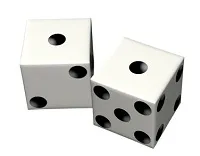
The six-sided die is the simplest and oldest type of gaming die. They are suitable for practically all classic games - from backgammon to Monopoly. The board games of our childhood always came with brightly colored six-sided dice made of cheap plastic.
Round Dice
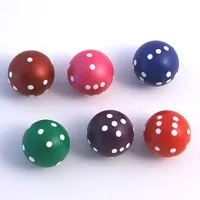
An entertaining variation of the ordinary six-sided die, which is actually a little ball. Cleverly embedded in it are small pellets that guarantee that the ball rolls freely, but when it stops, it always settles with one of the drawn "sides" facing up.
Role-Playing Dice
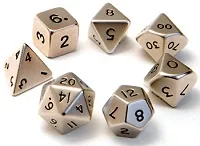
The tabletop role-playing game Dungeons & Dragons will forever be remembered among young elves for its set of seven dice - with 4, 6, 8, 10, 12, and 20 sides. There are two 10-sided dice in the set, and if they are thrown at the same time, they produce a number from 1 to 100.
100-Sided Dice
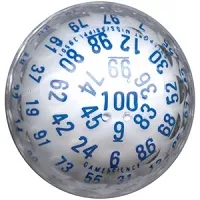
It is considered particularly stylish in Dungeons & Dragons to replace two 10-sided dice with one 100-sided die. 100-siders have an almost spherical shape and roll wonderfully; to make it easy to read the number that comes up, they are made very large (and heavy).
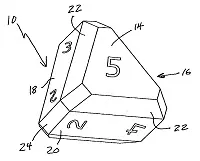
5-Sided Dice
Through complex mathematical calculations, scholars have determined the shape of a triangular prism, which has all five faces with exactly the same probability of coming up, thereby allowing it to be used as a 5-sided die. No known game utilizes a 5-sided die; it was created purely to celebrate the science of mathematics.
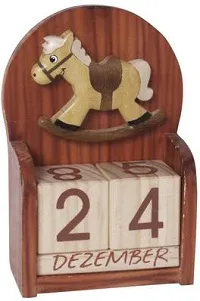
Calendar Dice
If you extract two number cubes from a souvenir calendar (they serve to indicate the date of the month) and discreetly substitute them for ordinary ones, you can have a lot of fun watching unsuspecting people roll 7, 8, 9, or even zero on a six-sided die.
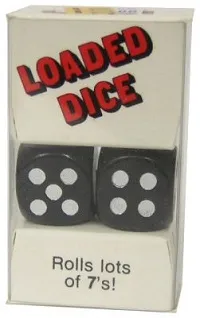
Dice with a Shifted Center of Gravity
Classic cheating dice. Inside them is a metal pellet, causing the number six to appear more frequently than the other numbers. They look no different from ordinary dice, but if one of the players at the table starts getting beaten up - it’s likely that they were using dice with a shifted center of gravity.
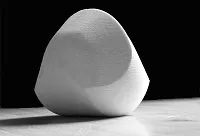
1-Sided Dice
The so-called "gambit." It always lands with the same side facing up. Another creation of professional mathematicians, as complex as it is meaningless.
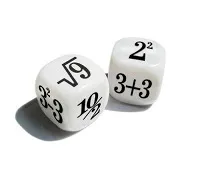
Mathematical Dice
Unlike the previous creations of mathematicians, these dice can be used practically. But if you're not a mathematician, you might find them a bit challenging - not everyone will immediately understand that "the cube root of 64 minus 3" is just one.
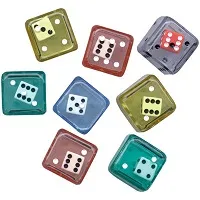
Nested Dice
Inside one large transparent die are several smaller dice. This is convenient when game conditions require rolling multiple dice simultaneously. Additionally, it simply looks impressive.
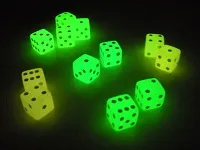
Glowing Dice
If your electricity goes out at home, you can always finish an important game with glowing dice. They are also indispensable for children, as they allow playing under the blanket at night, totally unnoticed by adults.
Alright, that's enough for now. I'll talk about the real oddities in the world of dice next time.