
Imperial Arsenal. "Sekach", "Vikhr", "Pobornik"
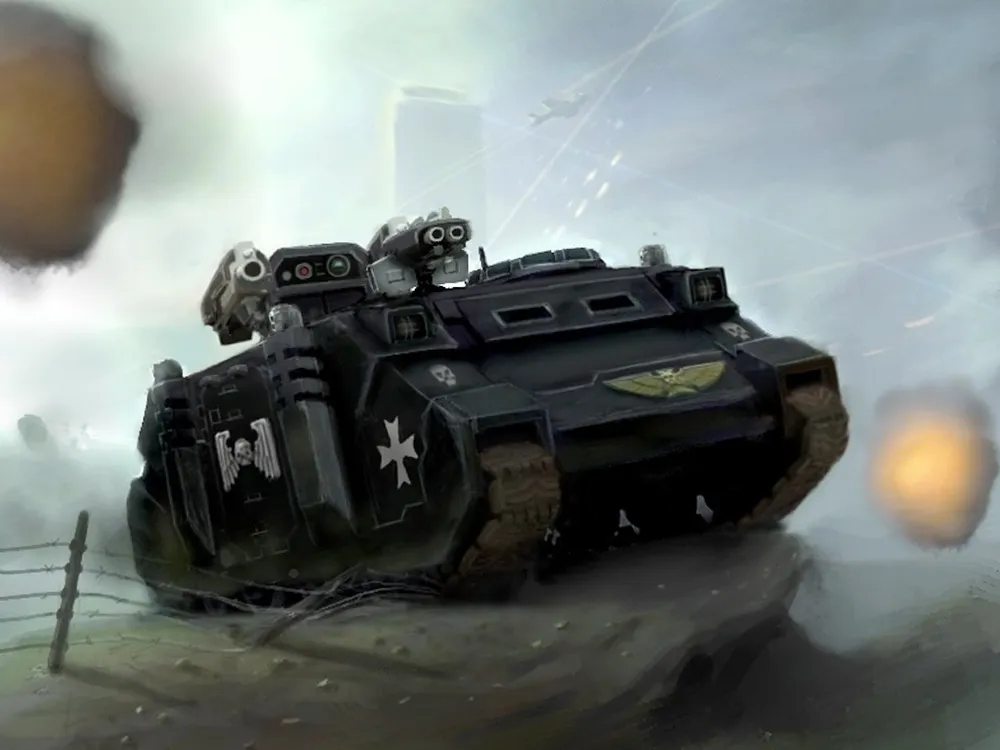
"Sekach"
"Sekach" is one of the most common modifications of the "Rhino", serving a transport function. Equipped with a stationary turret and additional armor, the "Sekach" sacrificed some transport capacity for increased firepower.
History
The schematic of the "Sekach" was found by the chief armorer Tilvius during an expedition to the Southern Frontiers. The "Sekach" became the main discovery; however, there are rumors that another schematic was found, though its contents are unknown. Soon, the "Sekach" schematic was tested and accepted, and just two hundred years later, the first trials of the new machine were conducted. Records show that the transport model "Predator" was a predecessor of the tank "Predator" and, according to descriptions, was very similar to the "Sekach". When Tilvius returned, the Lords of Mars quickly understood this. Work began.
Service Record
At the beginning of M36, the "Sekach" took the place of the "Predator", which became a full-fledged tank. The "Sekach", capable of transporting a squad of six battle brothers and providing fire support for already deployed fighters, became a useful addition to the arsenal of the Space Marines.
Leadership of some orders is confident that the "Sekach" is practically useless both as a transport vehicle, since it cannot accommodate a full squad, and as a tank — its light armor and lack of heavy weaponry do not allow it to compete on equal terms with the enemy's armored vehicles.
Others, however, find the "Sekach" quite useful in many situations. Firstly, the "Sekach" can protect infantry units supporting heavier machines like the "Landa Raiders" or "Predators". Secondly, the vehicle can perform reconnaissance functions, supporting motorcycle squadrons and delivering lightning strikes ahead of the main forces of the Space Marines. Thirdly, many commanders combine "Rhinos" and "Sekachs" to provide heavy fire support for attacking forces.
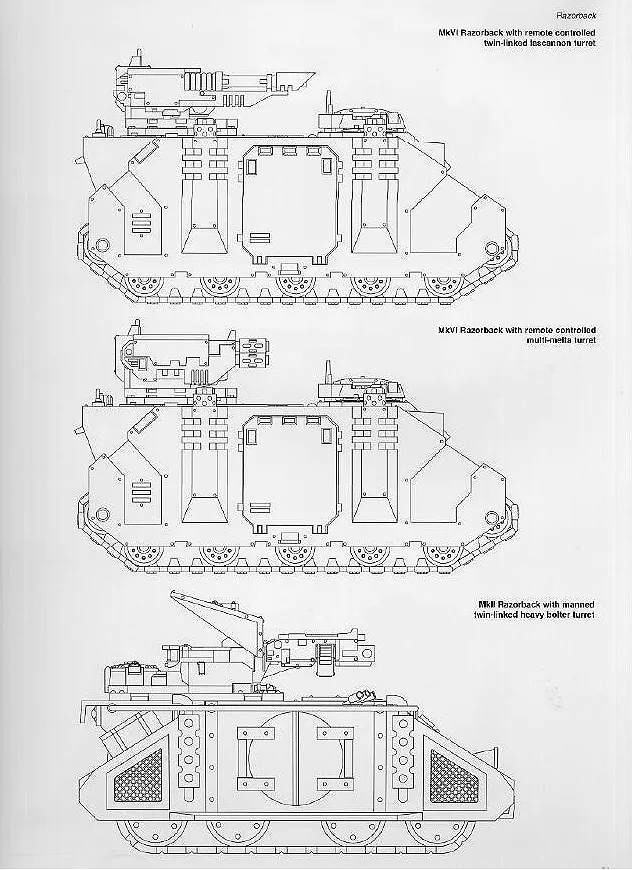
Features
The "Sekach" is equipped with a turret with heavy weaponry. The turret model constantly changed, from armored with a remote control system to open, controlled by a fighter protected by a gun shield.
The remote-controlled turret uses the same targeting system as the "Landa Raider", providing quick aiming and not requiring an additional crew member. The lack of fighters among the Space Marine orders was the key reason for the use of such turrets. Currently, several types of turrets exist for the "Sekach".
Technical Specifications:
Name: "Sekach".
Production: Mars.
Model: II-XVII.
Crew: driver.
Engine: MKII.
Weight: 31.5 tons.
Length: 6.6 meters.
Width: 4.5 meters.
Height: 5 meters.
Ground Clearance: 0.44 meters.
Maximum Speed (on road): 70 km/h.
Maximum Speed (off-road): 55 km/h.
Main Caliber: twin heavy bolter.
Additional Armament: -
Traverse: 360°.
Gun Elevation Angle: -5° to +45°.
Ammo Capacity: 1600 rounds.
Ammo Capacity for Additional Armament: -
Armor:
Turret: 50 mm.
Superstructure: 60 mm.
Hull: 60 mm.
Gun Shield Armor: -
"Vikhr"
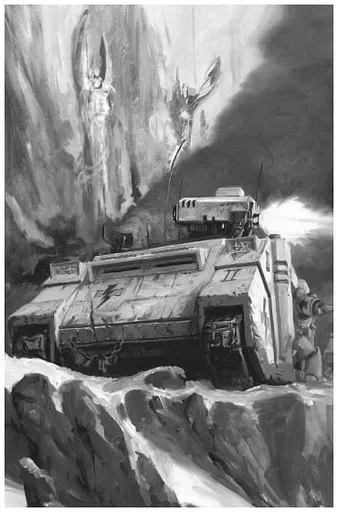
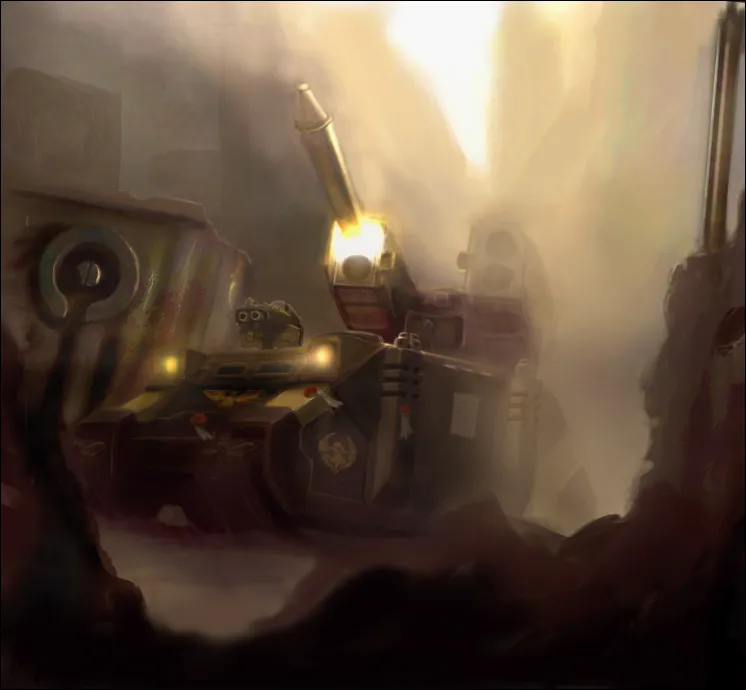
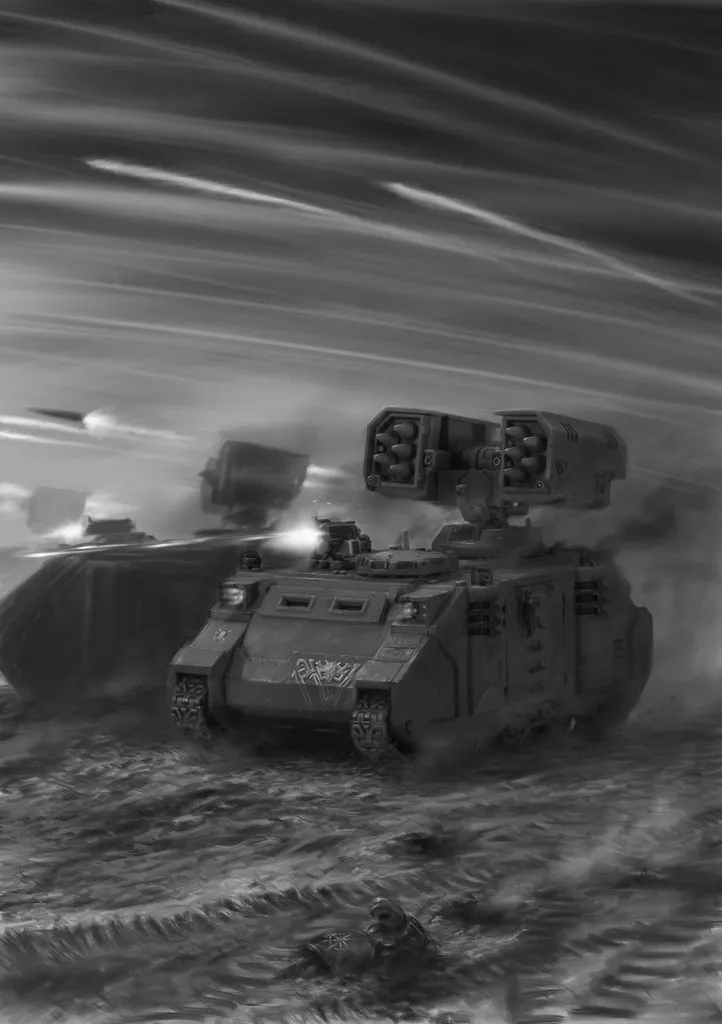
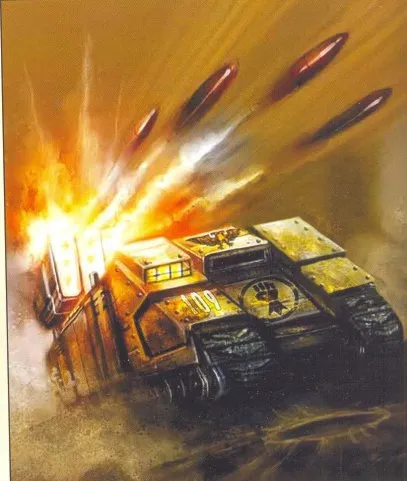
"Vikhr" is a highly mobile artillery system of the Space Marines. The name "Vikhr" is used for many models of multiple rocket launchers created on the basis of the "Rhino" chassis. The main purpose of these machines on the battlefield is to destroy important enemy assets with high-powered warheads before or during an attack. Over the past millennium, many models of this machine have changed, but even older models find wide application among the Adeptus Astartes orders.
Service Record
Unlike the Imperial Guard, the Space Marines do not rely heavily on artillery fire. Being a rapid response unit, they seldom stay on the battlefield long enough for continuous artillery bombardment to take effect. Warriors at the forefront of the attack require rapid, highly mobile artillery capable of delivering short yet effective strikes to eliminate key enemy targets. The ability to quickly respond to changes on the battlefield is the primary advantage of the "Vikhr" over heavier and less maneuverable Imperial Guard systems.
The ability to fire ballistic allows the "Vikhr" to fully utilize cover and not reveal its location to the enemy when firing.
The universal "Rhino" chassis enables them to follow the attacking forces of the Space Marines swiftly and quickly change position after a salvo to avoid return fire from the opponent.
Despite a variety of different models, the "Vikhr" remains virtually unchanged, with only two variations significantly differing from the codex standard — "Hyperios" and "Hunter" — specialized anti-aircraft systems used by many Adeptus Astartes orders.
"Hyperios" is equipped with automatic tracking and targeting systems, as well as anti-aircraft missiles of the "Hunter-Killer" type, equipped with mini-computers that allow the missiles to find targets themselves. Although the main task of these machines is to destroy aerial targets, the targeting system is versatile enough for eliminating ground objects. Such use of missiles is considered a last resort; however, Space Marine commanders require universal and reliable equipment for fighting an opponent that usually enjoys overwhelming numerical superiority.
In addition to highly accurate targeting systems, each missile has a small fuel reserve, which is nonetheless sufficient to intercept fast-moving targets. These missiles are not large enough to gain altitude like the "Manticores" but are very effective against targets flying at low altitudes. Another anti-aircraft model of the "Vikhr" — the "Hunter", is much older than the "Hyperios", yet still sees extensive use among the Space Marine orders, as seen during the last Armageddon War.
Several types of munitions can be used as an alternative to standard "Vikhr" missiles. Although their use is extremely rare, many Adeptus Astartes orders maintain small stockpiles of such munitions for emergencies.
The first such type is the mine payload, which, after detonation, blankets the area with small close-range mines, instantly creating a minefield. Being a defensive weapon, they are rarely used, but sometimes, in the heat of battle, cutting off the enemy's retreat path means victory.
The second type is the "ground-to-air" missile, used to defend Space Marine forces from aerial attacks. Although employing such munitions can make the "Vikhr" a fairly decent anti-aircraft installation, specialized machines like "Hyperios" and "Hunter" are better suited for these purposes, and after several unsuccessful attempts by the Exorcist orders to use missiles against Ork bombers, most were retired from service.
The last type of munitions is a long-range model. It was first used by a techmarine of the Iron Hands during the assault on the hive of Vortis, where the Space Marines required long-range heavy artillery. The use did not yield great success; however, several orders adopted the invention. The necessary increase in fuel volume and engine size led to a reduction in explosive substance, and consequently, the blast radius. The decrease in destructive power meant that despite the long firing range, the "Vikhr" could not inflict sufficient damage.
Features
The number of missiles varies depending on the model. The "Helios", for example, carries only six missiles, whereas the ancient "Taliy" with its famous square launcher uses twelve missiles, although of smaller size.
The transport capacity of the "Rhino" chassis has been utilized to increase the ammunition supply of the machine. Reloading is performed manually — a labor-intensive process that forces "Vikhr" systems to retreat to cover as soon as the launcher exhausts its munitions. Some orders equip their artillery systems with special servitors programmed to perform the reload ritual, significantly reducing the time between salvos.
Construction
The chassis of the "Vikhr" is selected in the same manner as for the "Predators" and "Brawlers" — following omens showing that the spirit of the new machine will best thrive in the role of a "Vikhr". The Master of the Forge is responsible on average for twenty to thirty "Vikhr" systems, although this number may vary from order to order.
According to Imperial standards, each "Vikhr" missile, like the rest of the Space Marine equipment, is equipped with high-tech systems that make them significantly more effective — the only way to compensate for numerical shortcomings.
For instance, the "Helios" missile features a contactless fuse using a photoelectric reaction. The active sensor emits infrared radiation, which reflects off objects back to the missile's photoelectric sensors, causing detonation. Typically, the sensor is activated within five meters of the target. If the missile misses (or fails to activate the detonation signal), a countdown begins for self-destruction after a minute — a necessary precaution to prevent unexploded ordnance from remaining in the target area. In addition, there is a standard detonation system that occurs upon direct impact.
The contactless fuse allows the "Helios" missiles to explode near the target, showering the area with shrapnel, highly effective against infantry, but practically useless against heavily armored targets.
Fuel burn rates are uniform across all missiles, so the only way to correct the range of fired missiles is to change the launch angle, a simple and quick adjustment method.
Technical Specifications:
Name: "Vikhr Helios".
Production: Helios.
Model: I-V.
Crew: driver, gunner.
Engine: MKII.
Weight: 33 tons.
Length: 6.6 meters.
Width: 4.5 meters.
Height: 5 meters.
Ground Clearance: 0.44 meters.
Maximum Speed (on road): 68 km/h.
Maximum Speed (off-road): 50 km/h.
Main Caliber: multiple launch system.
Additional Armament: -
Traverse: 360°.
Gun Elevation Angle: -0° to +55°.
Ammo Capacity: 60 missiles.
Ammo Capacity for Additional Armament: -
Armor:
Turret: 30 mm.
Superstructure: 60 mm.
Hull: 60 mm.
Gun Shield Armor: -
Name: "Vikhr Hyperios".
Production: Phaeton.
Model: I-IV.
Crew: driver, gunner.
Engine: MKII.
Weight: 33 tons.
Length: 6.6 meters.
Width: 4.5 meters.
Height: 5 meters.
Ground Clearance: 0.44 meters.
Maximum Speed (on road): 68 km/h.
Maximum Speed (off-road): 50 km/h.
Main Caliber: "Hyperios" missile launcher.
Additional Armament: -
Traverse: 360°.
Gun Elevation Angle: -0° to +65°.
Ammo Capacity: 40 missiles.
Ammo Capacity for Additional Armament: -
Armor:
Turret: 30 mm.
Superstructure: 60 mm.
Hull: 60 mm.
Gun Shield Armor: -
"Brawler"
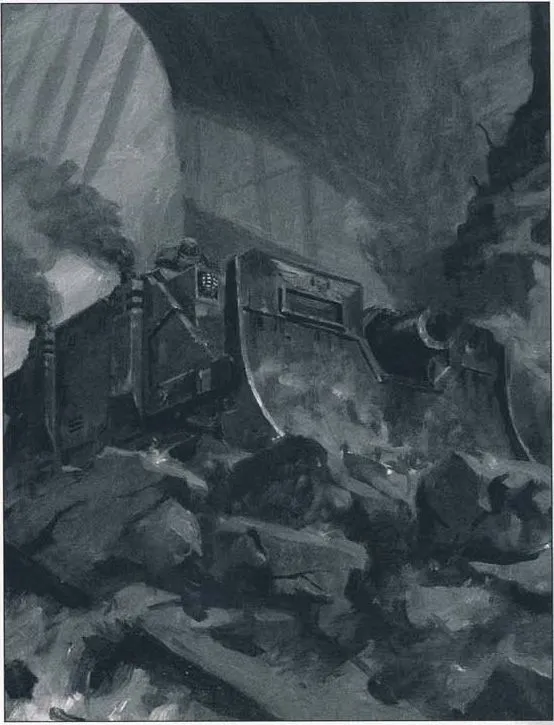
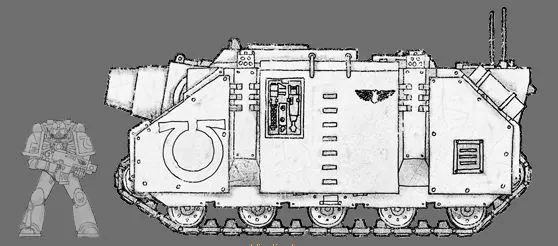
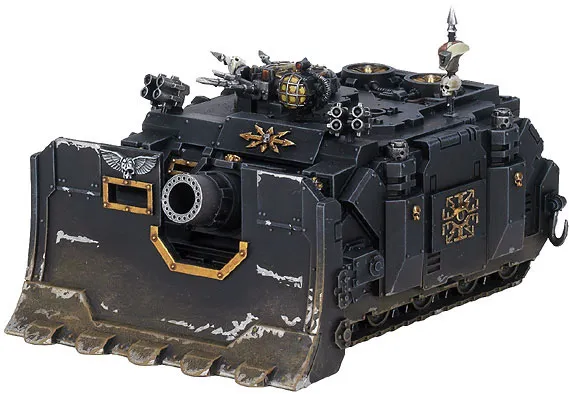
"Brawler" is yet another very ancient and valuable machine built on the basis of the "Rhino" chassis. The primary task of the "Brawler" on the battlefield is to destroy enemy fortifications, walls, bunkers, and blockhouses using the powerful "Destructor" cannon. The machine is often used to support Space Marine forces during urban combat and in areas where the short range of the gun is not a significant issue, such as in jungles.
History
Surviving fragments of ancient records suggest that the "Brawler" appeared during the Dark Age of Technology, as did other famous machines like the "Predators". The primary reason for the creation of the "Brawler" was the heavy casualties during urban combat and jungle battles. The "Brawler" was first constructed at the request of General Pobornus, who needed a self-propelled large-caliber weapon capable of keeping up with advancing infantry units and able to destroy well-fortified positions.
The best armored vehicle of the time was the "Rhino". Although its frontal and upper armor was not thick enough for such a machine, it was decided to use it. An appropriate caliber cannon was built into the reinforced frontal armor, and the space meant for passengers was replaced with a munitions compartment. The additional weight significantly increased the engine load, thus greatly reducing maximum speed.
Ten new "Brawlers" were sent to Rostern, where they exhibited excellent performance during the cleansing of settlements from Ork bandits, although nine of them were destroyed in the process. The remaining machine was modified and equipped with additional upper armor.
There are very few records of the use of "Brawlers" during the Great Crusade. Production was likely halted during that period due to the destruction of factories. It is no longer possible to say for certain. The "Brawlers" were not mentioned until Roboute Guilliman established the Codex Astartes, at which point the "Brawler" became a specialized Space Marine vehicle.
Service Record
Urban combat is a fierce and costly way of waging war, and offensive operations in such conditions are always fraught with difficulties. Due to the limited field of view, the use of heavy weapons is impossible, as is artillery fire. Buildings, streets, basements, and sewers provide defenders with excellent cover and hidden paths for counterattacks.
The heaviest fighting usually takes place inside buildings, and infantry stationed there typically requires support from other types of troops. No army is better prepared and equipped for urban combat than the Adeptus Astartes. "Brawlers" support tactical and assault squads, destroying enemy fortifications with point-blank fire. The "Destructor" cannon easily penetrates thick walls, and the bulldozer blade allows the "Brawler" to break through obstacles and small structures. The Codex Astartes states that the most dangerous places during urban combat are the crossfire streets, and therefore Space Marines should advance from building to building, using breaches in walls made by the "Brawler". Once a needed structure has been shelled, the squad uses anti-tank grenades, missiles, and meltagun to widen the breaches sufficiently for a Space Marine in powered armor to pass through. Defenders expecting an attack from the street or stunned by the "Brawler"'s gunfire are caught off guard by the explosion, followed by the terrifying figure of a Space Marine bursting in, leading an assault squad armed with flamers, fragmentation, and anti-tank grenades, chain swords, and bolt pistols. Moving from room to room requires great caution and takes time; however, it avoids casualties among the Space Marines from heavy weapons fire.
In addition to providing cover for assault squads, "Brawlers" are used to destroy buildings serving as enemy strongpoints or sniper hideouts. For the destruction of particularly large and well-fortified positions, groups of three or more "Brawlers" are created. After a hurricane bombardment of enemy positions, jump-pack-equipped assault troops and fighters in "Rhinos" enter the fray. Such uncompromising attacks have earned the Space Marines the reputation of angels of death.
Features
"Brawlers" are armed with the "Destructor" gun, which uses rocket ammunition. The round consists of a small solid-fuel engine that propels the warhead. By adjusting the fuel shape, one can achieve changes in the projectile's speed and range, ensuring sufficient accuracy for a munition of this size.
The main drawback of such rounds is the gases that accumulate in the barrel after the rocket is launched. If the pressure is not lowered, the barrel may deform during firing or, in the worst case, explode. The solution was to vent the gas during firing. After ignition, the gases are instantly vented through two exhaust pipes located on the upper part of the chassis behind the guidance system.
Inside, most of the space is occupied by ammunition, totaling sixteen. If also considering the round on the ramp and the one that is already loaded, the maximum ammo capacity of the "Brawler" is eighteen rounds. The ramp is equipped with small rollers, allowing the round to be moved to the barrel. The gunner places rounds on the ramp using a crane winch.
Due to the focus of this machine on assault operations, the main difference between the "Brawler" and the "Rhino" is the thickness of the frontal and upper armor, which has been reinforced for protection against opponents holed up in tall buildings. The reinforced armor required additional internal bracing, which inevitably affected the weight and therefore maximum speed of the machine. However, considering the specialization of the "Brawler", this is not a significant drawback.
Typically, "Brawlers" are equipped with bulldozer blades, effective for moving through debris-laden streets and breaking through walls and barricades during assaults. The decision to install a blade is made by the Master of the Forge after analyzing the combat task.
Technical Specifications:
Name: "Brawler".
Production: Lucius.
Model: II-XXVI.
Crew: driver, gunner.
Engine: MKII.
Weight: 42 tons.
Length: 7.5 meters.
Width: 4.5 meters.
Height: 3.6 meters.
Ground Clearance: 0.44 meters.
Maximum Speed (on road): 64 km/h.
Maximum Speed (off-road): 48 km/h.
Main Caliber: "Destructor" gun.
Additional Armament: -
Traverse: 2°.
Gun Elevation Angle: -0° to +45°.
Ammo Capacity: 18 rounds.
Ammo Capacity for Additional Armament: -
Armor:
Turret: -
Superstructure: 65 mm.
Hull: 65 mm.
Gun Shield Armor: 55 mm.
Materials used in creating this post:
Imperial Armour 2 (Eng)
Personal art gallery.
Special thanks to Surt for assistance with translation and proofreading.
An offline editor Midest's was used in composing this post.
If you liked my post, have corrections or additions - leave your comments, and I will try to respond as soon as possible.