Morrigan - reflections and facts.
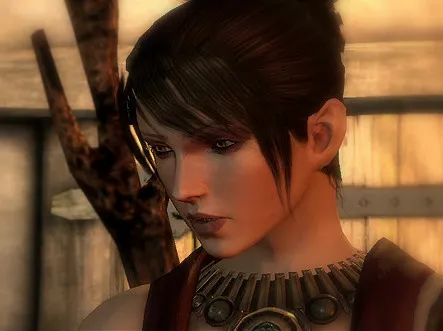
This article presents reflections on the universally beloved character of the Dragon Age - Morrigan.
Here you won’t find ways to level her up, quest descriptions, or tips on how to successfully pull her into your tent. Instead, this is more of a psychological and slightly academic overview.
I’m not speaking lightly when I say beloved - start typing "morrigan love" into Google, and you'll see that Google will eagerly assist you by suggesting the number of searches for this string is... see for yourself.
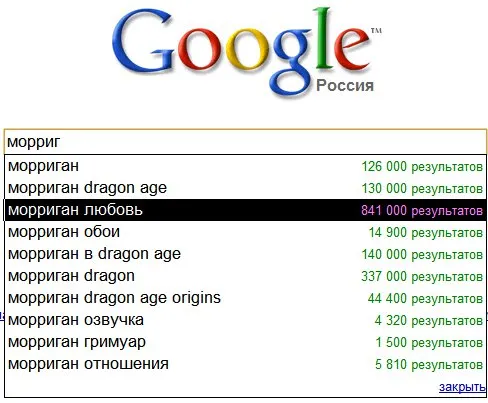
For the string "Liliana love", Google silently holds back, displaying some irrelevant feng shui in the first search results.
Let’s turn to Wikipedia.
“Morrigan (‘Great Lady of the Crow’) is a goddess of war in Irish mythology. She can be perceived as a separate deity or as a kind of triple goddess. The goddess did not participate in battles, but was certainly present on the battlefield, using all her power to assist one side or the other.”
The role of the mage in the party is fully revealed.
“Morrigan was also associated with sexuality and fertility; the latter aspect allows her to be identified with a mother goddess.”
She is the only character in the game who has two sexual scenes and is the sole woman in the storyline who is supposed to conceive a child. Everything as “the doctor prescribed.”
“Moreover, in legends, Morrigan is attributed with the gift of prophecy and the ability to utter all kinds of spells.” I think that with her ability to cast spells, our game Morrigan has no problems.
“As a war goddess, she assisted the Tuatha De Danann gods on the battlefield in both battles at Mag Tuired.”
Yes, we remember the great battles in our game. No one can deny that your Hero is practically a demigod, both de facto and de jure.
“Her sexuality is highlighted in the legend of Cú Chulainn when she tried to seduce the hero, but was rejected by him, causing a jealous hatred for Cú Chulainn to flare up in her heart.” Morrigan's sexuality doesn’t require any special praise; I would just like to add that being rejected is a heavy and very dangerous insult for a woman. I am confident that Morrigan can express her anger for far less insignificant reasons than underestimating her sexuality.
“Morrigan is also known for her ability to change her appearance. Often, she takes on the form of a crow.” In the game, there was a crow, but not Morrigan. But why would a crow be needed in battle?... However, the fact that our Morrigan is a shapeshifter is indisputable.
“...Under the influence of which, on the people of the Fir Bolg clan, fire and blood poured from the air, causing the poor natives to hide in remote shelters for three days and three nights.” No one will dispute that Morrigan could conjure a fire whirlwind or a blizzard, right?
“In Celtic mythology, the phenomenon of the triplication of deities is often encountered, like Brigid. This ‘fate’ also did not bypass the goddess of war, as myths mention several Morrigans, with which researchers associate four war goddesses: the Morrigan herself (‘great queen’), Badhb (‘the fierce’), Nimhean (‘venomous’), and Fea (‘the terrible’).
The allusions to the reincarnation of the Great Lady of the Crows into the Great Lady of the Game are transparent to the point of impossibility.
And now I will publish the voting results from the Bioware.ru forum.
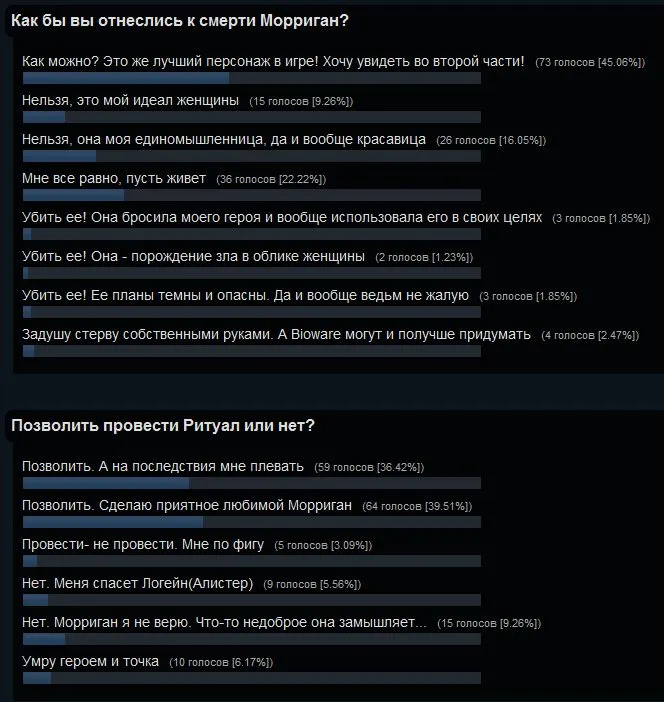
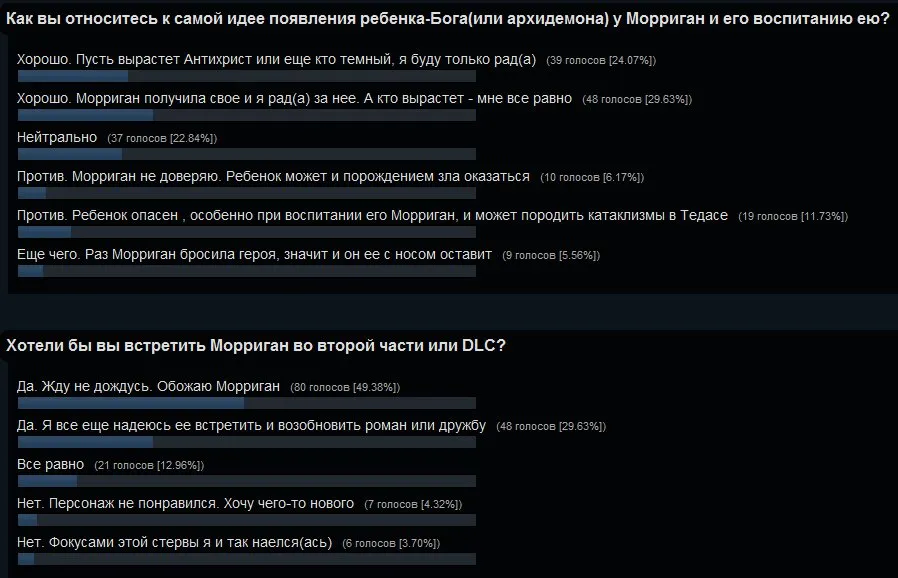
In my opinion, Morrigan is the brightest and most vibrant character in this game. Therefore, the voting results do not surprise me at all. Most men (and as it turns out, some women too) really like the image embodied in Morrigan: a strong, brave, smart, and straightforward woman. Her cruelty, bordering on malice, her lack of restraint in speech, excessive sarcasm, and lack of scruples are merely sharp spices to the main dish - a beautiful and clever female antagonist. Who, it turns out, can also be a tender loving woman.
Quote
“However, in recent years, the word ‘bitch’ is used (mostly by women, but not exclusively) not as a derogatory term, but as a definition for any woman who has taken on (explicitly or implicitly, willingly or against her will) a male line of behavior, based on struggle, competition, the need for dominance, and a pronounced desire to achieve a set goal by any means. Apparently, the main transformation of the meaning of the word ‘bitch’ occurred in the 1990s when women, forced to adapt to changing conditions, often turned out to be more variable, aggressive, and malicious than men. A certain category of women, capable of standing up for themselves, began to ‘fiercely push forward,’ ‘step over corpses,’ and achieve their goals by any means, including using their female attractiveness. Traits traditionally considered positive in women—kindness, modesty, etc.—suddenly turned out to be almost synonymous with ‘stupidity’ and inability to stand up for oneself. Having a large family became bewildering, while the ‘smart, beautiful, and single’ bitch evoked admiration, as she supposedly possesses a multitude of winning qualities that allow her to achieve what she intends.”
One can wonder for long about such an attitude towards Morrigan, but you won’t be able to ignore the song—thousands and thousands of people, when recalling the first part of Dragon Age, will first have Morrigan’s eyes come to their mind. And then everything else. The main and most powerful villain - the Archdemon - is unfortunately just a cardboard cutout. Well, he flies. Well, he hits hard. So?
Guys, admit it honestly, what stuck in your memory more - the farewell sex with Morrigan and her confession of love before the battle, or the battle itself with the Archdemon? Would you sacrifice a leg or an arm of your hero to keep Morrigan with him? It’s a rhetorical question.
Analogues of Morrigan also exist in real life. A psychologist I know described people like her very accurately:
“She looks like a classic picture of ‘intimophobia’ - fear of closeness. Not physical closeness, but emotional. In simplified terms - she has a long-standing (most likely childhood) psychological trauma, after receiving strong pain from a strong attachment (possibly to a parent), has adopted (unconsciously or semi-consciously) the position - ‘ah, well, then no one is needed, I’ll manage everything myself, I will be this samurai lone wolf.’ Her success, with a bit of aggressiveness, confirms this.
Her interest in the occult is also a symptom and, in most cases, a twisted attempt to find self-healing. And moreover, sometimes it works.”
She has a difficult character; she, like a ronin-samurai, will slice anyone who tries to offend her with her katana... But it’s precisely the wild, gnarly cats that become the most affectionate kittens when they feel that all is well. And you never get bored with them!
So, I would be extremely surprised if the Great Lady of the Crow is not with us in the second part.
The developers managed to create a very lively, wonderful, and captivating character. Yes, she is fictional, but... the great power of art! For me, Morrigan’s image is the number one reason to call Dragon Age not just a game, but a full-fledged artistic work.
On that cheerful note, one could wrap this up, but still....
Due to the fact that Morrigan was known long before Dragon Age Origins, when searching for information or pictures about her, please indicate ‘dragon age’ for clarification.
Otherwise, it might turn out like this
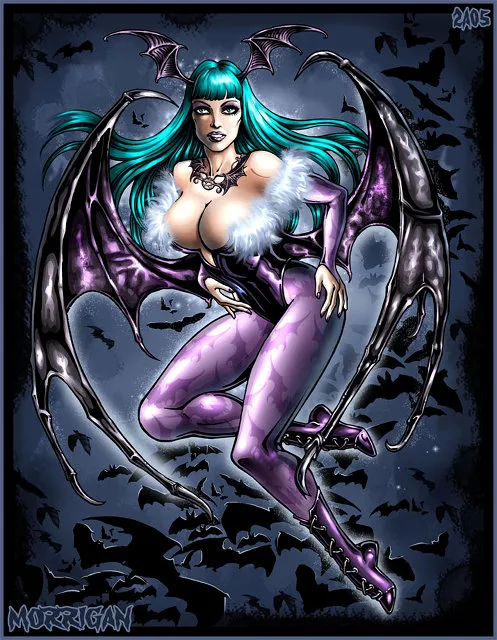
This is a completely different Morrigan. And she is miles away from the Morrigan of Dragon Age.
Our Morrigan is here..
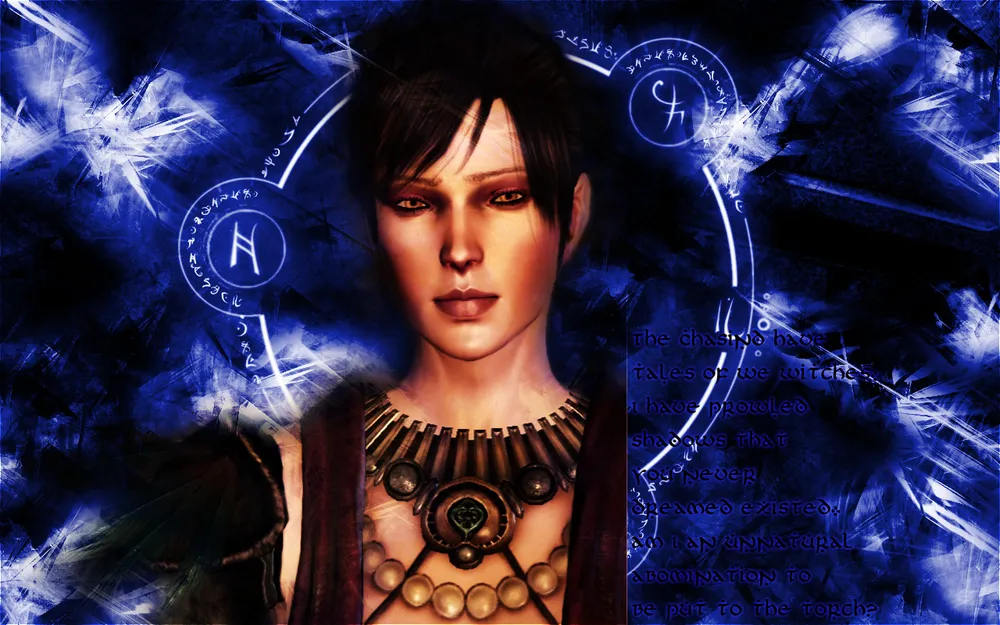
My slightly edited fan art for widescreen monitors.
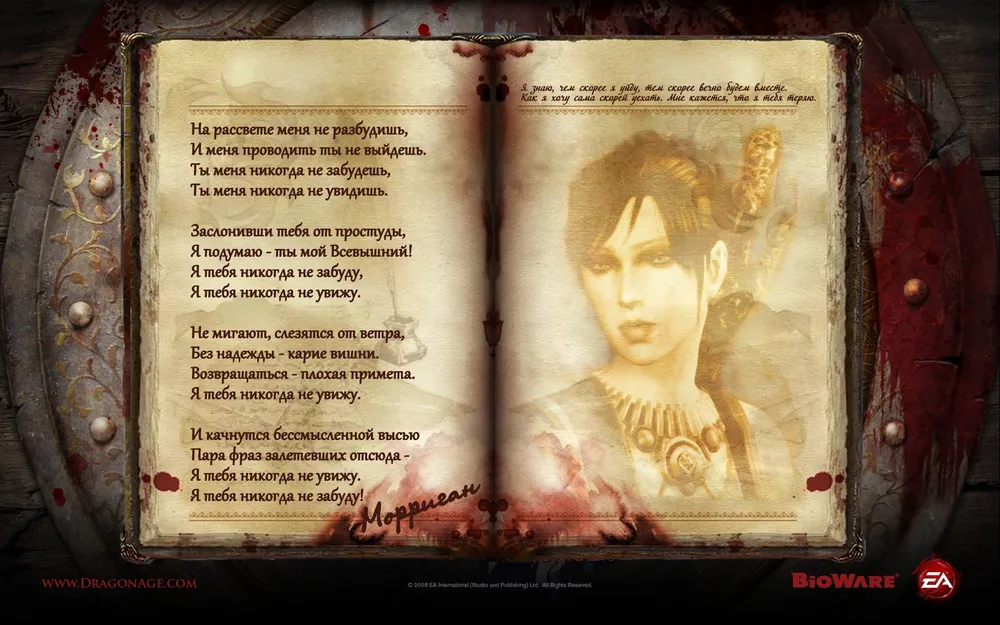
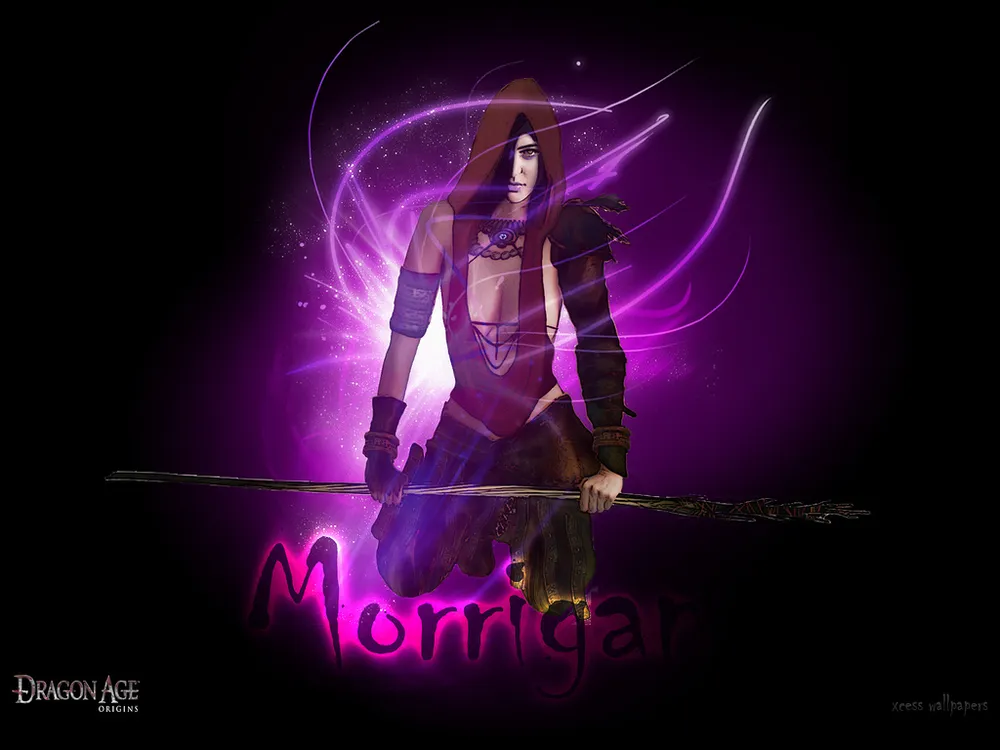
Wallpapers from other sources.