
Vaultris
In the last semester, I had to write a term paper for the subject "computer graphics." And I thought - why do something like "rotating cylinders" when I can work on something interesting? This is how the game I have the honor to present to you today came about.

I hope the screenshot intrigued you and we can continue.
The game supports several display modes. Each can be activated by pressing a number key on the keyboard:
Key -- Mode
1 -- 400x400 window, view directly at the screen
2 -- 500x600 window, view directly at the screen
3 -- 600x600 window, view directly at the screen
4 -- 700x700 window, view directly at the screen
0 -- 500x700 window, default view, shown below:
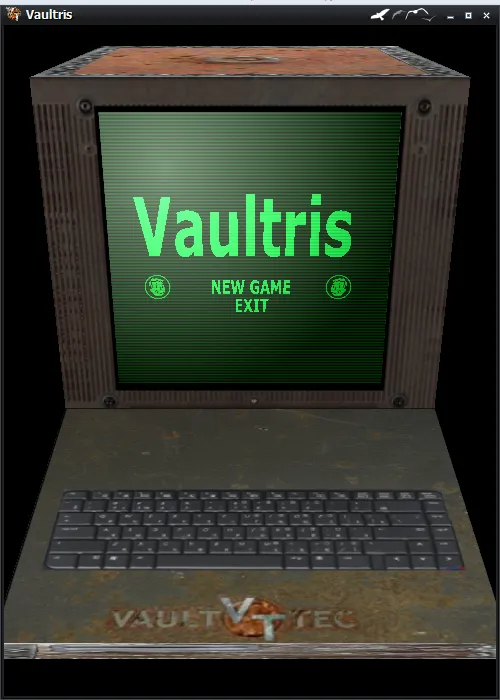
The game is a computer that has entertained generations of vault dwellers. ))) You can position the computer in space as you like. For this, use the control keys:
A
W D S rotate vertically and horizontally
R
- zoom in/out of the model
F
Y
G H J move horizontally/vertically
(I think it’s quite logical control, give it a try)


Now we have seen the main feature - on this computer, the vault dwellers played Tetris!)
Screen controls are as follows:
ESC immediately exit the game
ENTER confirm the action on the screen (menu, game over screen - go to menu)
Arrow Keys control everything on the screen (menu, game)
(also Up - rotate the shape)
Space during the game - pause
Let’s look at what’s on the screen:
Score – your score, I think it's clear
Rows – how many rows you’ve destroyed
Karma – I named it that) The lower your karma, the faster the shapes fall.
Increasing speed depends not on time, but on the number of rows destroyed. Moreover, the more rows you destroy with one shape, the more points you get for each, plus a bonus for the level.
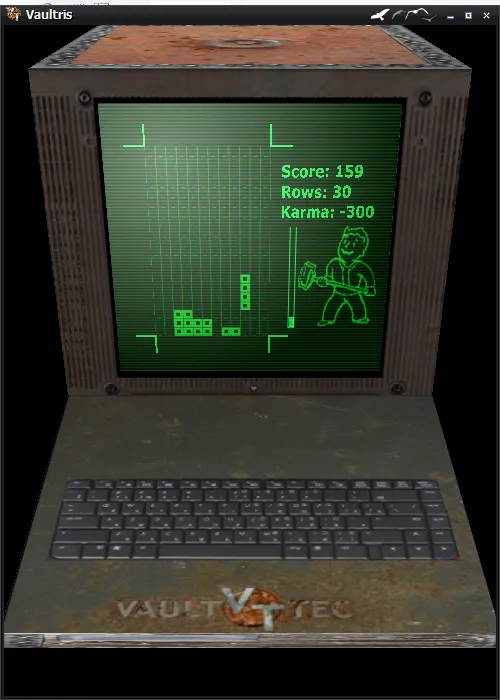
In the previous screenshot, you can see several things:
1) The karma image changes as it should) Only a true maniac can reach the last level of karma)
2) To the left of the karma image is a progress bar, showing how much you have left. The point calculation algorithm mentioned above assumes an exact number of destroyed rows until the game over, while the accumulated score depends on your skill.
Well, probably that’s all. When you lose, your score will be recorded in the leaderboard, so future generations of vault dwellers will remember your skill (the last score is marked with an asterisk if it made it to the leaderboard):
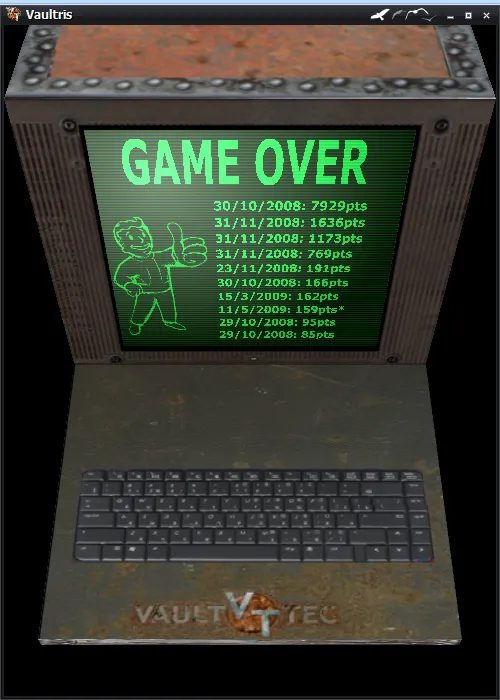
I especially want to draw your attention to the textures, drawn perhaps not perfectly, but with great love)
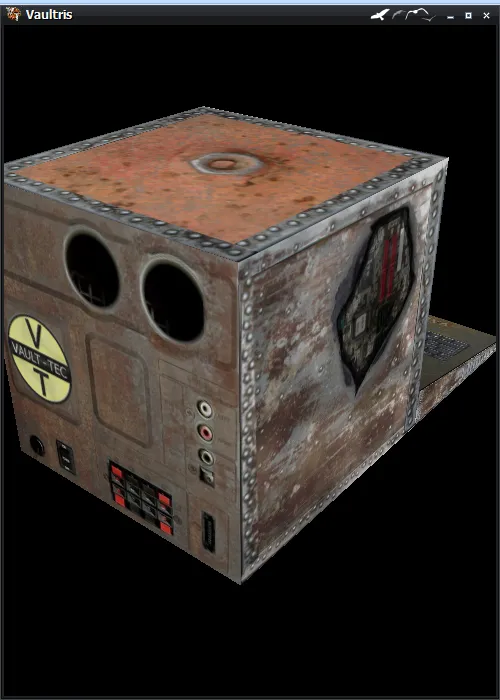
I also realized something very interesting. Perhaps when you played Tetris before, you thought that the lack of the "line" shape was a worldwide conspiracy to prevent you from beating the computer)) So, in the program written by my hands, it can be said to be flesh and blood, the line also does not drop exactly when it is needed). In all, I ask you to blame the standard C library from Mr. Stallman. However, to prevent this cosmic injustice, there is a cheat in the game, but I won't tell you what it is).
All game textures are stored separately; if you're interested, you can take a look at them, they are located in the directory vaultris -> textures. Be careful - spoilers about karma levels)
You can download the game from the site fallout-archives.com, which has kindly hosted it.
Here’s the download link: http://www.fallout-archives.com/files/12/72p1.php. (only 1.7 MB).
For development, the following was used:
- C language (pure C, not C++)
- winapi
- OpenGL implementation by Microsoft
- MinGW - free implementation of C/C++ etc. For Microsoft Windows
- Text editor GVim.
Enjoy the game.
P.S: I decided to post in the most popular section of all about Fallout and Tetris.
P.P.S: For netbook owners - run the game right in a small window using the eeeVaultris file.
P.P.P.S: I do not claim to be technological. I just enjoyed doing this and like the result)
UPDATE: If the game doesn’t work for you in Vista or Seven - try deleting the opengl.dll library from the game folder.