Races: Turians [Turians]
Warning! Wall of Text!
Known for their military might and strict discipline, Turians [Turians] were the last of the Citadel [The Citadel] races to be invited to the Council [The Council]. They gained their seat on the Council after their victory over the hostile Krogans [Krogan] during the suppression of the Krogan Rebellions [Krogan Rebellions]. They utilized a weapon that the Salarians [Salarians] who created it referred to as the genophage [The Genophage]. The genophage effectively sterilized the Krogans, depriving them of the ability to reproduce and drastically reducing their population, which ultimately doomed their rebellion. The Turians then filled the role of peacekeepers, previously held by the once compliant Krogans, and eventually earned a place on the Council in recognition of their contributions.
Hailing from the planet Palaven [Palaven], Turians are best known for their military contributions: many of their soldiers and ships serve in the Citadel Fleet [The Citadel Fleet]. Their ethics, focused on serving the needs of society, are also noteworthy. For example, Turians were the first to propose the creation of C-Sec [C-Sec - Citadel Security Services]. However, sometimes they can be overly harsh and strict towards other races. Mutual animosity between them and humans is evident, largely due to the role Turians played in the First Contact War [The First Contact War]. Old grievances and animosities gradually fade, as evidenced by the collaboration of the two races on the "Normandy" [Normandy], yet many Turians still harbor hatred for humans, and vice versa.
BIOLOGY

"Which colony am I from? Can't you tell by my face?"
Turians are typically tall: their height exceeds 6 feet (about 183 cm). Each hand has three long, proportionately thick fingers ending in claws. They possess several bones around their mouths that form a sort of beak. However, the most distinctive feature of their race is their metallic carapace, which evolved over time. The features of Turians are avian, making them resemble humanoid raptors. In Mass Effect: Revelation, David Anderson [David Anderson] mentions that Turians remind him of the evolutionary link between birds and dinosaurs. Members of this race have very recognizable voices.
Since the Unification War [The Unification War], Turians have marked their faces with intricately designed tattoo-like markings, indicating their allegiance to a specific colony, although it is uncertain what colony any given mark represents. These tattoos are generally white (especially among Turians with dark carapaces), but can come in various colors. For instance, the markings of Garrus Vakarian [Garrus Vakarian] are dark blue. Interestingly, the Turian term “clean faced” (meaning without colonial marks) can refer to both a deceiver who cannot be trusted and a politician, serving as slang for government officials.
Turians display predatory traits more prominently than other carnivorous species, such as Krogans. Their cautious eyes give the impression of exceptional vision. Their teeth and jaws resemble those of apex predators like crocodiles and ancient carnivorous dinosaurs. It goes without saying that their claws (on both hands and feet) seem designed solely for tearing flesh. Their agile bodies suggest that Turians can move very quickly.

There is definitely something predatory about Turians.
The core of Palaven, the Turians' home planet, is poor in metals and thus generates weak electromagnetic fields. Consequently, more solar radiation penetrates the planet's atmosphere. To combat this, most life forms on Palaven evolved to develop a sort of metallic exoskeleton to protect their bodies. Their shiny, plated skin makes Turians less susceptible to prolonged exposure to weak radiation. However, they do not possess any sort of “natural armor.” The thick skin of Turians does not protect against enemy projectiles or energy bolts. Their blood is dark blue, likely due to the presence of hemocyanin instead of hemoglobin. This aligns better with the biology of their metallic exoskeleton, as hemocyanin is a metalloprotein.
Although life on Palaven is organic and aerobic (meaning it uses oxygen for respiration), it is based on D-amino acids. Thus, Turians find themselves in the minority: they and Quarians [Quarians] are the only intelligent races in the galaxy whose organisms consist of D-amino acids. Human food, Asari [Asari], or Salarian food, which evolved in biomes with L-amino acids, is at best ineffective for Turians. In the worst-case scenario, it can trigger a severe allergic reaction that may lead to death if not stopped in time. Turian mechanic Lilihierax [Lilihierax] on Noveria [Noveria] used the idiom, “If you can polish your stomach enough.” This suggests that the digestive system of Turians is similar to that of Earth birds and reptiles. Some of them swallow small pebbles to help their stomachs digest solid food more easily.
The lifespan of Turians is comparable to that of humans. Nothing is known about their method of reproduction.
HISTORY
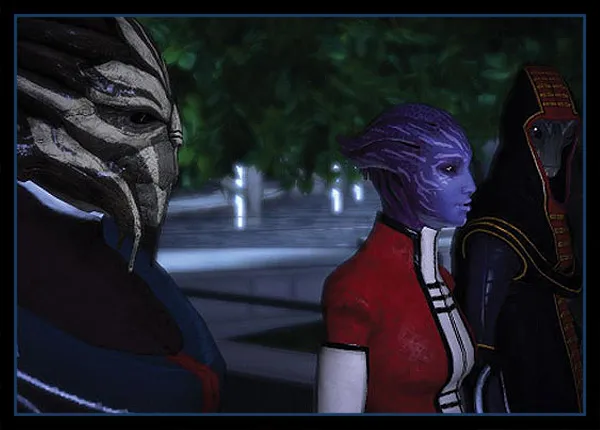
Turians are the guardians of peace and protectors of the Citadel.
The Unification War [The Unification War]
Turians had already established several mass relay systems and created colonies across the galaxy when the Asari reached the Citadel. Around the same time the Asari were forming the Council with the Salarians, the Turians found themselves embroiled in a brutal civil war. The Unification War, as it came to be known later, began with strife between the colonies furthest from their home planet of Palaven.
In these colonies, local leaders held power, many of whom had renounced the Hierarchy [The Hierarchy]. Cut off from the government's influence, the colonies became increasingly isolated and xenophobic. Colonists began to mark their faces with tattoos and symbols to distinguish themselves from members of other colonies. Open hostilities became commonplace.
When the war finally erupted, the Hierarchy refused to involve itself and upheld a strict policy of non-intervention. Only after several years of conflict, as the warring factions diminished, did the Hierarchy enter the war. By that time, the leaders were too weakened to resist. They were forced to lay down their arms and renew their oaths to the Hierarchy. Although peace was restored, it took several decades for hostilities among colonists to cease. Today, most Turians still bear markings identifying their colonies.
Krogan Rebellions [Krogan Rebellions]
In the midst of the conflict, the Citadel Council first encountered the Krogans. At the Council's behest, Turians directed the full force of their military might against the Krogans. The Krogans, in turn, recognized the danger they faced and declared war on the Turians. While the initial attacks from the Turians were successful, routing many Krogan bands, they precipitated a strong counterattack from the Krogans, devastating several Turian colonies. Undeterred by this show of force, the Turians fought with a singular goal: to crush the Krogans and eradicate them. Eventually, Turians utilized the genophage developed by the Salarians. Deprived of their numerical advantage, the Krogans were defeated, and by the year 800 of the Common Era, the rebellion was suppressed. However, sporadic attacks by rogue bands of rebels would continue for decades.
By the year 900 of the Common Era, Turians were granted full Council membership, in gratitude for their assistance during the Krogan Rebellion. They took on the role of militaristic peacekeepers, which had been vacant since the annihilation of the Krogans.

They are in love now. Once, they were killing each other..
The Relay 314 Incident [Relay 314 Incident]
After the Rachni Wars [Rachni Wars], the Council passed several laws prohibiting the activation of unmarked mass relays. In 2157 of the Common Era, adhering to these laws, the Turians were forced to open fire on researchers of an unknown race—humans. On one of the ships, the decision was made to withdraw and warn the Systems Alliance [The Systems Alliance], which retaliated against the Turians, destroying several of their ships. The situation rapidly escalated into war.
In the following weeks, the vastly outnumbered Alliance forces lost numerous reconnaissance groups and patrols in battles against the Turians. The confrontation reached a critical phase when the Turian fleet broke through Alliance borders and besieged the human colony on Shanxi [Shanxi]. With no other options, the Alliance garrison on Shanxi surrendered, and the Turians continued their conquest of the world, confident that a significant portion of enemy forces had been defeated. However, a month later, the Alliance's Second Fleet [Alliance's Second Fleet] caught the Turians off guard and expelled them from the planet. Both sides began preparations for a prolonged interplanetary war.
Before the conflict could escalate too far, the Citadel Council intervened and opened humanity's path into the galactic community. Through negotiations, peace was brokered, and the conflict came to an end. The Turians were compelled to pay a substantial compensation to the Alliance for their provocative actions during the conflict, which became known as the