
Pimple.
Dedicated to post-nuclear medicine.
Day One.
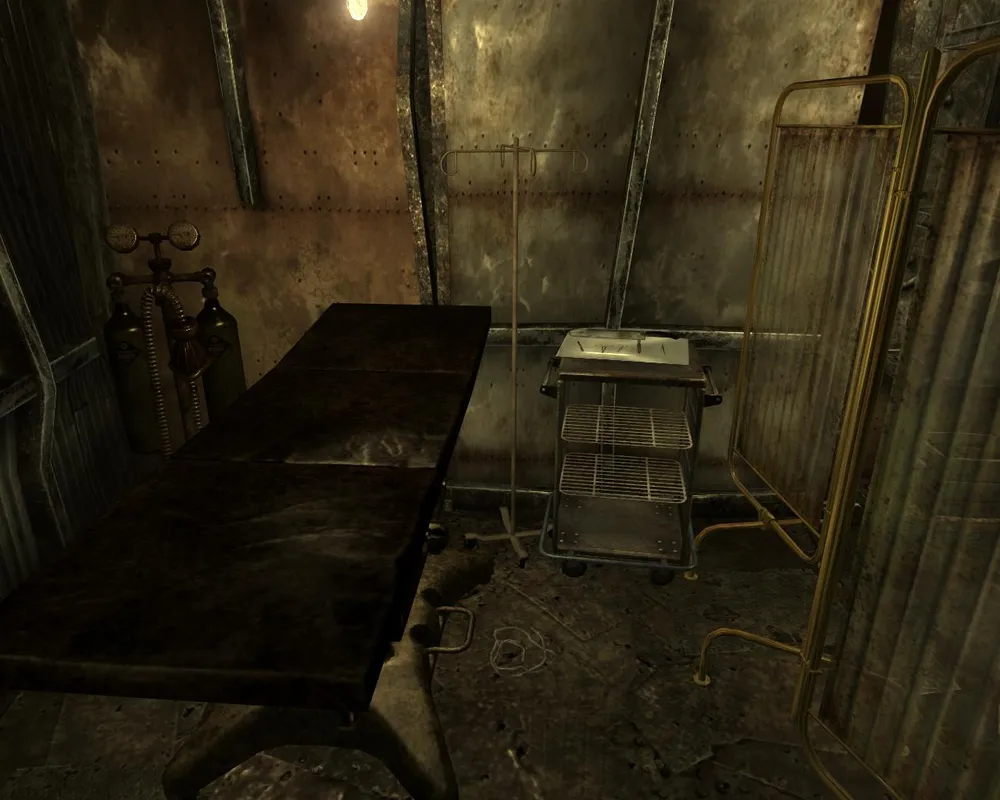
The bright crimson skin was so tense that the scalpel barely made a cut. As the tip barely touched the pimple, it burst on its own, expelling its contents. A filthy gray sludge, with a significant mix of blood, flowed down first the shoulder, then the forearm, dripping onto the floor. The doctor was surprised; the contents didn’t resemble pus at all, that good old yellow-green pus he had seen every time he opened similar abscesses. The patient lifted his head but immediately lost consciousness at the sight of the gaping wound on his shoulder. He was already too weak, with a temperature nearing forty, so weak that they had to carry him into the operating room. Yet, being stingy, he refused the painkillers! In a half-conscious state, already on the couch, he exclaimed, “Fifty caps for a vial of anesthetic is robbery!” Well, who else but a caravan driver would know about robbery? For fifty caps, he himself sold this anesthetic. The doctor sighed—he needed to bring the miser back to his senses.
-Jane! –the doc shouted, gathering used instruments onto a tray, and after half a minute, without waiting for an answer, shouted again even louder. -Jane, where the hell are you?! Bring the ammonia; this Snow White just fainted!
-Coming! –a shout came from somewhere in the reception.
However, the nurse wasn’t particularly hurrying, so the poor patient had to remain in oblivion for another minute. By the time the sister brought the ammonia, the surgeon had already cut off the dead tissue and, leaving a small rubber strip for drainage, was stitching up the wound.
-These men today, worse than women, I swear! –the full black nurse cursed the weakling, shoving a cloth soaked in ammonia under his nose.
The reaction didn’t take long—barely did the cloth touch his nostrils, the pitiful little man, who had collapsed on the couch, covered in cold sweat, shook his head, opened his eyes slightly, and mumbled something incoherent.
-Well, now he's going to throw up! –Jane said meekly, but reproachfully, stepping back to a “safe” distance from the patient.
Exactly as the nurse anticipated, the vagabond was turned inside out.
-Be a dear girl, Jane, clean all of this up. -the doctor said in a commanding tone to his annoyed assistant, processing his gloves with alcohol.
-Jane this, Jane that… What are you going to do when Jane sends this entire hellhole to hell?! -the nurse complained as she obediently went to get a bucket and cloth.
-Oh, Jane, you know, without you this hellhole will have to be just closed down; you're irreplaceable! -the doctor yelled a clumsy compliment, which Jane nevertheless appreciated. She burst out laughing, clanging the aluminum bucket she dragged from the storeroom.
-He'll feel better soon, -the doc nodded at the caravan driver, removing his blood- and vomit-splattered gown. -Let him go with God. Take ten caps from him, and I'm off to the reception; I have a tough day ahead.
-Tough day? –Jane glanced at the doctor from under her brow, wringing out a cloth soaked in disgusting slime.
In her gaze, indignation and a bit of annoyance were evident.
–Do you have a conscience, doc? All day long we have only Martha Madison scheduled, who will whine again about her pacemaker working too loudly!
-That’s precisely why it’s tough, Jane, -the doctor smiled slyly, -God is my witness, I’d rather open another dozen of those abscesses than listen to the grumbling of that old crone again.
Jane burst out laughing again—she enjoyed it when the doctor cursed Madame Martha because she didn’t like Madame Martha herself. However, the fact remains that no one in the town liked that cantankerous old woman, but this was a different situation, much more serious—old women squabbles, a long and senseless story of enmity and hatred lasting for a couple of decades.
In the doctor's reception room, Derek Anderson, the local hunter, waited, who had brought in the sick caravan driver.
-So, what’s with him? –Derek muttered as soon as he spotted the doctor.
-A carbuncle on his shoulder, the size of a potato, -the doc collapsed into a chair. On the table, as usual, a mug of cold herbal tea, prepared dutifully by Jane, awaited him.
–He'll be fine. And where did you find him?
-On the forest trail leading from the swamps, he was lying there unconscious. At first, I thought it was an injured raider, but then I looked closer—it was a familiar face. He’s already been here a couple of times with one of the caravans.
-Yeah, he’s a caravan driver, I remember him too, -the doctor confirmed Derek's words and hungrily leaned towards the mug again.
-It's all strange. -the hunter scratched his head, as if he was trying to understand something. -What is he doing alone in the wastes, even without a Brahmin? God knows what happened?
-Indeed strange, -the doctor put the empty mug down on the table. -Did he say anything?
-Well, -Derek scratched his head again, -He mumbled something incoherent. Something about yao-guy. Maybe a yao-guy attacked the caravan? –the simple-minded hunter suddenly made a hasty conclusion.
The doctor shrugged; he didn’t really believe that a yao-guy could pose a threat to a large and well-armed caravan:
-Why guess? He’ll come to soon enough; I’ll ask him.
xxx
Martha arrived slightly earlier than expected, sitting in a half-collapsed armchair in the reception area, dramatically placing a heavy metal box, crackling and humming, sometimes obnoxiously beeping, on the coffee table beside her. Two twisting and intertwining wires, blue and red, ran from the box to Martha’s chest. Each time the box began to beep, Martha’s face distorted in a grimace of despair, taking on a pitifully martyr-like appearance. Her eyes searched for support in the doctor’s eyes, which expressed not the slightest bit of pity, nor a drop of compassion. Years of practice had hardened the surgeon, crafting an immunity to any human pain.
-It’s too loud. –Martha sulked, pouting her lips, making her already wrinkled face look completely like a washboard.
The doctor remained cold and indifferent; in fact, he was indeed that outwardly, but inside, everything was boiling with rage. Had he been slightly less restrained, he would have yanked the wires from that bothersome old woman’s chest and joyfully taken back the damned box that supported such a wretched personality. But the doctor endured the elderly lady’s regular visits, repeating the same words to her again and again as if it was a spell:
-It works. That’s the main thing.
-Can’t you make it work just a little quieter? –the old woman begged, leaning her head to the side and lifting her sparse elderly eyebrows.
“Sure, if I turn it off, it will be quiet as a grave. In fact, you’ll calm down along with it!” -the doctor thought to himself, yet he answered quite differently:
-It’s simply impossible; the cooling system is making noise, and it must operate continuously.
-Can you replace it with something more compact? –the old woman persisted. -This thing is hard for me to carry!
“Sure, for a compact wooden box that’s convenient for lying underground! God, she hasn’t paid me for this stimulator and wants me to spend the annual clinic budget on a compact device with nitrogen cooling. And afterwards, she wouldn’t like the fact that it’s so cold!” Inhale. Exhale. Calmly and steadily:
-I will replace it with exactly that advanced model which you will purchase. It seems there is a wide selection of electrocardiostimulators in Rivet City. –the doctor smiled sweetly, extending Madame Martha a price list, which she, however, ignored.
The old woman contemptuously turned her head, staring at that annoying yet so necessary box.
-Sometimes I think it’s going to explode!
“Sometimes I think you’re a leech, and you tirelessly drink my blood!” -the doctor took a deep breath, trying to calm his suddenly quickening heartbeat. And he said again, slowly and tactfully:
-It’s a very good, reliable device. It hasn’t even reached half of its service life yet… -and biting his lip, he thought, “To our common sorrow, you won’t die for a long time!” Martha left again empty-handed, hissing curses under her breath at the heartless doctor.
Three shots of just-mixed, and therefore warm, spirit slightly lifted the accumulated tension, and a cigarette finally calmed him down. It wasn't even noon yet, and all work was already done. Silence and tranquility, only the caravan driver was moaning, whom Jane had a hard time carrying from the operating room to the ward. The nurse herself had run off somewhere on errands. The willful old woman didn’t pamper the doctor with little things, like keeping to the rules of subordination, but he no longer paid attention to it.
When doctors were first assigned to Magburg Town, he attempted to establish a hard “boss-subordinate” relationship with Jane. He was young, arrogant, willful, and thought a lot of himself.
-Please do not dictate to me what to do! Don’t forget, I'm the doctor, and you're just medical personnel! –the doctor huffed, reacting to a sensible remark from the nurse.
-Listen up, kid, -she said, looking him straight in the eye with kindness and placing her heavy hand on the doc's shoulder, -I’ve been working in this hospital for nearly fifteen years. You may be smarter than me, who knows. I didn’t graduate from any universities, so I won’t give you any advice, just bringing to your attention one simple truth. You can cut and sew like the Lord God himself, but if you’re a jerk in character, well, sorry, you won’t last here.
And those words were so vividly imprinted in the doctor’s mind that he almost overnight rethought his relationship with his own “I.” It was a heavy night, yes. But the doc no longer behaved like a jerk and perhaps because of this immediately became accustomed in Magburg.
Jane, old good Jane. She still works as a nurse since the times of the glorious Doctor Kirk, who founded this hospital. She loves to tell stories about the good old days, especially about her revered Doctor, who she respected no less than God. Her favorite story is how Kirk decided to become a doctor. A farmer who didn’t know anything about medicine, having buried his wife, buried himself in books, day and night studying the secrets of healing. The death of his wife prompted Kirk to radically change his career path, and, depending on her mood, Jane’s sometimes variable narrative about this fact was always more or less dramatic. Everyone knows that when Kirk's wife fell ill, he simply didn’t manage to get her to Megaton in time, and she died in his arms. Jane said that she died of appendicitis, although who can say for sure now?
Doctor Kirk practiced for many years before his reputation for skilled hands spread across the wasteland. It is absolutely known and beyond doubt that in the best years of his career, Kirk performed several top-notch surgeries, and he knew a few examples, so to speak, live. For instance, in Magburg, there are still the Siamese twins Todd and Ted Philips, separated by Kirk. Such an operation is the pinnacle of surgical mastery, and the patients still thriving to this day, are a sign of the godlike operator's skills. Therefore, no one paid much attention to mere trifles. For example, that clever Todd got the larger part of the brain, while lucky Ted got the right leg and, so to speak, his privates, which his smart brother sorely lacks now. Also, among the residents of Magburg, are individuals with limbs sewn back on by Kirk, lost in battles with yao-guy or torn off by antipersonnel mines. And the drunken Carl Erikson had his damaged liver replaced by a new one, previously belonging to a raider who was shot near the town. After such heroic feats on the part of the scalpel and forceps, Doctor Kirk was called nothing less than the best surgeon in the wasteland, and the operating wagon designated for him by the citizens of Magburg acquired the proud name “The Hospital Named After Doctor Kirk”.
All this was a long time ago. The glorious farmer-healer, who died prematurely from drunkenness, had been replaced by three other doctors, until the current doctor appeared in these parts. During the time when less skilled surgeons practiced their craft here, the fame of the hospital faded. Crowds of the suffering in the reception, ready to pay a shiny handful of caps for services, were, unfortunately, no more. Work for the hospital is mostly supplied by the small town where the hospital is located—Macburg City, the city of the “tin can.”
The steel frame of a fast-food restaurant, miraculously surviving after the bombing, served the city as a carcass. People enclosed the rusty skeleton-ruin in huge sheets of metal, which created around the building a sort of cocoon. Inside, the building was surrounded by plywood and cardboard, divided into blocks, which in turn became apartments. Much later, when the population of the town began to steadily grow, the apartments were divided again, and then again. Nowadays, the cramped cubicles where Magburg residents cram themselves, except for the mayor’s family, are just a miserable semblance of the once spacious and cozy apartments.
The city was named Magburg, in honor of the restaurant that had been located here before; however, the affectionate name “the tin can,” given not so much for its shape as for the abundance of iron in its cladding, became more popular among the people. The only entrance to the city is securely guarded by huge gates made of thick metal plates, which creaked on their runners every time they were opened. The founders took the issue of security so seriously that they left no windows in the city, only small holes crudely fulfilling the ventilation functions.
Doctor Kirk was not just disliked here—he was worshipped, elevated to the rank of an ideal, so any other doctor who came in his place had a hard time. Unlike his predecessors, the new doctor easily handled his duties. Whether it was due to his natural charisma, or professionalism, or the advice of the old lady Jane. Either way, the townspeople accepted him into their tight-knit community, entrusting him with their most valuable asset—health. The doctor took the city under his wing, being responsible for every life entrusted to him with his head.
By evening, as the doctor was leaving the hospital, he glanced into the ward where the operated caravan driver lay on the couch. The poor fellow was still asleep; the doctor decided not to bother the guy and put off conversations until the following morning.
**Day Two.**
The morning at the clinic always pleased the doctor. In the morning, there are no annoying patients; on the stove, the syringes and scalpels are rattling, boiling away in a small pot, and in the reception, there’s a barely perceptible smell of chlorine, left after the wet cleaning that Jane finished about fifteen minutes before his arrival. The morning is, usually, a time of meditative calm, when one can relax and stretch out in a chair, sprawling in it, outstretched legs, hands hanging down, gown unbuttoned.
However, this morning, the doctor was not able to rest; to his surprise, a distressed Jane informed him that the caravan driver was feeling much worse than yesterday.
The caravan driver was wrapped in three or four warm blankets, but despite this, he continued to shake uncontrollably. The patient was literally trembling, his teeth tapping a jig, while he occasionally groaned and mumbled something incoherent. The doc literally had to forcefully strip him of the blankets to examine the wound.
At the site of the pimple processed yesterday, a scarlet ulcer gaped. The ulcer was oddly shaped and irregular, with its edges seemingly raised above the surface, while the glossy bottom bled amid the dirty-gray tissue, as if flaking away at the edges. The doctor pressed against the edges of the ulcer; the patient let out a pathetic scream, trying to pull his hand away, but he was so weak that he couldn't even do that. In response to the pressure, scarlet drops of serous fluid oozed from the wound.
-I don’t understand anything! –the doctor swore, helplessly staring at the patient sprawled on the couch. –Where's the pus?
This question was aimed more at himself than the patient, who at the time was in a stupor, and was also aimed at expressing his confusion.
“Why is he half-dead? Why can’t he stand up or sit? Not because of that damned five centimeters wound on his forearm, for sure. Or has the infection penetrated deeper, into the muscles and tendons, and I just need to find it?” -the doctor reasoned.
Within half an hour, the operating room was set up. On a snow-white sheet stretched across the gleaming steel table, scalpel, hooks, and clamps lay in an orderly row, and right there, wrapped in steamed gauze were curved needles, threaded with silk threads.
A gauze mask, held by a plastic “muzzle,” was snugly fitted to the patient’s face. A thin stream of ether splattered from a flask attached above the patient, and he fell asleep. The doctor made two deep parallel cuts; the scalpel obediently slashed through muscles down to the bone, while the probe deftly maneuvered through the intermuscular spaces. Bright red blood streamed from severed vessels flooding the incision. The doctor pinched off the largest vessels with clamps, tamped the wound. The muscles looked alive and healthy, reddish-brown, fibrous, there was no pus.
Two or three minutes were taken for suturing the wayward tissues, a clean, sterile bandage on the shoulder, and the doctor exited the operating room bedraggled and defeated. He felt so helpless in this situation that he wanted to cry; it had been a long time since such a feeling overtook him.
-Antibiotics. We'll give him antibiotics. –the doctor said, collapsing into a chair. –There’s no other way.
-To this vagabond? –Jane, arms crossed at her sides, looked sternly at the doc, which usually meant her battle stance. –But you won’t see a single cap from him. After he gets on his feet, he’ll bolt out of here without paying; mark my words! He’ll say, “I, doc, didn’t ask you to save my worthless life!”
-If we don’t give him antibiotics now, he will die, Jane. That’s the same as smothering him with a pillow. –the doctor shot Jane a reproachful look, she found no response, waved her hand as if to say – do as you wish.
The glass syringe was so old that due to constant boiling, the graduations on it were nearly invisible. The needle was overtly crooked, and even though it had been sharpened quite often, it was dull. It didn't pierce the skin, it ripped it, painfully burrowing into the muscle. A murky solution of penicillin, at twenty million units of action, slowly left its reservoir under the piston’s pressure.
-After this, you must recover, you just have to. -the doctor said, glancing at the patient.
Then the physician disassembled the syringe into parts and placed them into the foul antiseptic solution stored in an old aluminum pot. Tenderly covering the patient with a blanket, the doc sighed heavily, regretting the medicine wasted on a stranger. Every drop of antibiotics in the wasteland is worth its weight in gold; this soup will need many more injections, it will deprive the entire city of its annual supply, but there’s nothing to be done about it.
After lunch, Guy Stromchek, a shepherd and an idiot by trade, showed up for the appointment.
-Guy, old friend, urine won’t cure your diabetes. –the doctor didn’t know whether to laugh or cry. –Remember, last time you tried to treat it with bloodletting, how did that work out?
-I nearly died… -whispered the fool, trying not to look up, staring shamefully at the floor.
-And before that, instead of insulin, you injected yourself with rabbit bile. Remember? What did it end with? –the doc persisted.
-I nearly died… -the idiot mumbled to himself again, quieter than before.
-And before that? –the doctor asked, stepping up to Guy practically nose to nose, causing him to curl into a ball on the battered chair in the reception. Now Guy was silent, biting his lip, and tears welled in his eyes.
–Diabetes is treated with insulin! Is it that hard to remember? –the doctor screamed at the slowpoke, -Urine—no! Insulin—yes! Do you understand me? Answer!
Then, Miss Olivia Pills, plagued by coughing spells, arrived.
-You need to quit smoking, darling; your bronchial asthma doesn’t like it. –the doctor smiled at the waitress, he had always been very kind to her, and she, in return, sometimes was affectionate with him, despite having a legal husband.
However, today, Olivia was clearly not in the mood for flirting. Her dry, persistent cough tore at her throat, hampering her speech, erupting from her lungs after any deep breath. A pair of standard tablets and her penultimate inhaler migrated from the pharmacy shelf into the waitress's purse.
After that came a local figure, the former mayor of Magburg City, Mr. Peter Morris, a dignified, gray-haired old man in a worn black fleece suit. Mr. Morris never dressed in any other way, despite the fact that it was often hot and stuffy in the city of the “tin can.” His constant companion, a black cane crowned with a silver knob in the shape of a wolf's head, clanged loudly against the steel floor of the reception. Morris took off his battered bowler hat, playfully tilted to the side, and neatly placed it on the coffee table. He slowly sat down in an armchair, raising the flaps of his jacket.
-I’ve made up my mind, doc. -the old man threw a leg over the other.
After listening to Mr. Morris's statement, the doctor nodded approvingly and pulled a stack of papers from his desk drawer.
-You need to fill out an application in the prescribed form in triplicate. Also, I need the signatures of your closest blood relatives. I can manage without them, but please try to get them to sign the papers; it would give me more peace of mind.
-They will sign. –the old man scooped up the papers in a bundle, -For now, my word still means something in my own house.
-Are you certain about this? Remember, you can always change your mind. –the doctor warned.
Morris continued to gather the papers into a neat stack.
-The pain medication is no longer effective, Doctor Pierce. This wretched thing in my chest troubles me more every day. I’m not myself anymore; I’m tormented by pain, constant pain. –when the old man spoke, it was as if the mask he had worn until then—the mask of a strong, influential man—fell away. Now, before the doctor sat a tired old man, worn down by life. He had physically changed too, hunched over, shoulders dropped, lips trembling, eyebrows furrowed. Just a sick old man, hopelessly ill.
-We can start the morphine treatment; we have enough supplies for that. The pain will go away… for a time.
-My father died on morphine, -Morris leaned back in the chair, trying to gather himself, attempting to don that familiar mask once again. –Before his death, he no longer recognized either me or my mother. He soiled himself, screamed from pain all night long. I don’t want that fate for myself. I don’t want my children to see me like this. I don’t want the only thing they remember about me to be my dying agonies.
-I respect your choice; I just had to warn you. -the doctor interrupted him; he didn’t want to listen to Morris's moaning anymore. Not that he felt sorry for the old man; it was more just disgusting. –Also, I have to tell you how the euthanasia procedure will take place.
The old man nodded, indicating that he was ready to listen; the doctor pulled out a colorful brochure from his desk drawer and offered it to the patient.
-You will be administered a substance that will painlessly stop your heart. The procedure will take place in the operating room, accompanied by soft, pleasant music. You will feel light euphoria; there won't be any unpleasant sensations, except, perhaps, for the needle sting. –the doctor tried to remember what else is said in such cases, but nothing came to mind.
-So, this was how they put dogs to sleep. Only without the pleasant music. –the old man scoffed at the doctor, showing no emotion on his face. The mask was already back on, and Morris had once again become stone.
-What day works for you, Mr. Morris? –the doctor pretended not to notice the old man’s rude remarks; such lapses are excusable in a situation like that.
-Saturday, -the old man replied without hesitation, -My son will arrive tomorrow; I want to spend a couple of days with him… So let it be Saturday. I’ll come by around noon; be ready.
–Do you have any questions for me? –the doctor asked at the last minute.
-No, -shook his head Mr. Morris, barely managing to rise from the chair, relying on his cane. –Although, wait, I do have one question. Have you already… done this?
The doctor nodded affirmatively:
-Once, back in practice in Rivet City.
The old man said nothing, just turned and left, leaving the door to the reception slightly ajar. For about a minute, one could hear him shuffling away down the corridor, the tap of his cane ringing against the floor.
Morris left, leaving a mass of negative emotions behind; you don’t talk with a person whom you soon will have to kill yourself every day. And it was terrible that the wasteland’s medical council had lifted the ban on euthanasia, placing the responsibility for its execution on doctors. The doctor longed for a drink again, a little, maybe a hundred or a hundred fifty grams, just to take the edge off, calm himself down, reach a pleasant feeling of alcoholic euphoria. But the doctor, taking control of himself, stifled the urge, deciding that lately, he had resorted to “calm me down” more often than he should.
Karl Erikson was shaking with a fine tremor, as if he had frozen to the bone. In fact, Karl wasn't cold at all; he was suffering from a completely different ailment—severe hangover, which seemed to have arisen after a month-long binge.
-I can neither drink nor stop drinking, -Karl rasped, shivering, -I'll be dead soon.
-What’s the matter? –the doctor asked with obvious mockery in his voice.
-I feel like I’m going to die soon! –the drunkard howled, shamelessly twisting his face. –A few more days and I'm dead.
The doctor clearly saw where the scoundrel was headed:
-You've crawled back here, Mr. Erikson? –he asked with a smirk.
The drunkard’s face immediately changed; it was as if he had forgotten that only a moment before he had attempted to weep; he nodded energetically, even smiled:
-Please, doctor, don’t condemn me! I just need a couple of cocktails in my vein… Vitamins, glucose… You know, I have a borrowed liver, it’s acting up badly… I need healing...
Before he could finish, the reception doors burst open, and in rushed the terrified boy—Dick Anderson. The boy's clothes, hands, and even face were stained with blood. He stopped in the middle of the reception, flailed his arms, and incoherently babbled:
-My father… He… The trap closed… He… blood…
Before the doctor could comprehend what was happening, two men barged into the narrow reception door, dragging the boy's father. Derek Anderson’s right arm was nearly severed above the wrist; it dangled by a flap of muscle, with the bone of the forearm fractured, its sharp ends protruding from the wound, blood oozing from torn vessels.
Instantaneous reaction, no delays. A tourniquet clamped the vessels spewing blood, stopping the hemorrhage, a cocktail of two narcotic painkillers instantaneously calmed the hunting man’s screams. The operating room was set up on the fly, and surgery began before the doctor was even ready. Small vessels and nerves were stitched by the robot, which the doctor had acquired during Kirk’s time. RO-14—the aged but sturdy operator robot. The tin can was breathin; it thinks three times longer than it should, but it performs its job perfectly. The bones were aligned manually, wound together with steel screws, while any small fragments fell to the floor of the operating room, deemed unnecessary.
They also sent for Philip Hughes, without whom similar surgeries were not performed in Magburg. The folks from Rivet City didn’t call Magburg City a corner of communism in the wasteland for nothing. Each resident of the “tin can” city had clearly defined obligations to the community. Derek Anderson was a hunter supplying the entire town with fresh meat, Madame Martha was the cook in the local kitchen, even the drunken Carl Erikson played the role of a handyman. Philip’s responsibility arose from a peculiar feature bestowed on him by his mother nature—a first blood group with a negative Rh factor. Hughes was a universal donor.
He considered himself the most important and needed resident of the city, and he was not far from the truth. Therefore, he always strutted around with his nose in the air. Philip didn’t engage in anything; all day long he lay on the couch rereading tattered books, and in the cafeteria, he had the right to grab as much food as he wanted, and whatever he wanted. No one could influence the guy; the moment someone dared to criticize him, he would respond with something like, “I hope you remember whose blood is pulsing through your veins right now.” But to his credit, if trouble arose, the guy was there in a matter of seconds. He never refused, no matter how much blood was taken from him or who it was intended for. And even now, Philip literally flew into the medical block, already rolling up his shirt sleeves.
The yellow plastic IV lines gradually filled with dark cherry blood from Philip, merging into a small glass vessel suspended on a metallic stand. This vessel sent the blood to its new owner, Derek Anderson. The operation lasted about three hours, during which time an entire crowd gathered in the reception, from close relatives to idle onlookers who had popped in to “see what was happening.” In Magburg City, interesting things rarely happened, so to go see someone else’s grief or, less often, joy, was considered almost a personal duty by everyone. The curious were chased off by Jane, who had emerged five minutes before the doctor.
-You’re just carrying microbes; get out of here! You’ve all stomped in, damn you! –the nurse’s voice could be heard ringing out from the reception, -Yes, Miss Martha, we know Mr. Anderson is dear to you, but for heaven's sake, disappear from my sight!
When the doctor left the operating room, having assured that the patient was coming to after anesthesia, only the hunter's wife and the frightened little son remained in the reception; kind people had managed to wipe the boy off his father’s blood.
-Your husband will be just fine. –the doctor slumped in the chair, took a few big gulps of cool herbal tea, -The blood loss is partially compensated, the hand is sewn back up, its function will recover, gradually, of course, not immediately. –another big gulp, -Perhaps in a month or two, and in about six months, Mr. Anderson will be able to hunt rabbits again. –the doctor leaned back in the chair and drained his mug to the bottom.
-Half a year? –Mrs. Anderson bit her lower lip and burst into tears, -Who’s going to feed our family for those six months?
-Come on! Don’t be upset, dear; at least not in this case, -the doctor set the empty mug on the table, -You see, dear, if this misfortune had happened in another part of the wasteland, it would have ended not with a six-month hospital stay, no. Your husband would have died, guaranteed.
These words made Mrs. Anderson fall silent; she didn’t merely stop whining and lamenting, but even seemed to sigh with relief. While she was busy with her husband, coming out of the anesthetic, the little boy, who had nothing to occupy himself with, decided to talk to the doctor.
-My dad is a hunter, -the little boy boasted, -Every evening, my dad and I check the snares that we set around the rabbit burrows, and you know, we practically always come home with a catch.
The doctor shook his head; he didn’t want to chase the boy away, but talking to him was simply too much effort. However, the boy wouldn’t be dissuaded:
-The main thing is not to let the rabbit scratch or bite you. One got me once. –the boy lifted his pant leg and, boldly rolling up his cuff, proudly displayed his battle scar to the doctor. The ugly crooked wound left by the fanged creature was taut with a reddish-blueish skin; it looked disgusting.
-A scar worthy of a real man! –the doctor praised the boy with a smile, while thinking, “What a clumsy bastard sewed the kid up?”.
The Andersons left almost at night, the hunter was taken home by friends. Jane left after them; the doctor, for a moment, also headed home, but remembered he hadn’t checked on the caravan driver in the evening yet. To his surprise, the doctor found the patient conscious, albeit delirious; however, even that was a positive sign.
-Where am I? –the patient looked around in fright.
-In the hospital, -the doctor perched on the edge of the couch. –What happened to you?
The patient didn’t react to the question immediately; for another few seconds, he turned his head, trying to understand what was happening.
-Yao-guy… -the caravan driver managed to croak out after gathering himself, -An old sick yao-guy...
-What happened? –the doctor repeated the question, trying to hear something other than the patient’s rambling while simultaneously checking his pulse, -How did you end up alone in the wastes? Where is your caravan?
-Yao-guy… -the caravan driver continued, -We killed him in the swamps... We ate his flesh, we drank his blood… Yao-guy...
The patient was agitated, trying to rise, but once again lost consciousness.
-Yao-guy? –the surprised doctor asked the unconscious man, -Eating bear meat is almost suicidal. Either you’ll catch rabies or parasites, or, alternatively, both diseases at once.

**Day Three:**
All the worst fears were confirmed; the medication had been wasted. By the next morning, the ulcer on the caravan driver’s shoulder had grown several times. The stitches, so carefully applied to the postoperative wounds, had burst, the edges of the wounds gaped, and the tissues that just yesterday had looked viable and healthy at the incision, today, presented a gray-black mass, crumbling at the slightest attempt to grasp them with tweezers. Even the vessels gaping from the wounds in the areas of the rejected and dead mass no longer bled. The arm itself had swollen, turned crimson, and the tips of the fingers were blue-black.
-We’ll have to amputate. –the doctor saw no other option.
-Poor thing, -Jane gasped deeply, shaking her head, -It will be tough for him in the wastes without an arm.
-Who isn’t tough in the wastes? –the doctor tried not to share others' grief; his own was more than enough. -He can buy himself a prosthesis in Rivet City.
A deep transverse cut in the middle of the shoulder exposed muscles that looked like boiled meat. Amputation would be higher; here the tissues were already non-viable, dead tissue must be removed while alive, every good surgeon knows that. The doctor made an incision higher, just next to the joint, the muscles in the incision were a red hue, the subcutaneous tissue was yellow. That will do. The operation lasted fifteen minutes, most of the time was spent on sawing through the bone; the cut went crooked, thus the saw blade got stuck in it, screeching unpleasantly. Once the bone was sawed through, the arm, executing a comical pirouette, plumped down on the floor, dousing it in blood.
The doctor lingered with the stump for another five minutes, carefully trying to align its edges, inserting drainer tubes. Meanwhile, Jane was clearing instruments, scrubbing a stained floor, in general, tidying up. Folding the limb at the joint, the nurse wrapped it in an old sheet and placed it on the lower shelf of the refrigeration unit. The doctor finished just as the patient slowly began to return from the world of etheric hallucinations to the reality in which, very recently, there was one one-armed caravan driver more.
xxx
The iron door of the medical block hadn’t been closed; it slammed shut so hard that a portrait of Doctor Kirk fell off the wall from a bent nail. An enraged Peter Morris Jr. burst into the reception. Pete was the complete opposite of his father—rude and nervous, short and unimposing. The parental gene of calm and restrained authority was not passed on to Pete, but he did grab hold of his father’s high position at the first opportunity. Of course, at that time, it all looked as if real democratic elections took place in Magburg City, with an election race and secret voting, but the administrative resource of the dying pap was engaged to the fullest. Other candidates had no chance; Morris Jr. had outdone them all by a good ten votes.
-You won’t kill my father, you bastard! Neither Saturday, nor Sunday, nor any other day of the week! –Pete’s pointing finger pressed into the doctor’s chest, their eyes met. The tired, calm gaze of the physician, who had just knocked back a couple of shots of spirits, met Pete’s furious and indignant glare. The doctor took a deep breath, held his breath, trying to keep himself in check.
Pete’s finger cracked when the doctor sharply seized it with his left hand and twisted it. The scoundrel didn’t at first understand what had happened, and after realizing it was painful, he bellowed, attempting to free his broken finger from the grip of the out-of-control physician, but it was in vain. In clumsy attempts to retreat, Morris tried to hit the doctor with his left hand, but the physician was quicker; he dodged the strike, jumping a little to the right, and a second later, he was already counterattacking. Pete’s nose made a nasty squelching sound as it met the doctor’s fist; the bully fell back, losing consciousness and choking on blood, which spurted out in crimson fountains from his nostrils.
The doctor opened his eyes, exhaled. Pete’s finger was still pressed into his chest, and his spiteful little eyes were boring into him. Slowly, deliberately, the doctor lowered his eyes onto the damned finger of the neurotic, then glanced back up at Morris Jr. That one seemed to read the doctor’s thoughts, as if he saw a colorful picture of his relentless beating that the doctor had just imagined so clearly, and quickly withdrew his finger, even stepping back two steps.
-Mr. Morris insists on this medical procedure; I’m sorry, I cannot refuse him euthanasia. –the doctor said dryly, clearly and then mentally spat in the neurotic Pete’s face.
-My father is just fine! He’ll last for many more years! I know him better than some half-educated little doctor! –Pete continued refusing to yield, waving his finger, even from a distance.
-Your father will die in a month or, if he’s unlucky, in two. –the doctor collapsed into the chair, pulled out Mr. Morris Sr.’s medical history. –In his chest is a tumor the size of your head, has invaded the lung, and is already heading towards the heart. During his last visit, I noticed the yellowing of his sclera and skin; that means the cancer is already in his liver, and it is dying. He has also lost considerable weight, evidently can’t swallow solid food; that’s due to the tumor pressing on his esophagus, well, at least he can still drink water, but not for long. I also noticed he’s practically dragging his right leg; he’s holding a cane in his left hand, which means the cancer is already in his head; it’s eating away at his brain.
The medical history, the thickness of an encyclopedia, flew back into the desk drawer, slamming shut with a bang. After listening to the doctor, young Morris stood in the middle of the reception, lost, speechless. However, the doctor did not intend to stop there; if he couldn’t physically cripple the scoundrel, he would try morally:
-The fact that your father doesn’t show you his suffering doesn’t mean he isn’t experiencing any. Upbringing and the military uniform, gathering dust in the closet, prevent him from showing his weakness, but any patience has its limits; pain will inevitably prevail. First, he’ll groan, then scream, then cry...
-Enough. –Morris interrupted the doctor. –I get it... I understand everything.
Morris Jr. lowered his gaze to the floor, and puckering his lips girl-like, held on for dear life not to burst into tears.
-I’m sorry… -he whispered, -Let it be… let you do it, or else, he’ll try to shoot himself...
Tears began to flow from his eyes spontaneously; Peter, embarrassed, wiped them with his sleeve and hurried off, carefully closing the iron door of the medical block behind him.
The doctor reveled in his moral victory; it was worth a lot to put Morris Jr. in his place since it is a rare pleasure. For such a celebratory occasion, it was worth having a couple more shots. The glass decanter, whose transparent belly was adorned with bizarre flowers that are now nowhere to be found in the wasteland, hid on the top shelf of the refrigerator and contained the spirits that had been diluted yesterday, which had been steeped. The cold decanter, leaving the refrigerator, almost immediately covered itself with tiny droplets as if it were sweating, becoming opaque. The doctor filled a shot to the brim, suddenly knocked it back, swallowing the contents in one go. Just as the anticipation of drunkenness was tender, the aftertaste of the spirit was utterly disgusting. The doctor grimaced, first sniffing, then chomped down on some dried rabbit meat to wash it down, lingering momentarily a minute, swaying in the chair. He refilled his shot again, prepared to take another dose, but he was interrupted.
-Doc, take a look… –the nurse stood in the doorway of the room, looking bewildered, her face pale.
The doctor hastily left the cozy chair and moved toward the patient; the latter was thrashing about on the sofa, moaning, the bandage on the stump was soaked through with bluish-black blood. The caravan driver’s shirt was unbuttoned, his chest and belly covered with tense red spots the size of coins.
“I’m feeling bad… I’m dying…” –the young man wheezed softly, curling up. Then, having tried to rise, he screamed, hoarsely and painfully, “I’m dying!” –he was held back from getting up by the tight ties with which Jane had previously bound him to the bed—who knows what the delirious might do.
The doctor, shaking himself out of his stupor, attempted to calm the patient, started telling him that the caravan driver would definitely recover, that all would be well in his upcoming long life. However, the caravan driver couldn’t hear him; he just kept shouting and thrashing, tightening the binding knots even more, “I’ll die like everyone else died! I’ll rot like all have rotted!”
Jane, without waiting for the doctor’s command, injected the patient with a narcotic; morphine calmed down the rager almost instantaneously.
-And you will rot... everyone’s going there, -the caravan driver managed to say as he fell asleep.
-He won’t survive the nights. –Jane quietly said as soon as the patient sank into morphine dreams, -I’ll bet ten caps.
-I accept, -the doctor nodded his head, surveying the patient, -He’ll pull through until noon.
**Day Four:**
No one likes funerals; however, if this is the only “cultural event” planned for the upcoming week in such a dull little town as Magburg City, why not go? Yes, of course, it is much more pleasant to go, say, to a birthday celebration or a housewarming, but due to the lack of a bright and cheerful holiday, in order not to lounge around at home or avoid the daily, vexatious work, one can sometimes show visible grief. That’s what every resident of Magburg City probably thought when they came to the funeral of the little-known caravan driver on that dreary evening; and if not everyone showed up, at least many did.
The caravan driver died quietly in the night, never regaining consciousness; Jane pronounced the time of death at 3:15. As usual, Mayor Morris Jr. handled the funeral arrangements, Karl Erikson crafted the coffin from makeshift materials, and men dug the grave, freed from their daily duties for this significant occasion.
People gathered in a spacious hall, occupying the entire first floor of the city’s “tin can.” The hall was a multifunctional area, serving as a pen for Brahmins, a marketplace, and a gathering spot. The cages for livestock were located closer to the entrance, right near the gates. Although this did not fully save the residents of Magburg from the stench emitted by the animals, it at least slightly mitigated it. The trading stalls, consisting of a pile of wooden boxes, were on the other side of the hall; space behind them could be occupied by any resident of the town who suddenly decided to sell something from their unnecessary junk, although, more often, it was caravan drivers who crowded there. In the center of the hall stood a podium crowned with the flags of the United States and Magburg City—a yellowed piece of white fabric, dirtied and depicting the head of a wolf. Steel staircases curled upward from either side of the podium, leading to living quarters. The coffin with the body of the poor caravan driver, standing next to the podium, looked unpresentable. The boards from which it was made were old and rotten, forming only its frame, covered with torn and tattered plywood. For instance, the left wall of the coffin had a hole the size of a fist, through which one could see the bare feet of the deceased caravan driver. However, the residents of Magburg City paid no mind to such minor details.
“Skipping work isn’t an option; if you hide, you’re guilty of something. You have to go.” -the doctor figured. He changed his gown for a jacket, reluctantly dropped off the ten caps he had lost to the nurse on her desk yesterday, and slowly descended to the first floor. He was no stranger to attending the funerals of his patients; yet he always felt out of place there. A feeling of guilt, stirred by overgrown conscience, made the doc feel as though he was the object of everyone’s ridicule and public scorn; however, it was altogether untrue. The number of lives saved by the doctor far outweighed the number of those he failed to save. Based on these fairly straightforward calculations, every educated resident of Magburg City could make even without a counting machine, the public patiently forgave him for the rare, yet tragic, fatalities. Today’s deceased was, in fact, a stranger to the townspeople, and he did not even fall under the official mortality statistics. Even unofficially, in a couple of days, hardly anyone would remember him. Therefore, the doctor’s apprehensions were unfounded and exaggerated; the crowd gathering in the hall didn’t even notice his appearance, consumed as they were by side conversations about the mundane.
The doctor, attempting to distance himself from the chatter, headed away from the main crowd to a corner where a man, disinterested in conversation, was already hiding. Mr. Peter Morris Sr. nodded, welcoming the doctor. The doctor would have, out of politeness, inquired about how his patient was doing, but Morris had already turned away, ignoring any attention. “So much the better” - the doctor decided as he sat down on a wooden bench.
The crowd was babbling; people had formed into groups by interest and were animatedly discussing current events. Out of ennui, the doctor started to eavesdrop on the conversations to keep up with the latest news.
-The yao-guy lives close to the city. –Guy Stromchek was actively gesturing as he spoke -I’ve seen his tracks by the dumpster more than once, but yesterday I saw the beast face to face. He was about two meters tall, with claws like sabers and teeth like knives…
-A head like a melon! –Philip Hughes mocked the local shepherd, -How did you see his teeth?
-Laugh all you want, but who knows, God forbid, the beast attacks someone. –worried Todd Philips intervened, -I won’t run far on one leg…
-Derek shot at him once, but only wounded him. –Guy insisted, -Now he’s a wounded animal thirsting for human blood...
-Hello, doctor –two meters from the physician, Olivia stood, grinning.
The doctor froze, blatantly, nearly rudely looking at the waitress, sweet white dress, with large black polka dots, fitted the general funeral background not one bit better than her own red lacquer shoes. Funerals? Who cares. Olivia looked stunning.
-Oh… Hello. -coming out of his momentary stupor, the doctor managed to croak out, -How is your asthma, Miss Pills?
-The asthma has retreated. –Olivia was clearly pleased with the effect she had on the doctor, -No more cough, no more shortness of breath, all thanks to you, doctor. I promise I will come by for a checkup soon; I’ve just been too busy.
The doctor nodded approvingly; Olivia meant not an appointment at the clinic, so his mood improved instantly.
-Oh, doc! Good day! –a fleeting bond shattered the short-statured man clad in a shabby black jacket and worn pants with crooked creases. Mr. Pills hugged Olivia around the waist, tenderly, -What you’ve done for my wife is simply a miracle! She always feels better after your visits!
The doctor swallowed so deeply it nearly choked him; Olivia caught her breath, paling. An awkward pause lasted about five seconds, of the two, the first to regain her composure was Miss Pills, who suddenly hurried off to speak with one of her girlfriends, dragging her husband along.
After mingling in the hall for about fifteen minutes, chatting about frivolities like the weather and health, not even recalling the unfortunate man lying in the rotten box, the public decided it was time to bury the deceased.
The funeral procession consisted of about thirty people, with six strong men gingerly carrying the coffin, striving to make sure that the rotting box with the body did not just crumble in their hands. They walked silently, slowly, for about fifteen minutes. The doctor breathed in the fresh air, searching for something to watch to relieve the monotony, in fact, every participant in the mourning ceremony was doing just that. The physician fell into thought, first about work, then about personal life—specifically, about its practically complete absence, then again about work. A cascade of musings was abruptly interrupted by the need to buy more antibiotics.
-Doc! –Jane tugged at the doctor’s coat sleeve. –The arm!
-What’s wrong with the arm? –the doctor replied, not understanding, glancing at the nurse.
-His arm, I buried it in the wasteland, far from the city. –Jane told the doctor, who was hurrying to put on his shoes at the small half-mat by the entrance.
The doctor nodded approvingly, smiling crookedly, then left.
“She’s infected! –the doctor trembled with fear and hopelessness, -Infected by the caravan driver! Probably through the blood when she was washing the instruments. Jane was never careful; no matter how much I told her about viral hepatitis and other contagions! The stubborn, headstrong idiot will pay for her mistake with her life!”
The doctor realized he was on his way to the hospital; already halfway there, his legs carried him to work.
“What about me? –the doctor shuddered, -I’m pretty sure, I didn’t touch the caravan driver without first putting on my gloves. I should be alright!”
But just as that thought unexpectedly arrived from the depths of his half-sleeping subconscious, the doctor was suddenly gripped by cold, sticky sweat—“What do you mean, I’m “alright”? All night I was shaking and shivering! Even now, it’s no better!”
At the threshold of the medical block, the doctor was met by angry visitors who had been waiting for him.
-Later… I’ll see everyone later… -the doctor threw at them as he dashed past.
He burst into the operating room, locking the door behind him; he stripped off his clothes and frantically examined his skin. A bright, tense spot the size of a chicken egg was appearing on his shin. The sore didn’t itch, didn’t cause irritation nor pain, the doctor would have taken a long time to identify it if he hadn’t carefully inspected himself. Yet the doctor was nearly fainting from weakness; each step was laborious. He lightly touched the spot, as he trusted his hands more than his eyes, and the carbuncle burst in response to the gentle touch, gray sludge gushing down his leg, right into his shoe.
“Now my turn”—the doctor took out his revolver, the barrel pressed against his temple. “On the count of three,”—the doctor decided, looking at the burning city, bidding it farewell. “One, two…” —he began to count, saying goodbye to the burning town.
Suddenly, the hinges of the gates cracked, and a plate of superheated steel crashed to the ground. First, a torrent of flame erupted from the opening, climbing upward for a good ten meters. At first, from the opened entrance, an inferno ignited fierce light, numerous flames and showers of sparks spilling into the night sky. However, just a moment later, as if obeying an invisible hand, the fire was drawn back, into the seething, fiery city “the tin can.” Following the flame, the air pulled in, whistling through the edges; it was as though the flaming city was breathing through broken nostrils while it exhaled somewhere above, through a hundred small holes in its husk, columns of fire.
From the image laid before him, the doctor stood stunned, it suddenly seemed to him as though the city had opened its gate, inviting him in.
-You’re right; to shoot myself would be a privilege, -the doctor said to the city, -Having burned to death half a hundred of my friends and acquaintances, I have no right to die so easily.
The doctor dropped the revolver, slowly rose to his feet, stood for another few seconds admiring the flames, then moved forward. He walked toward where fiery chaos ruled, where the wooden beams were ablaze, the melted plastic flowed, and the twisted iron warped; he made his way inside. With every step, the heat became even stronger, soon it was nearly unbearable, even breathing was hot, so drawing in as much air as he could, the doctor held his breath. Another step, another. Soon he stepped on the spread gates’ scorched ground, like an enormous griddle; the rubber soles of his shoes touched the heated iron before they melted away, sticking into sticky, bubbling, scorching goo. The doctor sped up, wanting only one thing—to end his suffering quickly. One more step, one more. He had barely touched the fire when his hair and clothes caught flame. His hair flamed, it seemed, in an instant; the burnt remnants fell off in a stream of sparks cascading down onto the doctor’s shoulders. The gown ignited, burning slowly; the synthetic material gradually melted, gluing to the skin.
One more step, one more. His skin flared up in unison with the clothes, first covered in huge bubbles that burst, pouring a stream of thick serous fluid. Thin slips of skin that remained after the blister shattered quickly dried up and shriveled, exposing massive areas of melting subcutaneous fat. The fat flowed and burst into flames, crackling as it sprayed around. The doctor collapsed to his knees, unable to take another step. He exhaled, and inhaled again the heated air that burned his lungs; he fell face down onto the blazing steel of the gates as though onto a griddle, not having made it just two steps to the entrance of the city.
xxx
The yao-guy watched the flame raging in the human nest, from a distance. On the ground scorched utterly by nuclear strikes, there was nothing left to burn, so he had never seen a fire like this before. The unprecedented sight enchanted the young bear; however, it terrified him even more. Animal fear, dictated by the instinct of self-preservation, was one hundredfold stronger than any curiosity; the bear cautiously stayed away from the flames.
In his rather short life, the yao-guy had encountered humans two times, both meetings nearly ending tragically for the creature, so he avoided the bipedals and steered clear of their nest, sporadically visiting the dump located near the city. But now, when the steel cocoon, the fortress of bipedals, blazed, heating to white, throwing out tongues of flame and showers of sparks into the night sky, it frightened the bear even more. The animal wandered through its territory, not taking its eyes off the burning city.
But suddenly, through the smell of the poisonous smoke, suffocating what seemed to be the whole wasteland, the bear caught a sweetish stench of rot, compelling it to distract itself from the terrifying spectacle. Food was nearby. The bear sniffed, the stench came from the turned-up dirt, beneath the rusted skeleton of the mangled vehicle. He looked around, listened, sniffed a long time. If this was someone’s catch, carefully buried for later use, the owner was nowhere nearby. The bear approached closer, sniffed again the dug-up earth, then, as if using a shovel, started digging with his clawed paw, inadvertently clawing at a piece of flesh found a short depth beneath. The piece of rotten meat, extracted from the makeshift grave, turned out to be a human hand, swollen, juicy, black and blue. The hand was lacerated in several spots, in these deep gaping wounds, maggots were already feasting on the decay.
The bear greedily inhaled the aroma of the rot, licked the black stump of the limb a few times, then bit into it, holding it tightly between its teeth, and headed deeper into the wasteland, away from the raging fiery disturbance toward the silence and tranquillity, where it could feed without care.
THE END
Thank you in advance to anyone who reads to the end; I would appreciate any comments regarding the story, addressing both the pros and cons. I am aware of the terrible spelling, because I placed the commas at random. ;)
Special THANKS to Teodor_85, the blog’s Fallout 3 representative, for kindly providing screenshots and substantive proofreading.