
Kirkwall. The City of Chains
Kirkwall (known as The City of Chains) is a coastal city and the main population center located in the Free Marches. It stands on the southern edge of the Wymarch mountain range, east of the Planasene forest, and to the north across the Ardent Sea from Ferelden. Hawk is known to have become the Champion of Kirkwall.
[cut]
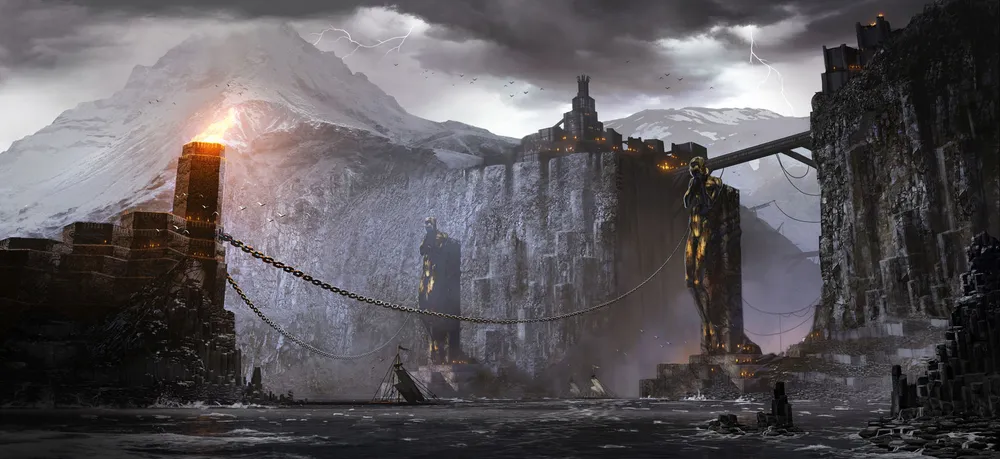
Description
Any ship approaching Kirkwall first sees the cliffs—a long "wall" that the city is named after. This cliff is made of the same black stone that the city itself is built from. Terrifying images of the city's patrons embody the Old Gods, carved into the stone. Over the years, the Chantry has erased many faces from the cliff wall, but erasing all of them is practically impossible.
A channel has been cut through the cliff, allowing ships to sail into the city through a dark corridor with walls that tower dozens of meters high. On either side of the passage stand two massive bronze statues of the "Kirkwall twins," which are not just for show: the city is located at the narrowest part of the Ardent Sea, and a massive chain can be stretched between the statues and the lighthouse, blocking the entire channel. This choke point of maritime trade has always been jealously guarded by the rulers of Kirkwall, as it allows for the successful extraction of taxes, duties, and tributes from the sea.
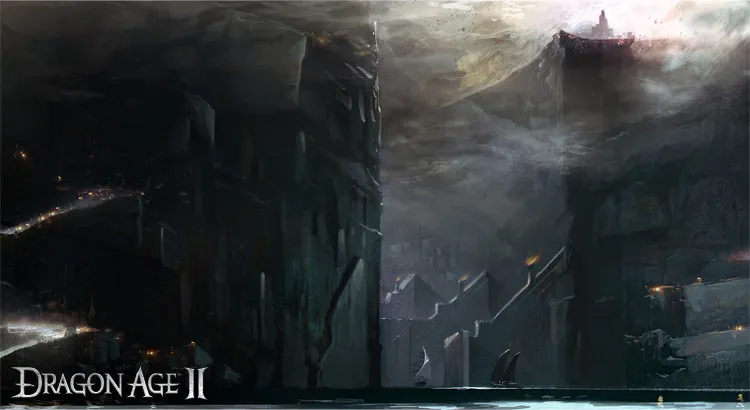
The city is in a prime location on the Ardent Sea, yet it still has many dilapidated areas. Although the Chantry and the Viscount's Keep are visible almost everywhere in the city, it is easy to get lost in the dwarven alleys, and street gangs rob those who wander through the Lowtown without a reliable guide or map. Smoke from the foundries clouds the air. Only a cold winter storm can cleanse the local air, but it cannot be said that the icy wind howling over the yawning mouths of ancient mines brings any relief to the locals. From time to time, clouds of vile vapors known as choking gas erupt from these mines leading into the Cloaca. It is quite common to find an entire shantytown that perished from asphyxiation in the midst of everyday hustle and bustle. Not far from Kirkwall, there are still abandoned remnants of quarries in the mountains where slaves were kept. In some of them, their spirits linger, clinging to memories of ancient tortures.
Thus, Kirkwall still resembles itself from the past; the downtrodden greedily struggle against poverty and those who oppress them.

Kirkwall (Codex entry)
Kirkwall, once located on the border of the Tevinter Empire, served as a refuge for nearly a million slaves. Taken from elven lands or brought from across the sea, these slaves served the insatiable thirst of the Empire to expand its borders. They toiled in vast quarries and extensive foundries, producing stone and steel for the Empire.
The complex past of Kirkwall is not easily forgotten, as traces of it can be found in many corners of the stone city. From the ship approaching the local port, one can see one of the city's symbols—a massive black wall. It can be distinguished from miles away. Terrifying images of the city's patrons—the Ancient Gods—are carved into the stone. Over the years, the Chantry has eroded many faces from the cliff wall, yet it will take a long time before this job is completed.
In the same cliff, a channel has been cut through which ships enter the city. Towering on either side of the channel are two imposing bronze statues—the "Kirkwall twins." These statues have a rather practical purpose. Kirkwall is situated at the narrowest part of the Ardent Sea, and a massive chain can be stretched between the statues and the lighthouse, blocking the entire channel. This choke point of maritime trade has always been jealously guarded by the rulers of Kirkwall, as it allows for the successful extraction of taxes, duties, and tributes from the sea.
- Brother Genitivi, In Search of Knowledge: Travels of a Church Scholar
Power

Kirkwall has been governed by a Viscount since the Orlesian occupation, and this title is Orlesian. The Viscount is only formally independent. The attempt of the previous Viscount, Perrin Trenhold, to expel the templars from the city proved fruitless. However, it had a significant impact on the next Viscount, Marlow Dumar, as well as on the entire city.
If the Viscount dies without leaving an heir, a gathering of the nobility of Kirkwall is convened to elect a new Viscount from among them.
After Dumar's death at the hands of the Qunari, Knight-Commander Meredith prevented the election of a new Viscount until her death. If the Champion supported the Templars, they will be elected as the new Viscount. If Hawk supported the Circle of Mages, they will flee the city in an unknown direction.
History of Kirkwall (Codex entry)
Chapter 1
Today it is hard to imagine, but there were times when Kirkwall was considered the edge of the world.
At that time, there stood Emerius, named after its founder, Magister Emerius Craivan. It was merely a small outpost at the very edge of the Tevinter Empire's holdings. In the quarries located there, the slaves of the magisters mined agate for the mighty temples of Minrathous. After the great city burned to the ground due to a slave rebellion, it was decided to move the center of the slave trade away from densely populated parts of the Empire. (It is likely that this reason is overstated, for at that time, the notorious Archon Vanairious Issar narrowly escaped death at the hands of an elven slave.)
Since the stronghold of the slave trade was to bring unimaginable wealth, competition between the rival cities lasted over twenty years, culminating in bloody slaughter in the border area, a safe distance from the archon's eyes. Magister after magister resorted to military force—usually in the form of small armies of slaves and mercenaries. About half of the slaves died in these battles before Emerius was finally chosen, thanks to the marriage of Craivan's son to the archon's daughter.
In just ten years, a mighty fortress was erected on the cliffs where Kirkwall now stands. Before the fall of the Empire, over a million slaves passed through its gates—an unimaginable number by today's standards. The Craivan family patronized the next three archons and actively contributed to extending the Imperial Highway into the Ferelden Valley. This move cost the Empire political influence due to the resistance of the Alamarri tribes. At its height, Emerius was a true jewel capable of rivaling the largest imperial cities. It was the greatest stronghold of civilization beyond Tevinter.
- Brother Genitivi, Kirkwall, The City of Chains. 9:24 Dragon Age.
Chapter 2
After the First Blight and the subsequent invasion of barbarians, the borders of the Empire continuously retreated. Many distant settlements in lands now known as the Free Marches found themselves cut off from the center of power. Numerous conquerors tried to unite these settlements into a kingdom, but resistance was fierce. Emerius held out for nearly a century until a slave rebellion broke out in the 25th year of the Ancient era.
This was not the first such rebellion in Emerius, but this time it proved to be the last. The city garrison was no stranger to suppressing uprisings. Even in the times of Andraste, the new regime did not last even ten years. Slavery flourished despite the Empire's decline. The flow of slaves across the Ardent Sea increased, and Emerius, due to its location at the narrowest part of the sea, became a strategically important place.
At some point, a slave-Alamarri named Radun became famous and demanded that his masters improve conditions for the slaves. He had such influence that magisters feared to touch him. As the demands became more and more absurd, the rulers eventually poisoned Radun. In fury, a crowd of Radun's supporters stormed the Bastille and was exterminated, leading to a bloody rebellion that lasted an entire year. The settlement burned, and the wealthy Upper City was plundered. The magisters were finally hanged before the cheering crowd. The city was renamed Kirkwall in honor of its cliffs: "kirk" means black. For more than a decade, the new city suffered from anarchy. Until the damage to the walls was repaired, it was easy prey for conquerors, and for centuries to come, it changed owners repeatedly. Paradoxically, with the rebellion, the era of independence came to an end.
- Brother Genitivi, Kirkwall, The City of Chains. 9:24 Dragon Age

Chapter 3
For the first time, the Qunari shook Kirkwall in 7:56 Dragon Age during the last of the New Holy Wars.
United, the peoples of Thedas attempted to rid the northern lands of the Qunari once and for all. The Qunari armies retreated. Desperately taking risks, their fleet rounded the coast of Amaranthine and landed a large army near Ostwick, one of the cities of the Marches. The Qunari intended to capture the cities of the March Starkhaven and Kirkwall: Starkhaven—to block the road north, and Kirkwall—to close the sea route for ships sailing across the Ardent Sea from Orlais, thereby cutting supply lines for the armies besieging Rivain. The attack on Starkhaven ultimately failed. However, the Qunari attacked Kirkwall deep in the night with the help of their sairebazi—magi on leashes. The walls were breached, and the city was captured. For the next four years, Kirkwall endured the heaviest occupation in its history.
Few records remain from that time. Only after the liberation of the city did the deeds of the Qunari come to light—children taken from their parents, forced conversions to Qunari religion, brutal labor camps. Ironically, the old slave quarters of the Lower City, preserved for centuries, provided an ideal opportunity to control the population. When the famous Orlesian cavalier Sir Michel de Lafayette defeated the Qunari and entered the city, he wrote: "Kirkwall is full of people with empty eyes. It is as if all their thoughts have been banished from their heads." Appointed (by the will of the emperor) as the first Viscount of the city in 7:60 Dragon Age, he dedicated all his efforts to eliminating the influence of the foreign religion. His lineage was respected in the city, so in 8:05 Blessed Age, when the city finally rose against Orlesian rule, the title of "Viscount" was retained despite its origins.
- Brother Genitivi, Kirkwall, The City of Chains, 9:24 Dragon Age
Chapter 4
The Trenhold family began its infamous rule at the very dawn of the Dragon Age less than a week after Maric Teyrn reclaimed the Ferelden throne from Orlais.
Since this was immediately followed by a civil war in Antiva (the notorious