
How to Create Memorable Adversaries for an Online Game
Transforming ordinary NPCs and bosses into truly interesting adversaries is a complex task for a development team. What principles govern the mechanics that make players scream with joy upon defeating a boss? How does a short story make an enemy genuinely detestable, and why are sound and visuals half the success? This material by Anastasia Jiova, Director of Game Development at Astrum Entertainment, addresses those curious about the answers to these and similar questions.
In online games, worthy adversaries are much more than mere cannon fodder or obstacles on the path to loot. They become key points of interest that enliven the game world, unite players, and give birth to stories that are later discussed for weeks on forums and streams.

Screenshot from the game NCORE
In many modern projects, whether it's a battle royale or cooperative shooter, developers strive to make artificial intelligence more than just a backdrop but a full-fledged participant in the match, influencing the dynamics of the battle. The process of developing such adversaries can broadly be divided into three components: gameplay mechanics design, narrative, and player emotions.
Designing Gameplay Mechanics
Gameplay mechanics are the brain and muscle of the adversary. They determine how the fight will unfold: will it be a memorable tactical challenge or devolve into monotonous spam? In a multiplayer game, the challenge should unite the team, prompting players to communicate and coordinate. When designing gameplay mechanics, developers generally adhere to a few principles.
Readability
The first and foremost law of designing any boss or serious mob is readability. Each attack, especially the lethal ones, must have a clear and understandable signal. Such markers can take various forms:
Visual animation. For example, the boss Fulgor from Elden Ring: Nightreign swings a giant sword before attacking, allowing players to determine whether to expect a pinpoint thrust or a sweeping area attack based on the type of swing.
Audio cue. In the same ER: Nightreign, the boss Adele lets out a loud scream before executing a jaw grab.
Floor indicator. For instance, a bright area indicating a zone of impending damage, as seen with many spellcasters in World of Warcraft.

Image from the game Elden Ring: Nightreign
Of course, developers can play with players' expectations. For instance, in souls-like games, bosses often have attacks with non-obvious delays. But even those become readable after several attempts. Without this, the battle would feel unfair and random, evoking frustration instead of excitement. This principle also applies in NCORE. For example, the boss Witch rises into the air before launching a powerful attack. She can also control other NPCs and gain invincibility from them — in such cases, she emanates purple "threads" serving as clues.

Screenshot from the game NCORE
Utilizing the Environment
In PvPvE games, NPCs often become a third force, introducing chaos into the conflict between players. For example, in season 4, chapter 6 of Fortnite, giant bugs swarmed the map, forcing players to either unite against a common enemy or seize the moment to attack.
In the first version of NCORE, mobs could attack players at any moment (even when players were sorting through their inventory), which generated negative feedback from the community. After testing, developers purposefully restricted their area, concentrating around chests. This decision:
Gives players a choice — to fight for loot or to bypass it.
Creates points of attraction. Everyone knows where to look for mobs and, consequently, other players, provoking natural PvP encounters.
Deepens tactics. The decision to attack mobs from a distance to provoke them and lure them out of their zone adds an additional layer of tactical thought.
Designing arenas for boss fights typically differs from other segments of level design. Here, the logic of the entire battle concentrates on a single opponent, giving developers the opportunity to create synergy between the boss's abilities and the nature of the environment. For example, the Juggernaut in NCORE has a powerful machine gun, while the arena features destructible cover. Meanwhile, the fight with the Butcher in Hunt: Showdown takes place in a dark room where players must navigate with minimal lighting sources.
Roles, Escalation, and Reward
Good design implies that adversaries serve different roles and their difficulty escalates. In NCORE, some mobs attack in close combat, while others provide cover fire from a distance. Snipers utilize cover, forcing the player to change positions.

Screenshot from the game NCORE
The difficulty of enemies also escalates. In NCORE, it is tied to the hex (location). For example, mobs in locations from the First World War on the easy level do not throw grenades; at the medium level, it happens occasionally; and on the hardest level, NPCs aim well and even dodge grenades thrown by their allies. This is not simply an increase in damage numbers but a qualitative change in behavior.
Rewards should correspond to the challenge and be valuable in the context of the match. In NCORE, bosses guard not just rare loot (unique weapons, armor) but also tokens necessary for the victory of the entire team. This motivates PvE-oriented players and provides them with an alternative path to victory, allowing them to avoid PvP confrontations.
Designing Narrative
One can create a perfectly balanced boss with brilliant mechanics, but if there is no story behind it, it will remain just a moving health bag to deplete for loot. Narrative is what transforms a faceless target into a character players want to defeat not only for the reward but for justice or pure curiosity. In multiplayer games, players often lack the time for lengthy cutscenes, and narrative becomes an art of brevity and implication.
Storytelling Through Environment: Show, Don't Tell
The most effective way to tell an enemy's story in a dynamic online setting is through the surrounding world. Where do they reside? It could be an abandoned laboratory, an ancient temple, a command post, etc. The nature of the location creates players' expectations. In Fortnite, giant bugs are most often found in nests illuminated by blue cosmic smoke. Entering such a location, players immediately associate it with an anthill and understand what enemies they will encounter.
The enemy's appearance is equally important. Scars, trophies on armor, style of clothing and weapons — all these are pieces of a puzzle. The aforementioned Butcher from Hunt: Showdown wears a leather apron and a pig's head — this shapes players' perceptions of him.

Screenshot from the game Hunt: Showdown
And while they have the option to explore notes within the game to learn more about the origin story of this monster, doing so is unnecessary — the most important information can be gleaned visually.
Brief but Impactful Lore: Story in Clickbait Format
Players in a multiplayer match do not have the time to read multi-volume novels. The story must be presented concisely and immediately grab attention. This technique is often used in Fortnite. For instance, players can hear brief (15-30 seconds) audio diaries or radio intercepts. In the 3rd season of chapter 5, players faced a wasteland warrior Megalo Don inspired by "Mad Max." On the map, players could find radios that revealed the villain's plans for destroying the game Island. In Hunt: Showdown, players find various scraps of diaries and notes that disclose the origins of the monsters.

Screenshot from the game Hunt: Showdown
A quest chain leading to the boss can piece together its story. In World of Warcraft, to reach many key enemies, players must first complete a sequence of quests in the area that explain why this character became a threat.
Successful narrative design transforms the battle from a routine into the culmination of a small but emotionally rich story. It answers the questions "Who am I fighting?", "Why is he here?", and "Why do we need to fight?", compelling players to invest not just time and bullets but emotions in the victory. Even in a fast-paced PvPvE match, a short but vivid enemy story can become the hook that pulls a player back into the game.
Designing Player Emotions
The greatest opponents in games linger in memory not only because of complex mechanics or a deep story but also due to the emotional engagement that arises from visual style, auditory pressure, and tactile sensations of power. This layer of design works on the subconscious, turning dry execution of game mechanics into an experience and catharsis for the whole team.
Visual Style
The visual style is the first and foremost hook that captures the player's attention. The threat should be readable not through the interface but through silhouette, animation, and scale. A recognizable shadow of a boss, visible even in the smoke of battle and chaos of attacks, immediately communicates its presence as the main event. An epic appearance of an adversary is a show in itself. In Fortnite, a massive queen of bugs bursts from the ground, towering over players' heads.

Screenshot from the game Fortnite
The fight with Fulgor from Elden Ring: Nightreign takes place in a desert, with the boss falling from a height and raising clouds of dust. According to NCORE lore, battles are shows that occur in the gladiatorial arenas of the future. Hence, the team adheres to the philosophy of "cinematic scenery," creating the impression that each boss and mob was set on the arena by show producers for maximum spectacle, without restricting imagination to historical accuracy. Mages hurling fireballs in medieval settings and snipers with laser sights in the First World War are not mistakes but conscious decisions that enhance the effect and intensity of the moment.
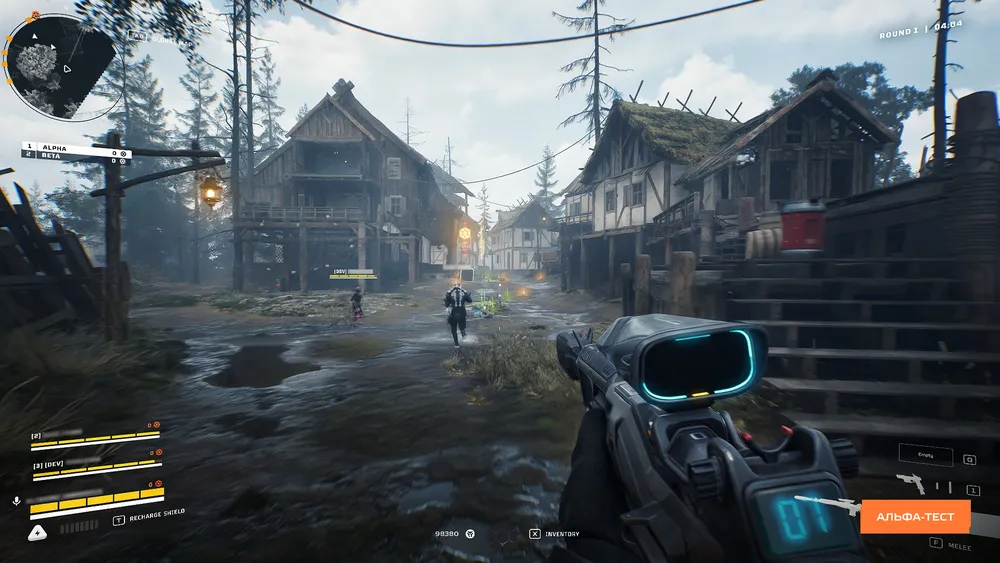
Screenshot from the game NCORE
Sound Design
The visual layout is only half of the symphony. Sound design is responsible for building atmosphere and conveying power. A unique musical theme that begins at the start of the battle instantly shifts players into the mode of "now we will face the ultimate challenge." This music becomes the soundtrack to their collective triumph or defeat, and subsequently, just its motif can elicit goosebumps. The voice of the opponent is its second most formidable weapon. Memorable phrases and shouts, whether a chilling warning or a furious roar, become part of community culture, turning into memes and passwords.
Clear and unique sound markers for each attack allow players to act even blind, relying on hearing, immersing them into a state of flow and making victory even more satisfying.
VFX and Particles
To make the impact on the enemy feel genuinely weighty, heavy artillery is deployed — visual and tactile effects. Powerful particles, camera shakes in sync with the steps of a giant, slow motion at the moment of receiving critical damage — all these seemingly minor details are, in fact, critically important. They add physical weight to every interaction, allowing the player to feel the force of their attacks and counterattacks. This turns the battle from an abstract exchange of damage numbers into a fierce struggle.
Sense of Triumph
The culmination of the entire battle should be a feeling of collective triumph. The death animation of the boss, a thunderous final chord in the music, and massive pop-up achievements on each team member's screen serve as rewards not only for skill but also for the emotions experienced together. It is that moment when, after an intense battle, the voice chat erupts in collective jubilation, that becomes the ultimate goal of emotional design. It proves that the team has defeated not just an algorithm but a real opponent, and this memory will stay with the players long after they claim their loot.
Creating great adversaries in online games is a synergy of gameplay mechanics, story, and emotion that turns an ordinary boss or mob into the central event of a match, one that players will talk about long after the session concludes. A modern AI opponent is no longer just an obstacle on the path to loot but a full-fledged co-author of unique gaming stories.