
Gamer Times

Hello, dear reader. You are currently reading the second sentence of the pilot issue of the new press on this site. It is called, as the title straightforwardly hints, Gamer Times.
What is this about? Well, basically, about everything. Incidentally, the title hints at that just as openly. So, hold on before you close the page. Please wait, we were joking… The magazine is indeed "about everything," but only about what concerns games. Reviews, previews, news, videos, the harsh life of developers, and even an event calendar — everything is here. In a separate corner, the section "Crafty Desktops" is lurking in the bushes, trying not to stand out — it’s all about various internet services and incredibly useful software. We will also have a section on "Hardware"; where would we be without it?
The writing of this issue was actively participated in by: Sergy (founder), R0ndo (who decorated this chaos), LiveSaifer (the event calendar and "Localizer's Corner" — his merit), ShadarRim (news), mobilas who dealt with the layout and design of the newspaper, Teodor\_85 introducing you to the history of game development, and the person who wrote this mundane introduction, Pegazs. He also runs the "Crafty Desktops" section. We recommend subscribing to all of this crowd if you don't want to miss the next issues.
We can already foresee the question about the design, which is clearly hanging in the air. We won't deny it — it is indeed minimalist, but not due to the designer's laziness. We simply believe that information is above all and do not want to burden the reader with the use of something external — you can always read us on this site, without going anywhere else. We don't want to create a "foreign element," you know.
But let's move on to, perhaps, the most important part of this whole introduction. We weren't able to do everything we wanted right away due to a limited number of project participants. Did you like the idea? Do you think you can write better? The door is open — we have unlimited space (we could post "War and Peace" daily). The acceptance bar is comparatively low, but we certainly won't pass up on any Lemurs. And the most pleasant part — everyone who participates in the creation of an issue will gain experience from the administration. So not only altruists are welcome =) Almost any section is accepted — be it esports or reviews. As long as it fits the format.
The planned publication mode is twice a month. Since we cannot predict how many people will express a desire to help us, this number may decrease.
And yes, the introductions in the following issues will be shorter, don't worry =) Enjoy your reading.

Mobility is Everything
Sometimes hard drives die, files are accidentally deleted, flash drives get lost… It's always sad, don't you agree? Especially sad is that by the law of meanness, flash drives with important data get lost more often than empty ones.
Well, is it not for nothing that we have the twenty-first century upon us? Let’s see how we can protect ourselves from such problems. And at the same time, enhance our mobility, thereby simplifying our lives if you have more than one computer.
Ninite

A wonderful service. It allows you to install dozens of the most important programs in five minutes — starting from Skype and browsers, to Gimp and Google Earth.
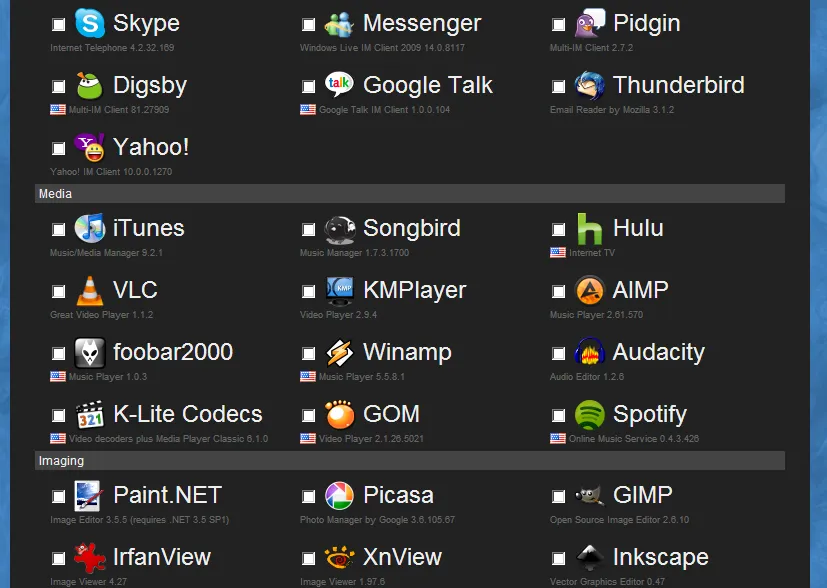
We check the boxes, click the "Get Installer" button, download a single installer, run it and… heck, we can go for a walk; the automation will take care of the rest. By the way, it includes programs mentioned later in the text. And note, next to some programs, there is a characteristic American flag — a warning that the English version of the program will be installed.
A good alternative. The only difference lies in the set of available programs and different approaches to installation: freenew.com is less automated.
DropBox

An absolute must-have in the realities of our lives. The magic box allows you to synchronize data across multiple computers while simultaneously uploading files to the server. It looks like a folder, but whatever you place there — will immediately appear on the DropBox server as well as on all other connected computers under one account.
There is the ability to share (simultaneous access to a specific folder by a group of people), which, by the way, was used to create this issue. You can use it as a file exchange service or gallery. File synchronization occurs in a binary method (only the changed portion of the file is sent, roughly speaking).
The free version is limited to two gigabytes. That’s more than enough for various documents. However, this space can also be used for games like VVVVVV or N. Synchronization of saved games is in action, however. For a fee (100 a year), you can use 50 gigabytes, which is enough for a pretty decent photo collection. For double that amount, you can get one hundred gigabytes.
DropBox supports Windows, Linux, practically all Apple products, and mobile phone access is possible through a web interface, although more or less in "read only" mode. The downsides: to save something, you need to move it to the service folder or work in it directly. Internet is also required.
The available space, regardless of the subscription type, can be increased in three ways: by inviting someone to the service, completing training, and signing up via a referral link. The last two methods, naturally, are one-time only. So don't be shy, go ahead and use the referral link. The "ceiling" on the basic version is over 10 gigabytes.
However, if, for principled reasons, you don't want to use referral links, we also have the regular version.
Drive Backup

People fall into two categories — those who make backups and those who are already making them. Drive Backup software has relatively rich settings, but its essence is simple: it automatically creates a backup of any folders/files to a designated external device as soon as you connect it to the computer. Or vice versa – from the external device to the computer. It's generally convenient — you can set all settings once and not worry afterwards. However, you must frequently use this "external device" to achieve maximum effectiveness.
There is also a manual mode. With proper use, one can even achieve a certain type of synchronization, which will certainly appeal to those who take work home.
I recommend downloading from here.
Evernote

A service for creating notes. A notepad, quote book, diary, a place for thoughts, clippings from articles — a vast array of possibilities for use. Implementation is through a web interface, application, or browser plugin (Chrome, Firefox). The most multifunctional variant is, of course, the application. All notes are categorized by creation date, tags, and/or folders created by the user. By pressing the Prt Sc button, you can highlight a portion of the screen and save it as an image.
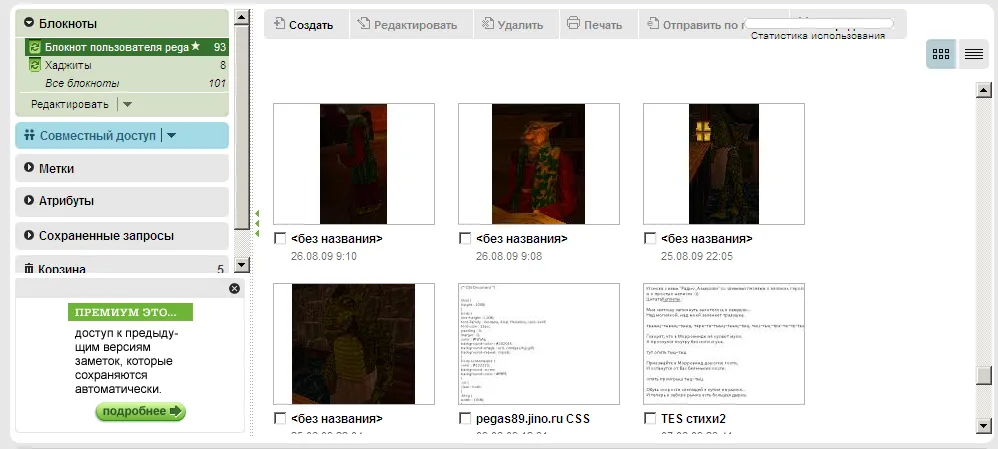
Support for the Russian language is available, so it is easier to understand the details on your own. Personally, I couldn't get along with the program — I’m just not good at taking notes =)
Pusk.ru

An excellent start page service. Its main disadvantage is that it's quite bulky and made using flash technologies.
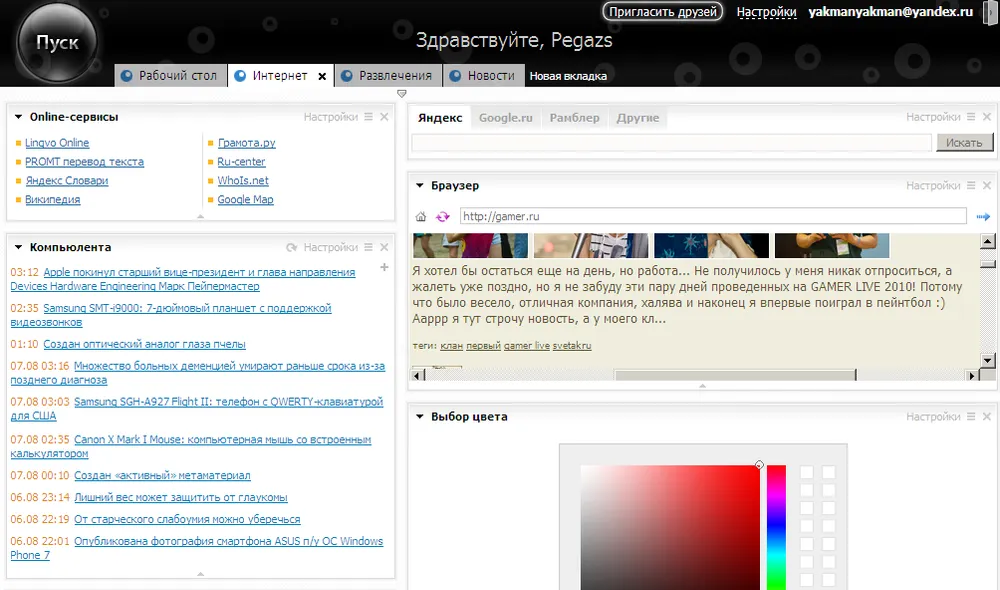
If that doesn’t bother you, and your current homepage isn’t as perfect as you’d like, then this site is definitely worth checking out: a browser within a browser, file trash, any RSS feeds, widgets for webmasters, monitoring of two to three email boxes at once, the ability to create multiple start pages and switch between them (for work, news, entertainment...) with so many settings that you could hang yourself. Everything is movable, fixed, repainted, enlarged, and reduced — you can customize it almost perfectly.
Visual Bookmarks
There are a huge number of services providing the opportunity to store your bookmarks. Typically, these are set as a startup page. There are certainly many of them, and it's worth searching for one tailored to you, but still, describing a couple of them won’t hurt for understanding what visual bookmarks are.

In general, such services are divided into two types: "purely" visual and mixed. The first type includes SpeedTile.net — the user can see many boxes with their favorites. The aforementioned example features categories, sorting of bookmarks by alphabet, date, frequency of visit — whatever your heart desires. Drag & drop is supported, there is a convenient search for bookmarks at the top of the page. There is even a special plugin for Firefox. Import/export is unfortunately not provided.

A minimalistic, "mixed" type can be attributed to the rastr.ru site. Clocks, calendar, radio, news, and very, very compact bookmarks. Convenient categorization and editing. Hovering over a bookmark reveals a pop-up window with the site. All the features of the service can be tested even without registering. There is no import/export.
meebo

Installing a bunch of programs isn't always necessary. For example, for communicating simultaneously both on Jabber and ICQ, it's enough to install QIP Infium. But you can actually not install anything at all, and just use the services of meebo.com

The main goal of the service is as simple as two plus two — to allow the use of services like ICQ, Jabber, gtalk, Windows Live! and some others at the same time without leaving the browser. It’s convenient. And I think some resourceful mind has already found many applications for such a service. For instance, meebo.com works great in Steam.
However, I must note that the Russian translation is lacking and filled with artifacts. So I recommend using the English version if possible.
That's all for now. Of course, there are many programs that could further boost mobility, but this "gentleman's set" will be enough to significantly cut down on the hassle with USB drives and minimize the number of tragically lost nerve cells.
Keep your computer clean, and your mind clear!

Localization Corner
Summer is already coming to an end, and with it, the entire gaming industry is waking up. Slowly, many long-awaited, and not so long-awaited, games are approaching release. For example, Starcraft 2 was recently released (localization - Blizzard, distribution - 1C), which all strategy lovers have been waiting for a decade. It is no surprise that on the very first day it sold millions of copies and received overwhelmingly positive reviews from the press. Alright, let’s get to the main topic. Today, we will talk about the most anticipated projects that will delight domestic gamers in the next few weeks.
• I’ll start with good news for fans of role-playing games. A localized version of the project Drakensang: River of Time is scheduled for release in August. The action of the game takes place 23 years before the events of the previous part. This time, we are in for a journey across the mysterious Aventuria. Exciting adventures, unexpected plot twists, and much more are promised. And it's the pure truth, as the game has already been released in many countries and has been received quite positively.
Localizer: Snowball Studios
• On August 24th, the release of the turn-based strategy Elemental is scheduled. Wars of Mages. The events unfold in a fantasy world that has barely survived a devastating magical cataclysm. It’s incredible, but even after this horrific catastrophe, bloody wars did not cease. I won’t delve into the plot description and will simply say that we are promised a huge world, magnificent storytelling, innovative role-playing elements, and much more. For instance, an editor that allows you to create your own monsters and even entire continents. We are looking forward to it.
Localizer: Snowball Studios
• Doesn’t it suit you, you say? Do you love exciting and continuous shootouts? On August 19th, a bloody criminal action Kane & Lynch 2: Dog Days will hit store shelves, telling the story of two ruthless and wild killers. Kane and Lynch are back to stir up trouble on the criminal streets of Shanghai. Not least interesting is the game’s approach to visual style, executed in a documentary filming manner. A demo version is already available for download on Steam.
Localizer: Новый Диск
• Also, a new adventure game from the creators of the Penumbra series is expected to go on sale soon. “Amnesia: A Machine for Pigs” will transport players back to the 19th century within the confines of a mysterious castle. The main character of this action, Daniel, will explore numerous corridors and dungeons that hold many secrets. According to some publications that tested the product, it is shaping up to be one of the scariest and most atmospheric games of the last decade. There are no reasons not to believe them.
Localizer: Snowball Studios
• Well, now perhaps the most important part. How long gamers have been waiting for truly captivating stories. Very soon, on August 27th, we will be able to play the long-awaited continuation of the great gangster saga – Mafia 2. The events of the game unfold in the fictional city of Empire Bay. An excellent plot, exciting chases and shootouts, a huge and living world — this is what the developers promise. Although the game has not lived up to the expectations of some publications, we will believe. After all, we are hardly often given the opportunity to immerse ourselves in the atmosphere of the 1950s, and it cannot be missed. And yes, the demo version will be released very soon, on August 10th.
Localizer: 1C-SoftClub
Now about some less important, but still interesting releases:
12 August, Rabbits Go Home:
Another arcade game about the adventures of crazy rabbits, inexplicably ported to PC.
Localizer: Buka Entertainment
13 August, Victoria 2
Global historical strategy set during the Victorian era.
Localizer: Snowball Studios
13 August, Fallout 3. Add-ons The Pitt and Operation: Anchorage:
Two add-ons to the third part of the cult role-playing series — completely in Russian.
Localizer: 1C-SoftClub

“The History of a Game” - Wolfenstein 3D
*A game does not become a cult classic immediately. First, in the first year, or even the years after its release, it must go through several stages*
of development that, in the end, can make it legendary. This includes both mass love from gamers and high sales, a reasonable policy from the developer company in relation to its support, and much more. But perhaps another fundamental factor is the inclusion of novelty and ingenuity in the game, which can make a breakthrough in the genre, create a subgenre, or even an entirely new class of computer games. Thus, a game largely becomes a cult classic; it is loved by many generations of gamers and constantly ranks in lists of the greatest games of all time. Then, after decades, we launch such a game, traverse levels already long passed, and nostalgically recall the previous times, saying: “What a legend, son…”
Folks, in the "History of a Game" section, as you might logically gather from its name, we will talk about the legendary games of our past. Mostly, these will be games released in the 90s of the last century, but sometimes these frames will be expanded to encompass the nearby decades. “Why recall old games at all?” you may ask. And truly, for what reason? They are already in the past; many people have forgotten about them; even more modern gamers have never played them and have not even heard of them. So why? Because, friends, we all must respect, honor, and remember the past. Just as every citizen of their country should know its history to have a vision of the future, we, who inhabit the vast global state of gaming enthusiasts, must remember the best foundational games in its history. It is exactly for this reason that this section was created. Also to simply engage in nostalgia together…*
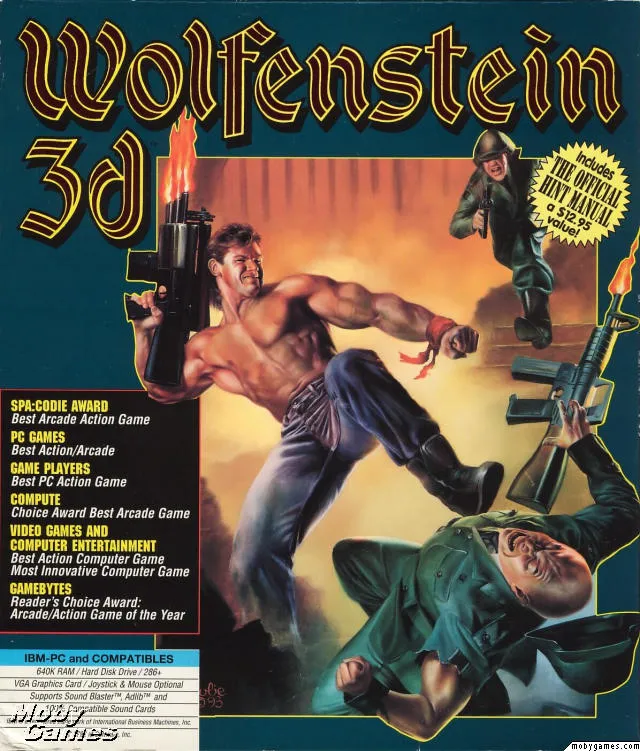
Wolfenstein 3D
The beginning of the 90s was simply a golden time for the entire gaming industry. During this period, genres were birthed, game developers gained traction, and legends were created. The game we discuss today is from there, from those golden, initial years of the last decade. I only need to say a few words for you all to remember it. Nazis, prison, underground, escape… You’ve already guessed? I had no doubt. Today we will remember the cult, legendary first-person shooter released in 1992 that was named “Wolfenstein 3D.”
So, in the early 90s, the young and later legendary company “id Software” was at a crossroads. One of the company’s founders, Tom Hall, suggested continuing work on the series “Commander Keen,” which had made them popular, but others, including John Carmack, persuaded him to create a new game based on the engine of their previous work “Catacomb 3D.” Tom did not regret the decision to create a new product — the game released in 1992 surpassed all their earlier works, including Commander Keen and Catacombs, in popularity. Moreover, it has forever remained in the memory of gamers, becoming a game for all time.
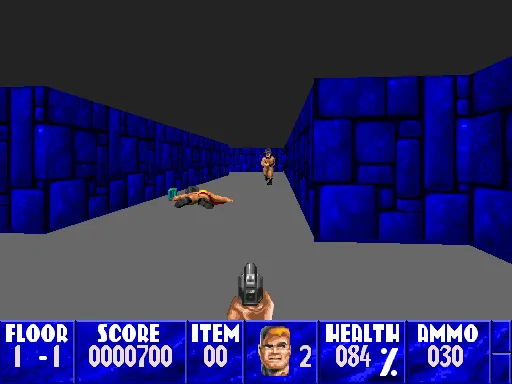
“Wolfenstein 3D” is still positioned as the first first-person shooter in history. On one hand, this is true, while on the other, it is a misconception. Yes, first-person shooters were released long before Wolfenstein, and sometimes they even cite games released in the seventies. I don’t know what shooters existed back in those times, but at least in the late 80s and early 90s, several games of a similar sort were released, among which we can recall “MIDI Maze,” “Hovertank 3D,” and “Catacomb 3D.” Each of them was focused on the idea of a first-person shooter and could have become the progenitor of the genre. Why did this not happen, and only in 1992 was “Wolfenstein 3D” named the first game of this type? Because those games weren’t brilliant and never became popular. It takes a revolutionary technology that defines the genre and the ability to communicate its advantages to the minds and hearts of gamers to start a genre. The first to achieve this were “Wolfenstein” and “id Software,” so the accolades belong to them. Quite well-deserved accolades, I must say.
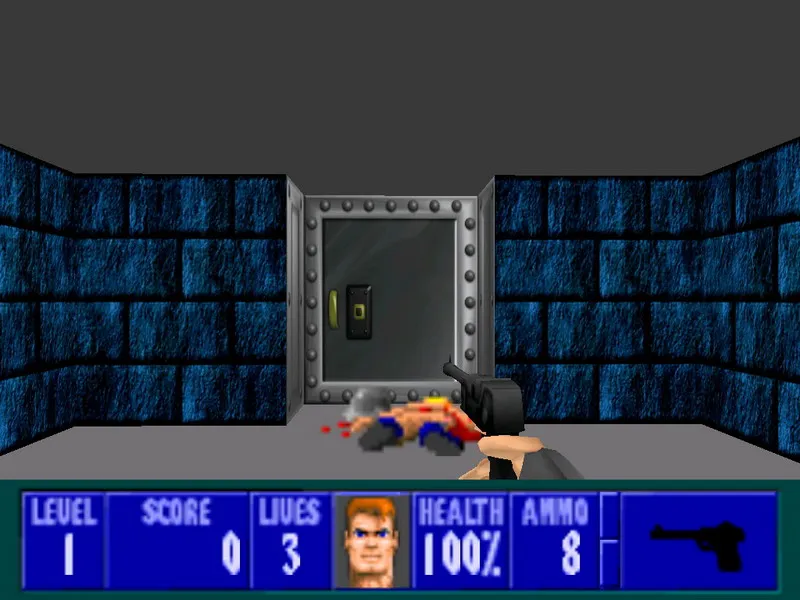
In those days, Wolfenstein was an incredibly beautiful game. Pseudo-3D graphics, using the revolutionary ray-casting technology allowed to somewhat animate the virtual world. The sprite technologies, which were applied to create a one-dimensional buffer, also contributed to the perception of the game as quite realistic, rendering endless corridors of the Nazi castle with Germans, their minions, and big, nasty bosses.
In general, the game was quite simple and straightforward. According to its plot, soldier William Blazkowicz escapes from a Nazi prison fortress named Wolfenstein. During his escape, he faces many armed guards and guard dogs. The building is filled with rooms containing various treasures, food items, medical kits, as well as different weapons and ammunition. The player navigates through levels of the game, facing a "final boss" – a particularly strong enemy at the end of each storyline episode, whose defeat requires quite a bit of effort from the player. The game does not excel in the number of enemies, weapons, and artifacts — all of that is in minimal amounts. The plot is monotonous and linear; we must follow the path identified by the developers, and no deviations from the main campaign are possible. However, along the way, we can find hidden rooms containing significant amounts of ammunition, gold, and unusual opponents. Yes, in one of these hidden rooms, one might even encounter the famous Pac-Man and fight against him. Such quirks certainly added variety to the game, but it didn't make it particularly original. “So what’s the genius of Wolfenstein?” you might ask in astonishment. In its simplicity, I reply. Yes, the developers deliberately eliminated all unnecessary elements from the game; they purposefully abandoned initially planned tactical options to make it as simple and clear as possible. This fact played its role. The player was not offered a mass of gaming refinements, reflections, and courses of action; they simply handed us an automatic rifle, left us in a dark corridor, and said: “Run forward or die.” And realizing this simple, primal choice, we ran. We ran, killing everything in our path, eager to escape the grim and creepy nest of the Nazis.
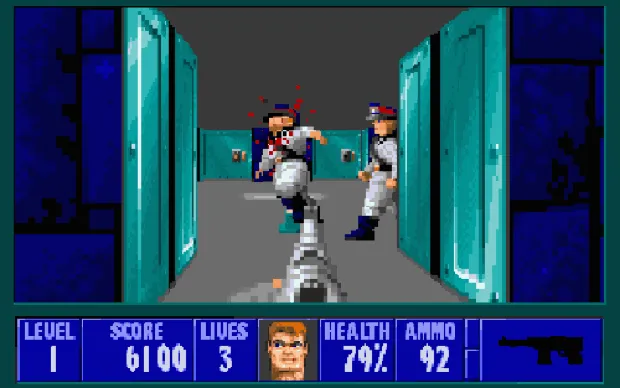
As I mentioned earlier, there were only a few types of opponents in the game: a German shepherd, a mere soldier, an SS soldier, a mutant, and an officer. Each differed only in uniform color, strength, and the weapon they were equipped with. Alone, they did not pose a particular danger but could cause trouble for the player only in large groups. Fortunately, such groups were plentiful along the path to the exit, and boredom would not be our companion during the action. More dangerous in the game were the “bosses,” which appeared on every level. Battles against them were always lengthy, requiring considerable resources and health reserves. The developers, by the way, approached the creation of bosses with inventiveness; among them were prominent German generals, Adolf Hitler himself, and even his ghost. All this could not help but amuse, even during combat, making boss battles not only serious encounters but also somewhat humorous. Moreover, the game had elements of humor: the cries of soldiers as they fell to the floor, their conversations through walls, the barking of the dogs, funny artifacts, and health stimulants — all painted a rather non-dreary picture of the Nazi castle's underground. But it’s precisely because of such elements that this game appealed to gamers: simple, unrealistic, and straightforward.
The weapons in the game also did not shine with originality or variety, and you could count them on one hand: a knife, a Luger pistol, an MP-4 submachine gun, and a Gatling six-barreled machine gun. With such a modest set of weapons, we were to battle simple soldiers and bosses. If soldiers typically went down after one or two shots from the pistol, then meeting bosses recommended having a machine gun in one's arsenal — and a sufficient quantity of ammunition since they consumed it at an extraordinary rate.
The interior of the castle was pragmatically severe. No excesses, just walls, wooden tables, and the same chairs. On the walls hung swastikas and portraits of the beloved Führer, and occasionally rusted hooks with ancient skeletons. Otherwise, just corridors and rooms, rooms and corridors. We had to navigate through the game with no map, thus forcing us to diligently memorize every entrance and exit, every turn, and every door. Very well, the bodies of the slain enemies assisted in orientation: by their laid-out silhouettes on the floor, one could guess whether we were in a room or not.
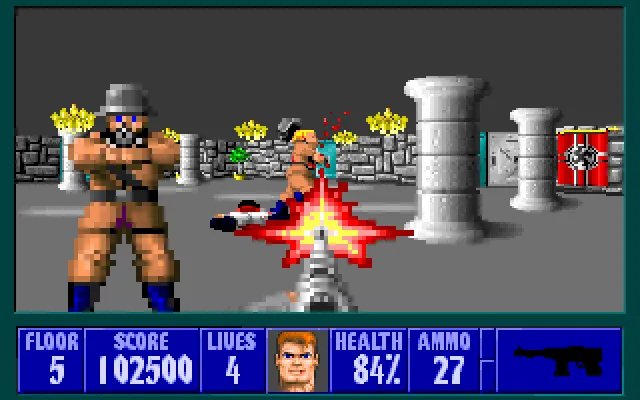
So, with a straightforward set of arms, fighting against a greater number of non-diverse foes, we ran through the straight corridors of the Wolfenstein castle. The game was well-received by gamers, and immediately after its release, it spread across the world, receiving top ratings from gaming magazines. At that moment, everyone realized that a new, popular genre had appeared in the gaming industry — the first-person shooter or FPS, or if you want to transition to western terminology — "first-person shooter." Prior games were not remembered — they had no chance of being considered as the foundation for the genre, while after the release of “Wolfenstein 3D” it became clear to everyone that games similar to it would come, and their popularity would skyrocket. And so it happened. The following years gifted the world several gaming hits in the FPS genre, among which was the direct descendant of Wolfenstein — “Doom,” the legendary “Quake,” and the tremendously popular “Half-Life.” Undoubtedly, it was the bold attempt of “id Software” to create a new-old game that paved the way for these games to exist, proving to the entire world that indeed, a first-person shooter could thrive.
Unfortunately, Wolfenstein itself did not grow into a series, although several additional missions and games were released for it. Initially, the game “Rise of the Triad” was intended to be a sequel to Wolfenstein, but later the idea evolved into another direction, and the end result is hardly a sequel to Wolfenstein. The prequel to the game “Spear of Destiny” was released after the original Wolfenstein, using the same engine, but the developers did not achieve success.
In 2001, the world saw a game called “Return to Castle Wolfenstein.” It was essentially a reimagining of the 1992 Wolfenstein, but what conquered the world a decade ago did not earn even a fraction of its great predecessor’s fame in the early 21st century. The only thing remarkable about this game was its multiplayer mode, in which most gamers engaged.

In 2009, a sequel to “Return to Castle Wolfenstein” released under the simple and straightforward title “Wolfenstein.” The original game was only reminiscent in name and some key characters, yet overall, it was designed in a sci-fi style and came under fire from many authoritative publications. The attempt to revive the former glory of Wolfenstein again failed.
As you can see, “Wolfenstein 3D” is a rare exception in a situation where a great, legendary game did not lead to a series of equally remarkable, if not better games. Why did this happen? Most likely because the developers did not get stuck on one storyline and used merely the idea and the technology to create numerous great but utterly different games. To be fair, they can be considered sequels to that very legendary shooter, which, in its time, managed to make a paradigm shift in the industry and forever win the hearts of many gamers worldwide. I, too, belong to that number, and sometimes, for the sake of pleasure, I launch Wolfenstein and, transported back into my childhood, run through its familiar corridors, firing away with my MP-4, battling bosses, collecting treasures, progressing from level to level towards that coveted exit from the cursed castle. And each time, as if for the first time, I rejoice when I manage to overcome yet another straightforward obstacle on my hero’s simple path. At that point, it is hard to tear myself away from the game; playing it makes you forget about the day and night, duties and idleness, lunch and dinner. In “Wolfenstein 3D,” everything is simple, yet simultaneously complex. And therein lies its legendary status and all its greatness.
*Thank you all for your attention, until new encounters in the **