
HUD-less Design of the First Assassin’s Creed
I present to your attention another interesting article by Stanislav Kostiuk, which, unlike the article about Assassin’s Creed IV: Black Flag, has not appeared in Russian until now (in the Runet, there is only a video created based on it). Since the illustrations in the original post seemed too small to me, I took the liberty of inserting images of my own production into the translation. In most cases, they almost completely mirror the author's images. However, there are also some that, while differing in appearance from the original images, are conceptually similar to them. And for those who are only superficially familiar with the game, I have supplemented the “clean” screenshots with screenshots featuring arrows to make it clear what is being discussed – look for them under the spoilers. And yes, everything described below I tested myself while preparing the translation. Therefore, I can confidently say: the HUD-less design truly works.
Author: Stanislav Kostiuk,
senior game designer Ubisoft
HUD-less Design of the First [Assassin’s Creed](/games?search=Assassin’s Creed)
Until the release of "Black Flag," the first [Assassin’s Creed](/games?search=Assassin’s Creed) was my favorite game in the series. But even in "Black Flag," there is nothing that makes the first part truly special. This is absent in the second part, in "Brotherhood," in "Revelations," in the third "Assassin," in "Unity," "Syndicate," or "Rogue." I might be countered: "Of course, Stas, the first [Assassin’s Creed](/games?search=Assassin’s Creed) has interesting ideas, a stunning atmosphere, and a storyline; it laid the foundations of the franchise, but it is monotonous and boring. Aren't the subsequent games much better?" Well, in some respects, yes. And in some respects, no. After all, "nothing is true and everything is permitted." The first [Assassin’s Creed](/games?search=Assassin’s Creed) has one feature that provides a level of immersion that cannot be achieved in any of the sequels. I mean the HUD-less design.
The design of the first [Assassin’s Creed](/games?search=Assassin’s Creed) (at least its console version; we will talk about some missions that appeared later in the PC version) allowed you to complete the game from start to finish with the user interface completely turned off. That is, without a map, objective markers, icons, control indicators, etc. The user interface was obviously added at the very last moment, most likely after playtests were conducted. On one hand, I understand the rationale for its emergence, but on the other hand, it interferes with experiencing the sensations that the game could have provided. Let me try to prove what I just said. Let’s take, for example, the mission to eliminate our first target in Acre (and the second in the game overall) and try to complete it without a single element of the user interface and without referring to the map.
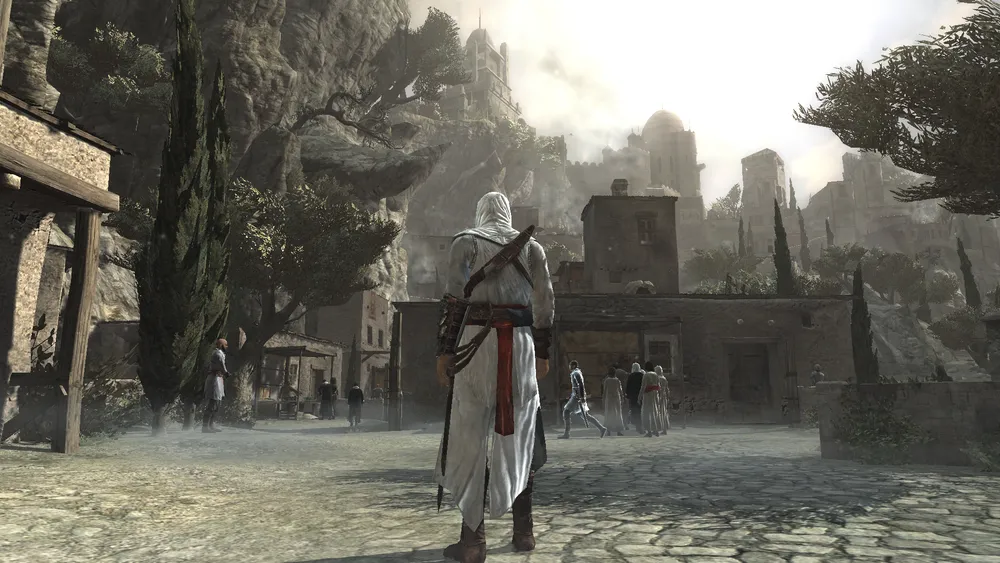
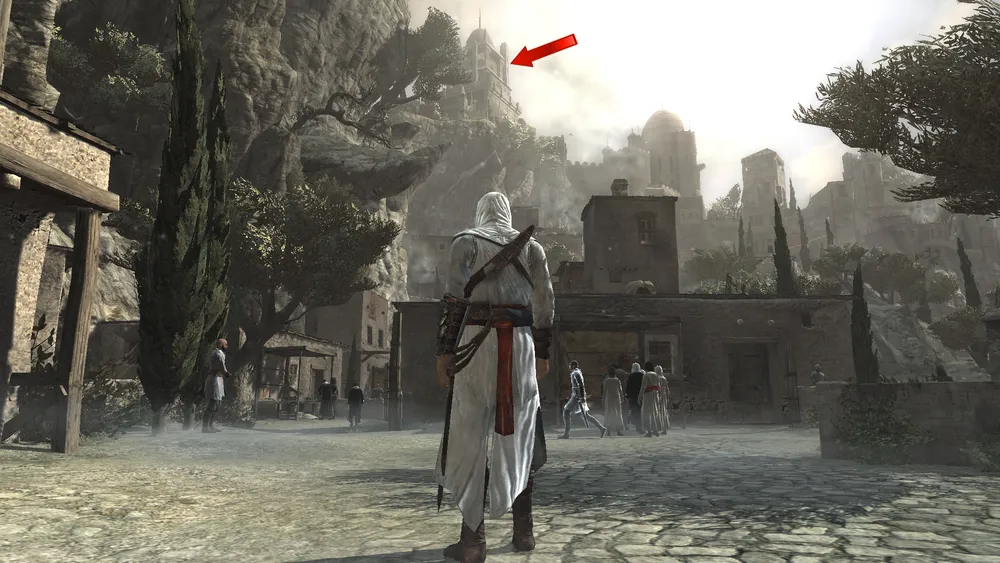
The mission starts in Masyaf. This is the first settlement that will become available for exploration, and it is fairly easy to navigate. As soon as you enter the village, you will see the local architectural landmark in the distance – the Assassin's fortress. It is there that Al Mualim will name your victims.
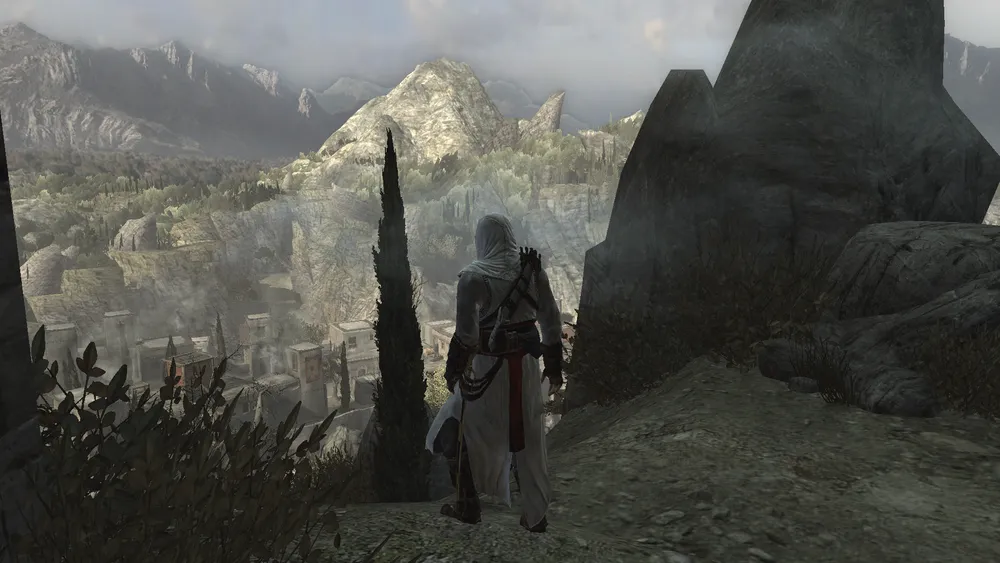
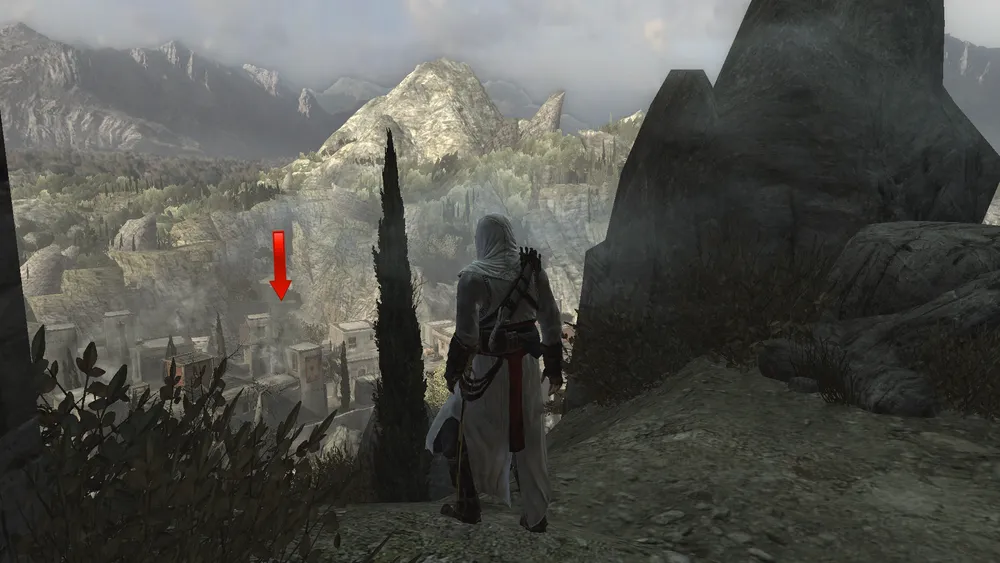
From the top of the mountain in Masyaf, the exit [from the village] is visible. So we know who our target is – Garnier de Napluse from Acre.
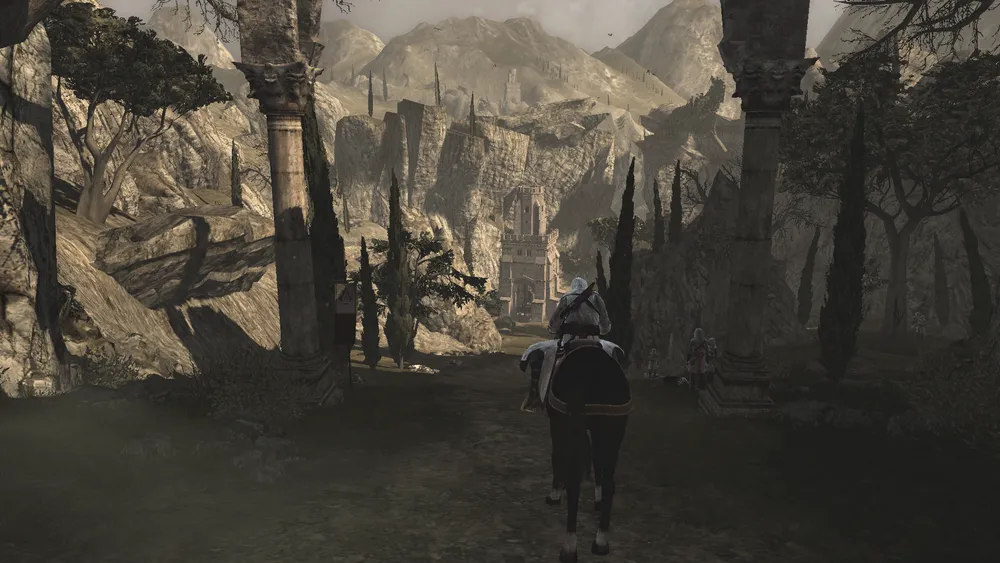
First of all, of course, we will leave Masyaf, mount a horse, and gallop along the only road available to us until we reach the next area – the Kingdom. This is a kind of hub that connects all the cities. We won’t open the map or use GPS [that is, the mini-map. – Translator's note.]. But how will we get to Acre? Well, fundamentally, there's nothing complicated here.
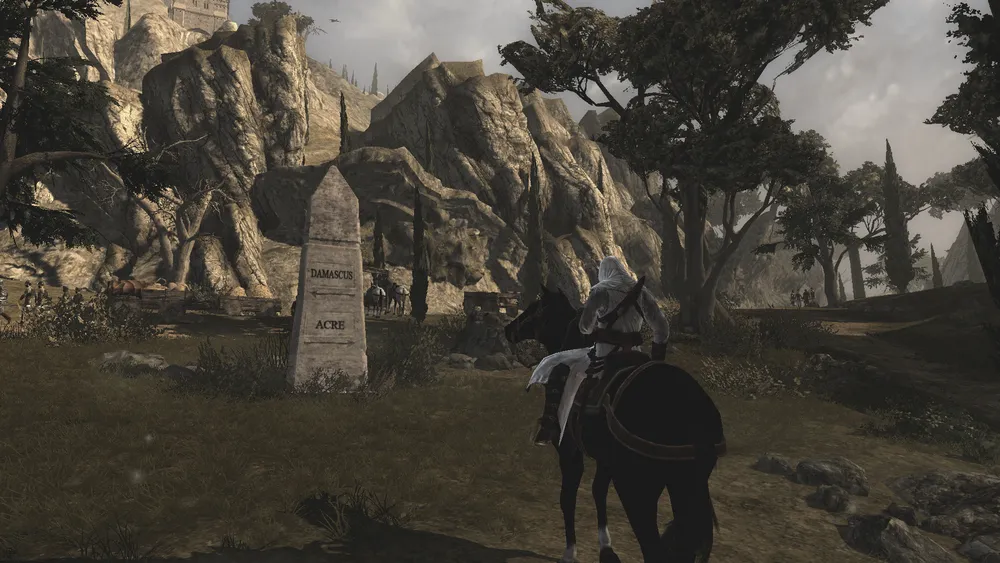
There are signposts at intersections pointing out where to go. The same would be true in real life. There’s essentially nothing to do in the Kingdom besides riding along the road and looking around (or collecting flags and killing templars if you're into that). The trip becomes much more exciting if you pay attention to what you encounter along the way.
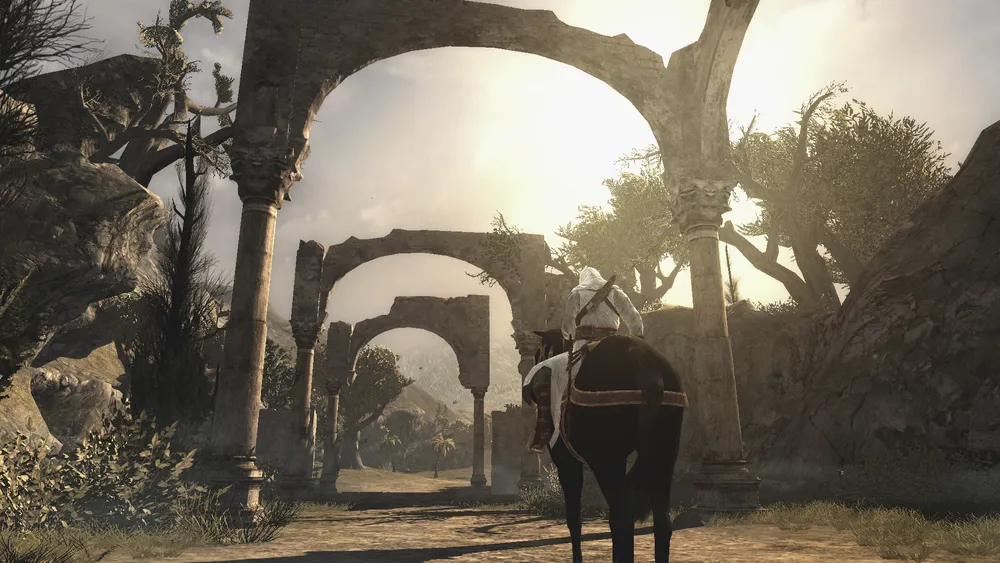
At some point, you will see a row of stone arches – an environmental element denoting the transition from the area you are currently in to the neighboring one. In this case – from the Kingdom to Acre.
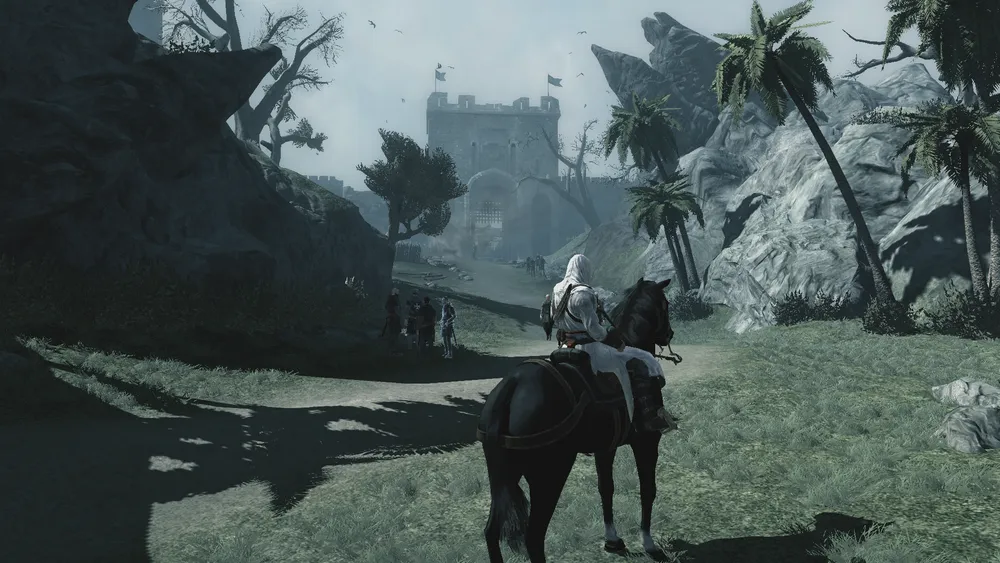
And here we are in Acre. Our task is to get to the Assassin's Bureau and learn more about the victim. However, before that, we need to get past the city gates, which are guarded.
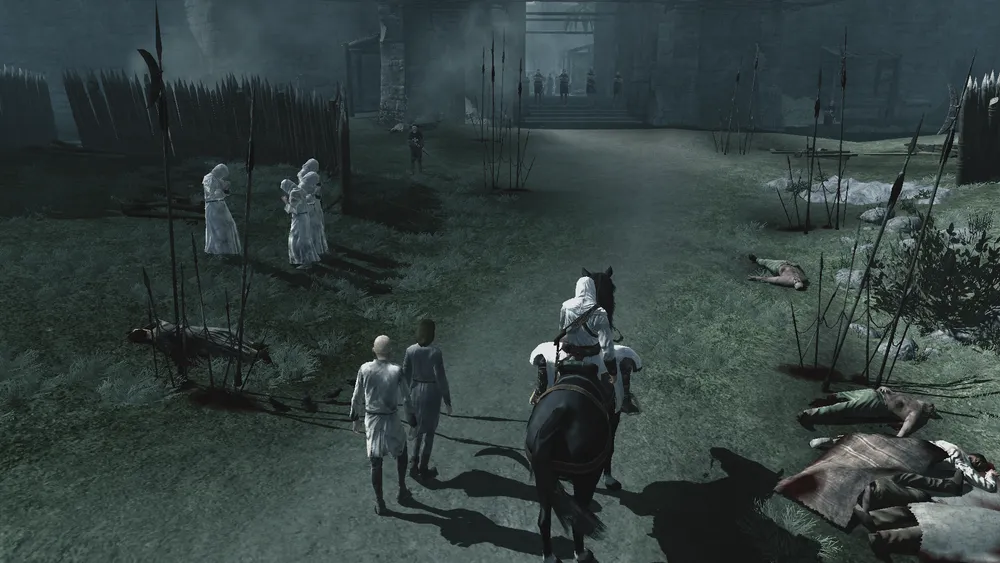
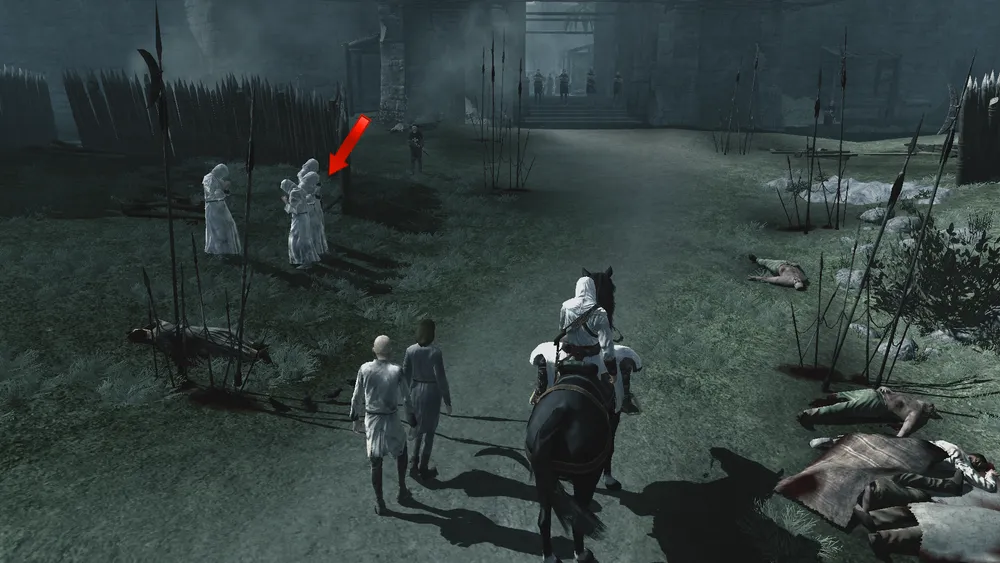
As soon as we approach [the gates], we hear cries for help. Sound design comprises an important part of the gaming experience, and below I will name one of the main reasons why this is so. Right now, however, we have a monk in trouble, and if we save him, we will have the opportunity to enter the city discreetly, blending in with a group of his fellow believers.

[There is another way to sneak into Acre – along the beams above the guards’ heads. – Translator's note.] However, no matter what you choose, in the end, you will still end up in the city.
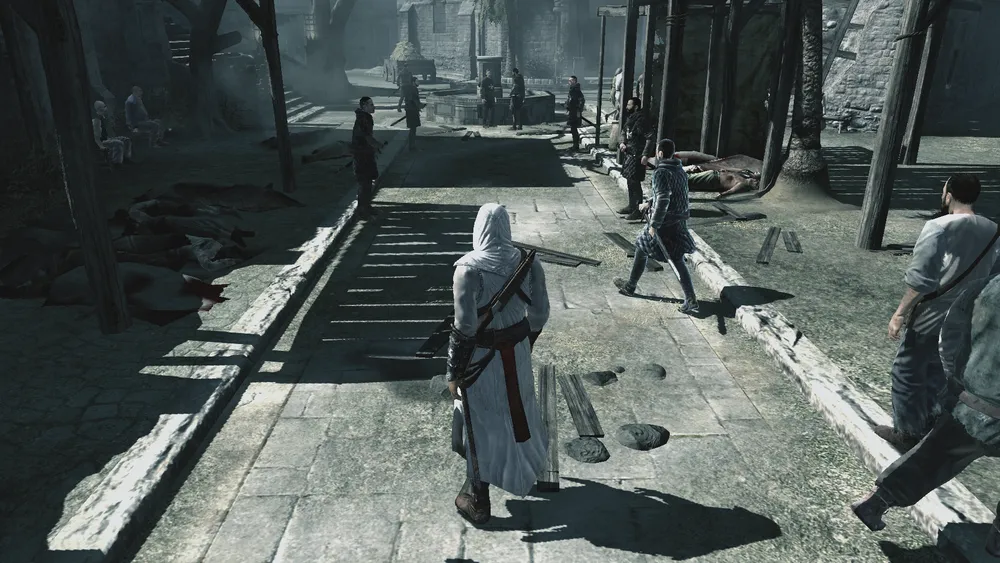
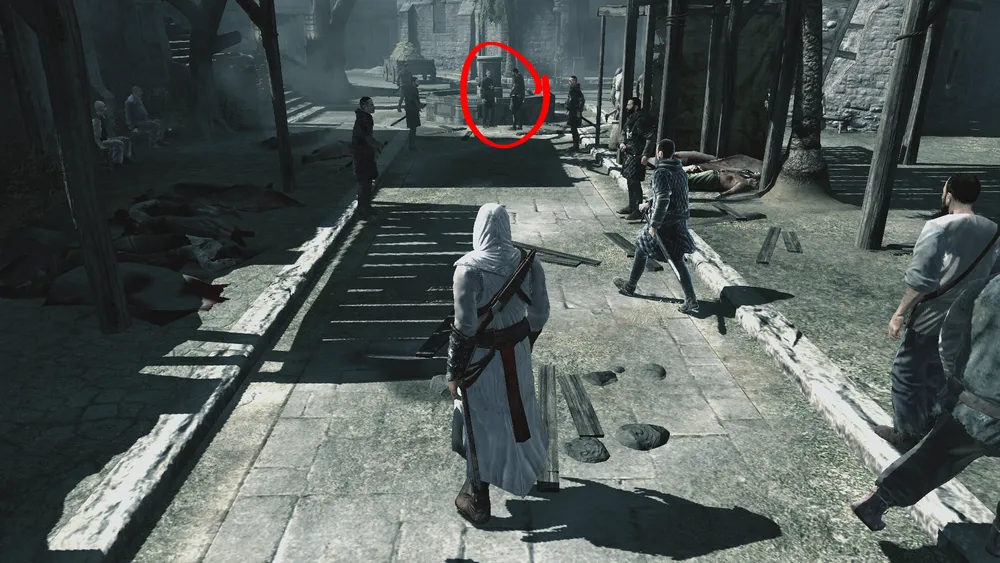
So, first of all, we need to find the Assassin's Bureau (without visiting it, we won’t be able to proceed with the elimination of the victim, even if we know all about them), and in this connection, I would like to draw your attention to two guards who are having a conversation not far from the city gates. In fact, characters talking in the middle of the street or square are not very common in [Assassin’s Creed](/games?search=Assassin’s Creed).
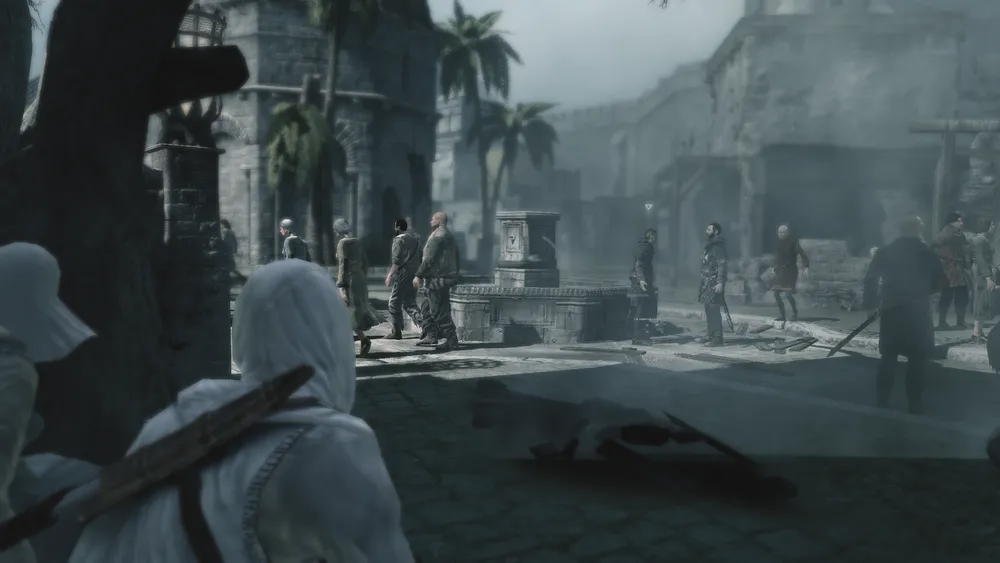
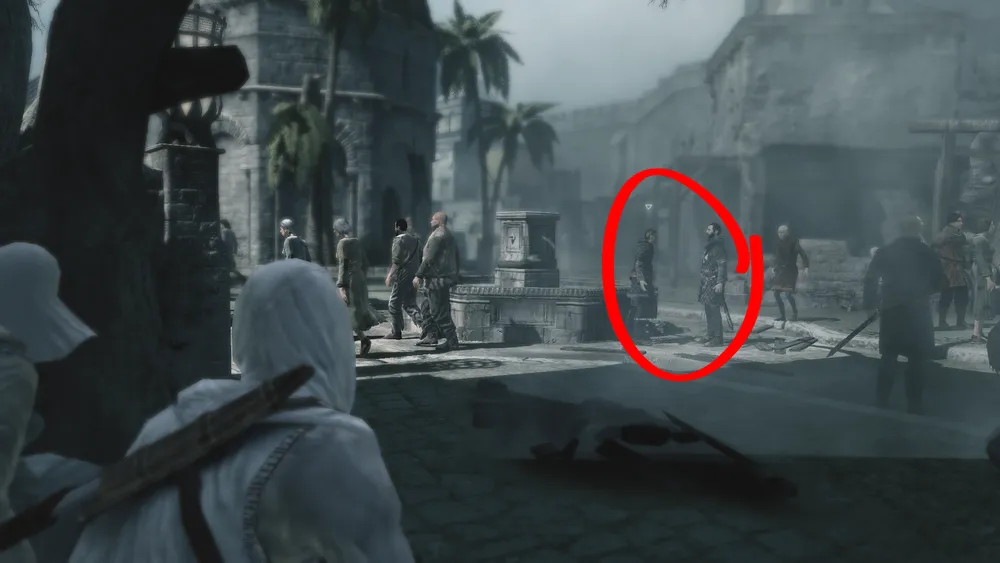
Townspeople gather at stalls with goods or town criers, walking the streets; there are sometimes pairs who converse on the sidewalk and away from the main flow of passersby, but if something similar happens right in the middle of the road or in a specific building, it means these people have important information relevant to the current mission. Thus, recognizing visual patterns is an important part of HUD-less design. You don’t have quest start markers, but you have the ability to look around. Therefore, you must notice what falls out of the general rule, does not conform to it, an exception. This is one of the techniques used by developers, and the aforementioned two guards are a typical example of it. They are discussing a poorly guarded passage into the fortress where Garnier has settled.
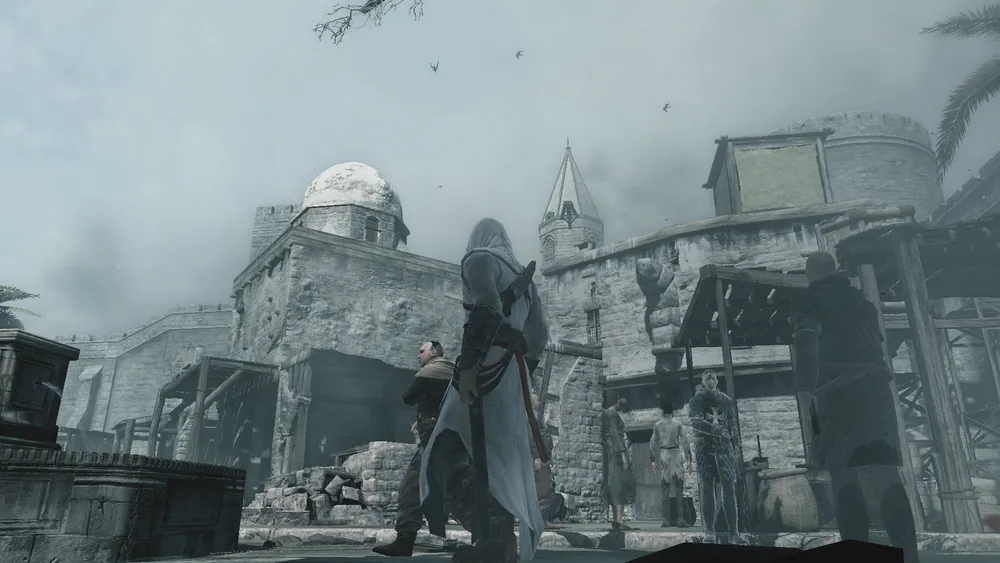
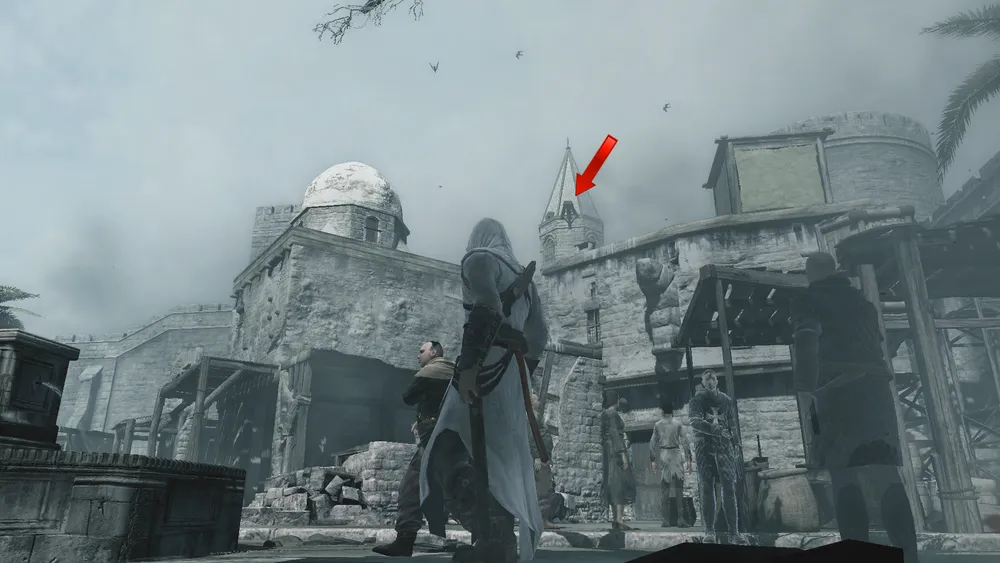
However, obtaining this information does not cancel the need to find the Bureau. The city is large. And although only one single quarter is currently available for exploration (since this is our first visit to Acre), it is still big enough to get lost. Here’s one of the reasons why viewpoint points were added to the game. You can recognize them by two signs: 1) they are, well, high, and 2) eagles soar above them.
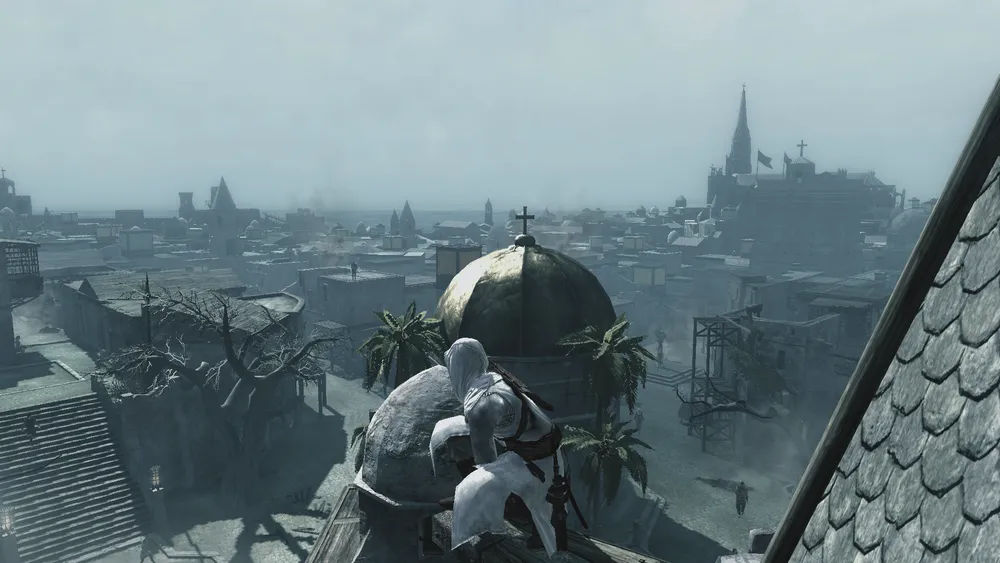
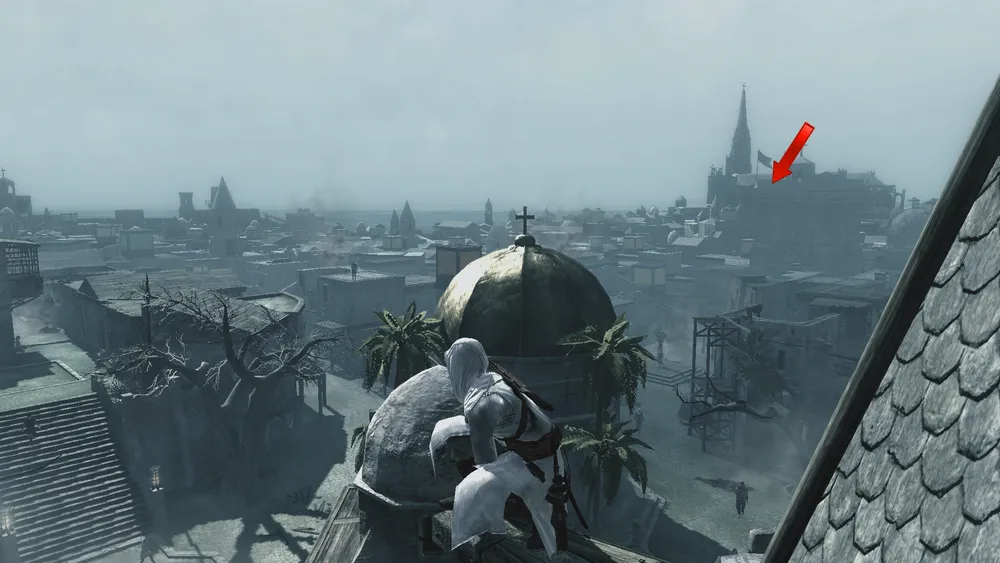
We climb to one of the viewpoint points and inspect the city. We see other viewpoint points, as well as points of interest, but we need a roof that has a sign of the Assassins (we learned this in Damascus, where finding the Bureau is quite simple). There is nothing similar nearby. Well, let’s visit another viewpoint point located not far from the first.


Hmm, still nothing. But in the distance, a rather remarkable semi-ruined tower [which is also a viewpoint. – Translator's note.] It seems that is where we must go. Such searches also have a side effect – you inevitably notice and memorize important landmarks, places that stand out against the backdrop of other urban buildings. On the way to that tower, I notice a church, run past a bazaar (most of the covered markets in the game have the same roofs), see that near the city gates through which I entered Acre stands a fortress, and also notice areas currently inaccessible to me, such as a huge cathedral. You are not just wandering through the city, running across rooftops. You are memorizing what you see, perhaps not in too much detail, but well enough.
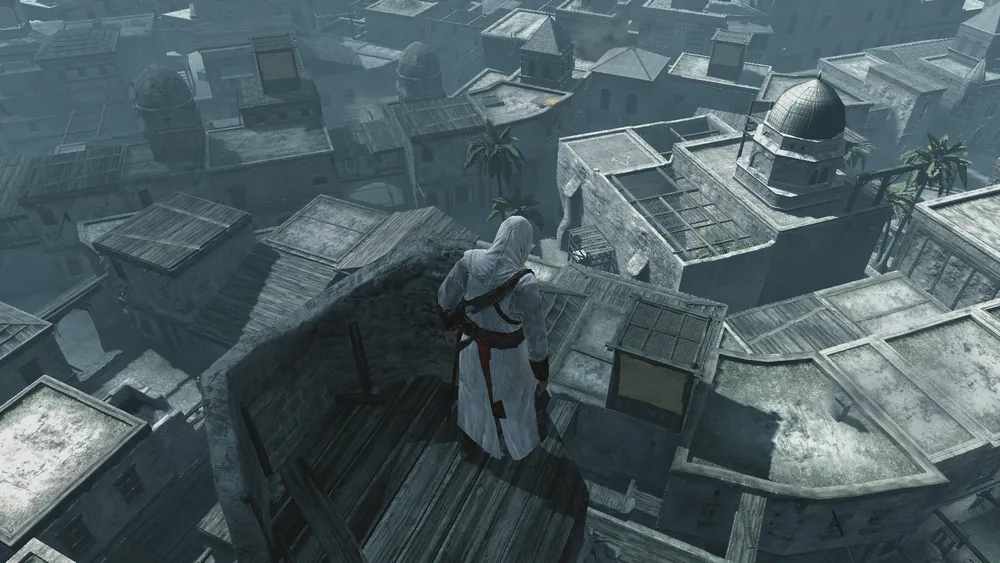
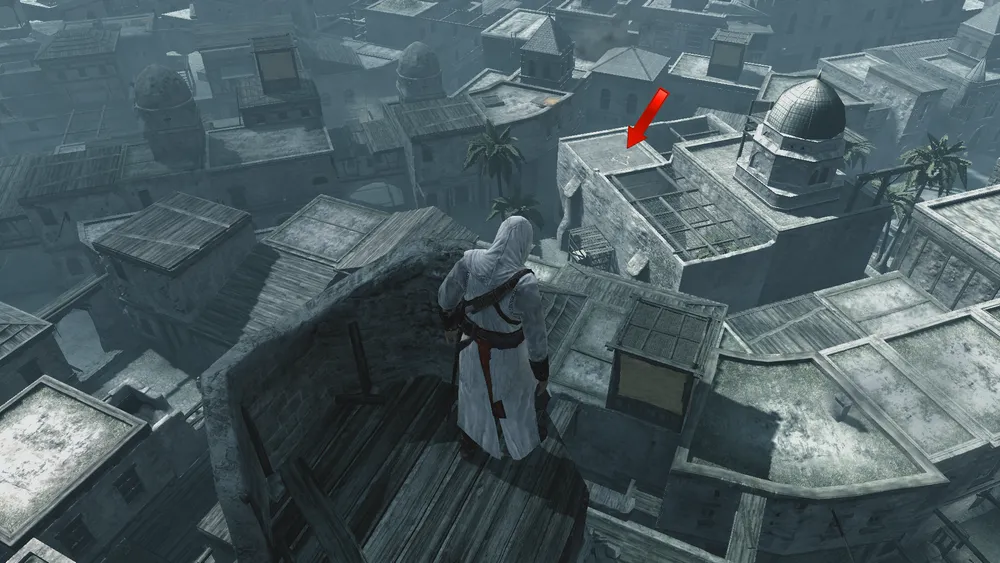
Climbing to the top of that semi-ruined tower, I finally saw it – the Assassin's sign on the building that I can enter through the roof. That's where I need to go! And of course, I learned that the Bureau is near this semi-ruined tower.
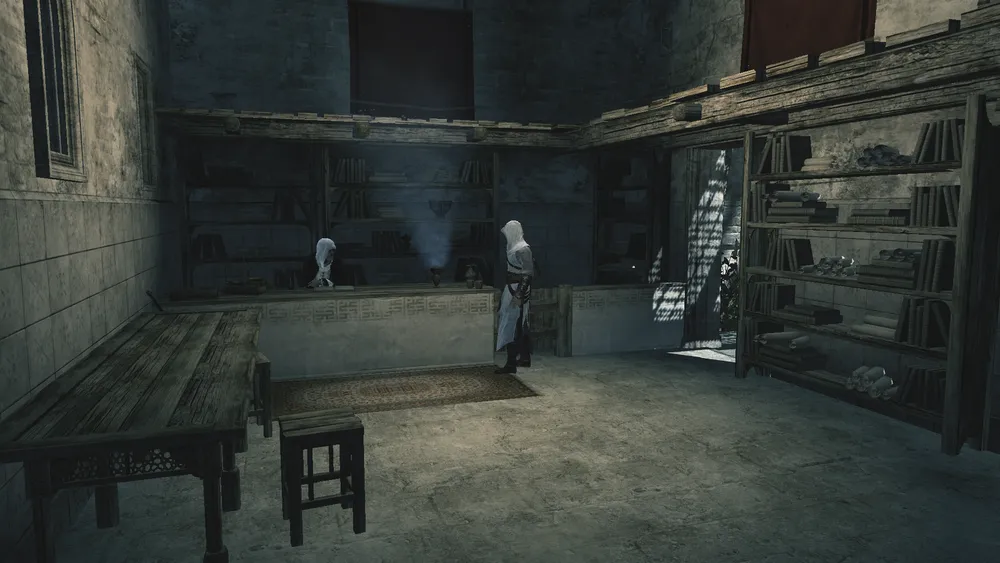
Inside, I am greeted by Rafik, who tells me how and where I can learn more about the victim. He mentions the public park to the north of the Bureau, the church to the west that I’ve already seen, and the abandoned market to the northwest that I passed by. Conversations with Rafik are usually not short since he talks about places where you can gather information, and when you don't have quest markers, such conversations are important. On the other hand, you really don’t need characters like Rafik because if you visit special places that stand out against the backdrop of other urban buildings, you will likely find something useful, a source of important information.
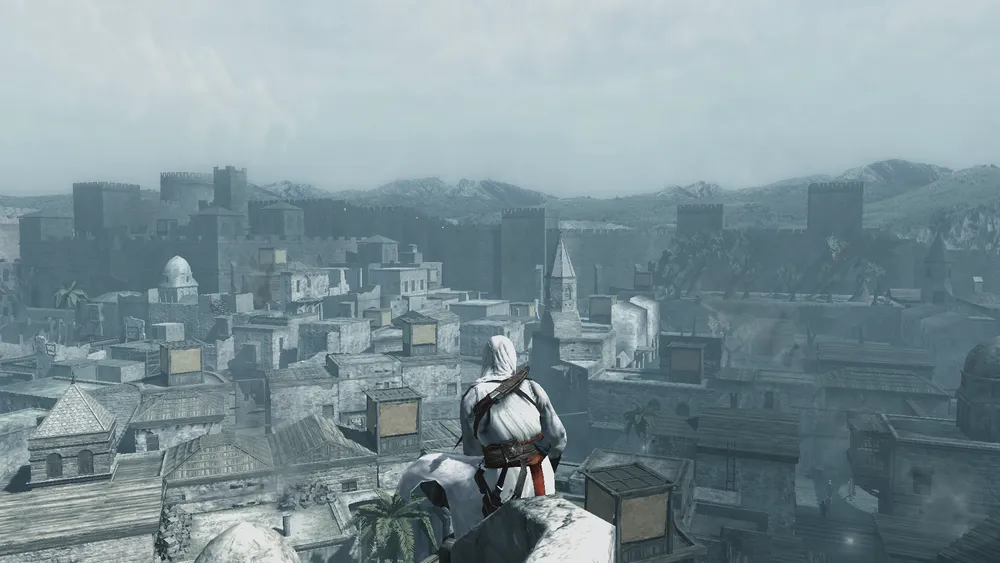
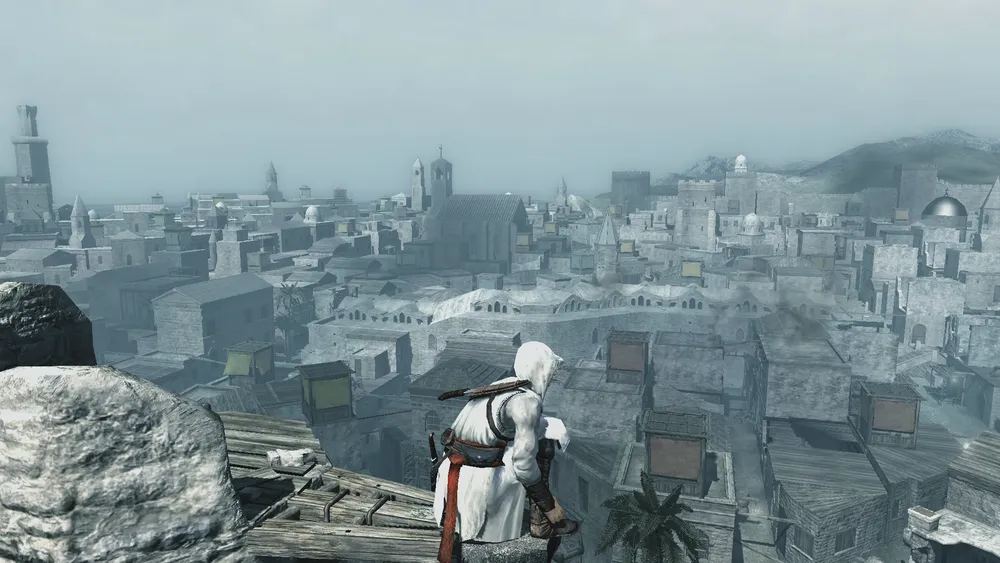

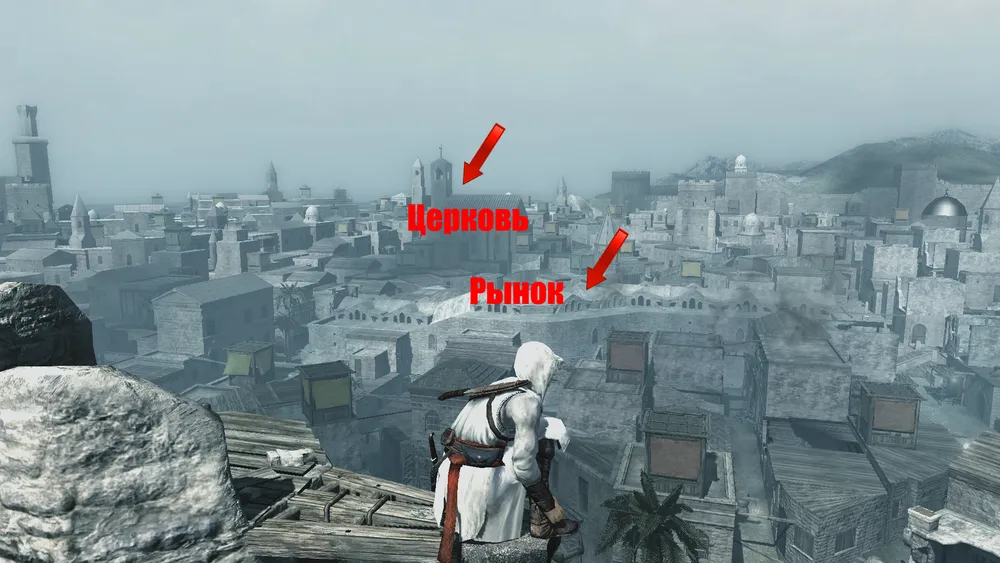
Since the church, as Rafik said, is to the west, I now know where west and north are (I’m ready to assume that you can also navigate by the sun, but personally, I had no luck with that; I’m one of those who prefers to check with local landmarks). [In principle, all three mentioned landmarks can be seen from the top of the very semi-ruined tower from which we were looking for the Assassin's Bureau. The group of trees in the distance is the public park. The long zigzag line of roofs is the market, and the structure behind it with a cross on the bell tower is the church. – Translator's note.]
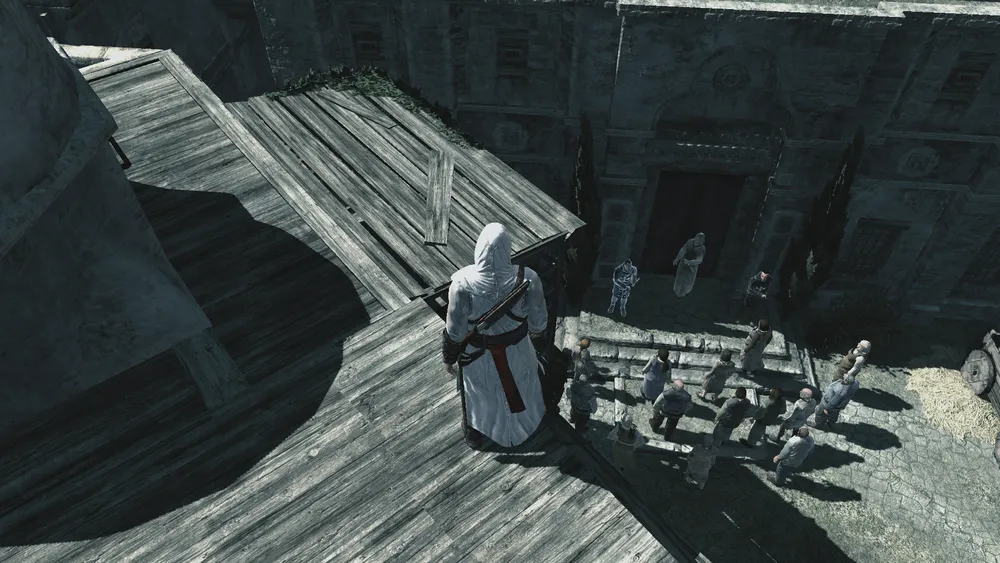
So, I decided to start in the north, at the public park. On my way there, I came across a town crier. They are, by the way, quite numerous in the city, audible from a distance, and for the most part, they recite the same speeches concerning the course of military actions and the Crusade. This “same thing over and over” may seem boring, but in reality, it plays a very important role. A bit later, I will briefly explain why this was done.
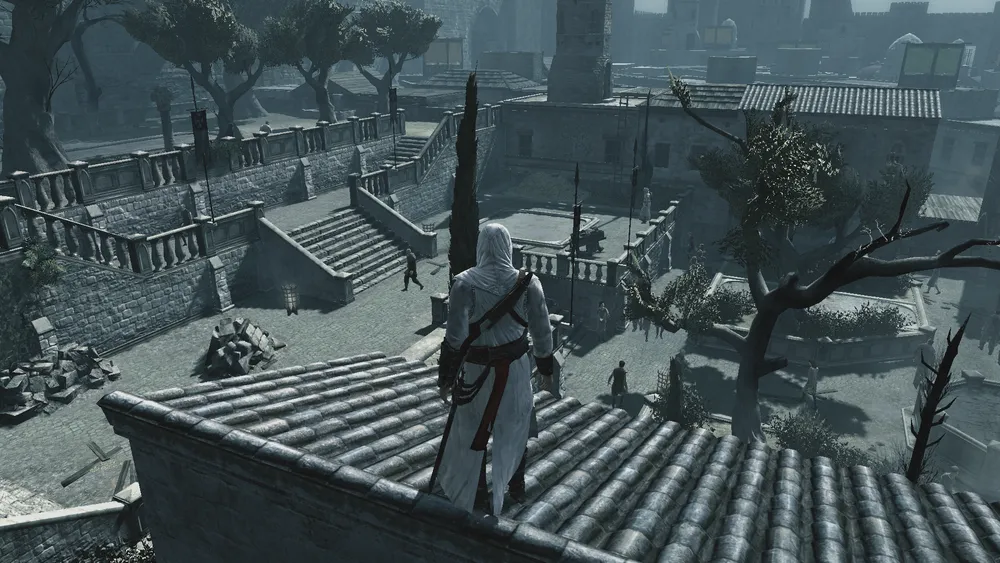
I reached the so-called public park. But how do I find the source of information? This is where eagle vision comes into play, helping to discover enemies, victims, allies, and all those who have information relevant to the main goal of the current mission.
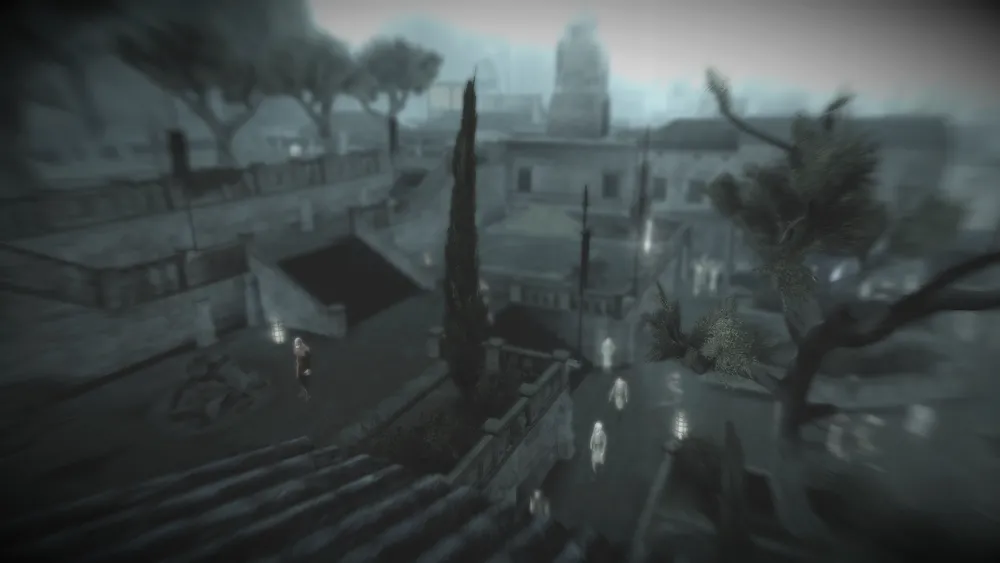
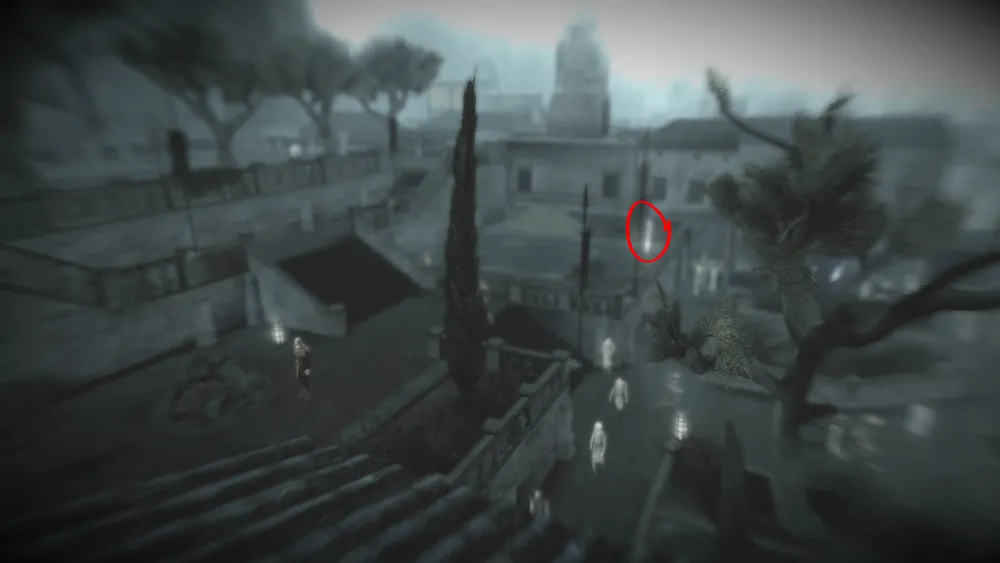
What is that flickering white silhouette in the distance? (It may not be visible in the still screenshot, but it is there in the game.) Why, that’s our informant! Ironically, he will ask you to collect flags within a time limit, which may be the worst of all side quests in the original (console) version of the game. Of course, it can be completed without a user interface because all flags are located along a single trajectory that begins very close to the informant, but it’s a convoluted path, and it’s easy to miss something. [Personally, I managed to collect all the flags only on my second attempt. – Translator's note.] While this may not be the best example in terms of the objectives of this article, I will still describe how I completed this sequence during my last replay. And I wouldn’t say it went smoothly.
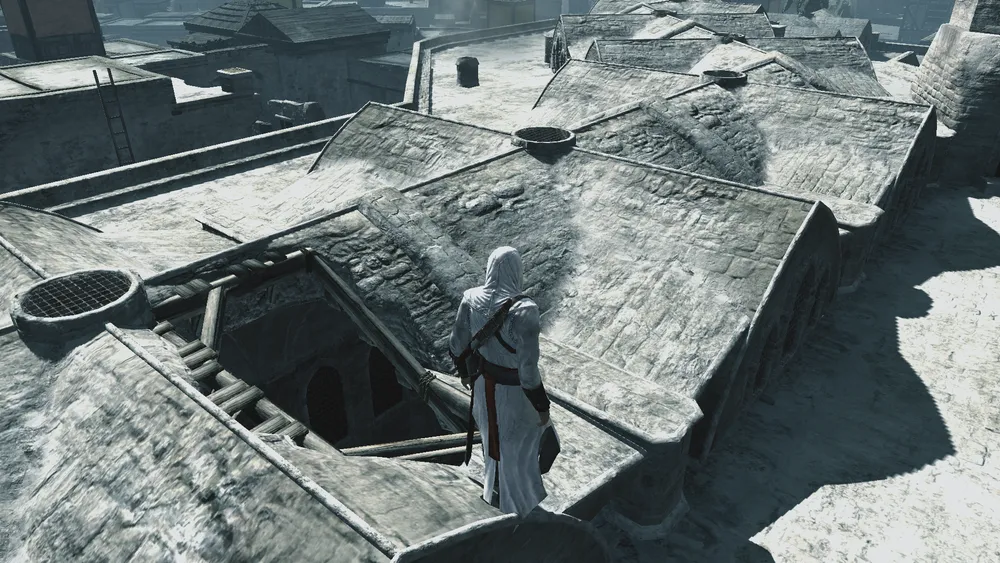
The informant told me where the fortress of the Hospitallers was located and confirmed that Garnier was there. I think it’s time to visit the abandoned market. I already know where to find it, thanks to my ever-improving knowledge of the city.

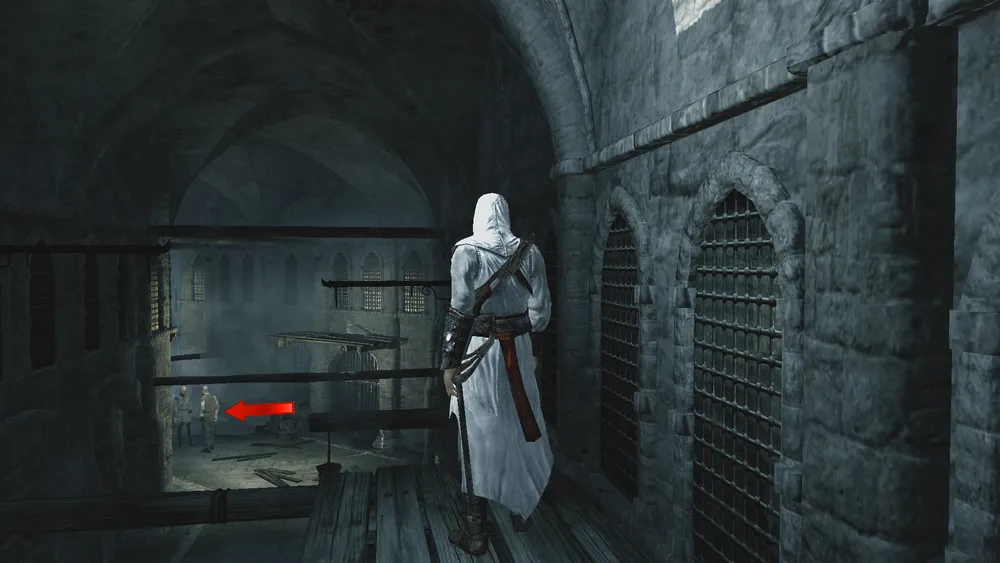
At the market, I encountered two people who were having a conversation right in the middle of the passage. Visual patterns, remember? They must know something. And, as it turned out, they indeed do know.
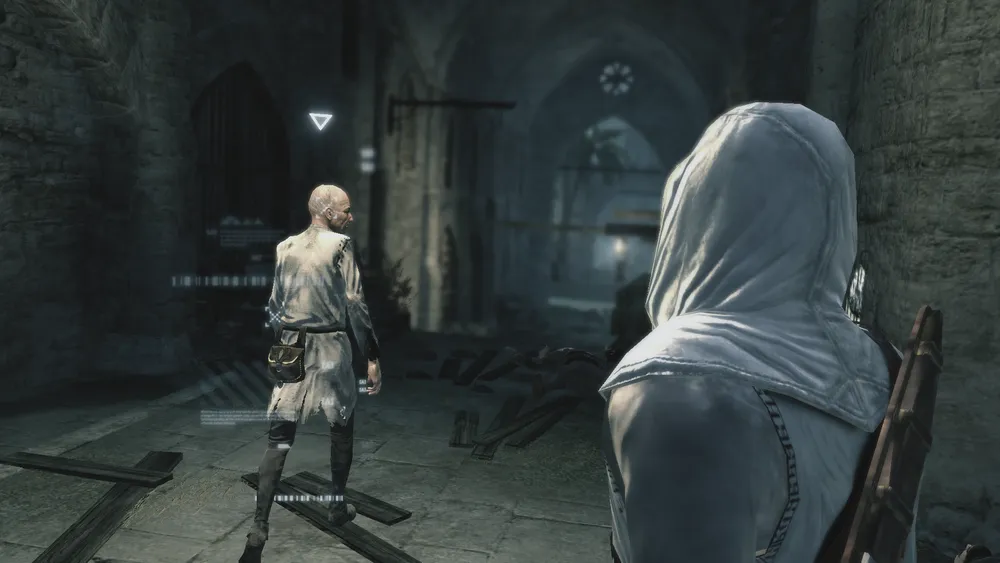
One of them has a letter that I will steal. It says that some of our victims are connected. This information is not particularly important for eliminating Garnier but is significant in the broader context of the entire story.
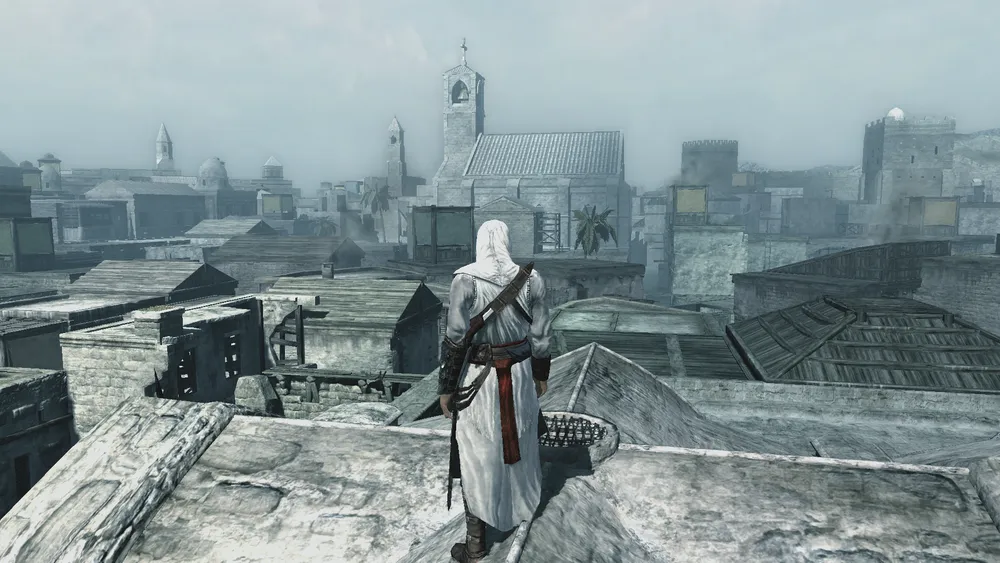
Now it’s time to head to the church and find out what can be found there. And here, knowledge about how sound patterns work will come in very handy. Standing near the church, I hear not only the town crier discussing the Crusade but also another voice giving a speech in support of Garnier, our victim. This means you could theoretically just walk around the city and hear someone mention your target in conversation. That’s how you’ll know where to go.
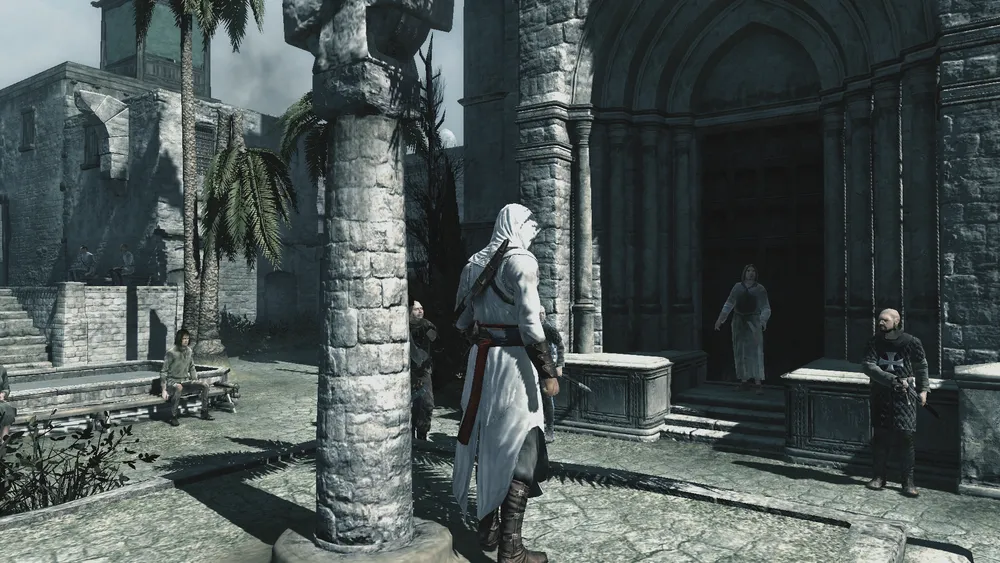
We can interrogate this person and find out when the best time to attack our victim is. After that, we will have several uncompleted tasks left for gathering information, but those we have already completed will be sufficient for Rafik to give us the green light to proceed with eliminating Garnier. In addition to the mentioned ones, there’s another type of tasks – discreetly eliminating targets indicated by the informant in exchange for information. These targets are always located nearby the quest giver and can be found using eagle vision.

The path to the Bureau is now well known to us, and reaching it is no problem. In case the player has forgotten something, Altair in conversation with Rafik will reiterate all necessary information: for example, that the fortress of the Hospitallers is far to the northwest.
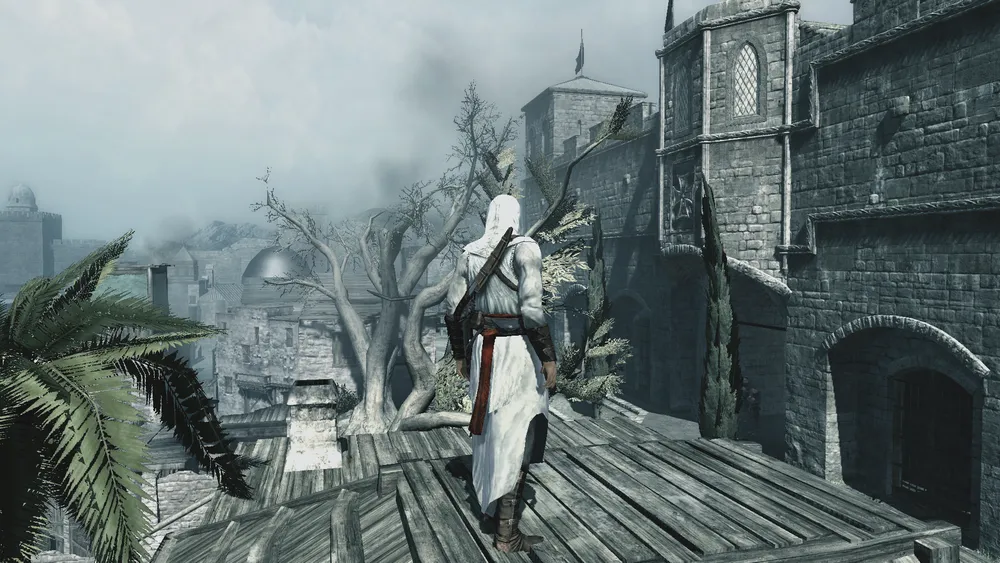
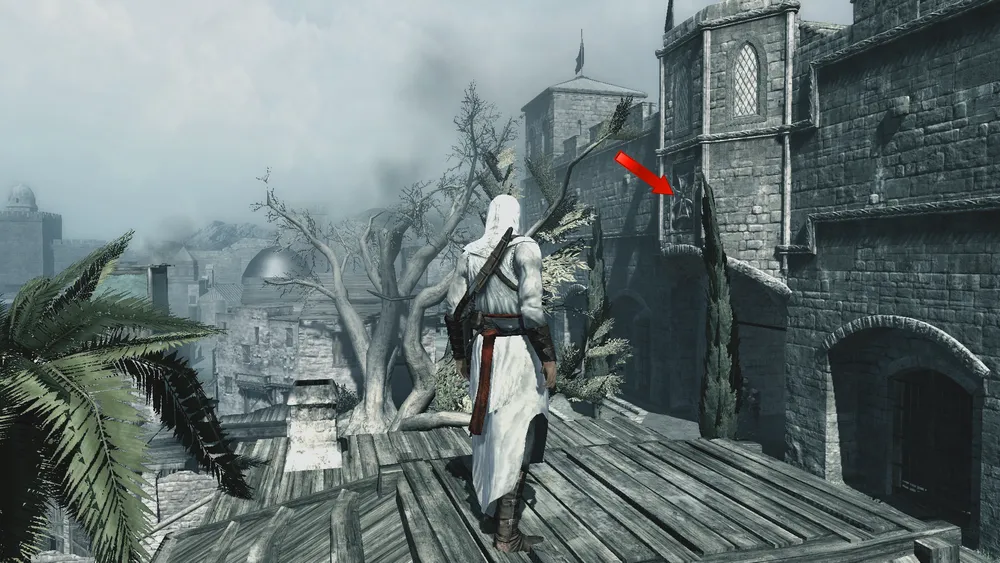
We head northwest until we see a building with the Hospitaller coat of arms. That's how we know we’re at the right place. By completing tasks for gathering information, we also received letters and maps showing the locations of the guards. They are useful even with the user interface turned off.

Even if we are playing without a map, we can still imagine the layout of the building and the arrangement of internal rooms to understand how to infiltrate it.
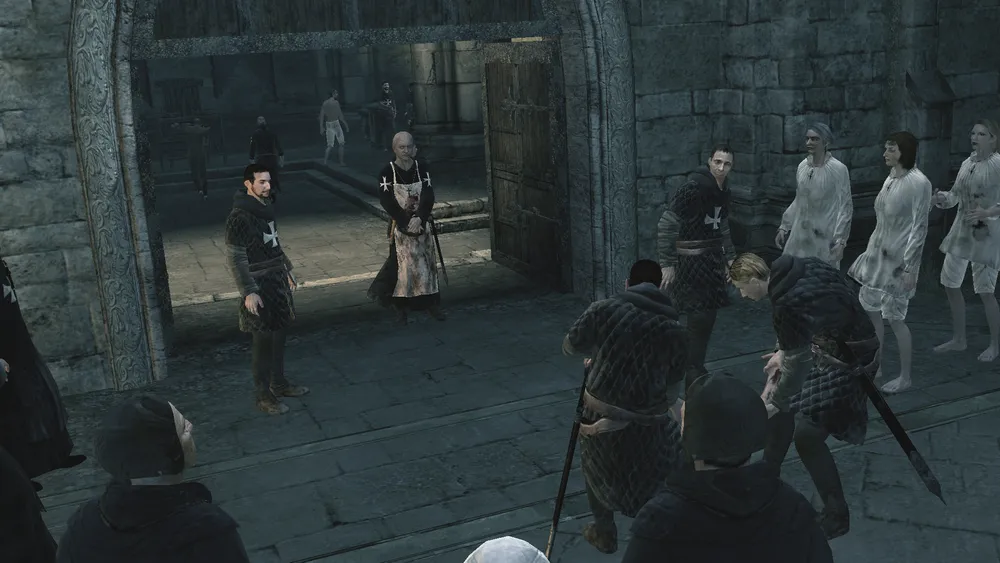
Upon entering the fortress, we witness Garnier ordering the breaking of one of the patients’ legs who tried to flee. After it is finished, we can proceed with his elimination.
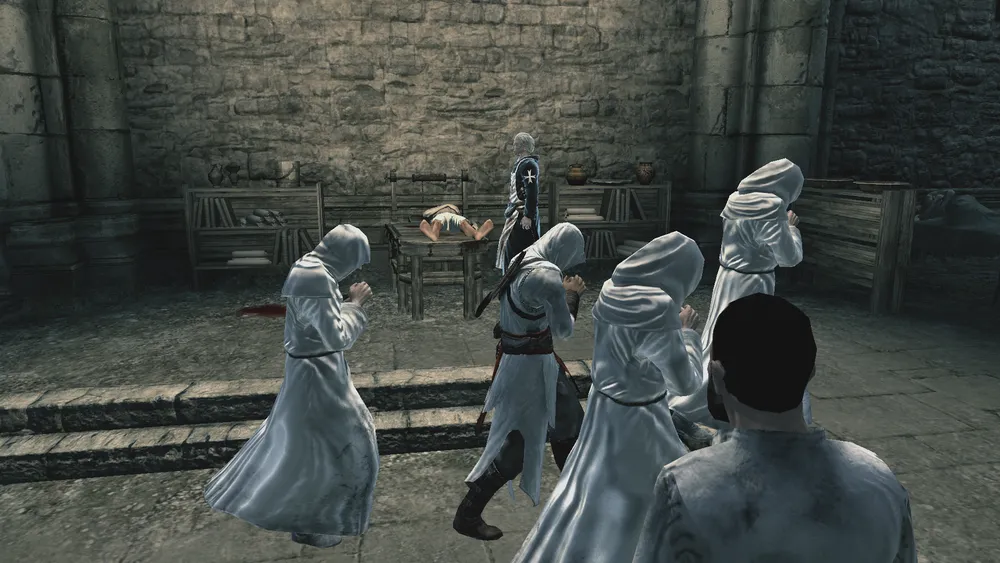

We find Garnier in the hospital as he makes his rounds among the patients and kill him.
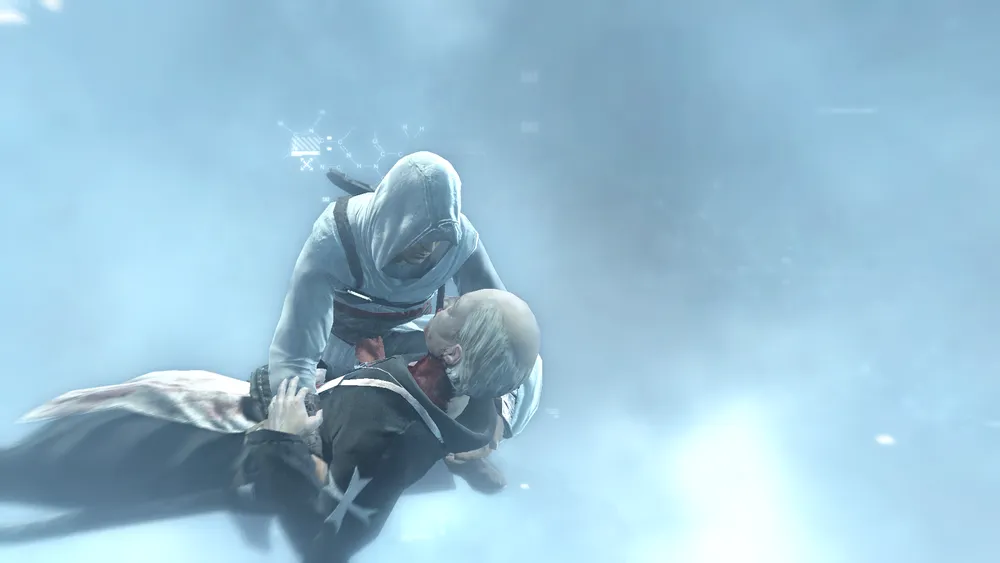
As he dies, he, like other antagonists in the game, will reveal his vision of what is happening to us. His words will make Altair ponder whether he was truly a bad person?
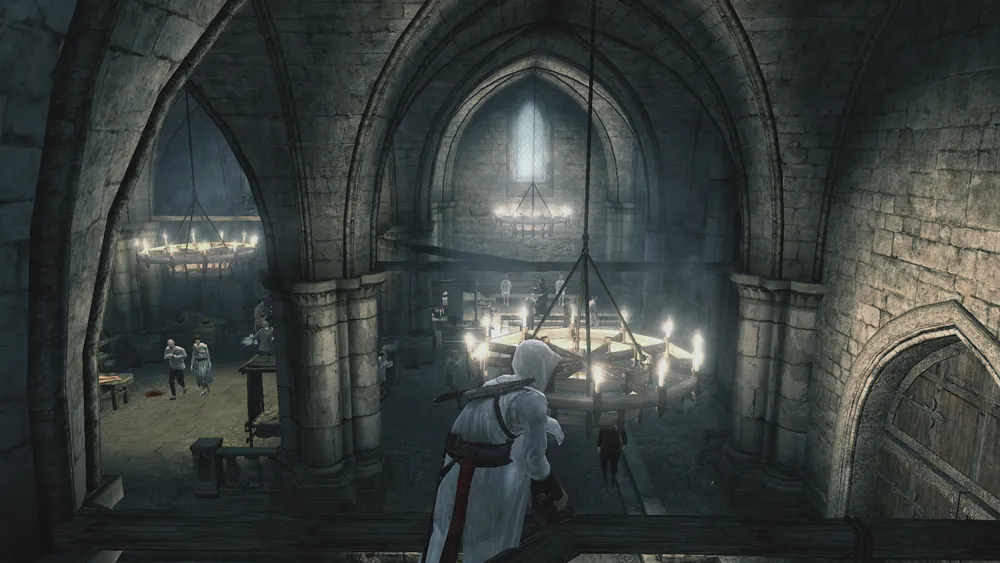
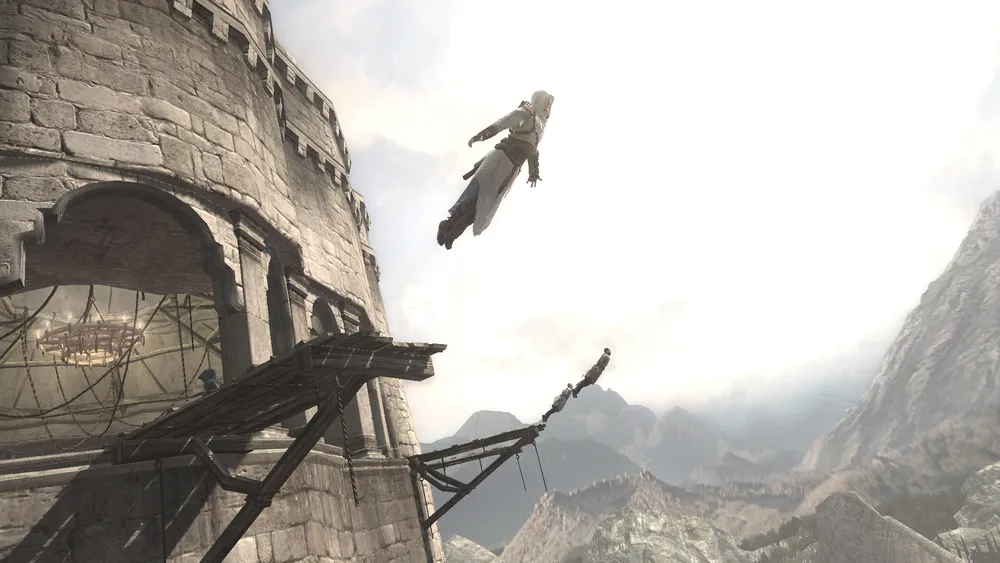
Now that the victim is dead, the guards will start hunting us. We quickly look for an exit – climbing the staircase, we ascend to the scaffolding and from there through the chandeliers [and beams] reach a broken window. And we are out.
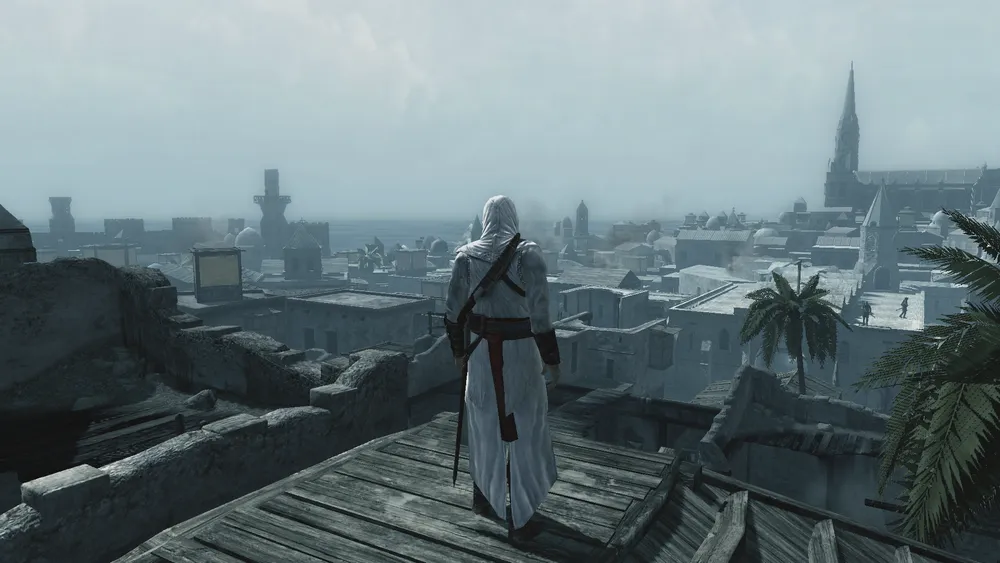

So, we are still being pursued. Aaaaah, where are we, where do we run? Oh, right! There’s the semi-ruined tower! Our landmark! Forward! But first, it’s worth checking around, finding cover, and hiding.
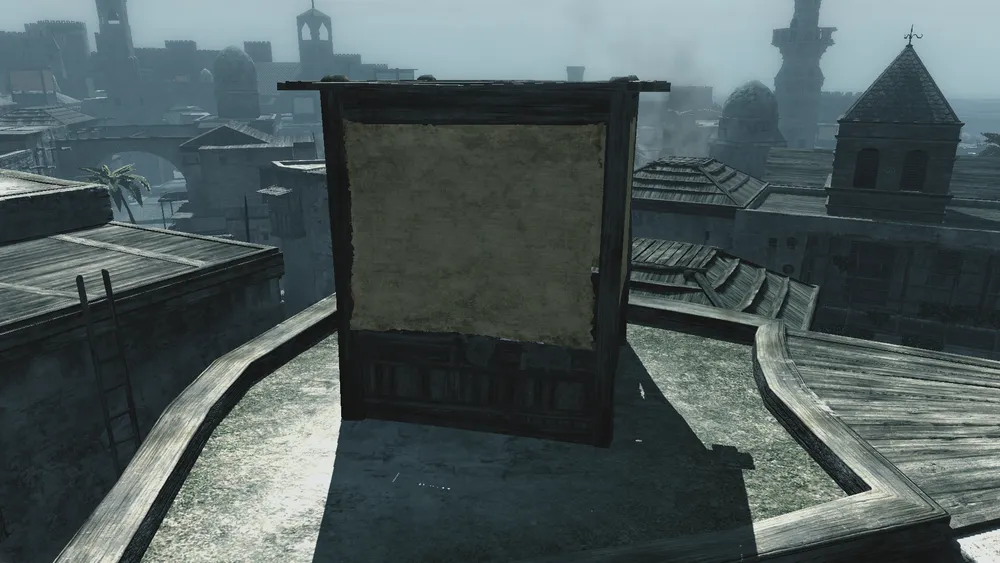
Let’s pause on one more moment. When you play with the user interface turned off, you don’t have a social status indicator in front of you that shows whether the pursuers can see you or not (and you can only use cover if they don’t see you). For such cases, the game has two kinds of hints. The first is visual glitches of the Animus, which occur when alternating between the statuses of "the pursuers see you" and "the pursuers do not see you." The second is music that changes depending on the current status. Since you don’t have a mini-map with blue markers indicating the locations of cover, you will need to watch out more carefully during the chase. In the first [Assassin’s Creed](/games?search=Assassin’s Creed), it does not stop until you hide or get far away from enemies.
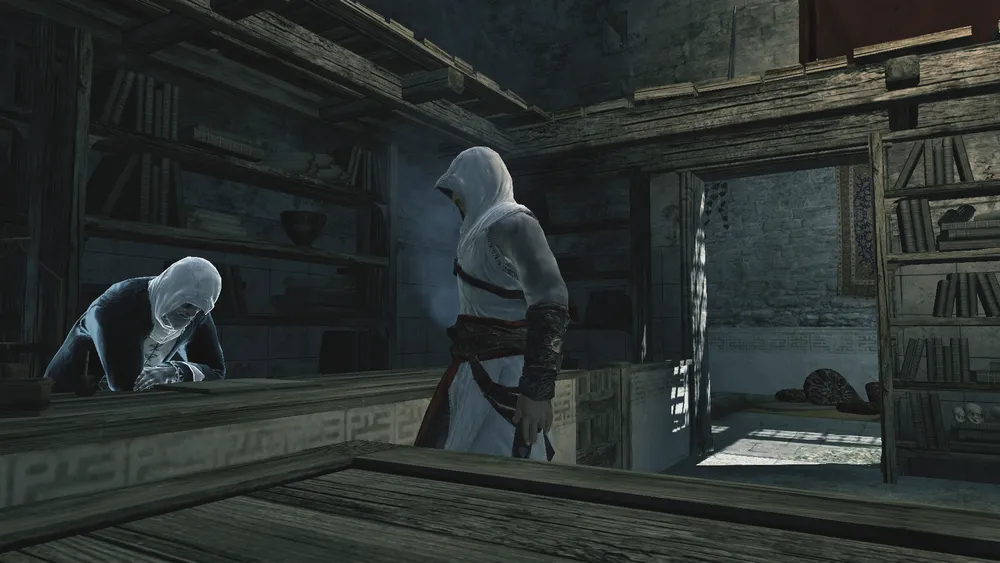
After shaking off the guards, we return to the Bureau and show Rafik proof that the deed is done. Garnier is dead, and we must return to Al Mualim in Masyaf.
I intentionally described everything in such detail so that you could feel what it's like to play the game with the user interface completely turned off. You explore the city, learn where everything is located. You listen, you watch, you search for broken patterns. You explore, you notice details. In Jerusalem, for example, the market where you need to find information is located in the southern part of the city, close to the entrance to the Jewish Quarter. And where is that Jewish Quarter? You look around and see a synagogue with a Star of David in the distance. You head towards it and soon notice gates – this is the entrance to the Quarter. So somewhere nearby should be the market.
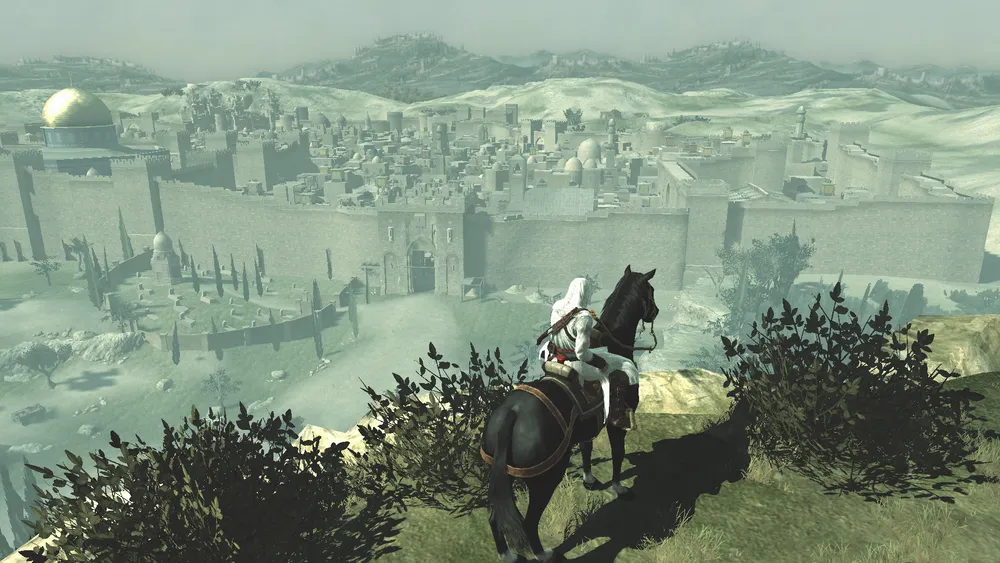
A clearly distinguishable cyclicity, repetitiveness of actions is present in the first [Assassin’s Creed](/games?search=Assassin’s Creed) so that you can notice and assimilate patterns and then successfully use them. You are an assassin. You listen. You watch. You rely on your intuition. Once you turn on the mini-map with markers, all this disappears; the recurring patterns lose all their profound meaning. That's why, after playing a little, people began to feel bored: instead of figuring out where to go on their own, which is precisely what makes the first [Assassin’s Creed](/games?search=Assassin’s Creed) so interesting, they knew the endpoint from the very start.
Does that mean the game is excellent? No. There are many things that could be improved. Sometimes locations and important places are mentioned as if you should know what they look like (but in this game, unlike the later ones, there is no Animus database). Sometimes it can be challenging to find the mission starting point due to its unfortunate location relative to landmarks.
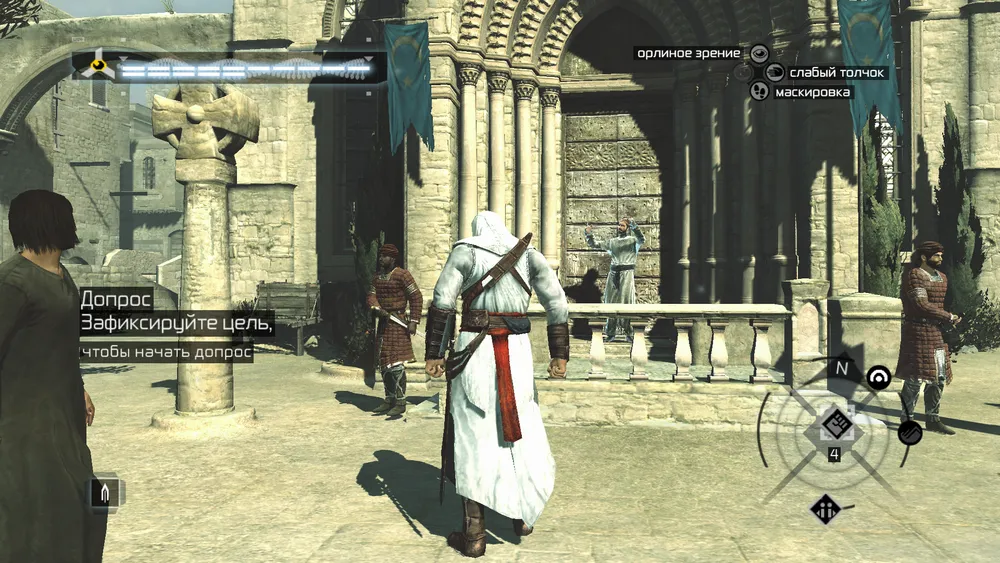
And yet, the most significant drawback of this game lies in its non-inclusiveness. If you have difficulties with spatial orientation in an urban environment or with hearing (subtitles are absent in the first [Assassin’s Creed](/games?search=Assassin’s Creed)), you genuinely cannot play it. Not to mention that there will always be people who would prefer a more casual simulator of a professional assassin. Such shortcomings could have been fixed without giving up the idea of a missing user interface, but it would have required the introduction of many new mechanics and gameplay elements. This explains why the user interface was needed. At the same time, the design changes significantly if you initially plan for its presence in the game.
When porting the first [Assassin’s Creed](/games?search=Assassin’s Creed) to PC, several new types of tasks were added to it. Two of them work well with the user interface turned off: elimination of archers (you climb on the roof, turn on eagle vision – and you already know where your targets are) and escort (you simply follow the character you are to accompany). In contrast, in developing the other two types of tasks, the possibility of playing with the user interface turned off was clearly not taken into account: destruction of market stalls (the stalls are located close to the starting point of the task, but it’s very difficult to identify which of them need to be destroyed) and a rooftop run where you need to get from one informant to another within a certain time limit. The second is generally impossible to complete without regularly checking the map with markers because the informant you are heading to is somewhere in another part of the city, and you have no idea where exactly.
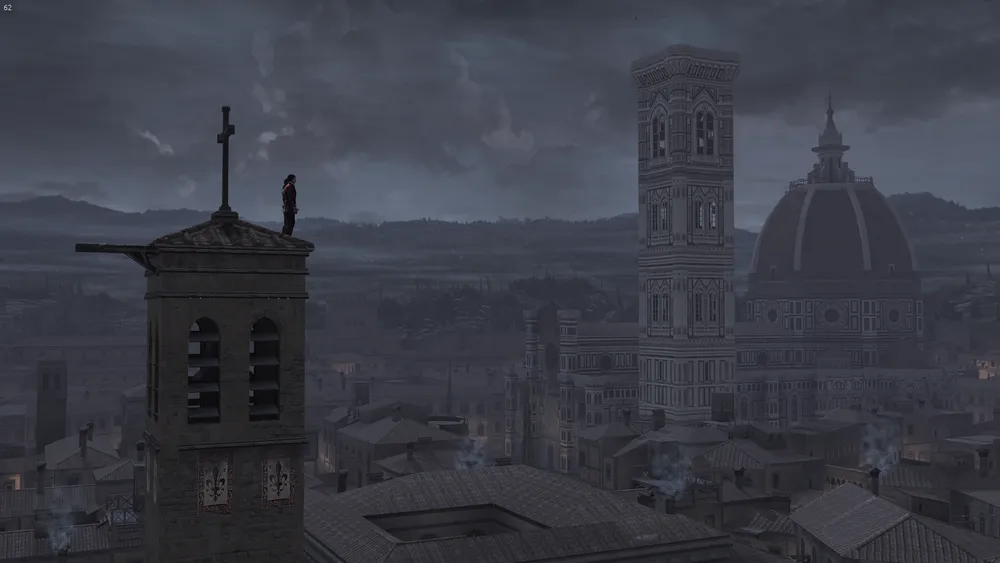
It becomes obvious when you start playing [Assassin's Creed II](/games?search=Assassin’s Creed II). As soon as your Ezio stops following his brother, you have no idea where to go, without the user interface or a map. Are you going to visit Christina? Great, but... where does she live? Do you need to get home? Um... yeah, and where is that? The previous level of immersion can no longer be reached.
Of course, the gameplay of [Assassin's Creed II](/games?search=Assassin’s Creed II) and subsequent parts differs by greater variety, but you can no longer comfortably play them with the user interface completely turned off. Take, for example, something as trivial as the number of throwing knives. In the first “Assassin,” they are all displayed on Altair, but in subsequent games, you cannot see how many he has left just by looking at your protagonist.
I believe a wonderful solution would be to combine the approaches of the first game and the subsequent ones. The design of the first [Assassin’s Creed](/games?search=Assassin’s Creed) is tailored to the fact that you do not use any auxiliary tools at all, but once you start using them, the entire impression of the game collapses. The sequels, however, do not assume completing the game with auxiliary tools turned off, so it is indeed impossible to fully enjoy these games without them. It would be great to combine these two approaches. Let me give a small example. Suppose we have a location where you need to switch to eagle vision while on the roof. Done. I activate eagle vision, find Christina’s house, and go there.
However, I would like to leave eagle vision the way it was in the first [Assassin’s Creed](/games?search=Assassin’s Creed) (activated only when the character was standing still), rather than the way it became in the second, where it continued to work even when the character was moving. The thing is, all this, if we're talking about HUD-less gameplay, will inevitably affect a vast number of design decisions regarding mechanics, the world, missions, the story, and even the script. However, in the end, it would lead to a deeper immersion [into the game].
If you have played the first [Assassin’s Creed](/games?search=Assassin’s Creed) with the user interface turned on, I suggest you try playing it without it. You will have a completely different gaming experience and, I think, you will find it quite interesting.
Original article: HUD-less Design of Assassin’s Creed 1
I will also leave here links to translations (mine and not only) of other articles by Stanislav Kostiuk dedicated to the Assassin's Creed series games.
How Missions in Assassin’s Creed II Utilize the Open World
Connecting Open World Brotherhood
About Assassin’s Creed: Revelations and the Importance of Cutting Away Excess
Ubisoft Game Designer on Missions in the Open World in Assassin's Creed III
The Connection Between Narrative and Gameplay – The Experience of Assassin’s Creed IV: Black Flag
Why Assassin’s Creed: Rogue Has the Best System for Finding Collectibles in the Series