
Should we trust 'Vanka the Company Commander'?
"Don’t think that words about the war can be pulled out of thin air or invented. We need concrete facts without any hackneyed phrases or literary flourishes. Otherwise, the war will sound false and cheap."
Alexander Shumilin
I think few would disagree with the opening quote, which, incidentally, comes from the same book. However, the question remains: how much does its content correspond to the citation provided almost at the very end of the text? Supporters of the claim that the victory was achieved "not thanks to, but in spite of" often love to refer to this particular work: they assert that this is where the truth about the war lies! But is it really the "truth"? Let’s investigate!
First of all, I would like to thank those who worked on proofreading the book text. The fact is that before buying the printed edition, I read the online version, which was overflowing with a monstrous number of spelling and punctuation errors and poorly constructed sentences. (The typesetter of the online text is not to blame; all of this are the author's "pearls" since he stubbornly repeated the same mistakes; I will return to this later.) The proofreaders did a good job, thank you!
By the way, the book edition contains only 24 chapters and a little over three hundred pages; while in the online text there are forty-six chapters and a full eight hundred pages: the editors worked hard, deleting many "empty" chapters and shortening the text of the remaining ones. Therefore, when quoting something that has been removed, I will mark this fragment, and I will not indicate the chapter numbers due to discrepancies, only their titles. Let’s begin!
ONLY INFANTRY FOUGHT…
Author's Foreword: "In those harsh days of war, the entire burden of battles for the liberation of our land fell on the infantry, on the shoulders of ordinary soldiers." - so, according to the author, besides infantry, no one else fought?
Let’s see what is written further:Chapter 'Surrounded' (fragment removed) -
"None of us thought back then that in modern warfare hundreds of aircraft and tanks would participate in battles on narrow fronts, with several hundred artillery pieces. And the infantry would be used just to clean up after the noise." - wow! What about the leading role of infantry in victory?
Chapter 'New Company' (removed): "It was not those, who pulled the reins and hid behind the shields of their guns, who fought and went under fire."
Artillerymen – hid? Anti-tank units sent to tank-dangerous areas to shoot at direct target – that is, clearly visible to tanks – did they hide? Going with a rifle against another infantryman is one thing, but standing still with a gun against attacking tanks is quite another! An infantryman might survive being hit by a bullet, but what will happen to the artilleryman when a tank shell hits his gun? Given that 80% of losses at the front are caused by artillery fire?
Large caliber in the rear? And the counter-battery fight in Leningrad, when the Germans immediately responded to the fire of our guns? In case of an air raid, the infantry will scatter off the road, but where will the artillerymen go? And to roll a 76mm gun behind the infantry, under enemy fire, and carry ammunition boxes on their shoulders? If the infantry did not see and understand the war of artillery, it does not mean that the artillerymen did not have a war.
Chapter 'Front and Rear' (removed): "In the confrontation, the Germans had everything, while we, as is known, had only bayonets and rifles."
Tanks, one would assume, were taken out with bayonets? And stones were thrown at airplanes? "The Germans had everything" - well yes, guns without chassis, neither valenki nor winter clothing (the author himself described their poor boots and greatcoats). It was because Germans eagerly used trophy PPSh, our tanks and guns.
"Artillerymen, for example, also fought, as they said, on the front line. Throughout the entire winter of '41, I saw them twice in the ranks of the rifle company." - they should not be in the ranks of the rifle company, they have different tasks (see above). It is interesting whether he will also refer to tankers and pilots as cowards and rear rats: saying, didn't they appear in the ranks? (Later, the author indeed called pilots cowards - saying, they don't fly over the front line, they don't cover the infantry.)
Chapter 'Retreat from the Town of Bely' (removed): "Only in the infantry did the soldier see the tank, drop his trench and run, with only the helmet flickering." - how is that? Didn’t the infantry "win the war," as the author claimed earlier?
Chapter 'The Gunners' (removed): "We knew only one thing: that we fought with people, rifles, and machine guns." - well, yes. No tanks, no aviation, no "Katyushas", no artillery. In short, nonsense.
Chapter 'By the Great Luka': "Each battalion is supported by a tank company. The tanks stand at the starting positions, behind the infantry." - oh really?! What happened to: "we fought with infantry and rifles!"?
Chapter 'Kulaginsky Heights' (removed): "And those soldiers cannot be budged with threats. They demand artillery fire, fifty airplanes to smoke out the German fire points. It's not '41 or '42 anymore. Soldiers today are totally different. Am I going to stand up and march against the Germans? First suppress their fire points!"
Soon after: "The war is conducted by rifle companies. Vanka the company commander makes war." Well yes, only the infantry makes war! Suppress the points, give airplanes! Otherwise, I won't go into the attack!
Chapter 'Approach to the Highway' (removed): "The soldiers-riflemen felt a weight lifted from their souls, like a heavy stone had fallen off. Of course! They can sit behind the scouts!" - and what about the infantry, which fought alone? Now sits behind the reconnaissance…
MILITARY LITERACY…
Chapter 'Fortified Area' (fragment removed): "What we would need here is a barrel with a diameter of about one hundred twenty millimeters,..." - correctly: caliber one hundred twenty millimeters! (By the way, a caliber of 120mm of those times is a howitzer. Why do they need it in a pillbox, where flat trajectory guns are needed - howitzers fire parabolically? And later: a lieutenant commanding a unit intended for defense in pillboxes cannot correctly name the caliber of the gun?)
Chapter 'Left Bank of the Volga' (fragment removed): "On December 11, '41, under the fire of German anti-aircraft batteries, immediately two regiments of our infantry fell to the ground." - the infantry was attacking, and they were being hit by anti-aircraft shells from 88mm anti-aircraft guns? Except for 20mm automatic anti-aircraft guns 'Erlikon'; this should be mentioned! Considering the author considers himself an honest storyteller about the war... **Let’s refer to the source:**
"According to German data, the battle with the advancing Soviet infantry lasted four hours, during which time, eight men from the crews of 20mm guns supported the reflection of the attack with fire from rifles, the rest fired at Soviet shooters... German anti-air gunners counted over 100 corpses of Soviet fighters and commanders in the open space between the forest and the village." - where are the two regiments and a total of eight hundred dead?
Chapter 'Retreat from the Town of Bely' (removed): "The machine guns were positioned below the crest line. The Germans could not see the flashes and smoke from the machine-gun fire." - so, the machine-gun fire was conducted from closed positions. An extremely complex matter. I quote specialized literature: "...the difference in the angle of elevation when firing at a distance of 100 meters and at 1500 meters from the PK with a steel-core bullet (9.6 g) is just over 2 degrees. When firing at 900 meters (sight 9) for a standing target of 1.7 m, the affected area will be approximately from 825 m to 900 meters, while when firing at 1000 meters (sight 10), the affected area will be approximately from 940 m to 1000 meters." - it is highly doubtful that machine gunners could manage to fire even under the belly of a tank (as the author writes) unless a thorough preliminary sighting was done, which the author does not mention.
Chapter 'In the Trench at Tyma' (removed): "How many mortar batteries are in the platoon?" - yet another nonsense. A mortar battery consists of two platoons, from two to four 120mm mortars each; mortar batteries cannot be found in the platoon, it’s all the other way around.
Chapter 'Approach to the Highway' (removed): "...the sharp shot of the bullet is still absent." - the weapon fires, not the bullet.
"Everyone looked at the tanks. There were two. Two heavy Ferdinands." - "Ferdinand" is not a tank, but a self-propelled gun.
THE SOLDIERS' FOOD…
Author's Foreword: "It is a constant hunger, when the soldier in the company received instead of food salted water mixed with a handful of flour, in the form of pale gruel."
Moreover, on all pages, the author refers to soldier's food as either "bread" or "gruel" - no porridge or anything else; only a third of a loaf of bread per person per day. Moreover, from '41 to '44, the soldier's "menu" does not change. Can we believe that?
Was it really fed salted water with traces of flour at the front?! And on such "food" the soldiers fought against the Germans?! I cannot help but quote a passage from V.E. Giller's 'In the Name of Life' (its other title: 'And Again into Battle'), about the food for the wounded in a field hospital (1941):
"The sanitation workers and helpers walked around with enormous baskets feeding the rows of standing, lying, and walking wounded. They issued monstrous-sized sandwiches with butter, cheese, sausage; again filled the baskets to the brim, went back to feed, filled it again, and this procession continued from morning till evening, from evening till dawn. We could not seat everyone at tables and feed them. The wounded helped find a solution. The sergeant of the rifle company, an experienced carpenter, once addressed me:
— Approach the shortage of products, so to speak, from a material and ideological standpoint, then everything will immediately become clear to you. Do you not have food accounting? No! So, the food is uncontrolled? Uncontrolled! Is the product tasty? Tasty! And they give as much as one can eat, — how could one refuse? At the front, after all, you won’t see caviar or cheese. There food, you know what: cabbage soup, porridge, lard, various concentrates. (underlined by me). So think about how to bring order so that people are fed and products are not wasted."
Of course, not everywhere were the wounded given such sandwiches; but it is easy to understand that soldiers at the front were not fed with salted water containing traces of flour. And those who doubt it can conduct an experiment on themselves: a pot of water, two spoonfuls of flour, boil it and "eat" for a couple of days, adding to this "dish" a third of a loaf of bread a day. To keep the experiment clean, one can engage in heavy work in the winter air... I highly doubt that on such "food" one could last long.
Chapter 'Two out of Eight Hundred' (removed): "The first thing a soldier should do is to have a meal. They didn't eat all night!" - How does Nosov say: "Well, you, brother, are a joker! 'Didn’t eat all night!' Who eats at night?!"
Chapter 'Evacuation Hospital' (fragment removed): "In her hands was a tray, on the tray a bowl of aromatic gruel, a glass of compote and slices of white bread. I rise on my elbows. I stretch my nose toward the bowl and see, in front of me, hearty, meaty cabbage soup. Yellow glints of broth float in between swirls of sour cream." - wow! Cabbage soup with meat and sour cream, but this is still "gruel"! And I am supposed to believe the author's words that the frontline fighters were fed diluted flour in water under the same name?
REAR 'RATS', COWARDLY COMMANDERS…
From the author's foreword: "I am, for example, outraged by booklets 'about war' written by front-line 'frontfighters' and 'diggers' of staff and rear services, in the literary processing of journalists. And what do those write, who are elevated to the rank of preachers of truth?! Take K. Simonov with his novels about the war. K. Simonov himself did not see the war, didn’t look death in the eye."
Simonov?! Did he not see the war?! "I was not a soldier; I was just a correspondent, however, I have a patch of land that I will never forget, — a field near Mogilev, where I saw for the first time in July '41 how our troops over the course of one day destroyed and burned 39 German tanks..." Konstantin Simonov (By the way, in July '41, the author of 'Vanka the Company Commander' was not even at the front!)
Another fragment from the author's foreword (removed): "The author described how the 'chronicle of events' was filmed during the war: 'The company was withdrawn to the rear and ordered to run across the field'." - another wild nonsense. The film that won the 'Oscar' - 'The Destruction of German Forces near Moscow' - is staged? The documentary film epic 'The Great Patriotic War' was created in the rear? With a credits list of hundreds of living and dozens of deceased cinematographers?
Chapter 'Surrounded' (fragment removed): A deserter, who apparently stopped in his own village, convinces the retreating to not reach their own: "For such words, he could be shot on the spot. But fortunately for him, among us, there were no people who did that as their trade. They had long ago, at the first signs of the German breakthrough, picked their long overcoats, got in their cars, and headed deep into the rear." - is he talking about the very divisions of the NKVD,**which stood to the death at Moscow?**
Chapter 'Left Bank of the Volga' (fragment removed): "From the full and satisfied life of regimental commanders to the filthy and round-faced rear rats, all fed at the expense of trench soldiers, and yet shouted and made a dissatisfied face." - well, yes, yes, heard, how can that be: "The war was won in spite of the commanders!" And what does this digger see in terms of at least his regiment's defense line? And divisions? How does he define his task? He cannot do anything without command!
Chapter 'Front and Rear' (removed): "The regimental commander with his staff was located five or six versts away from the front line. But it's not about where everyone sat. They considered themselves direct participants in the war." - the same again! The author thinks that kolkhoz workers, who only reached the front and understand nothing about military affairs, can do something by themselves without command? Well, okay, the regiment commander in the trench, hit by a random shell - who will command? Colonels do not lie on the road; this is not a soldier, to whom they gave a rifle and go ahead; the colonel must be trained for a long time; his job is to plan combat operations, not to sit in a trench.
Chapter 'Tsarevich River' (fragment removed):
"Once, our division commander exclaimed:
– I fought with the Germans near Dukhovshchina! But, honestly, he never saw it, did he, the war. Others did fight! He thought about where and how to send soldiers against the enemy’s fortifications." - a flock of sheep led by a lion will always defeat a flock of lions led by a sheep! Would they have won at all if command had not indicated when, where, and how to attack or defend? And this person managed to rise to captain?!
Chapter 'Bunker on the Road' (fragment removed): The author about telephone operators: "So with the receiver on his neck, he will live to the end of the war. He will come home - he will say, I fought!" - he was at the front? Then he fought! And what would the troops do without communication?
From chapter to chapter, the author continuously muddies everyone who did not sit in the front trench: they, in his opinion, did not fight at all. That is, these are peaceful civilians who delivered ammunition, weapons, uniforms, food, treated the wounded: since they did not sit in the trench, they did not fight? And nothing that without rear personnel, no soldier could fight? Just as he could not fight effectively without command?
The author is also outraged by: here the heights were taken by the soldiers, while the medal is obtained by the commander, he did not go into the attack! A simple question: can any of the soldiers plan an offensive that would take the height? Determine the number of necessary munitions; assign the best time to attack and directions of the offensive; coordinate the volume, duration and timing of artillery support; ensure the evacuation of the wounded? The author - a captain! - does not understand such simple things?
THE AUTHOR'S WAR…
"Choking on blood and strewn with soldiers’ corpses on this beautiful land, we clung to every hill, to every bush, to the edges of the forest, to every village, to every burned house and broken shed… Times were hard, the enemy was standing near Moscow. You will find it hard to imagine what those battles were like."
Let’s try to imagine. According to the online text: in fortified areas, there was no fighting, they retreated. Rzhev: fired at the Germans and shot from a machine gun, at a distance, there wasn’t any close contact. At the Volga, I shot again from a machine gun at the Germans, again from a distance; missed the retreat and the defeat of my unit. November '41 - the hottest combat time near Moscow! – the author, with his unit, sits in a trench and does not move at all - just like the Germans. Finally, at the end of November, he was ordered to conduct reconnaissance by fire - and the Germans had left the village! December '41, an offensive - and again the Germans are fleeing, while his unit captures a German field kitchen. And so it goes...
Of course, there were shelling and bombings, but during the time the author was in the infantry - not a single close and certainly no meeting engagement; not a single hand-to-hand; the Germans were continually retreating. Only once did the author face "tanks" (self-propelled guns "Ferdinand"), and they did not attack either, but stood still...
Indeed,in the chapter 'Two out of Eight Hundred' (removed) it describes how the author miraculously survived when the Germans shelled two regiments… (I suspect that even the editors realized how ridiculous this description was and removed the chapter from the book.)
So, maybe the author took his a little when he moved into reconnaissance? Not at all! Maximum: he went out to the neutral zone to meet a group that had taken a prisoner, yet constantly: schnapps and lard. '44, chapter 'Bondari': at last he went through the front line, and the Germans… left the trench! Then the scouts were ordered to take the height— and again the Germans withdrew!
But were there injuries? Yes, they were: always random, shrapnel. Yet twice after the hospital, the author left for Moscow without permission, which is desertion by wartime laws.
Judging by the book, personally for the author - not the hardest war, he even visited home. So why so much anger and rage against the command, rear workers, pilots, artillerymen, communications soldiers, NKVD? In my opinion, the reason lies in the removed episode from chapter 'Left Bank of the Volga':
"The commander received eight years of imprisonment, and for us with Tatarinov, under article 19321 'B' of the Criminal Code of the RSFSR ('The self-willed retreat of the commander from the given orders for battle, not for the benefit of the enemy, but contrary to the military rules, entails — imprisonment for a term not less than three years, and in the presence of particularly aggravating circumstances — the highest measure of social protection': quoted by me) we were conditionally given five years each. When we were finally given the last word, I, choking with injustice…" - yes, he survived and even earned ranks. But he was terribly embittered towards everyone. Very reminiscent of the story of another "author" who composed something about some "archipelago": he also survived and was embittered; he wrote even more than eight hundred pages, and more than a thousand.
And lastly: have you seen the author's biography? From October '41 to January '42 - four months! – commander of a rifle company (just at that time when, according to his book, there was no need to fight; they sat in defense). After that, a battalion adjutant (not a word about this in the book!); from March '42, commander of a machine-gun company at the division headquarters, from September '42 – chief of staff! (And what about the 'rear rats' who disdain being in the trenches?!), from March '43 – assistant chief of staff for reconnaissance: again the commanders he despises, sitting in the rear, and again – not a word about this in the book! So such a war, such a "truth" about it, "sounds false and cheap."
P.S. Why did I read and thoroughly analyze a work that I consider largely, to put it mildly, not very honest? As a wise person once said: "You must know your enemy!" Now we know that it is not worth spending time on "Vanka the Company Commander", better to read the books of other front-line writers: 'Brest Fortress' S.S. Smirnov (air defender), 'The Living and the Dead' Konstantin Simonov (military correspondent), 'Hot Snow' Yuri Bondarev (artilleryman), 'In August '44' V.O. Bogomolov (scout).
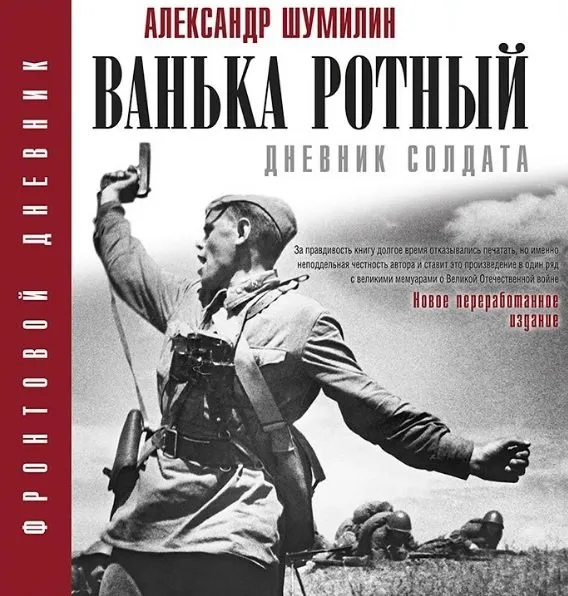
P.P.S. I did not, as usual, turn upside down the cover of a disliked book: the depicted person on the title photojunior political officer A.G. Yeremenko, raising soldiers to attack, has nothing to do with A. Shumilin; I respect such front-line soldiers.
Another addition: so as not to spoil the impression, I did not search for reviews of "Vanka the Company Commander" until I read the book myself. Of course, my analysis of this work is quite superficial, although logical. Recently, I discovered a review of several chapters of the manuscript, created by a true specialist, **I recommend for your consideration:**