
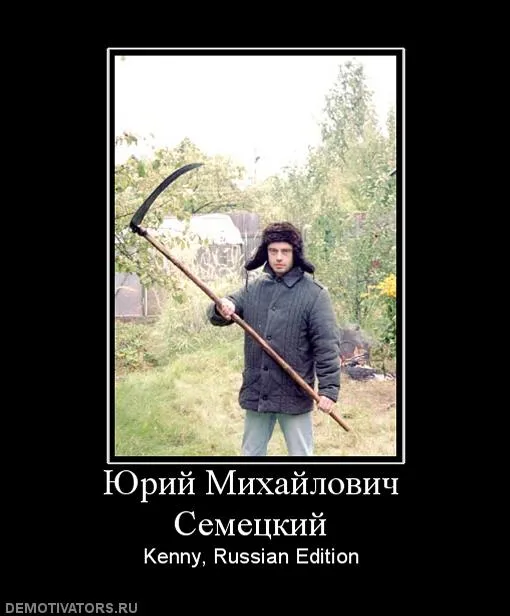
Feel like a Semetsky. Not a contest.
"It's too early to kill Semetsky"
Disclaimer:
This post, as you might guess, is mostly dictated by my heavy suffering from reading submissions for a certain well-known contest. Admit it: you too were waiting for it to finally end, weren't you? Oh, how I waited…
Of course, due to this suffering, this post is somewhat of a LiveJournal type, so those who do not enjoy this kind of reading may pass by. I would like to talk to the rest of the more "socially active" part of the community (which sounds almost like an insult) and perhaps analyze what I've read.
We are all, or almost all, gamers, hardened by countless virtual battles. Emerging alive from the most desperate and hopeless fights, hardened, and with a certain unhealthy cynicism towards the preparation of meat on the gaming field. That is to say, many, as was evident from those fifty-plus works, have stopped perceiving killing as something "out of the ordinary." As something for which we still bear responsibility. This, I won't hesitate to say, irresponsible attitude has migrated into the works. There was a feeling that most participants simply habitually smashed mobs in anticipation that one of them would drop a graphics card. I won't speak for other readers and judges, but this is definitely not the kind of attitude I expected from the contestants.
I will say something rather scandalous here: first and foremost, by participating in any contest, you must forget that awful formula "It's not about winning, but about participating." It is this formula that allows for low-quality work to be produced. By signing up for a contest, tell yourself that you must win. You absolutely must win. Otherwise, there is simply no point in participating. Why jump into the meat grinder? Just to jot down, "Vasya was here"? The works mostly looked as though they were done, excuse my bluntness, "half-assed." I don't understand this. And due to my misunderstanding, I can perceive it as a blatant disrespect, because if you don’t try your hardest and if you don’t strive to jump higher than your head (and “don’t shoot the pianist, he plays as he can” is not an excuse), nothing will ever come of it, and from the outside, it will look something like this: “Well, I wrote some crap, maybe it will work out? Maybe I'm lucky? Maybe the jury are a bunch of idiots?” … So, unfortunately, the jury are not idiots, and hoping to ride on luck, authority, charisma, or a high status on the portal is like hoping in the 21st century to meet a living dinosaur on the main street of a metropolis. In principle, it’s possible, but it’s just incredibly foolish. Experience shows that even the most dim-witted reader does not like being treated as a complete fool who will swallow anything fed to him. Feedback can be expected accordingly.
A little more about responsibility: many are discouraged by the fact that the number of submissions was unlimited. But still, it's better to focus on quality rather than quantity; this is clear as day. It's better to write one excellent piece than ten mediocre ones. My advice – go even further: when participating in a contest, imagine that your submission is your last word. AT ALL. And that it will determine not only whether you win a prize, but whether you will live on. This last word, after it – nothing, silence, emptiness. Based on this last word, you will either be remembered as a winner or remembered as, sorry, someone who messed up. Or not remembered at all. And it is precisely such a fate that I believe awaits most of those who submitted to the contest: either they will be remembered as having messed up, or they will be completely forgotten the next day – you decide what is better for you. As far as I'm concerned, being a winner is still more pleasant. And it all boils down to… no nerve, no strain, no realization of your own responsibility. Again, with such an attitude, such settings, you shouldn’t even go to the shop for beer. What if you run into a group of thugs? … will you explain to them that you're not to blame for running slowly or hitting weakly? And this won't concern them at all. Accept it as an axiom: if you got into a fight, it's either win or die. There is no third option.
On that note, I think we can conclude this part about "the correct attitude to...".
55 works were showcased at the contest, of which about 50 suffer from the same "ailments."
3000 characters – is that little? For some, catastrophically little, I won't argue, as many did not know what exactly they wanted to achieve. Those who did know would have gotten their point across with even fewer characters. The goal was the death of the chosen character. Here I won’t dive into the depths of literary theory or give lectures on plot architectonics, but I'll say it simpler: "don't kill more than you can eat." There is no need to create entities, especially if they are dead entities that play no role in the plot. Their presence plays no role, and neither will their demise. Writing about such things makes no sense. And it seemed that when you "killed" some character during the contest, in the book or game he was not just a function (waving at the ferryman and Granny Shani), but why then were significant and plot-relevant figures given deaths that are downright embarrassing to talk about? Let alone write about...
Is the game worth the candle? Is 3000 characters worth describing a coincidence or absurdity? Oh, for the sake of absurdity, you spent 2500 to describe a bunch of things that are completely unrelated to the matter, only to suddenly have Geralt fall into a pit and break his neck in broad daylight. For the sake of coincidence, you spent three paragraphs describing a dialogue between someone and someone, while you killed a key character in two lines... Roughly speaking, you are not able to adequately manage the space given to you. You cannot turn a death into a tragic coincidence; the randomness ends up being rather the fact that your chosen hero even landed in that episode. You cannot, while describing an absurd death, convince the reader that the death is absurd, and not just a silly construction of the text.
By granting a character a wonderful opportunity to die in battle, you act like genuine children of your time, having watched too many knight films. On the battlefield, there is no place for pompous speeches or beautiful weapon flourishes. The goal is the enemy's death, not a dance with blades. The goal is the enemy's death, not dialogues about existence. Instead, it turns into a friendly sparring session with such friendly exchanges of niceties, and the character's demise becomes rather an accidental and absurd event, rather than a logical outcome. It seemed as if two acrobat brothers came to practice acrobatics and poke fun at each other, and suddenly someone stabbed someone. Or two women got into a fight over a man: one beating the other with all her might and cursing her to high heaven. Just like at the market – nothing to add, nothing to take away. Guys, you have a very limited space (which every third one complained about), well, you could have prioritized properly between process and outcome… Really, again, imagine, excuse the tautology, yourself, here, in the 21st century, going for a kill. Why the theatrics? Extra movements, extra sounds, extra witnesses? You might not be holding a combat weapon for the first time, but you are aiming it at a living person for the first time. Here, every second of hesitation threatens to derail the plan. Whether it's a prolonged monologue, which could attract unnecessary listeners, or just an excess of your internal reflection causing you to lower the muzzle or take the knife off the throat of the unfortunate. In the end, you might suddenly feel sorry for the one you wanted to finish off a second ago in an honest or not-so-honest fight. In short, when killing a character on someone else's carelessly positioned sword, do it confidently and "silently," if the killer character does not require another pattern.
The most subtle moment, after all, is psychological credibility. The emotional side of the question. It’s difficult to hit the golden mean here: to ensure that the feelings of the reader are adequate to the feelings of the characters, and for the characters' feelings to be adequate to the situation at hand is not that hard, yet not that easy either. For some reason, it always ends up being either too "dry," or an ocean of tears and hyper-reflection spills forth over the knife stuck in the belly.
Surely, each of you has heard about the famous "I can't believe it" of Stanislavsky. Far fewer know that towards the end of his life, Stanislavsky decided to abandon this and recognized it as unfit, as it only made the situation worse: if at first actors played without feeling anything, without “living” their roles or understanding their characters, later, being thoroughly worn out by that constant “I can't believe it!”, they started to feel too much and take to heart what happened to their characters, and accumulated so much of this for themselves that they practically lived the emotions of others, but… it didn't help the acting at all. All those feelings remained deep inside, as their own, sacred, inviolable, and were not demonstrated to the audience. The audience was not transmitted the necessary emotional state.
We can witness the same situation here. The character either feels absolutely nothing, or suddenly opens up their incredibly rich inner world and, lying on the floor in a pool of blood, recalls their whole messed-up life from the moment their umbilical cord was cut, or they are deeply musing, tormented – why, for what, how can this happen, life is unfair, fate mocks-a-a-a-a… Zzz… Zzz… “I yawned three times while reading,” as they say. But this character feels so deeply! Only these feelings, unfortunately, prove to be simply inadequate to the situation, as a rule.
Last in order, but not in importance, is the understanding of the character's relationship with the surrounding world. This is what participants should have worried (and many – for which big thanks – worried) about before they started working. And preferably not afterward. And, ideally, not during. Or else all this process of understanding pops up in the text (and then the work can be recommended to people suffering from insomnia), while the young and undoubtedly talented author begins to complain about the strict limitation on the number of printed characters again.
Of course, all this does not apply to cases when the author is just kidding, but this also needs to be done well. Otherwise, the event simply turns into a farce. But if you are trying to work seriously, I would modestly recommend you to keep the above in mind for the future so that the next similar contest does not resemble a panopticon quite so much.
Your faithful daughter of Captain Obvious, Eversleeping, was with you on the waves of radio GAMER.fm.