
RoboCop: Rogue City. Return to Detroit
It can be interesting to see how developers grow and aren't afraid of making mistakes. Gaining experience and releasing new projects, they gradually gain more recognition among players.
Perhaps this story unfolds perfectly with the Polish studio Teyon, founded in 2006.
Initially, they created small arcade games and puzzles. But once they tried to diversify their portfolio and released [Rambo: The Video Game](/games?search=Rambo: The Video Game) in 2014. The game turned out to be an absolutely linear shooter, and its technical performance was disappointing. There might have been some details in this game indicating the developers' love for Rambo films and recreated the atmosphere, but in 2014 there were plenty of other interesting projects, so [Rambo: The Video Game](/games?search=Rambo: The Video Game) received its share of rotten tomatoes, and Teyon's reputation was tarnished.
When this company announced the development of its new project, Terminator: Resistance - a game based on the franchise of famous sci-fi action films by Cameron, this news was, of course, met with indifference. What? Another trashy piece is about to be released?..
But it seems that the management of Teyon did not waste time after the failure of [Rambo: The Video Game](/games?search=Rambo: The Video Game). Some measures were taken, and organizational work was done to fix the workflow, or the staff gained new experience and mastered new skills for their work. But the fact is, to the surprise of players, the new game from the studio, Terminator: Resistance, looked much better. The game had satisfactory gameplay, but the developers demonstrated their love for the original films and were able to thoroughly recreate the atmosphere and recognizable details of the war with Skynet and the machines, as it was first shown in the 1980s films. In particular, it depicted a similar post-apocalypse in the ruined Los Angeles, dominated by cold blue tones at night (contrasting with the yellow palette from the fourth film "Rise of the Machines"). The developers worked on other details and the transfer of recognizable moments.
Thus, Teyon managed to redeem themselves. Yes, their Terminator: Resistance cannot be called a masterpiece, but it was a well-made game, into which the authors even put their souls and provided fans of the terminators a great opportunity to immerse themselves in familiar locations and events of the war with Skynet. And there is a scarcity of games based on the "Terminator", so nostalgic players were very pleased with such an unexpected gift.
Now the company has gained credit and after the news of them developing a new game based on the RoboCop films, the audience began to follow the news with interest.
How can one make a game about RoboCop?.. After all, he is a slow character, and essentially quite invulnerable. Arcade games were released on consoles, made at a decent level for their time. There was also an unsuccessful shooter RoboCop from the French studio Titus released in 2003. Not much going on.
Teyon had a challenging task ahead: to find an interesting formula for the gameplay. Fortunately, they decided not to make RoboCop: Rogue City a complete action game, since our protagonist is primarily a policeman.
If Terminator: Resistance showed that the developers learned to make attractive games and create an atmospheric environment, then in their new game, there is a variety of gameplay.

The demo version allowed players to personally try RoboCop: Rogue City, and the impressions were very strong. It turned out that the game combines shooting action and enhances this process with various side activities in the form of police work. When RoboCop heads to Detroit on a mission, the player gets the chance to stroll through the city streets and find various quests: issuing parking tickets for violations; admonishing people disrupting public order, and other minor tasks. Engaging in criminal investigations becomes more interesting, which involves inspecting the crime scene, analyzing evidence, and questioning witnesses and suspects.
So, after trying the demo, many became eager to purchase such a wonderful game. So what awaits them?
The events of RoboCop: Rogue City chronologically take place between the second and third films of the franchise. So the drug new-k from the second film is present here, and the OCP corporation continues to gradually tighten its grip on Detroit and aims to start the construction of its Delta City.
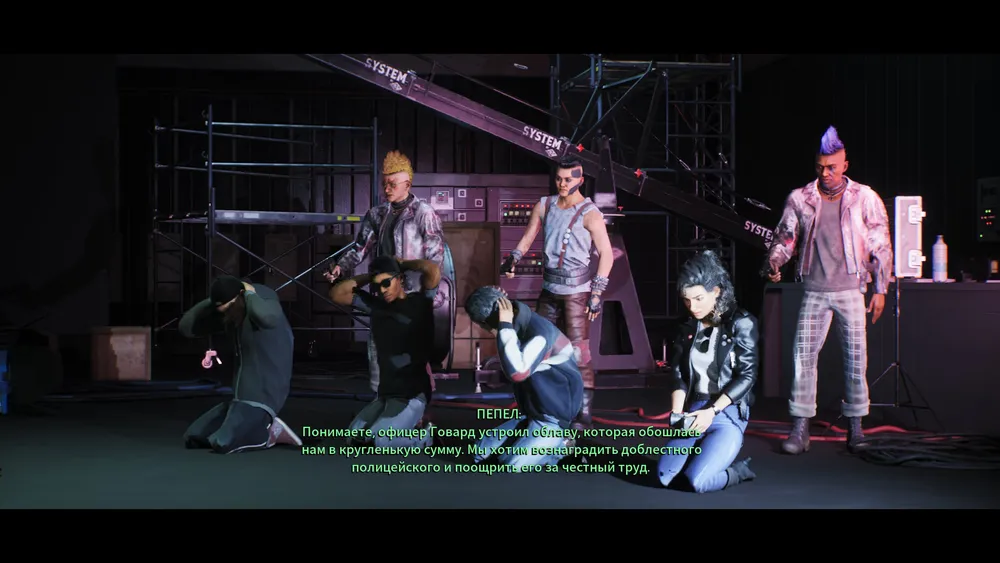
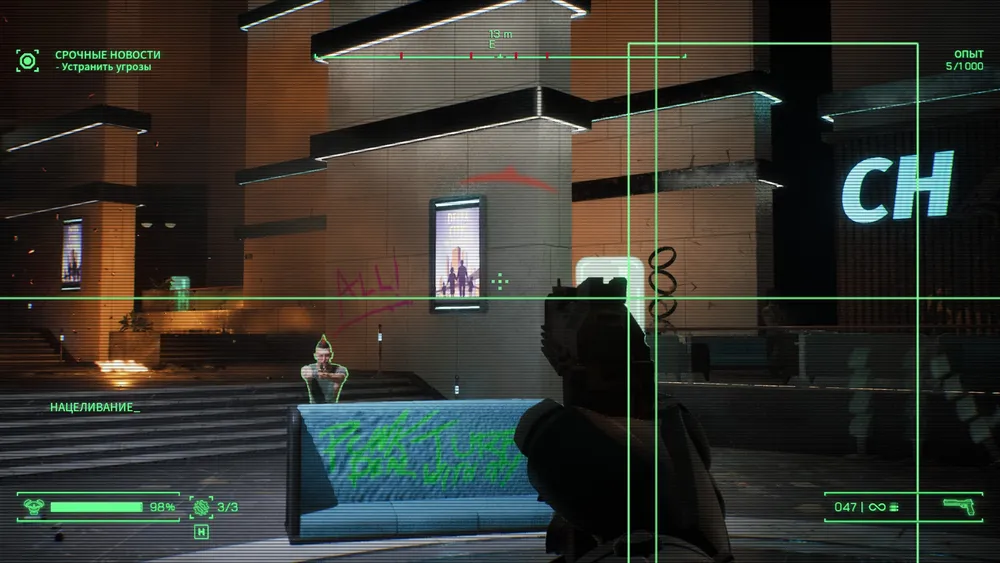
A new criminal authority emerges in the city. He is unknown but announces a search for those willing to collaborate with him in some affairs. And he promises good rewards for the work. This offer stirs the city's gangs, one of which captures the Devine Channel television studio and takes hostages. They go on air and address this criminal boss, hoping to attract his attention. In fact, the game will start with a level dedicated to freeing the television studio from the bandits. So, the first level is entirely combat-oriented and also includes training tips. In particular, the authors quite cleverly solved the balance issue of the combat system. Pressing the right mouse button activates the scanner (and the sight), which highlights enemies falling within its field of vision, marking them and illuminating them in green, just like in the movie. But the player still has to shoot enemies, so there will be no weapon auto-targeting. You will have to hit bandits in critical weak spots. The scanning mode also helps to notice some hidden buttons, items, and if the room is filled with smoke, it will also highlight enemies.
In the heat of battle, you can actually take down an enemy with a hand strike using an extended spike (as in the movie, yes!) or grab a bandit by the throat and throw him away (and this could be done even in Crysis). Of course, there will be explosive items: barrels, tanks, canisters. You can not only shoot them but also pick them up and throw them at enemies. Thanks to his strength, RoboCop can lift heavier items: televisions, containers, and others. Thus, fights can get heated here. This feeling is further emphasized by partial destructibility, but primarily it reminds one of a third-person shooter like Stranglehold, in which essentially the locations were covered with chunks of concrete, walls, stone, and other cladding that fell apart after gunfire.
RoboCop begins to be haunted by memories of his past life, and he falls into a stupor at a crucial moment when it was necessary to save a hostage. Luckily, he is helped by his partner Ann Lye, but the incident was caught by journalists, and the public learns about it. The corporation is also unhappy with the troubles associated with their product: they now believe that RoboCop is experiencing technical malfunctions in his operation.
After completing the first level, the player will get the chance to stroll through the police precinct. Everything here is depicted exactly as in the movie: the underground parking, shooting range, and maintenance room for RoboCop himself. The justification of the game’s conditionality is well thought out: since the OCP corporation is concerned about RoboCop's actions, they install a chip for collecting statistics and assessing his condition. Thus, after completing story missions, we will see a final evaluation: whether all tasks were completed, whether side quests were undertaken, whether any secrets and evidence were found, and so on.
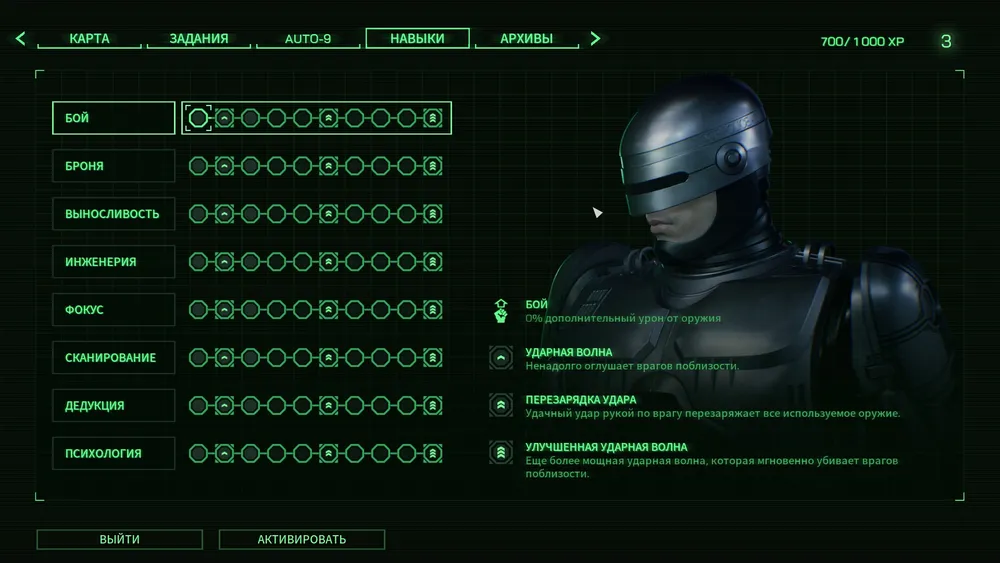
Experience points will help upgrade several skills of RoboCop: not only the banal armor and attack power but also improvements to aim, deduction effectiveness, and interaction with people. In total, there are 8 skills, and one upgrade point provides a passive improvement of 5%. Each branch includes three special bonuses. It can be assumed that it is more beneficial for gaining interesting gaming experience to upgrade unusual skills; for example, deduction will allow gaining more experience, and the first bonus of this skill will enhance the capabilities of scanning mode and allow finding various secrets (for example, by traces on the floor, understanding that a cabinet can be moved to open a passage to a secret room). The next bonus marks the location of valuable items on the game map, and the final bonus increases the accumulated experience by another 30%.
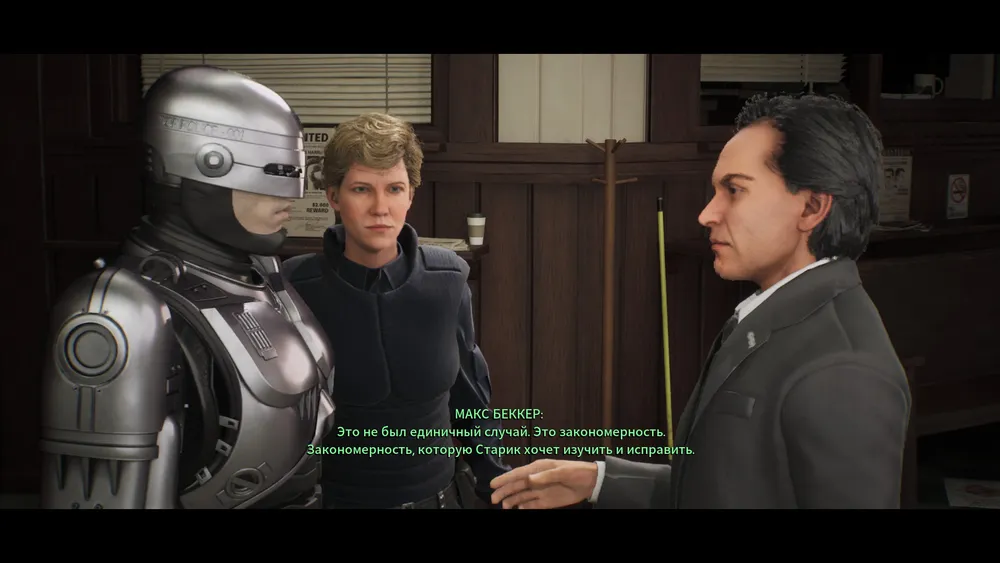
Since RoboCop has started to malfunction, the inspector assigned to monitor him from OCP, named Max Becker, will frequently annoy with his critical remarks and orders. The character is so convincing that I initially thought he was in the film. And there will also be sessions with a psychotherapist assigned. These conversations will allow players to portray the role of RoboCop at their discretion - as a human or indeed a machine?.. It should be noted that the image of RoboCop in the game seemed to me to ignore the events of the first film, as Alex Murphy lost his identity and initially did not show himself at all. He acted precisely as the programmed RoboCop, his movements being notably mechanical, and his voice monotonic. But when memories began to return, Alex Murphy gradually discovered himself within the guise of a machine, and by the end of the film, RoboCop's behavior changed: movements and voice. So this internal conflict should have already been left behind in the timeline for Murphy. But let us assume that for the variety of gaming situations, the authors intentionally allow players to choose actions for RoboCop more frequently.
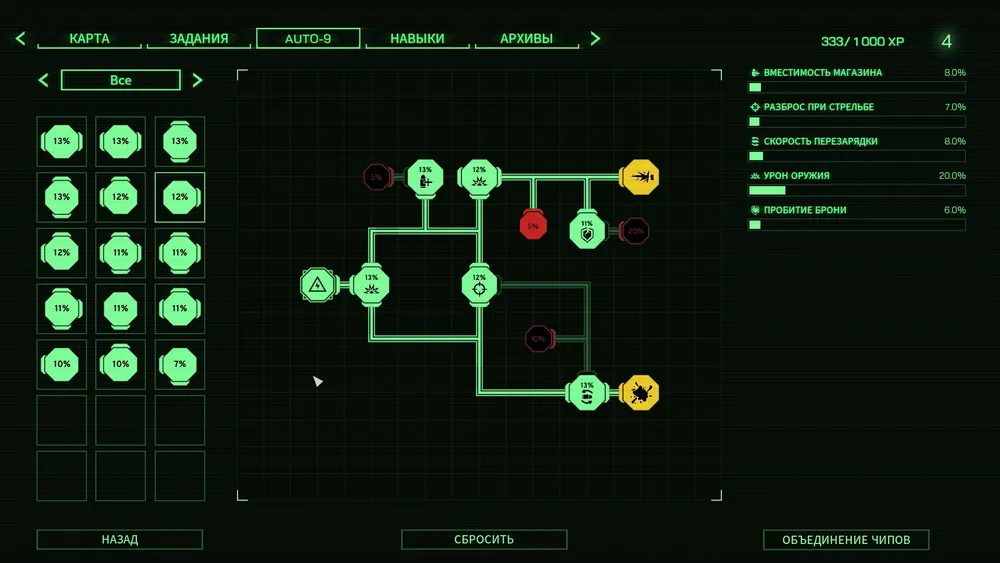
In addition to the role elements of upgrading RoboCop, there is also the upgrade of his Auto-9 pistol. In the game, players can pick up weapons on levels, but it’s more to diversify the shooting experience. The Auto-9 here has an infinite ammo supply (just occasionally need to change magazines). Players will find chips and later start encountering boards for the pistol. Each board has its topology with cells for placing assembled chips: chips have a certain percentage of effect, and the cells influence certain properties of the weapon. Upgrading the pistol is similar to the logical game "Pipes": we have a power source, and it's necessary to connect it to the cells using chips that have different directions of signal reception and transmission. But some cells provide not only positive effects but also negative ones. So sometimes it might be better to ignore activating such cells and use chips only for beneficial enhancements to the weapon's parameters.
So, after a combat assignment, the player will find themselves for the first time in a large location in Detroit. Here one can explore the surroundings and find side quests, as well as perform police work: issue parking tickets, admonish order violators. In doing so, you can follow either the letter of the law and immediately impose a fine or leniently give a warning. In these cases, the game will notify about RoboCop adhering to the law or about increasing approval from the citizens. It seems that there is a hidden reputation in the game, but nowhere in the character menu can this information be seen. Clearly, it is also part of role-playing your robot-police officer.
The first visit to Detroit will please with investigations of certain crimes. This task most resembles a mix of Deus Ex: Human Revolution and Batman: Arkham. RoboCop will scan the crime scene for evidence and analysis of what happened, and then question witnesses or suspects. The most important thing is that this part of the gameplay introduces variety to the shooter, and perhaps truly allows one to feel the role of RoboCop.
Also, there are items hidden around the locations called "crime evidence": these include counterfeit money, compromising documents, new-k drugs, stolen bags and wallets, and more. Collecting this junk brings a little experience, and also influences the final assessment after completing the mission.
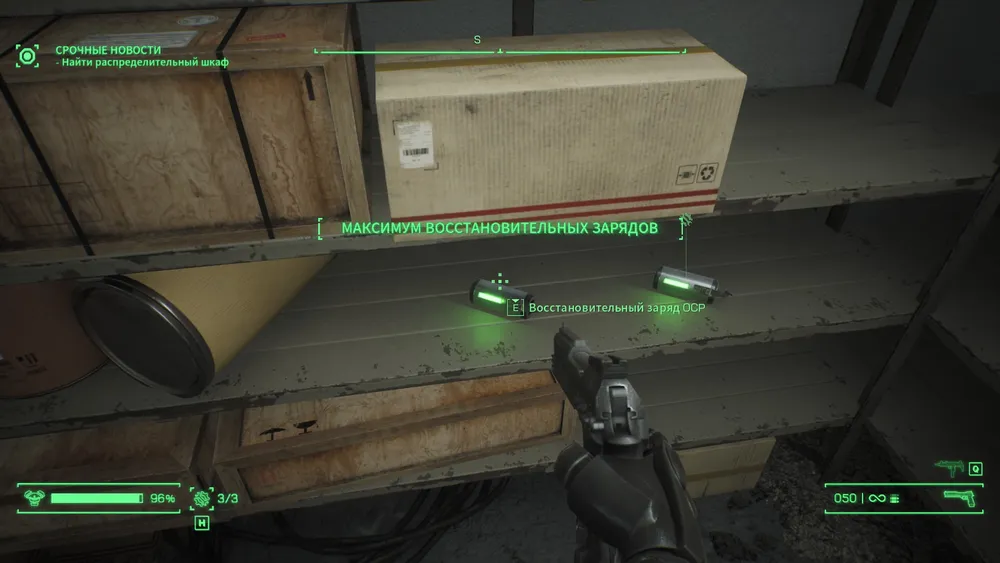
Moreover, there are more valuable corporate items: in the OCP containers are chips for upgrading the pistol; sometimes, you can find a "medkit" for Murphy (you can only carry three at a time unless you upgrade the skill to increase the limit). It is beneficial to memorize the locations of such containers, as they might come in handy to return to them for healing or replenishing supplies. Such service details can lie even independently on the level. Additionally, there’s a data diskette — it grants a skill point.
The authors have significantly raised the bar for themselves this time. Therefore, of course, they did not make too many quests and levels with freedom of movement. But instead, they tried to work on the diversity of combat episodes. Thus, in the game, there are various types of opponents. The encounter with a new enemy type is designed uniquely and reminds somewhat of Borderlands. There are grenade-throwing bandits who throw grenades; thanks to our aim, one can try to blow up a grenade with a shot. Bikers ride motorcycles and circle around RoboCop: one can either kill the rider or blow up the bike. Especially unpleasant are the machine gunners and grenade launchers, as their shots considerably damage the main character's health. Fortunately, sometimes levels are designed in such a way that you can bypass a firing point, break through a wall, and strike enemies from the flank or rear. But only if it's foreseen in the map design; what a remarkable interactive opportunity it could present!...
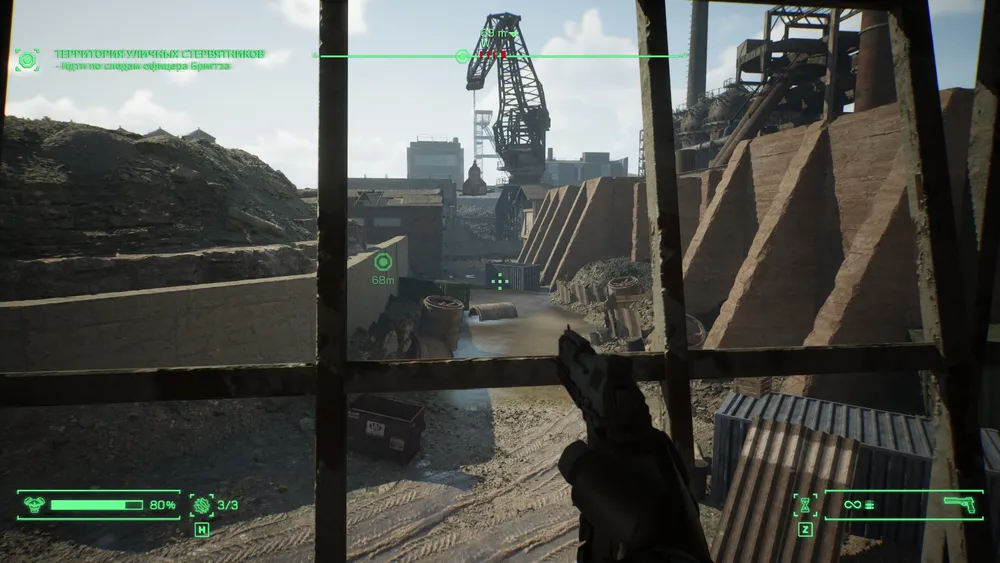
At one point, RoboCop: Rogue City vividly reminded me of Fallout 3: Detroit itself resembles a city in a post-apocalyptic world, and on an abandoned factory, bandits have scattered mines. Such traps were loved in Fallout 3; however, here, RoboCop can’t disarm them. But since we have infinite pistol ammo, it’s not a problem to blow up the mines with shots. Targeted vision and scanning help additionally highlight the silhouette of the mine against the dusty ground, and there’s also a blinking indicator on it. However, interestingly, the scanner does not see through water, and because of this, I blew up on a mine from a puddle.
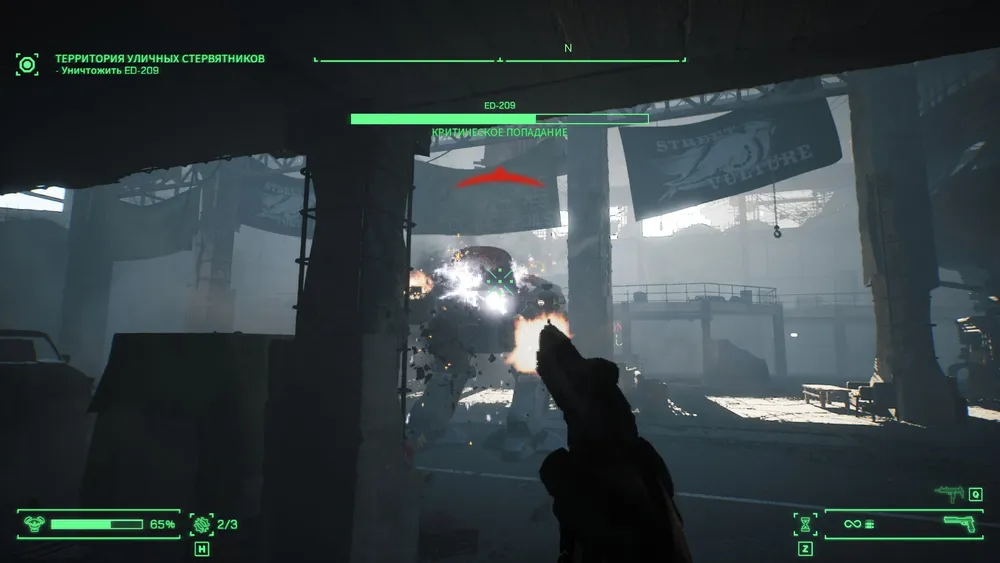
The subsequent fight with the bandits is memorable for the fact that with police backup, the robot ED-209 arrived. The gates opened, and the two robots stormed the entrenched criminals, while the OCP unexpectedly wanted to compare the efficiency of their products. Two score counters appeared, and one had to try to shoot more targets than ED-209. Then, as usual, ED-209 glitched and became the first mini-boss.
In any case, after storyline missions, we return to the police precinct. There, you can always find some side missions, which turn old RoboCop into a courier: either collect signatures for a postcard to the hospital or find a fault in the electrical wiring and other minor tasks. Here, we also observe the development of the investigation of the case of the new criminal authority. The police precinct sometimes serves as a briefing location before the next mission.
Note: By the way, the shooting range can come in handy to test different boards modifying the pistol to choose the most suitable one in advance.
It’s a pity that the game uses a checkpoint save system. When it comes to small locations, you can quite quickly move through the designated area of the game. But when landing in a large location, one should be more attentive concerning key events that will permit saving progress. In the worst case, one might have to repeat some actions again if they failed to reach a checkpoint and left the game prematurely. Fortunately, one can skip dialogues by pressing a key.
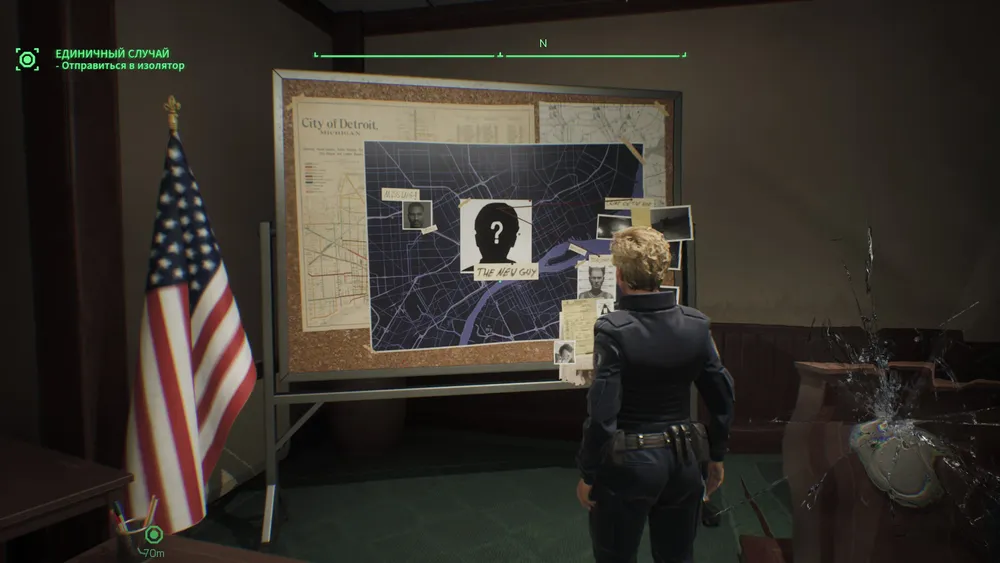
In the police precinct, new notes may appear. Collecting such notes not only helps explore the details of this world but also rewards experience points. Although Teyon has yet to reach creating TVs with broadcasting their programs like in GTA, there are radio receivers here. If you turn them on, you can listen to some advertisements or fragments of radio broadcasts, and there's bound to be a satirical remark.
RoboCop: Rogue City can delight players with interesting situations not related to the gameplay. For example, one might have to help a person find a video cassette with a movie whose title he doesn't quite remember. But he hopes that RoboCop’s scanner will help find the needed title faster. While marking suitable options along the way, we will listen to our new acquaintance's musings about cinema and answer his questions: do we think sequels are an evil?.. Is it great to make remakes?.. It will be a brief but memorable conversation.
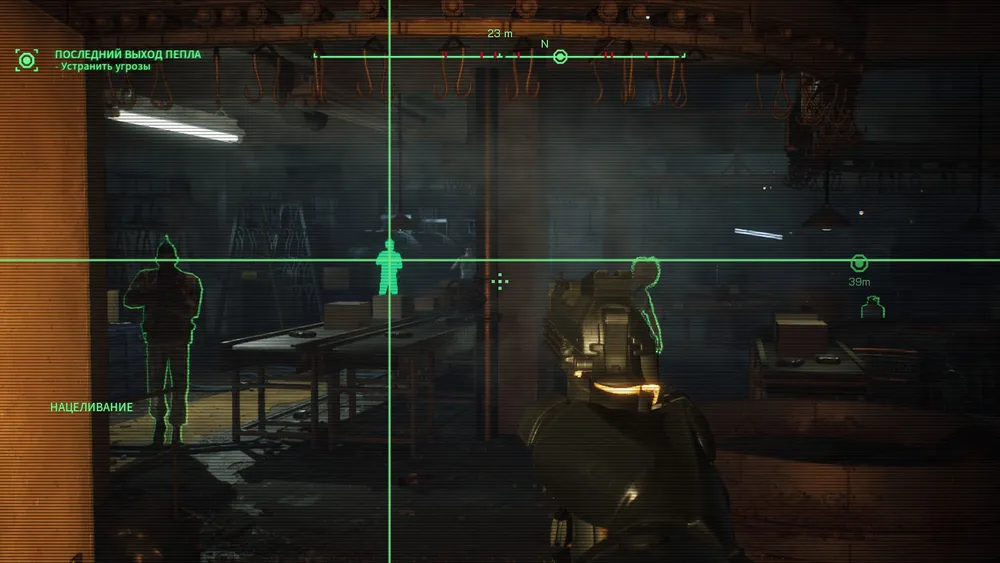
Thus, the game delights not only with its narrative but also with gameplay related to shootouts or quest completion. And all this in the spirit of the recognizable atmosphere of the 1980s science fiction film; in fact, it is already retrofuturism: it showcases more crude technologies, similar to what one can observe in the "Aliens" franchise. It is very cool that Teyon was able to create these details in the game.
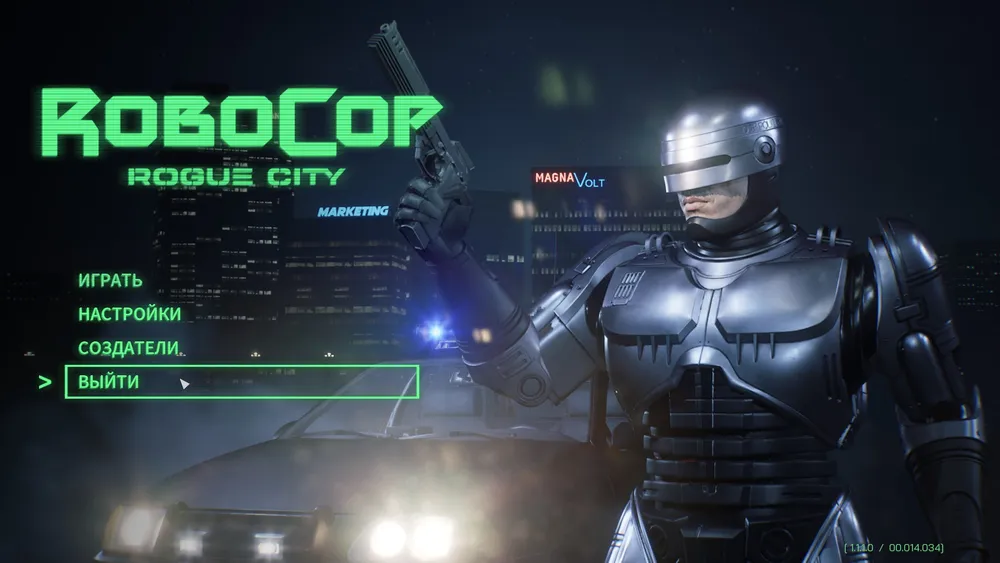
Among significant drawbacks, optimization issues are noted. The problem is associated with the Unreal Engine 5.0, which they are still learning to work with. It has technical features that do not significantly affect the quality of the image but can seriously overload the system in the process. Because of this, RoboCop: Rogue City may sometimes noticeably drop in frames per second. However, from my side, I can also note something good about optimization: the game ran on my GeForce 1050 Ti, even though the official minimum requirements stated a 1650 card - a more powerful model. Since the release, two patches have already been made that eliminate several bugs and improve the game's performance, so Teyon is not abandoning technical support for the project.
Interestingly, for Terminator: Resistance they released a small storyline addition. It would be great if players awaited an expansion for RoboCop: Rogue City, which could help solidify the success of this game.
At the same time, the project still feels like a sturdy B-class game. I cannot call RoboCop: Rogue City something of AAA level. But perhaps that is for the best. Otherwise, they would have stuffed everything typical in modern AAA titles here, without love for RoboCop films. As it is, gamers received a delightful action game, and players who grew up on RoboCop films will be even more satisfied.
If the developers continue in this spirit, one could bet their next game could really aim for A-class status, not B. And now, of course, it’s curious: will Teyon continue to explore the cinematic legacy of the 1980s?
I express my gratitude for the provided game key for its evaluation.