
With a Simple Face for Complex Problems - Review (PC)
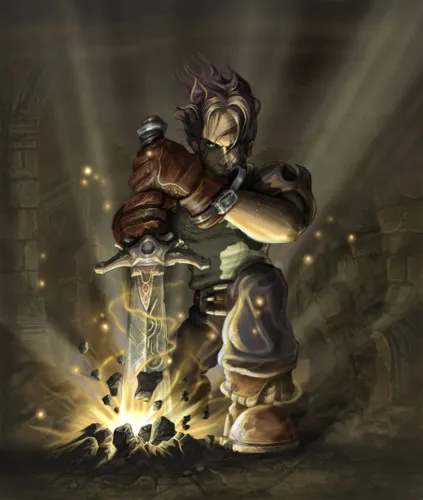
Perhaps, “Molynye” will soon become a household name. It will denote a completely unique status, one in which one can create absolutely any nonsense without the risk of losing reputation. No matter what you do, everyone still loves and forgives you. The release of [Fable III](/games?search=Fable III) has become yet another omen of the impending arrival of that moment: it seems like Uncle Petya has made a lot of promises, and in half of them, as usual, he successfully bailed out, molded some nonsense, and stuck a bow on the side - and it still turned out great. Hooray for Molynye, hooray for the son of a bagman!
As many already know, the resulting game does not shine with plot novelty: the king is a tyrant, the Hero is a fool who for long hours of gameplay knocks with twisted horns on the doors of royal chambers to overthrow and punish, to take the throne and then look at it like it's a new gate. Because, like Molynye, he promised everyone the sky in diamonds, only to find out that if he doesn't satisfy everyone by the deadline, his fans will tear him to shreds. Viewed from this perspective, [Fable III](/games?search=Fable III) is quite autobiographical.
Do you want a ride or a show?
When the first part of Fable was carefully reworked to introduce the unfortunate category of people who were deprived of gaming consoles and contenting themselves with PCs to the wonderful world of gaming, many delicious additions were added to the plot. Those times are gone. In the third part, there were no additional perks given to PC users. It seems they thought that the mere fact the game was ported to PC was already a great gift. In the end, did you really want Fable on PC, or what?
So we got Fable on PC… and the console essence still hasn’t gone anywhere. The simplicity that was present even in the first part has reached absurdity here, and it's particularly noticeable in how battles unfold. In the early levels, during intense fights, we click the enemy to death until our fingers start cramping and the mouse begins to melt in our hands, but while previously, as the Hero “grew up,” the enemies also tried to match that, now... let's be frank: killing a werewolf in two hits is, of course, good. Effective, fast, convenient. But it leaves a strange aftertaste: as if something was missing. The time spent cleaning the lawn of the band of these woolly nuisances didn’t even leave room to nostalgically remember the bright past when I roasted a disgusting troll with lightning for half an hour or spent ages chasing the endlessly duplicating Braer Rose in a mirage. Against such a historical backdrop, the quick “crash-crash” and a mound of fresh corpses look like an awkward fap to a two-minute porno clip against the backdrop of a passionate night of love.
We probably owe consoles the absence of something as significant, in my opinion, as a mini-map in the corner. Given that the locations are meticulously crafted and look exquisitely beautiful, getting lost in them is as easy as sending two bytes. Of course, the glowing trail will guide the player out of any wilderness, but the almost complete lack of understanding of where I am going was stressful. It was most stressful when I had to find just the right NPC among several dozen identical ones in an entire village who I had to report to about going who-knows-where and bringing him some unknown thing. If that wretched map showing the unfortunate brownian particle's movements around the location had been in the corner, life would have been a bit brighter. And to hell with the NPCs! I would just like to understand which point of the location I'm at… instead of having to teleport to the Hideout and search for where my character is hypothetically located – that feels really tedious.
Remember, developer: every time you deprive a player of their sense of spatial orientation, a kitten dies in the world!
Plant seven rose bushes and know thyself
What can be said about the quests, aside from the fact that no revolution occurred in them either? The quests are handled rather well than poorly, but again, due to the console nature, we are utterly deprived of the opportunity to do anything beyond running back and forth, preparing meat, and working as a courier. The traditional “go, kill, bring back,” which is solely saved by plot resolutions and world-building. If one can overlook the sporadically appearing graphic artifacts, the leisurely health-renewing jog to an unknown point on the game map brings great aesthetic enjoyment. To be honest, the TES series, with its extensive and thoroughly crafted maps, has somewhat stopped impressing me since I felt like a tiny blade of grass, watching my fairy Princess, so small – in such gigantic halls or caves – or trudging under the scorching sun across the dunes of an endless desert. Epicness doesn’t always have to be shown by rendering every blade of grass. Sometimes it’s enough to present the oppressive emptiness that stretches for many virtual kilometers around the hero.
But, while wandering through such fairy-tale locations, you inevitably encounter varying degrees of disappointment. It turns out to be very upsetting when you receive Nothing when you expect Something. When, after a long journey, you anticipate a great battle, and at the final point, you receive either “crash-crash” or a conversation about eternity with a ticket home. While the atmosphere builds, sets the mood, the outcome of most quests is a damp squib. Completing them is essentially worth it only for the stories and atmosphere.
Stand out are the “escort service” quests. If in previous installments we could thoroughly whack the merchant we’re escorting on the road to the other end of the map, or even kill him a little, in the new Fable our Hero bears the brunt of everything in proud solitude. The moment danger appears – the person being escorted immediately pretends to be rags, no one touches him, and all the trouble falls on us. But, thank goodness it’s not a problem to kill any miscreant in two or three hits, this complete indifference doesn’t particularly upset me, nor does the almost total uselessness of the dog. Just look at that tail-wagging piece of trash! While his owner is being beaten, that face is blissfully chasing its own tail. In real life, even the most timid greyhound would lay a three-story doggy curse on an assailant for attacking its owner. But this one – not even a whimper…
Another separate line is the “relationship building” quests. Again, in real life, people go out of their way to earn the attention of someone famous, like Putin. But in the glorious Albion, it’s completely different. The residents there are particularly audacious. “If you take this thing for me, maybe I’ll stop hating you,” says some unclear bloke to the Queen. Oh really. And can’t you spread some jam on your tonsils? I’m the Queen, your feelings shouldn’t concern me at all, you should be thinking about what to do to not be hated by me.
It’s a pity you can’t respond like that. Yes, yes. You can’t refuse the quest! So it turns out: right now, I’ll drop everything and go hunting for someone else’s underwear in an underground cache. And then also someone else's whatever in an underground cache that is – oh wonder! – in the same place as the previous one. A double combo. It occurred to me that theoretically, in such a setup, one could take a shovel and dig up the entire nook entirely, find EVERYTHING buried there, and then walk around asking everyone: “Guys, whose stuff is this?.. Alright, and whose is THIS?” - to build relationships with everyone at once and never return to it again.
[Sims Medieval, The](/games?search=Sims Medieval, The)
After the Hero ascends to the throne, the game noticeably slows down and turns into constant runs between the treasury and the throne room, where decisions are made about how to squander the state treasury. If you set aside the questions of ethics and morality, this part of the game is arguably the weakest. The Medieval Sims showed that managing a kingdom is an engaging and entertaining process, and while those Sims became heavily infused with RPG elements, in [Fable III](/games?search=Fable III), the royal court is imbued with boredom and despair. However, it is also where the most fairy-tale elements reside.
When deciding what to do with the tax rate, or finding out that the country is hit by an economic crisis that can only be further exacerbated, you also discover that much will indeed have to be paid from your own pocket if the Hero decides to be impeccably good. And so, our King or Queen goes to the town and starts picking up side jobs as a blacksmith or rolling dough in the baker’s shop. Or pretends to be an askew, getting paid to play three chords.
After earning a couple of million gold coins at the baker's, I pondered...
A couple of million gold…
…For rolling dough…
…WHERE does the baker get that much money?..
…An enormous extra income, not backed by the state’s monetary fund…
…Clearly coming in bypassing the state treasury…
…And they still complain about the economic crisis…
...And these cute millionaires throw a fit when I raise taxes so that only two hundred thousand come to the treasury afterward, while they must have heaps of gold in their basements? Oh yes. The Queen is an outright tyrant after this!
These people literally force me to implement even harsher policies than were under King Logan! So, it turns out that my people either die in hellish agony or hate me. And no matter which way the balance tilts, in the end, I hear: “Well, you really messed up there…”
- No, guys, let’s start over: I can leave you Logan!
- Sorry, but no. With Logan, the kingdom was doomed.
- For crying out loud…
Eyes Wide Shut
The atmosphere of the game is something that it's unclear how to relate to in this case. The very beginning, when one is forced to choose between the death of the residents of your state and the demise of your loved one, immediately makes you feel that instead of a kind and cheerful fairy tale, we will receive something phallic. Intuition, in general, does not deceive: sometimes making a choice is indeed quite difficult because the outcome options are more terrible than the last. For instance, fulfilling a promise made to practically one’s own father risks leading to the death of hundreds of thousands of innocent people. Violation will brand you the ultimate jerk in the eyes of those who just lost their loved ones. Knowing that you are fighting for the lives of people who are almost certainly going to hate you and wish you the same fate as the previous king, and having no opportunity to resolve issues with minimal loss – this feeling is oddly incompatible with what we are used to calling a kind fairy tale.
And the degree of “kindness” relentlessly rises throughout: poverty, unemployment, totalitarian regime, child labor, destruction of nature… the most terrifying nightmares become reality… a hero, on a hard journey, losing one best friend after another… Where's the fairy tale?! The problems suddenly piled on the residents of Albion could generously sponsor the darkest of dark fantasies.
And what will save the player from this stifling atmosphere of impending doom? Well, besides the occasionally completely misplaced, but still trademark humor. Perhaps the character design, occasionally so grotesque that they seem impossible to take seriously. As if a squad of Teletubbies showed up at a funeral, starting to suggest everyone hug. And in addition, most of the characters are simply devoid of any individuality, and then the player can start to wonder: are they really worth saving? Do they even deserve to be saved?
Because of this, the atmosphere of the game incurs some losses. By deciding the fate of these identical dummies, one can only realize the seriousness of problems intellectually while on the emotional level, emptiness settles in. Essentially, I could only handle any decisions by closing my eyes so as not to see this faceless “people.” For a role-playing game, this situational context is simply devastating: to play a role, one has to avoid immersing oneself in the game, but rather to try to pull oneself out of it as far as possible.
As a result, trying to mix complex moral choices™ with “fairy-tale quality” in one game results in a very ambiguous cocktail. And the morality of this fairy tale also turns out to be very, very strange.
No matter what trouble the upcoming day may bring, a Hero will always come who, maybe, won’t save us all from terrible destruction, but will instead cheerfully crow, and suddenly everything will be funny and cheerful, and we will face inevitable death with silly smiles on our faces.
Three write, two in mind
What conclusions can be drawn when wrapping up everything said above? Molynye has created a devilishly beautiful and very complex thing, which, despite its numerous shortcomings, deserves attention and even praise. Generally speaking, it’s a normal situation: the higher the overall level of execution, the more painfully even the tiniest flaws are perceived. After all, in translation from Albion, “Fable” means “a game that is simply pleasant to play.” However, if Molynye continues to tackle serious problems with such unserious characters, collapse is inevitable.