
"Renaissance and Decline" - preview of Deus Ex: Human Revolution
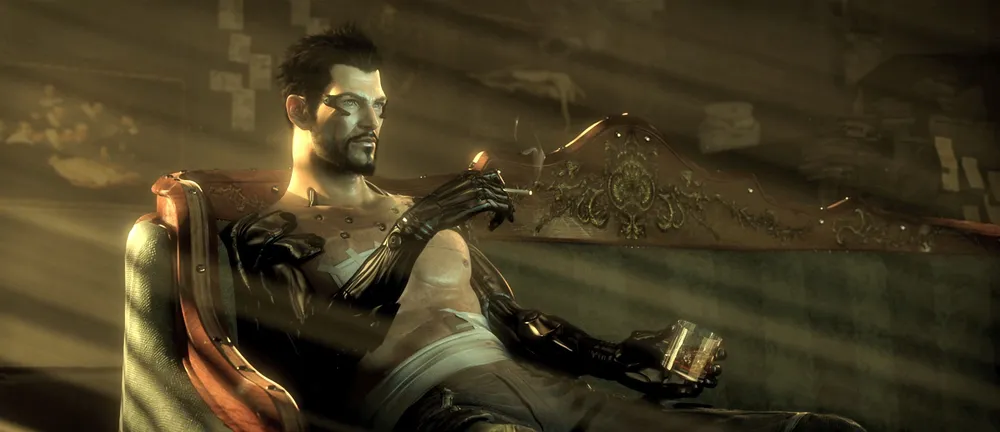
Deus Ex: Human Revolution has been, to this day, on my list of the darkest games of the year (and not only mine). I was resolutely unclear about what to expect from the creation of Eidos Montreal. The debates about the technological aspects of the project fueled the situation quite well. It was argued how one could take seriously a first-person role-playing shooter with graphics that had become outdated by several years. And the ambiguous innovations of Deus Ex 3, such as the ability to hide behind cover with a subsequent camera angle change, were met with skepticism by fans. In short, I was incredibly curious to visit the office of New Disk (the publisher of HR) and try out the working version of the game.*
The future, as predicted by hundreds of diverse scriptwriters, does not promise humanity anything good. Eidos did not invent the wheel; instead, they took a familiar concept of cyberpunk. However, we do not often get to enter dystopian worlds, and our broadened horizons, if any, are more grateful to the literary works of recognized authors in the genre. In addition to the mutual progress and regression of society, Eidos added traits of the Renaissance, thus connecting two completely different historical time periods. The Renaissance of 2027 found its embodiment in Human Revolution; just pay attention to the furniture, the interior of some rooms, and such seemingly unnoticed yet very characteristic candlesticks of their time. Stepping outside, we are presented with a magnificent view of a megacity of the future. Not such a distant future, I might add. The advancement of technology and the overall leap in science have left their marks on the city's appearance. Even the toilets have begun to 'keep up' with the times, providing users with large information displays with the latest news.

Pay attention to the main character's personal quarters
I did not start my narration without purpose regarding the stylistic aspects of Deus Ex 3, as it plays a significant role in the project. From the very first days after the announcement, Human Revolution stood out against its peers due to its art design: the soft lighting in warm tones perfectly highlights the image of the cyber-renaissance era, and various small details enhance the effect further. What is pleasing is that the screenshots released online are minimally processed by artists: the game itself is also rich in yellow-brown shades, and the virtual world of Human Revolution is almost unlike typical future cities. At the very least, it has its unique charm, which is worth a lot.
The Revenge of the Strong
The action of the first eight hours (possibly more, I'm not sure) unfolds in the city of Detroit in the year 2027. HR is a prequel to the original game released at the very start of the twenty-first century. In 2052, humanity faced major problems, or rather, by then, the consequences of those very problems – mankind found itself on the brink of complete extinction. Essentially, it was all predictable: the ecology was completely destroyed, the world economy lost its stability, people were in panic, and governments were unable to rectify the situation. And this is just half the trouble: a certain virus (the name of which - Gray Death - speaks for itself) takes hundreds of lives every hour, while the vaccine against this dreadful epidemic costs an incredibly large sum. Only the wealthy can afford to buy the drug. Society, as expected, divides into several classes, with some clinging to the top while others await their demise at the very bottom of a peculiar pyramid. In the new Deus Ex, while the problems are somewhat simpler, they still warrant serious contemplation, especially since various forms of societal activity greatly encourage us to take action.
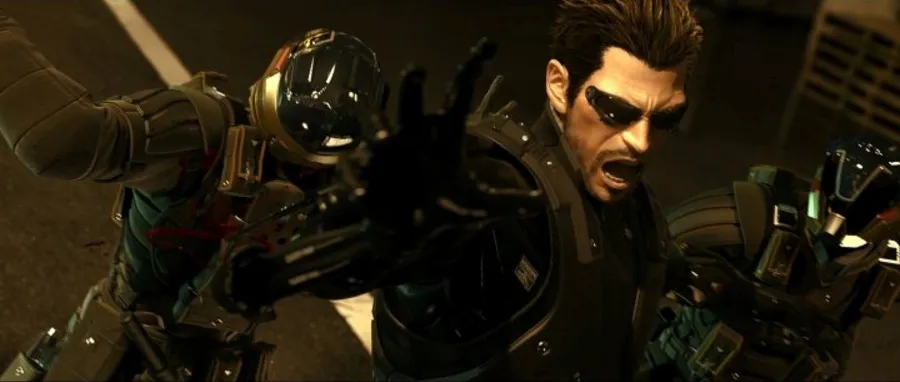
As is customary for an action hero, Adam is quite the badass
The events in HR start at Sarif Industries, a company that develops and produces implants to maintain human life. David Sarif, the owner of the company and a scientist, states: “We are just helping people overcome physical weaknesses, no more than that.” To ensure stable financial income, the company also supplies its developments to the military, which greatly displeases local 'Green Peace' representatives. One fine evening, agents burst into the building, causing chaos, destroying everything, and killing everyone in sight. The latest developments of Sarif Industries are burned, and the scientific personnel are eliminated. Among the few survivors was Adam Jensen, saved only by an operation to implant the technologies into his body. Once an ordinary man, Adam has effectively become a machine, retaining only his mind, spirit, and feelings.
"Cybernetic implants in our body are no more dangerous to your health than computer games."
Hugh Darrow, journalist
Guided, among other things, by personal motives, our protagonist decides to investigate who organized the assault on Sarif Industries. The signs of a terrorist act are clear: the criminals have professional weapons handling skills, a well-planned clean-up of the corporation's building, and several other facts. Before proceeding to the missions, however, the game gives us a chance to get accustomed to the local interface. I must say right away – forget about aiming. Not only because it is held on the middle mouse button by default. The alternative view of firearms is simply unnecessary, as headshots can be achieved with a classic crosshair. By the way, headshots are always fatal, regardless of how thick the enemy's armor is – if the head is unprotected, a single shot is equivalent to one corpse. In such a stealth-action game as Deus Ex, this is an important aspect.
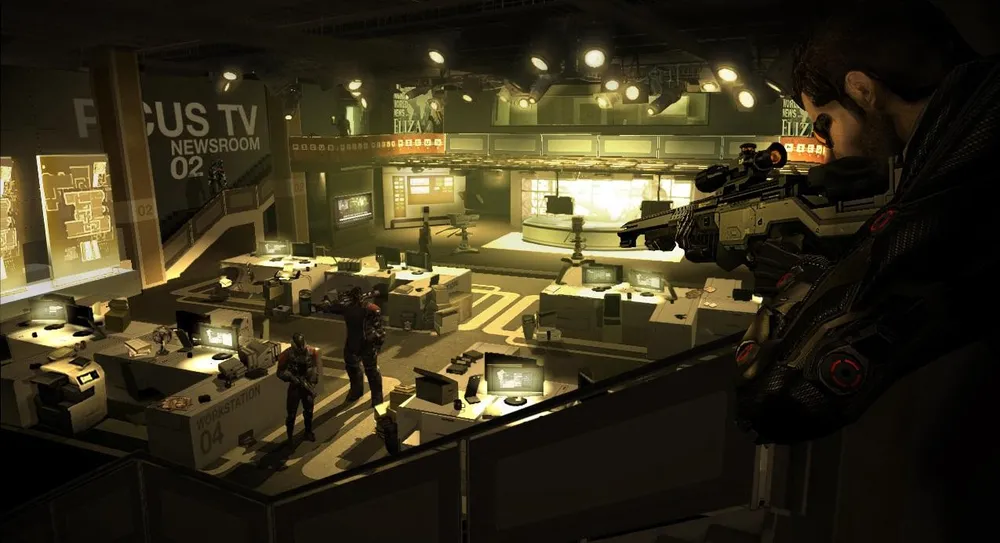
The tranquilizer rifle - one of our best friends in stealth mode
The previously mentioned ability of the hero to hide behind cover is genuinely helpful. After all, how easy it is to observe the enemy's movements without exposing oneself. It may not be entirely fair, but on one hand, we can admire the main character's appearance, and on the other, the third-person view provides an excellent opportunity to assess the situation. While the enemy searches for us just a few meters from our hiding spot, we have time to devise a plan, a strategy, to implement it in practice afterward. I especially want to note the incredible difficulty of Human Revolution, which will undoubtedly benefit the project. There are only three difficulty levels, and they are named as follows: **