"Leader's Routine". Review specially for gamer.ru
Nearby radzh has already briefly described the key differences and features of "Victory Day" III. I will just write about how it is played. What we have to do, what we have to endure, and what brings us joy.
"Victory Day" meets us in a truly "Paradox-style" way. Here are some dates and a global map. Wherever you point, that's yours. You can choose any country, from giants like the USSR, Germany, and Great Britain to small ones consisting of two or three cities.
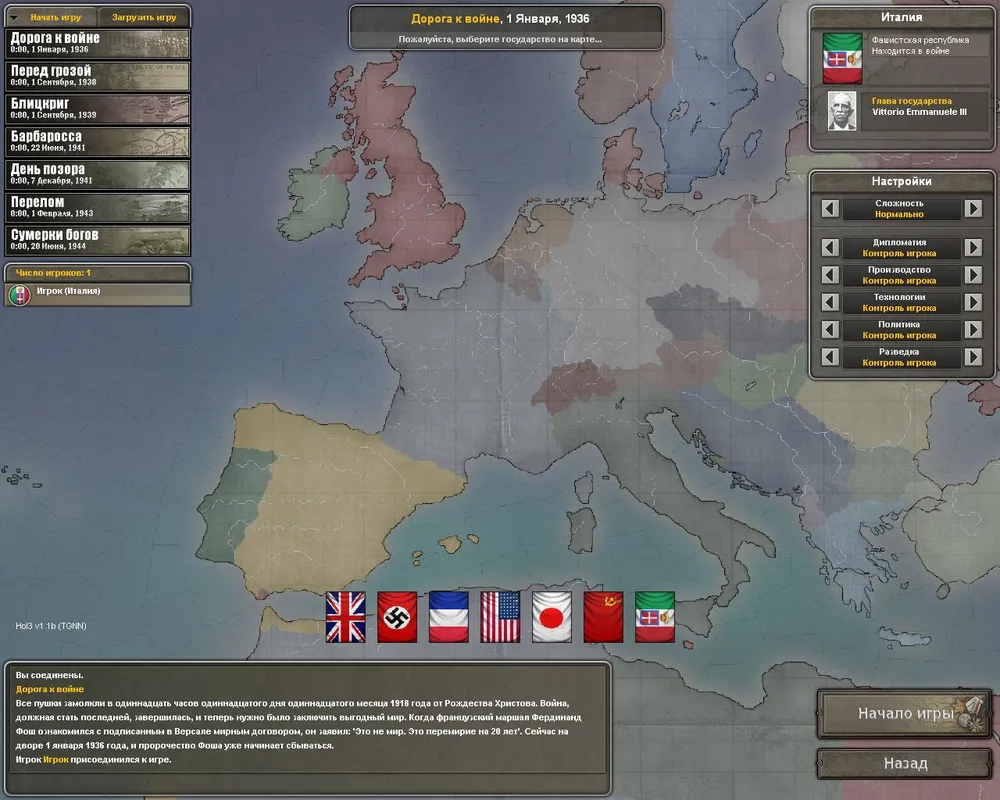
Here it is — the global map. It hardly changes year after year
However, the game immediately wishes to protect us from the ill effects of controlling a small country. Otherwise, a newbie may start with Switzerland and spend ten years just looking around and stuttering when Germany asks something. Thus, we are offered to choose strong and active powers. I would not refuse that offer. However, not all recommended countries are equally beneficial. In 1936, for instance, the USSR finds itself in a dark and unpleasant situation. Pulling the Soviet Union out of this pit is not easy for everyone. France and Great Britain have colonies that also require constant attention and dealing with. Eventually, they become a burden, constantly reminding you of themselves and causing unrest. You'll have to deal with issues in Africa, and solve resource supply problems in India. And God forbid some barbarians declare war. Thus, sending a fleet across the entire ocean is not only costly but also feels lazy. For a first encounter, this is all too much. One can become confused, give up, and forget everything. Thus, the victory day will never come.
Therefore, I recommend choosing either Germany or Italy. The latter is preferable. It seems tailor-made for the initial timid and uncertain steps in the game. First of all, you immediately go to war. But not against any European power, which could reach Rome in three days while you ponder what all these sliders and numbers in the menus mean. You find yourself fighting Ethiopia, which is more interested in sniffling than rushing into battle, dreaming of overthrowing you from the throne. Moreover, it is simply very dynamic to play as Italy. Initially, it fights, then actively engages in foreign policy, tries to form a close friendship with Germany, attacks Yugoslavia, and may capture Switzerland. It has good industrial potential and plenty of leadership points — it certainly won't be boring.
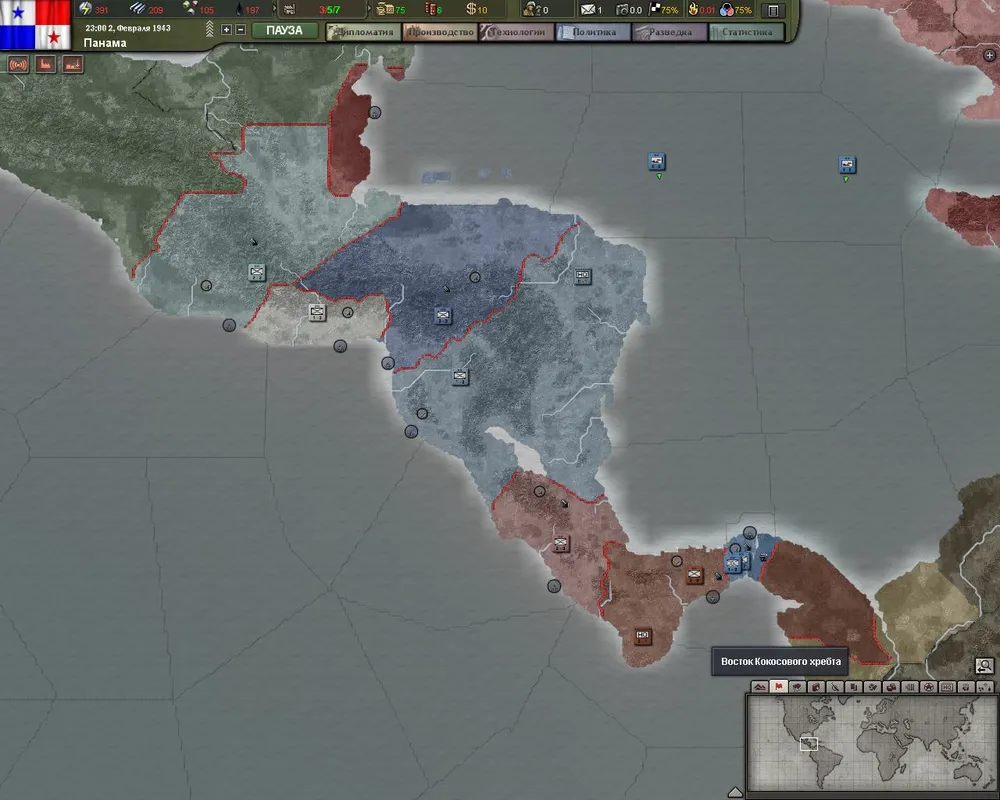
To rule Panama, frankly, is not particularly fun. You simply watch the main events unfold, and nobody takes you into account at all
Now, a few words on why I recommend playing specifically in 1936. For example, if you want to dive headfirst into war and take the USSR in 1941, at the onset of the Great Patriotic War, you will find a terrible mess on the screen. Hundreds of red figures are defending, gray ones are advancing, the fascists attack from all sides. Every second (yes, every second), twenty (yes, twenty) messages about battles pop up. Explosions and pings from incoming messages blast from the speakers. And some creatures even offer to trade during this time. Like, let’s say you give us a kilogram of electricity, and we’ll give you some money in return… Playing feels utterly unpleasant. The scale of actions is too vast, and it’s too vague what one should do. You didn’t build the defense, nor did you choose the various divisions. Therefore, it's better to embark on a quieter thirty-sixth, when shots hadn't yet sounded in Europe, armies were small, and technologies undeveloped. Then you can build a strong empire yourself that will attack when and how you want, and when you are ready.
How do we rule?
Let’s imagine that you heeded my advice and started playing as Italy. I repeat, for a first-time player, this is virtually an ideal country. Not only to practice but also to enjoy the game. I know people who first studied "Victory Day" III while leading Australia. That’s like reading a boring textbook. You just monotonously sit, watch, and think of something else. But there’s really no practical experience.

The triangle helps you understand how close a country is to one of the three alliances. The more influence you exert on a foreign state, the faster it moves towards you
So, let’s see what constitutes the life of a state. If you enjoy playing this way, then it’s worth rushing to the store.
First, you need to pay attention to resources. There aren’t too many of them, but they are very significant for the state, especially if you are at war or planning to deal substantial blows to your neighbors.
Besides the usual four resources needed to create technology and factories, there’s also fuel and supplies — which the army constantly consumes, and thus reserves often run low. If our warehouses end up empty, it’s time to feel sad and surrender — there’s no one left to fight.
And the last resource is money. It’s what keeps us afloat. No large country can survive without trade. The USSR produces an enormous amount of energy, so much that you could practically feed people with it. But with military supplies, it’s a constant struggle — there's never enough, as the army is massive. Germany, on the other hand, has an excess of supplies, but lacks other resources. And there’s no place from which to obtain them. Being small, the country has few natural reserves; its factories are nearly operating at full capacity, so nothing can be dug up from the ground anymore — trading is essential.
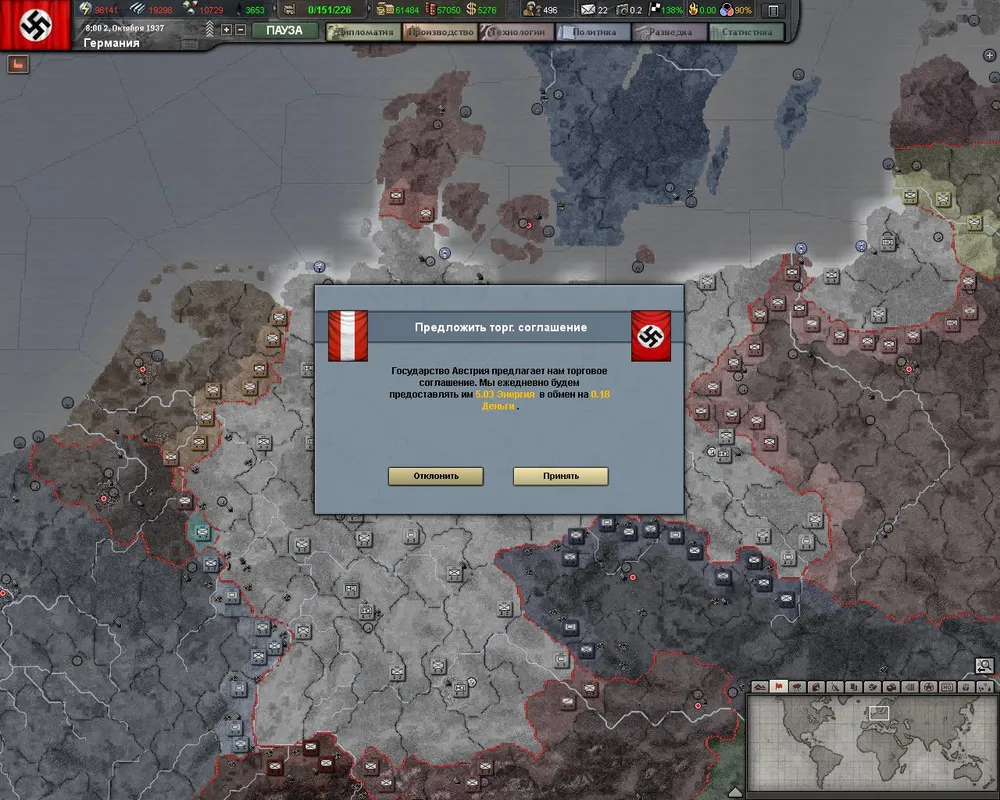
Countries almost every second send you trade agreements like these. If you’re not particularly interested in the economy, it’s better to either ignore them or pass all diplomatic tasks to the computer. But then you won’t see a large aspect of the game
You can, of course, delegate all trade relations to the computer, and it might handle them somewhat. But AI is AI. Therefore, it’s better to take matters into your own hands. Enter the diplomacy window and first choose the countries with which you want to form warm relations. Then check what resources they produce abundantly and which they lack. Start entering trade agreements. Buy 3 oil from the USA, sell 5 energy to Finland, supply military supplies to Turkey, and purchase steel from the USSR. You can even enter multiple agreements with one country. Not in a row, but after a few days. The more you trade with someone, the more favorable they become towards you. I would strike up friendships with Americans when I was Germany. We had about thirty trade agreements.
At first, it may seem that there’s nothing complicated about it. But then you recall how many countries there are around you, and that not all can sell you even 1% of the required resources. It’s daunting, really, only at the beginning. You must establish trade and then just occasionally tweak and modify things.
But buying and selling isn’t always a solution. For example, oil is incredibly expensive and can only be purchased by those nations exporting military supplies. Only they are approximately equal in price. The rest will have to… Yes, fight. The resource system in "Victory Day" is very interesting and realistically implemented.
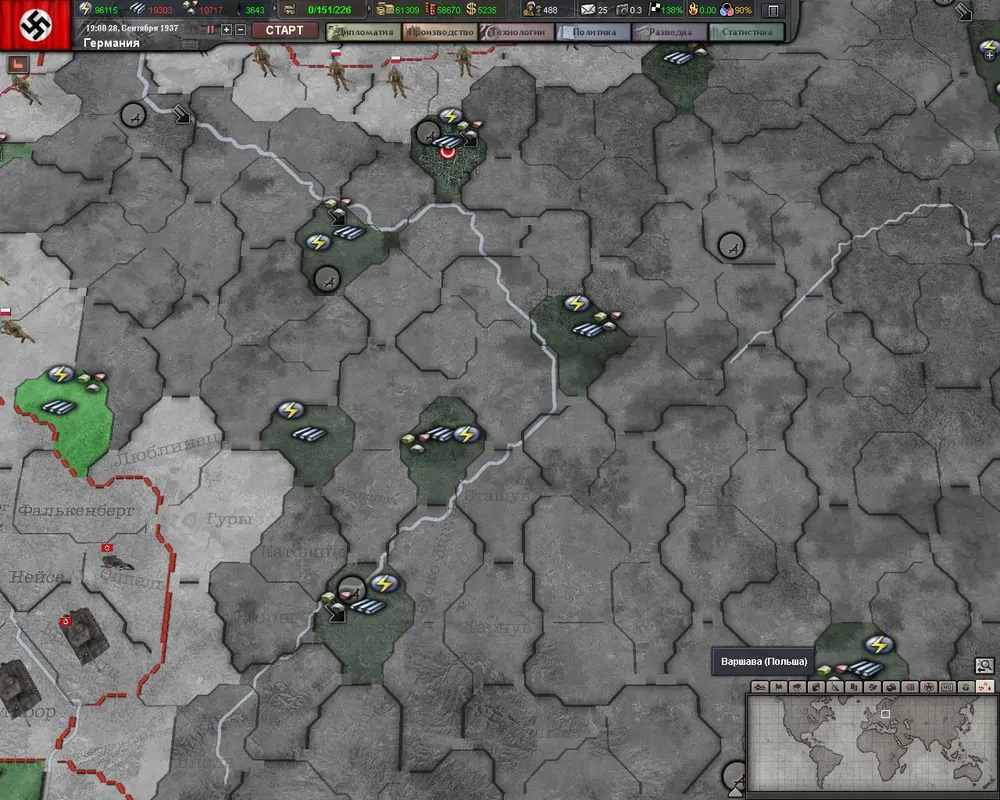
On this map, all resources are highlighted in green. The industrial regions, so to say. But oil is harder to spot. It's just a black drop on the vast gray map
In some provinces in every country, there are resource points. For example, in South Asia and in the USSR around the Black Sea — there's a lot of oil. Obtain it — and tanks can carefreely roll through all of Europe. In Germany, France, the USA — there are many powerful factories generating energy, mining and producing steel, and rare materials. By the way, another essential resource is people. Potential recruits and soldiers for your army. To have many of them — you must capture provinces rich in population. It's an interesting tactic (but, of course, not the only one — people can also be