
Eador. Review.
They say this game is hardly interesting to anyone these days. Some outright claim that the game is just no good, citing the 2D graphics, lack of animations, and other reasons. That’s their right. Personally, I really enjoyed the game. It reminds me of my favorite Heroes II, Dominions, Disciples, and even a bit of Warlords. The graphics, while 2D, seem quite fitting; moreover, everything is rather colorful and well-designed. The character portraits are particularly good, and I also like the other illustrations found in the game. There are no animations... well, that's that — it's not a big loss; I don't play "Eador" for the animations. The game also has an excellent soundtrack, though it could use a few more compositions. Overall, I think it turned out very well for a project primarily made by one person. Of similar and well-known "craft" games, I can only point to "Battle for Wesnoth".
There are quite a few texts in the game. There are random events: some are deadly, some are costly or vice versa, and there are even some just plain funny ones. Sometimes it’s quite difficult to predict the outcome of our choices—let's remember the whirlpool and its thousand 13 devils, heh-heh. Also, dialogues with Zar portray boredom and "spice up" the stay in the astral plane, and one can learn a bit about the world from him too.
The battlefield is divided into hexagons, and the battles are well implemented.
The gameplay, while monotonous, is still quite interesting, mostly thanks to those random events. However, I wouldn’t recommend "overindulging" in the game. One or two shards a day seems to be the optimal pace, or else Eador might get stale too quickly.
Personally, I think the game is undoubtedly a success.
And, perhaps, a small review.
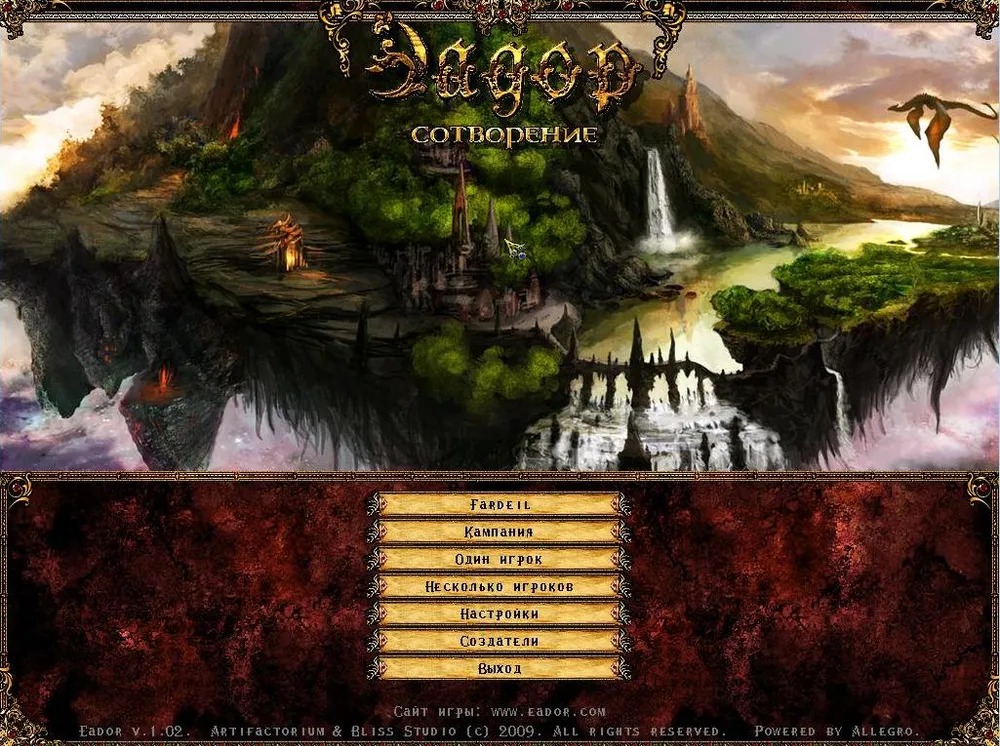
This is how the game greets us. Beautiful art, pleasant music, and quite a convenient menu.
The very top line is the profile-switching menu; there, you can change the difficulty, the emblem, the name, the title of the ancestral castle, and the avatar—there’s even one female variant, here:
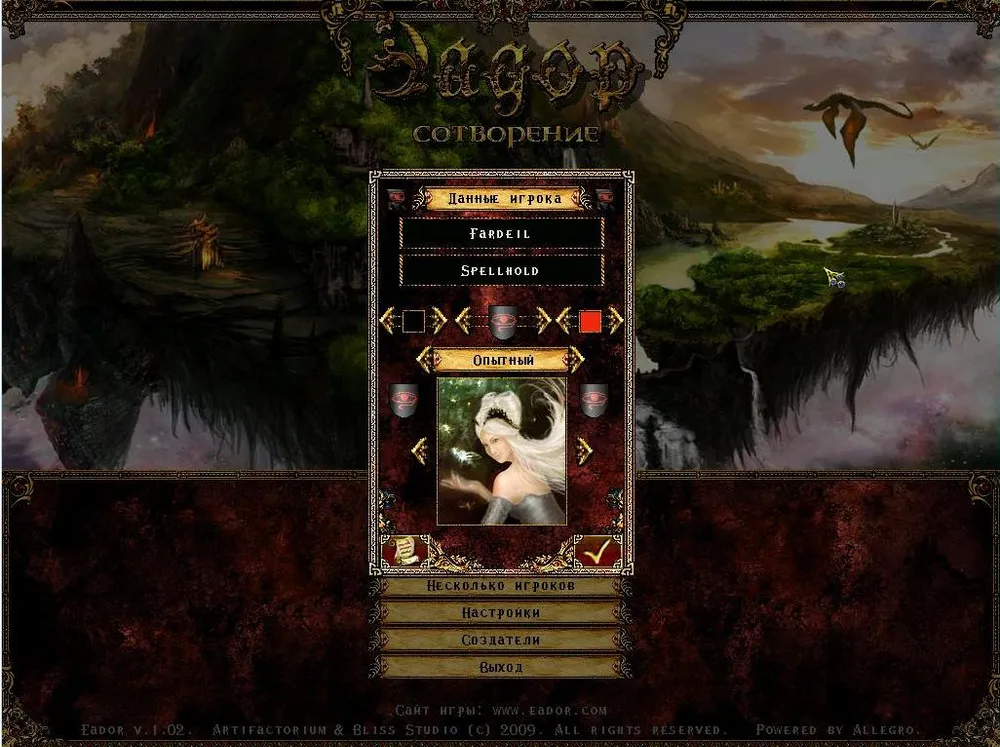
A small warning—there’s currently no confirmation function for deleting a fighter and selling items in the game, even though one can check a box in the settings. So be careful \_\_
The game features a "karma" system: perform good deeds and you become good, commit evil acts and you become bad. I don't see much point in being neutral, unless you’re roleplaying something.
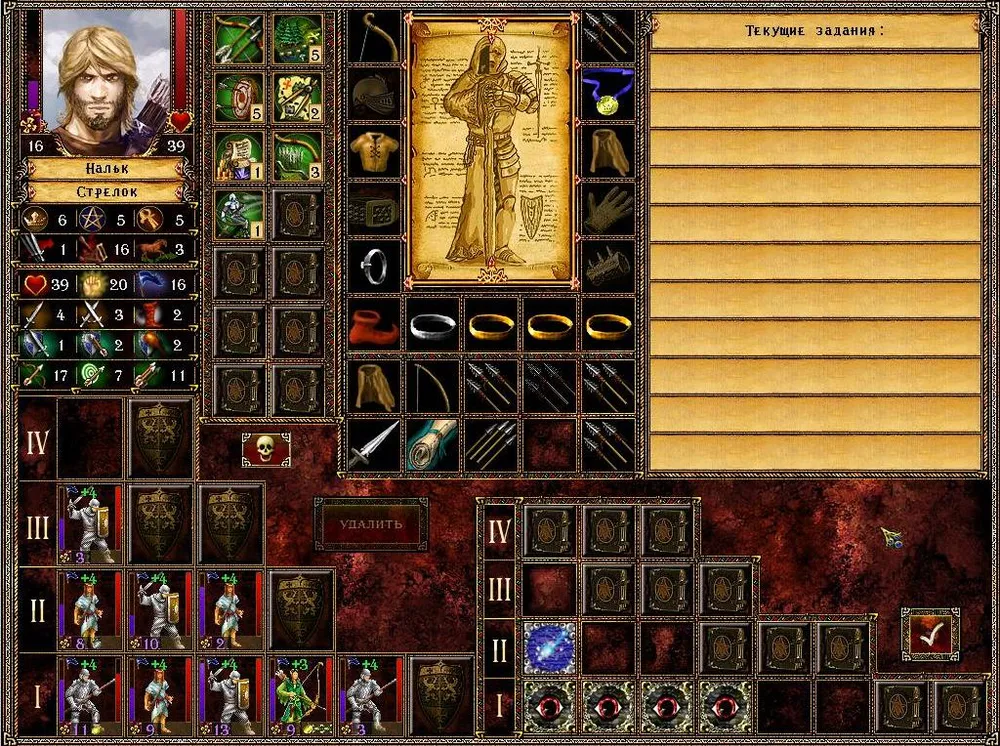
Heroes
They represent you on the floating islands in the astral plane; it’s through them that our will is transmitted to people, and with their help, we capture shards. There are four types of heroes to choose from: Warrior, Scout, Commander, and Wizard. Hiring the first one costs 100 gold and 10 crystals; the subsequent ones are more expensive. Buying a hero of an already existing class will cost you an even larger sum.
Warrior specializes in melee combat, can wear any armor, and use ordinary, heavy, and cold weapons.
Scout only wears light armor, can use bows, crossbows, and regular weapons. The trickiest part about him is the wear of arrows, as they often run out unexpectedly, so if you have plenty of money, I recommend buying him a backup of at least two dozen barbed arrows.
Wizard only wears cloth clothing, uses only wands, staves, and common weapons. By the way, from common weapons, I can recommend the "Assassin's Stiletto"—but that’s more suitable for a scout; a wizard rarely needs such weapons.
These three classes, when leveled up and equipped with good gear, can replace an entire army on their own. However, the scout and especially the wizard won’t last long without cover, and a warrior without support won’t stand against monsters of rank 3-4.
Commander I haven't forgotten; he’s just a bit different. All his abilities focus on enhancing the squad: increasing damage, health, resistance, defense, etc. He can only manage as a second level fighter at best, but he’s the only hero who can have fully filled troop slots. He can wear medium and lighter armor, cold and regular weapons, as well as banners (which also give some kind of benefit to the squad). To be honest, I’ve only encountered such a marvel as a banner once in the game, but there's still time ahead.
A squad can have a maximum of 16 fighters, including the hero. They all earn experience in battles and level up.
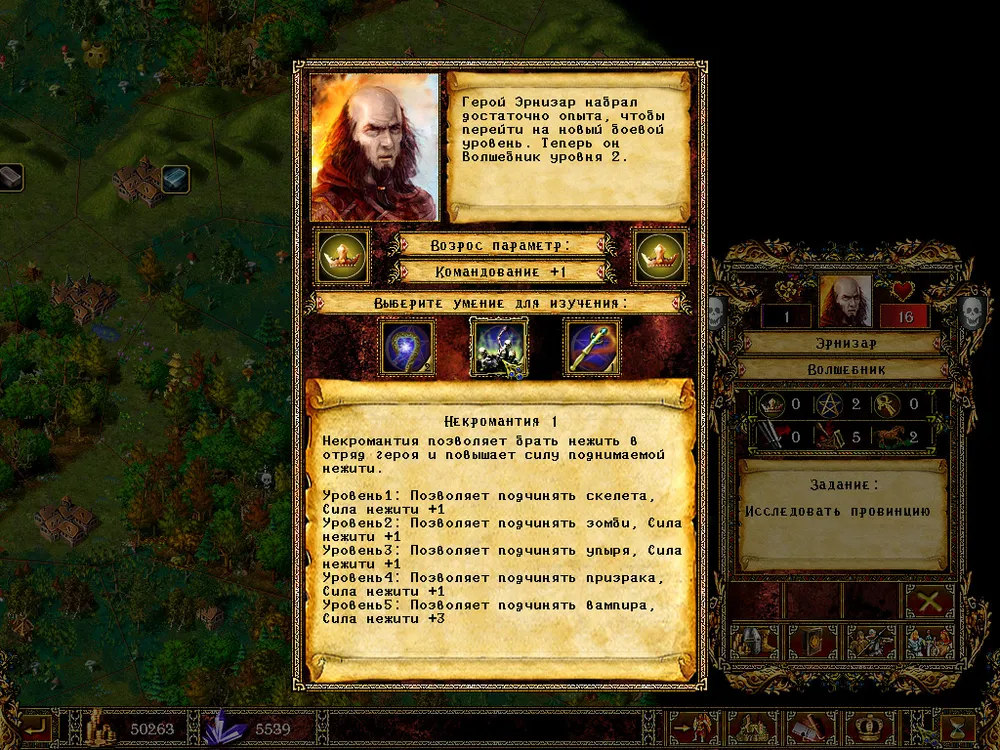
A hero has a choice of three abilities for each level up, while a regular fighter only has two. At level 10, the hero is offered to choose a specialization. There are four specializations for each class: three of them offer some multiclassing; for example, the commander can learn to use ranged weapons and study scout abilities, or, by choosing a different option, can learn fighter abilities. Whether to dual-class a hero or not is decided based on circumstances or preferences. Besides, if you do dual-class, this hero will only be able to learn the abilities of both classes up to the third level. At level 20, you receive an enhancement of your chosen specialization.
\By the way, the screenshot shows another game feature, which is not always visible—it's possible to keep summoned undead in your army during battle.**
A killed hero can either be resurrected immediately if he’s in our province or delivered to a castle if he’s on foreign land or if you don’t have enough money to resurrect him right then and there. In general, after delivering him to the castle, he can be kept dead for as long as you want. However, you can also choose to leave an unwanted individual for the crows right away.
Ancestral Castle
The starting point of each shard. In the castle, we build buildings, hire heroes and fighters, study spells, and it also has a small shop and a storage. Losing the castle means your defeat.
You can form an alliance with someone like elves, centaurs, or orcs. This will give additional structures in your castle and allow you to hire fighters from the allied race; also, neutral lands belonging to the ally will be transferred to you upon capture without battle.
Squads
That is, our fighters. They are conditionally divided into "good," "neutral," and "evil". Not without reason—if you're evil, the "good" troops will have lower Battle Spirit and vice versa. The same situation applies to the "evil" troops. Only the neutrals face no consequences.
Here’s how the information window for a warrior looks
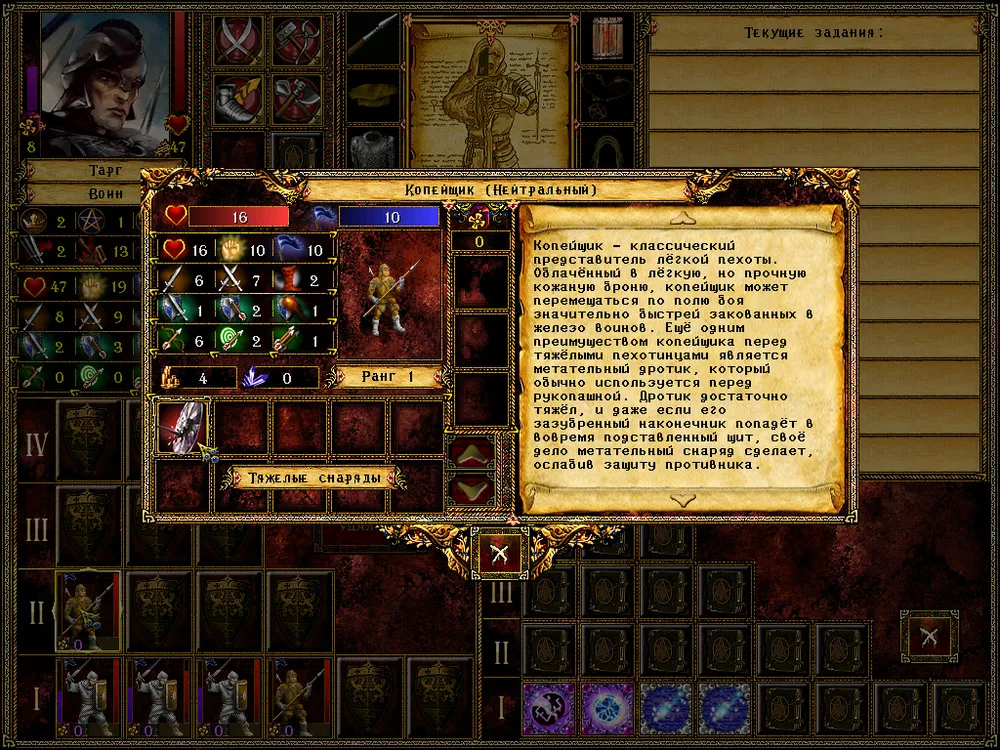
Many fighters have some special traits, like "Break Weapon"—reduces damage, "First Strike," "Armor Piercing"—the target's armor at the moment of the shot/hit is halved, etc.
Besides the improvements from leveling up, a fighter can be awarded medals and orders for various distinctions in battle. They increase the maintenance cost of the fighter, but many of them provide a noticeable boost to combat qualities. There are 13 in total, and a fighter can receive a maximum of 3. Mercenaries already have a "Mercenary Sign," which occupies a medal slot, so they can only receive a maximum of two from you.
Shard Map
Looks roughly like this

There are four types of terrain: plains, forests, swamps, and hills. The type of terrain affects the ability to build certain buildings and the map where the battle will take place.
Resources
There are ordinary resources—gold and crystals—and something like strategic resources—wood, mandrake, horses, marble, etc.
In the game, it's important to have access to strategic resources, otherwise you'll have to pay for each of them when building buildings and hiring warriors. Every time we "pay" for a resource, its price increases. Having access to a resource frees us from these additional payments.
The game features a variety of artifacts, some of which form sets. The set provides decent bonuses, but sometimes combining items from different sets yields even better effects.
The story revolves around the fight against chaos and the eternal struggle between the Lords for the shards of the once "whole" Eador. I've not delved too deeply yet, so I can’t say much. So far, I have encountered only Belez (an evil necromancer) and Oinor (a good mage). They are nearly opposite in everything, except one thing—they're both incredibly arrogant, so it's not my path to follow.
This is how battles proceed in Eador.
A battle proceeds thusly—first, one player moves all his fighters, then the other.
For example, here’s my scout's battle with a "guardian."
Guardians are a squad of fighters guarding a province. They can be incredibly weak (in this example, though they're acceptable for the very beginning), or powerful (like the "Dark Brotherhood" guardian).
To start—here's the hero's window.
Here's the start of the battle. The troop placement phase. The first turn goes to the one with the higher initiative; if the initiative values are equal, the first turn goes to the attacker. Here, the first turn goes to my opponent, so I can see how he has positioned his fighters.
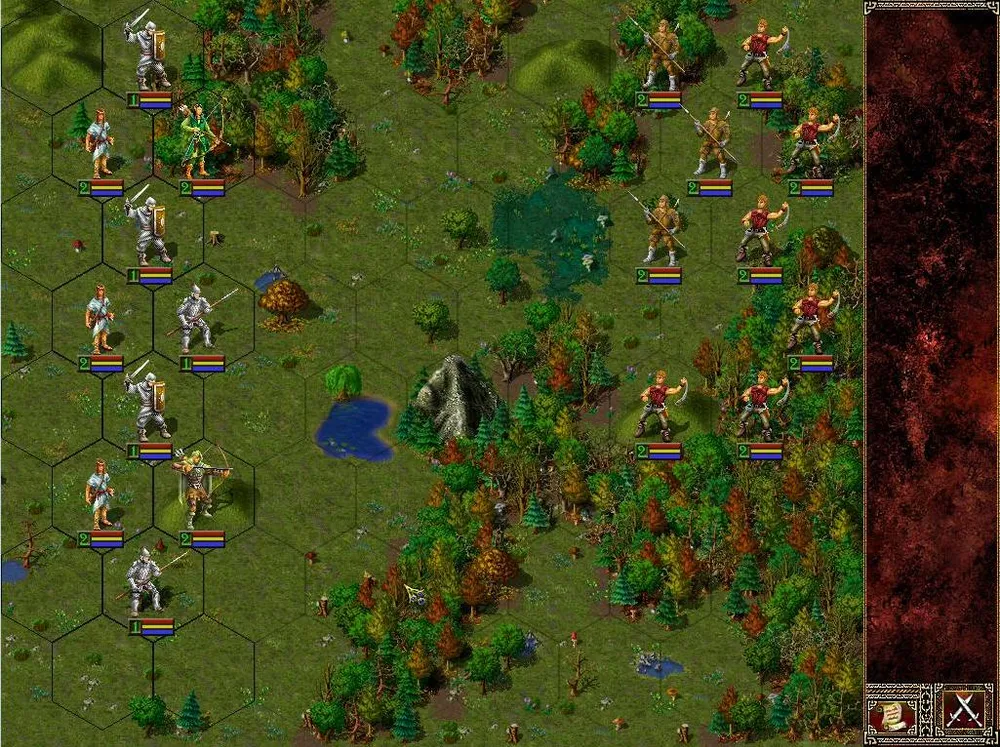
The scout has an ability that allows him to conduct diversions at the start of each battle. My skill isn't highly developed yet, so I only have one type of diversion—false alarm. It drains the stamina of the opponent.

If your archer is on a hill, his shooting range increases by one. My hero, with his range, can shoot across the entire field. The red circles indicate that this fighter is in the danger zone.
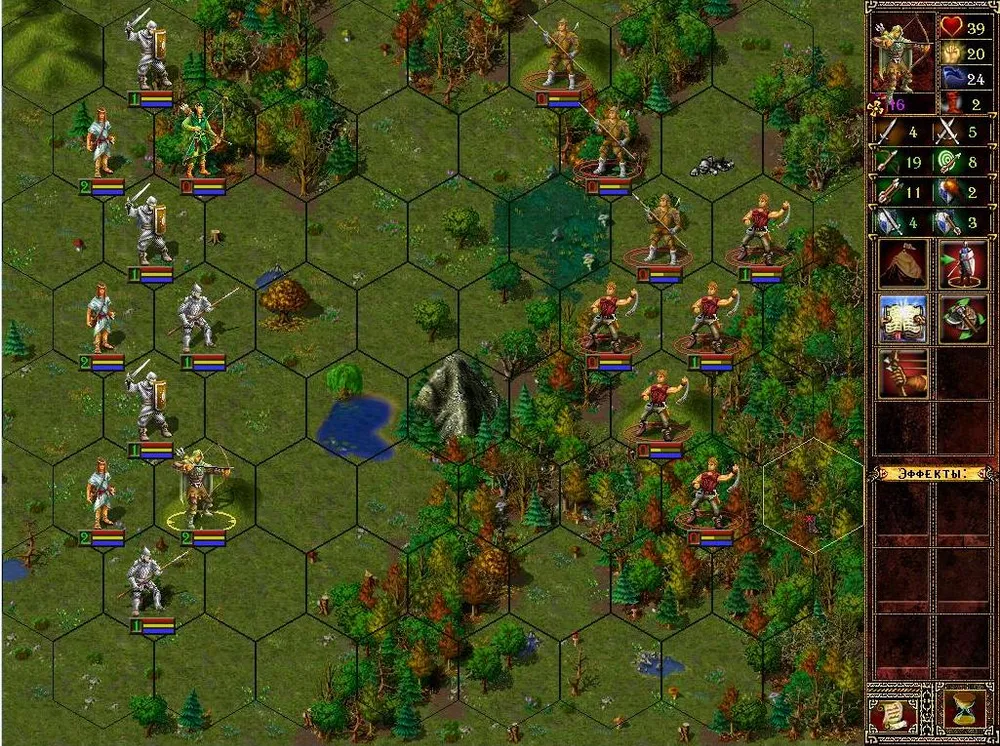
Each hero initially has a spellbook (in battle, on the right panel, the book is displayed along with other special actions); I currently have four fears and one spark in there (not even sure why I placed spark there), but I haven’t needed to use them. Overall, you choose a spell and target it, or cancel if you changed your mind—it's really that simple.
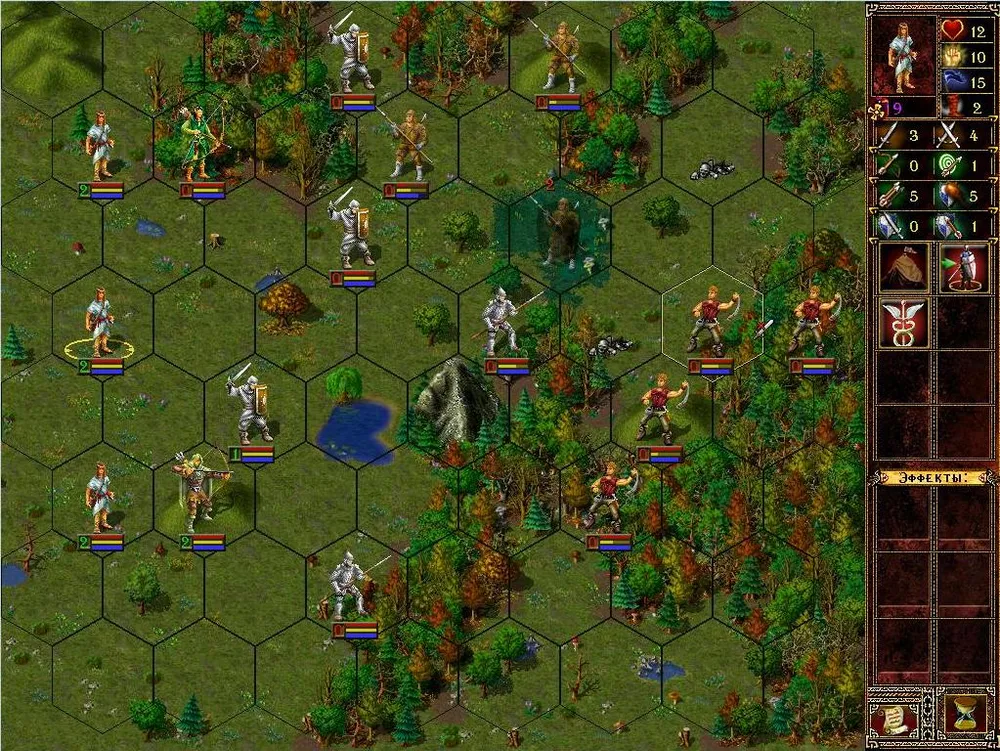
It’s not very noticeable here, but this pikeman killed that guy in the swamp. At the moment, the healer is highlighted.
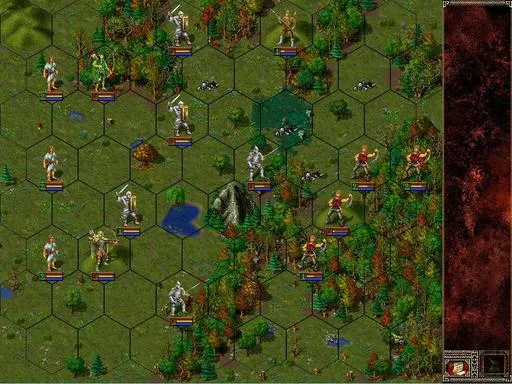
The bars under the fighters indicate health, strength, and battle spirit. The number next to the bar represents the fighter's speed, i.e., the number of tiles (hexagons) he can cross. Some of my fighters, for example, the swordsman, have a "March Rush" ability, which increases the fighter's speed by 1 for a turn, but it costs strength.
If stamina or battle spirit is less than 5, any damage dealt by the fighter decreases. If strength is zero, the fighter cannot move and "rests" on the next turn. If battle spirit is zero, the fighter panics and flees.
Different types of terrain provide different bonuses; for example, forests provide protection from arrows +2, while hills increase range and offer +1 protection.
Here’s how to view the shooting sector:

We build such a little hexagon. An elf shoots for 5 tiles, so we draw imaginary lines of that length from the "base" hexagon in six directions and connect the resulting vertices. Voilà, the shooting sector for that unit is ready. The same method applies to others.
That’s probably all for now. Happy gaming! \_\_