
With a slow shuffling gait — a review of "The Walking Dead"

Doctor: — Very interesting. Body temperature around fifteen degrees, no pulse, breathing absent, eyes red, swollen, with discharge. I'm afraid you have… conjunctivitis.
Patient: — I'm so hungry… I want to eat… I want brains…
Doctor: — Okay, okay… Just don’t rub your eyes under any circumstances.
«[South Park](/games?search=South Park)»
The '«[The Walking Dead](/games?search=The Walking Dead)»' came to life as a graphic novel that quickly gained a loyal fan base. Later, the comic evolved into a television series that achieved mass popularity. Now, the 'Walking Dead' has shambled its way into the video game industry. The developers of the dead came from a studio experienced in the niche of 'movie-based games'. 'Telltale Games' is known (or not so much) for creating '«[Jurassic Park: The Game](/games?search=Jurassic Park: The Game)»', '«[Back to the Future: The Game](/games?search=Back to the Future: The Game)»', as well as the game series about Sam and Max.
They presented '«[The Walking Dead](/games?search=The Walking Dead)»' to us in the form of an interactive movie with some quest elements, a meticulously staged performance in several acts. And this format of the game seems perfect for it, as the main idea of the comic and the series is not to shoot the undead, as one might think at first glance. In fact, both the graphic and television versions of '«[The Walking Dead](/games?search=The Walking Dead)»' emphasize not the action, but the narrative, sometimes quite slow, focusing on the characters' development, their stories (and only then on their agonizing deaths).

Moreover, the originals unabashedly use the classic 'spider jar' technique. I mean, what could be more amusing than watching a group of completely different people unite in the name of saving their own skin? Watching them start to bicker about anything and everything… And how will each character react when harsh reality grabs them by the throat and squeezes a little tighter… Guessing who will break first — the tough guy with steel muscles or the whiny girl… And deciding for yourself who truly did the right thing and who did wrong, because the line between good and evil has been utterly erased! And the zombies… they are merely a backdrop, some global catastrophe that could easily be substituted, say, with an Ebola pandemic.
I’m happy to inform you — the computer '«[The Walking Dead](/games?search=The Walking Dead)»' is executed in exactly the same spirit. The subtleties of touching relationships in the far from love triangle 'human — zombie — human' are presented in the best traditions. In the very first episode, our protagonist will join a group of survivors, make friends and gather enemies. And their relationships have only just begun to develop. But, unlike the originals, the game offers one very attractive feature — the player can influence the development of further events through choices.
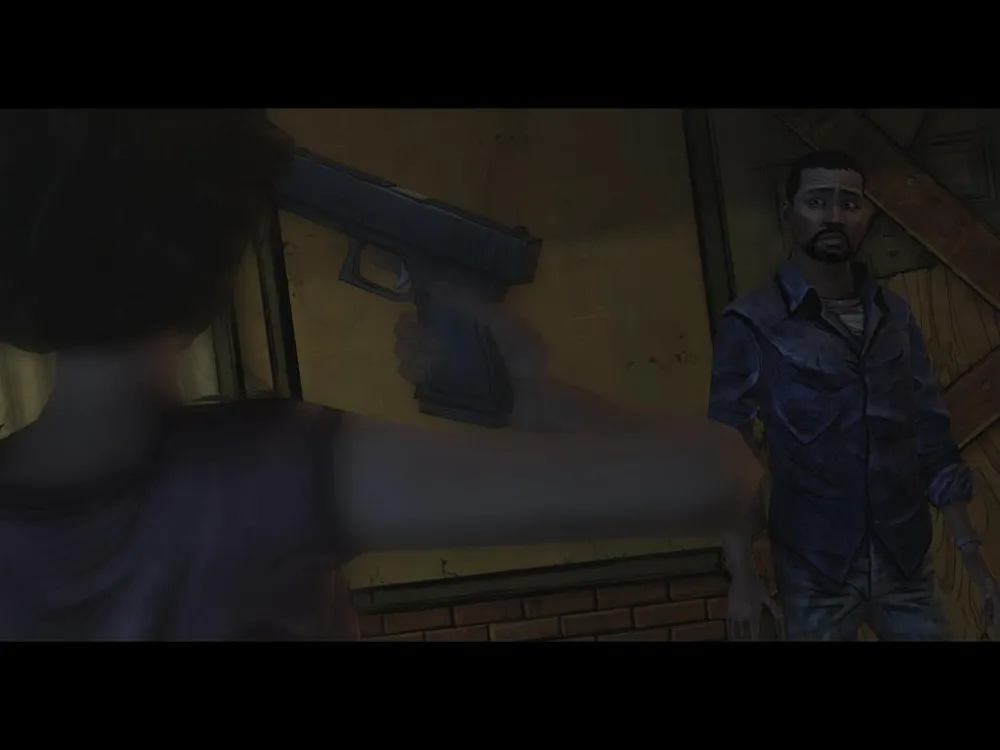
Most often, this is choosing a phrase in a conversation — between a rude or polite response, between truthful or deceptive. These responses will affect the way the interlocutor perceives the protagonist. For instance, if someone catches you lying, they may openly express their distrust later. Or, conversely, an honest and truthful answer about your not-so-righteous past might make someone avoid you. But sometimes the choice is much more serious and interesting — the player will have the opportunity to decide who of their newly minted friends will live and who will die.
There won’t be much time to think, weighing the options carefully; there isn’t much time for soul-searching and moral dilemmas. If you don't manage to decide — consider yourself quiet, or, in the worst-case scenario, you stood still like a statue and helped no one.
Since at this stage we have only the first episode of the game, it's impossible to properly assess the consequences of the choices made. For example, there is a moment when we have to choose whom to help, say, Vasya or Petya (the names were chosen randomly). We choose one, and the other is eaten by cadavers before our eyes. The question here is — what if later both Petya and Vasya behave completely the same, playing the same role? In this case, there’s no real choice, just the illusion of one. Another option is that Vasily will help us fend off an attack from the corpses in the next episode, while Peter shamelessly retreats, leaving the group to its fate (oh, Petya, Petya!). Now that would be real consequences of a real choice! That’s real influence on the outcome of events (it’s practically an RPG!)! Personally, I hope everything goes that way from now on. However, having completed the first episode a couple of times, I haven’t yet faced truly severe consequences for my choices — it all went according to a similar script, with only minor insignificant variations. So we wait for episode number two, which I hope will finally allow us to regret our actions or to rejoice in them.
It's simply impossible to retell the plot in such a short game; even a micro-spoiler is akin to one of the mortal sins. So I will try to remain silent about the script, noting only that it is perfectly fine.

The main character of the game, a certain Lee Everett, is entirely new to '«[The Walking Dead](/games?search=The Walking Dead)»; he was not in the comics or the series. Which is good. Because he has his own story behind him, which remains unknown to us. This story will partially unfold in the first episode, leaving the sharpest moments for subsequent chapters.
Some personalities that our black protagonist will encounter on his way are well-known to devoted fans and evoke a sense of raving fan happiness (girls squeal with bated breath — 'Hershel!!!'). However, the familiar faces play only episodic roles. It makes sense; there isn't even a hint of Lee in the original.
There are no objections regarding the secondary characters — they are ordinary people like you and me who were unexpectedly hit by a zombie apocalypse. Each of them has their own character and a brief backstory. Some are permanently crushed by circumstances, while others attempt to maintain their composure and are ready to fight. Their actions can be logical and sequential, or impulsive and thoughtless, making the computer characters even more lifelike. And this is indeed a great plus.
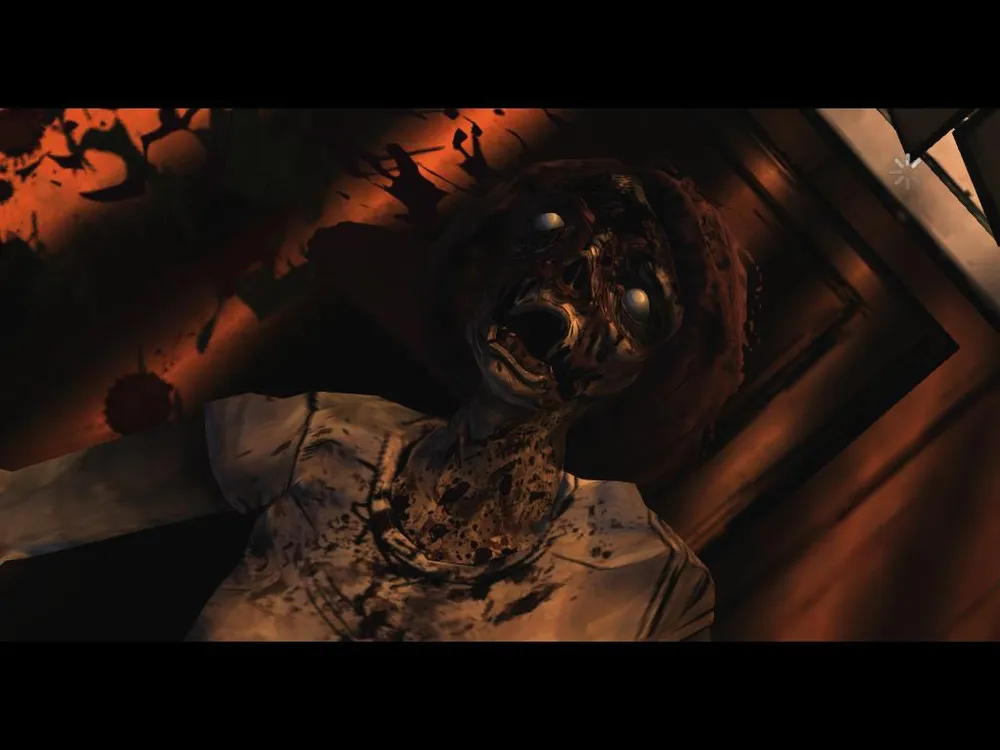
The zombies in '«[The Walking Dead](/games?search=The Walking Dead)»' are vivid representatives of the 'Romero' subclass of the undead: slow, shuffling paralyzed beings (I keep asking myself — 'How on earth did these clumsy ones manage to fill the whole world?'). Moreover, despite the fact that the zombie apocalypse occurred just yesterday, the undead look as if they’ve been lying under the snow all winter, and when they thawed, they ended up on the dinner table of a family of hungry martens. Yes, the makeup team obviously overdid it.
Additionally, just like in the original, the game's undead behave precisely when and how the 'invisible director' needs them. They patiently wait on the sidelines until people finish their important conversations or hide in a meticulously prepared ambush, ready to spring into action at the appointed time. When it’s required, they shuffle slowly, but in the next episode, as if by magic, they speed up. If the narrative demands it, they won’t notice our heroes, who are crouched behind… steel bars (0_o).
This strict direction is both good and bad at the same time. The problem is that it doesn’t always work. Sometimes a scene looks quite lively — the protagonist struggles with the next cadaver for life and death, and it makes one’s heart stop. But then, in the very next scene, the heroes clear the blockage that has blocked the road to the car, while zombies are crawling all around… So slowly and unhurriedly… Just slow enough for people to jump into the car at the last second and flee. And that looks unnatural, contrived, and stupid (just like the bars). Thankfully, such episodes are quite rare — literally a couple or three (including the bars, yes).
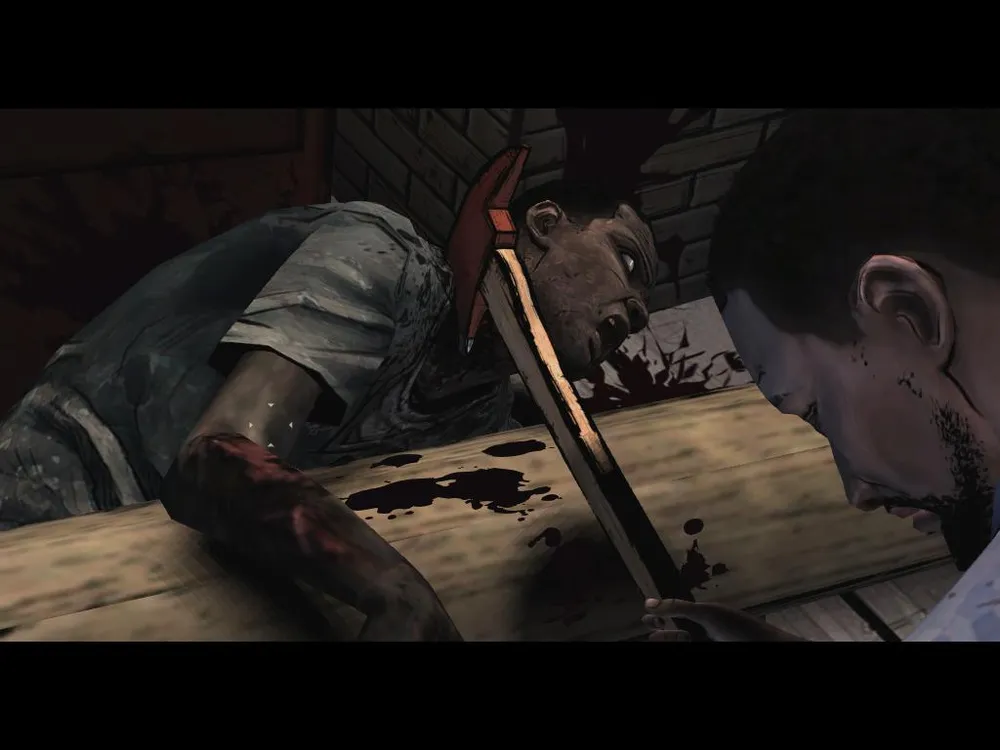
As for the gameplay, there's not much to say — it's remarkably simple and straightforward. The left mouse button is used for nearly all possible actions: to explore the surrounding environment; to hit the rotting face of the dead; to push a stuck car; to pick up an item; to open a door; to run from one cover to another. The protagonist will even crouch if he senses danger. Only sporadically will the hero need to stretch his legs by moving around an area using the good old 'WASD' keys, or to slam the infamous key 'Q' repeatedly to shake off the clinging undead.
There is no difficulty selection in the game as such, but you can complicate life by disabling hints in the game. However, I honestly don’t understand who would want or need that.
The graphics are presented disguised as a comic. Although, of course, the comic style of the game is fundamentally different from the style of the original '«[The Walking Dead](/games?search=The Walking Dead)»', but that's something to be thankful for — a black-and-white game would look very... strange. At the same time, behind that atmosphere, the developers successfully buried the miserable graphics. What can I say? Well done!
By the way, the episode is incredibly short — I spent about three hours on my first playthrough, and the replays only took one and a half. At the end, before the final credits, in the style of the same TV shows and comics, they show us clips from the next episode — hinting at the difficulties the group of Lee will face in the near future. This clever technique works — personally, I will be looking forward to the next chapter with anticipation. By the way, you won’t have to pay for the subsequent four episodes; the entire season of the game series is sold in 'Steam' as a whole — including the already released first episode and the four expected parts.

In conclusion, I would like to say that '«[The Walking Dead](/games?search=The Walking Dead)»' is indeed intended for a specific circle of gamers (not that narrow, however) — fans of the comic or the series. The game set in the 'Walking Dead' universe beautifully fits into it, following all the main commandments of its older brothers while retaining their atmosphere. This game is like a long-awaited new series, but with the possibility of role-playing and the necessity of making decisions, making it interactive. Fans will undoubtedly appreciate all this; moreover, they can forgive or simply overlook a lot. For example, the occasional absurdity and some vagueness of choice consequences. It seems to me that this was the task that 'Telltale Games' faced, and they managed it brilliantly. But how can '«[The Walking Dead](/games?search=The Walking Dead)»' attract someone unfamiliar with the source material or, even worse, someone who tenderly hates it? I'm afraid it has absolutely nothing to offer.
Thus, I take my leave. Kill zombies, love your loved ones, and fight for good by any means. Special thanks for proofreading this clumsy text goes to Surt. Thank you all, and goodbye.