
The Psychology of Sales in Steam
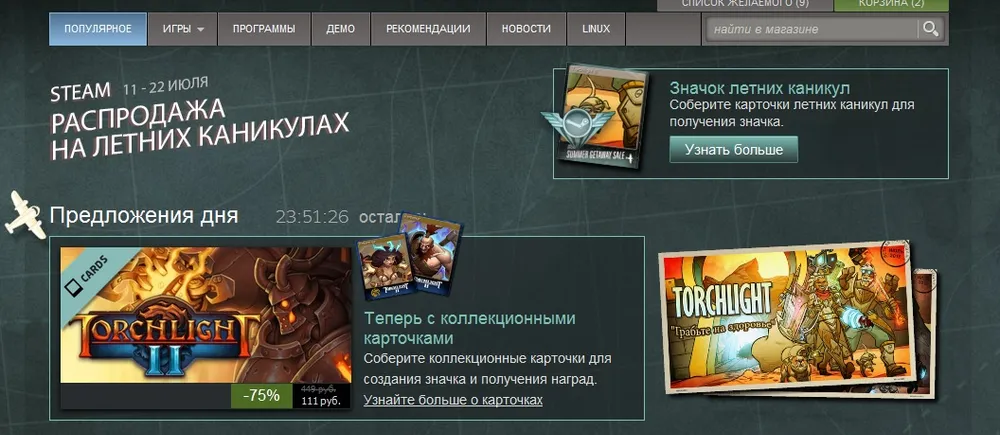
Who said that in summer we should urgently rush to the Mediterranean beaches, grow radishes on an industrial scale, or admire sunsets amidst endless fields? Toss aside the romance. I know what you did last summer, last winter, and what you are doing right now. Of course, many are still hilling the beds and stirring up romance (but why are you reading this text, I wonder?), but we know… Gabe, may the Force be with him, doesn’t need to ramp up the propaganda machine to draw millions of people into Steam links. You will do everything yourself. Open your wallet, transfer funds from your card, beg for an n-number of funds, and go fishing for the latest whispers of the summer sale. And don’t be ashamed of it. Everyone does it (except those with empty stash and willful individuals).
And I've already added [Walking Dead](/games?search=Walking Dead) and [Thief: Deadly Shadows](/games?search=Thief: Deadly Shadows) to my cart too. No amount of patience will be enough to refrain from grabbing a piece of the shared pie from the festive table. Jamie Madigan, author of the Psychology of Video Games resource, also isn’t shy about showcasing his purchases on the blog – he's already bought [Hotline Miami](/games?search=Hotline Miami), Fez, and The Swapper (great choices, Jamie). One can assume that neither he nor I have anything against the sale. It’s a common thing – Gabe is ready to please his flock once again. I buy a couple of necessary games on discount, Jamie buys, you buy. But some throw more into their carts than they can carry. And the thousands spent then gather dust in personal libraries, waiting for their moment. Usually, they don’t wait.
As Jamie points out (but you already know), the principle of the sale has hardly changed – there are daily deals flashing before us at the top that change every 24 hours. There are flash discounts that need to be snagged every 8 hours. Plus, user voting, where we pick one game out of three available, and the winner gets a discount for the next 8 hours. But there are nuances. This time, by participating in voting and purchasing games, we get collectible cards. It takes just ten bucks to get one of ten cards. And by gathering the cards… apparently something useful will come of it? I don’t know.
Artificial Scarcity
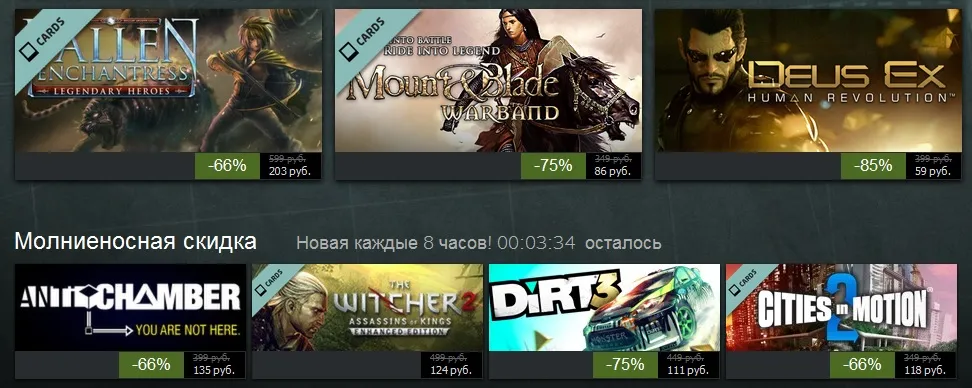
Research shows that the tactic of “offer valid for a limited time” is a super effective method during a sale because we value things that are in limited availability much more. Psychologist Stephen Worchel demonstrated this method using cookies. The study set up an experiment as a consumer taste test – they offered to try cookies from two jars. One jar was filled with delicious treats, while in the other there was initially not much product. People said that the cookies from the half-empty jar appeared more appealing, tastier, and more expensive. Of course, the cookies in both jars were identical. The games presented in the online service are constantly available, so Steam capitalizes on the attractiveness of a fallen chance. All offers are time-limited and come with a countdown that we can all see. When we start pondering a purchase, we have no idea if there will be another attractive opportunity to snag a game at a low price. So many prefer to act immediately and not postpone the matter. Moreover, the price for this purchase may turn out to be higher than in subsequent offers.
Progression Effect
Human nature is such that we find it hard to abandon a task we’ve started. Unfinished tasks drip on our brains and remind us that if we put in the effort and come closer to the result, we will feel a little better. This is why many of us can’t progress further in the main quest in an RPG when numerous unfinished side quests are nearby. In one experiment, researchers handed out empty cards to visitors at a car wash, which would allow them to wash their cars for free after accumulating a sufficient number of visits. Each time a customer washes their car, they receive a stamp and get closer to the goal. Half of them received a card stating “wash your car 8 times, and the next one will be free.” The other half had cards saying “wash your car 10 times, and the next one will be free,” but they already had 2 stamps on their card (as if they had already used the service twice). Thus, each client only needed to come and wash their car 8 times to earn the right to free service. As a result, people with two “starter” stamps more often became regular customers.
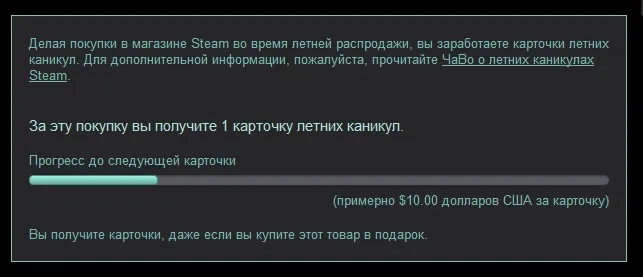
Steam exploits this feature of human nature by distributing collectible cards – a random card comes to your inventory after spending 10 dollars. When adding games to the cart, the indicator kindly tells you how much more you need to spend to get the next card. A simple demonstration of progress is quite enough to create a feeling that you have not yet reached your goal. And some people buy one more, albeit cheaper, game to fill the indicator. Another clever move by Steam in this direction is to show the filling of the indicator even before you pay for the purchase (“for this purchase, you will receive 1 summer vacation card”). After receiving the coveted card, the progress continues, because you have so far only obtained one card out of the 10 required. And it all starts over.

Commitment and Consistency
We do not wish to act inconsistently. Once we take on certain commitments, we trigger a mechanism of psychological pressure to stick to our decision even to the detriment of ourselves and our interests (in the case of digital service purchases, our wallets suffer as well). In his book Influence: Science and Practice, Robert Cialdini gives the following example. Once, he and a professor friend found themselves at a lecture on transcendental meditation. It was conducted by two lecturers who were trying to recruit as many people for paid courses as possible. They claimed that their program would not only help find inner peace but would also teach people to levitate and pass through walls over time. During the lecture, Cialdini’s friend became increasingly dissatisfied, and by the end, he stood up and convincingly refuted all the promises. Despite the fact that even the lecturers had to admit the professor's correctness and promised to verify his claims, people still lined up. They paid 75 dollars, even though they also heard the refutations from the professor. Why? Because they had set a goal, committed to resolving personal issues through transcendental meditation, and decided to act consistently, staying on course. And no amount of iron logic could shatter their hopes of fulfilling that commitment.
Now let’s switch our attention back to Steam. You’ve probably noticed how the service sends you email notifications when a game from your wishlist is sold at a significant discount. Many place games on this list in case of sales. And when an email arrives, players feel a sense of obligation. You didn’t add it just so it could sit there for years? On the contrary, you feel that this game could bring you immense pleasure, or it was just highly recommended by friends. Hence the roots of commitment and the ensuing consistency. Commitment can also arise from voting for a discount on one of three games. If you don’t own it yet, of course. By actively participating in surveys, players hope for a certain result. If the candidate wins the vote, there’s a greater incentive to put it in their cart – players feel as if they’ve won a small contest, and the discount is a well-deserved reward.
Contrast of Perception
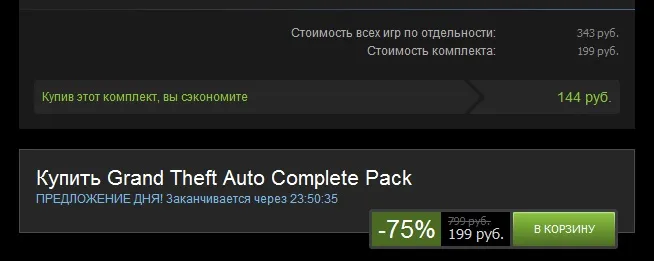
The principle of contrast of perception is also hardly optional in all areas of trade. When comparing the prices of two items, we often exaggerate the difference between them. In Steam, this is even possible with a single game. It’s unlikely anyone would be tempted to buy a game that received average feedback at full price. But as soon as it gets a tag of “- 80%,” we often change our minds. The principle of “anything is sweet for free” works against us, and we can easily buy an obviously bad product, but at a low price. The contrast method also manifests itself in the form of DLC bundles. After spending 300 rubles on a game, there’s the temptation to acquire a bunch of additions for 20 rubles simply because that amount seems insignificant compared to the full price. Yet we’ll get the game in “luxury” format, complete with all costumes and goodies. The third manifestation of contrast comes when comparing a game to a bundle it’s included in. Steam kindly points out that in the full bundle, the price will be noticeably lower and even shows the amount we’ll save by purchasing one game versus the entire collection. Sometimes the desire to save 1000 rubles instead of 200 kicks in, and we end up taking a bunch of games that we may never launch.
Partial translation of the article The Psychology Behind Steam's Summer Sale