
Reputation in Mass Effect 3 (guide)
- People. Reputation. Pragmatist? Hero? Is it correct to determine? Seek the way. Ethics are defined by the stage of society. Be yourself, Shepard.
Introduction
I must admit, in the previous series of the game, it often irritated me that in order to gain the reputation points I wanted as a hero, I had to choose responses I didn’t like. Moreover, the moral interpretations of the bioware characters sometimes seemed very strange to me. In the personal mission with Jack, I did not gain hero influence points because I simply couldn’t let go of the criminal who incited my fierce rage (the guy who was about to continue those inhumane experiments on children, which Jack had suffered from). As a result, I couldn’t reconcile Jack and Miranda, and Jack died in the final mission. The bioware characters believe that the hero should have let him go, and that’s where we significantly disagreed...
My introduction is to this point. Some players complain that they are now forced to choose friendly responses, even though these responses do not resonate with them. In particular, some guys “sweat” in conversations with the engineer who “lost her husband”. Or, conversely, while playing as the “evil” Shepard, someone suddenly realizes that giving the arrogant journalist a punch in the jaw for the third time could lead to losing the war, and that also displeases them. Why must the “hero” be such a bore that he can’t treat the ordinary Alliance dropships enjoying themselves in the bar? Why is it that the “renegade” knows the proper ritual of “Let’s drink to us,” while the hero cannot give the right answer (“Who’s better than us? - “If they existed, they’re already dead!”?) :)
I want to reassure those who are not yet aware. The reputation system in Mass Effect 3 is not at all the same system we saw in previous installments. Now it’s all simpler and more democratic!
What’s new and how it works
The scale grows as a whole. When reputation points are added, the scale recalculates and creates a percentage graph. Your persuasion or intimidation parameters are influenced by the entire scale. It looks like this:
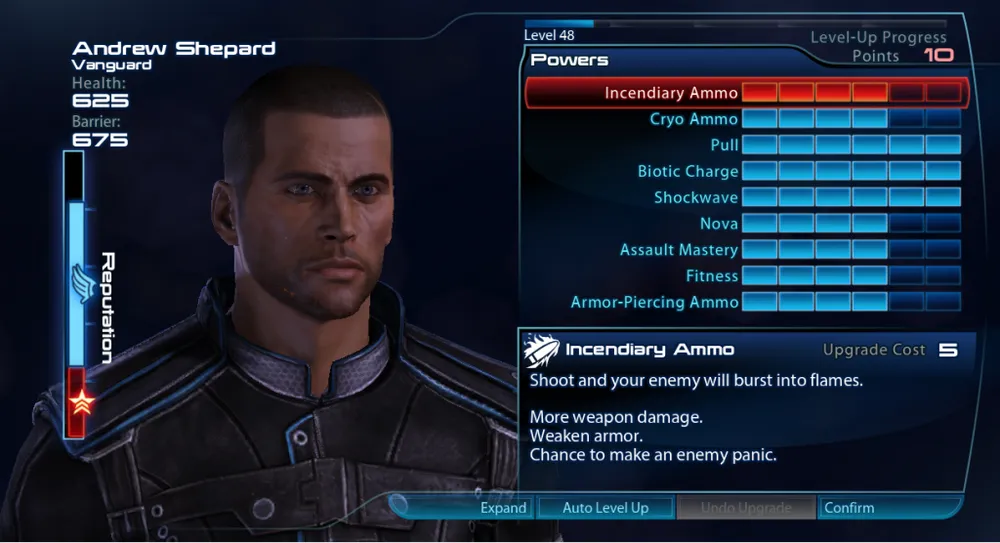
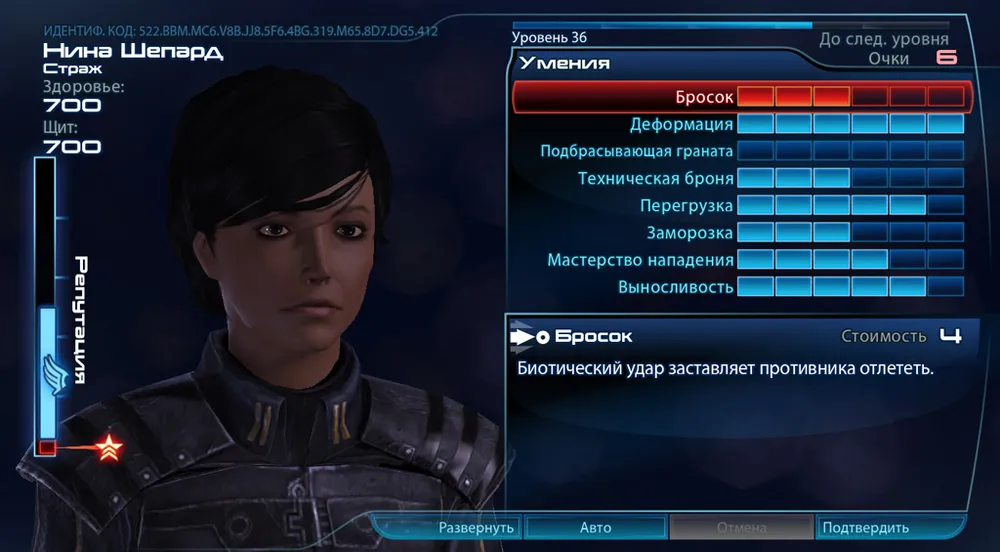
The blue part of the scale shows hero points, and the red shows renegade.
This is achieved by introducing a “neutral” reputation into the game. Neutral reputation points are not marked anywhere on the scale; they simply increase it while maintaining the percentage ratio of hero/renegade.
Visually, the awarding of neutral points is indicated by an icon that combines the hero's wing and the renegade's star:
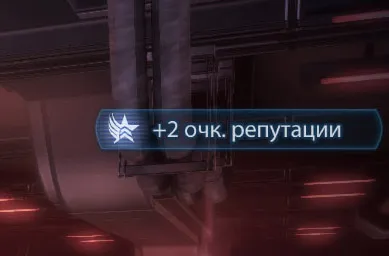
Hero or renegade points are only earned in specific quests, but in most cases, either only neutral points are awarded, or neutral + hero/renegade. It looks like this:

While figuring things out, I replayed the first conversation with Vega on the Normandy eight times. As a result, no matter what responses, gender, or class of hero I chose, I only got 2 neutral reputation points.
And so it is with all companions: 2 points - and that’s it. This allowed me to choose the style of conversation and gameplay that I liked, selecting both friendly and aggressive responses at the same time (for example, I don’t understand why the “hero” should allow himself to take a hit to the jaw ^^).
Another example:
- If you help refugees, you gain hero reputation.
- If you decide to destroy a colony captured by the Reapers with an orbital strike to prevent the emergence of a million new husks, you will receive renegade points.
- In the case of military assistance to allies, for example, during the cleanup of a Turian location, you will gain neutral reputation, as this action is advantageous and characteristic for any side of Shepard's personality.
Checkpoints
Now let’s look again at the scale. The divisions on it aren’t just for show. They denote qualitative jumps in persuasion/intimidation parameters. What do these divisions affect?
“Key options in dialogues during crucial game moments are initially closed, - writes Patrick Weekes on Blog.BioWare.com. - You can only choose them once you’ve gained enough reputation points. Each division represents a sort of checkpoint. If you see that you’re just a bit short of the next division, and someone says to you something like: “Let’s head to [the character's homeworld] and end this once and for all,” it wouldn’t hurt to complete a couple of side quests first and try to reach a new reputation checkpoint on the scale.”
So, now there are no penalties for mixing paths. In previous installments, if we wanted to maximize the persuasion skill, we had to roleplay as a hero regardless of whether we liked it or not, thus becoming a pure pragmatist.
In the third part, the quality of persuasion and intimidation is determined by Shepard’s fame in the galaxy, regardless of whether that fame is positive or negative, meaning a TOTAL score that sums up points from both hero and renegade.
So now we don’t have to worry too much about what’s a heroic response or what’s practical, and we can avoid roleplaying an angelic heroic or thoroughly evil personality.
Important Points
However, there are a couple of significant points to mention.
Firstly, in a conversation with Jalisa, choosing the paragon response attracts her to Shepard's side, and you gain a military resource (in the form of Jalisa’s journalistic talent and donations from various humanoids). Otherwise, you don’t receive this resource. The same goes for Diana - no matter what negative feelings Shepard (in your opinion) might have towards the journalistic fraternity, it’s still better to take this sweet girl on the “Normandy”: her broadcasts are also a military resource that increases humanity’s chances of victory.
Secondly, at the very end of the game, there will be a dialogue with the Ghost. Whether the Hero/Renegade phrases will be available depends not so much on reputation, but rather on whether you chose Hero/Renegade phrases in conversations with the Ghost throughout the game. Choosing Renegade responses unlocks the renegade dialogue option, while choosing all Hero responses unlocks the hero branch, respectively.
Overall, reputation points in ME3 are more a reward for thoroughness and completing more assignments. Unfortunately, this further distances Mass Effect from the RPG category. However, given that combat has become significantly more interesting and intense in the third part, I can forgive it... :)