
"To kill, not to pardon" - review of Assassin's Creed: Brotherhood
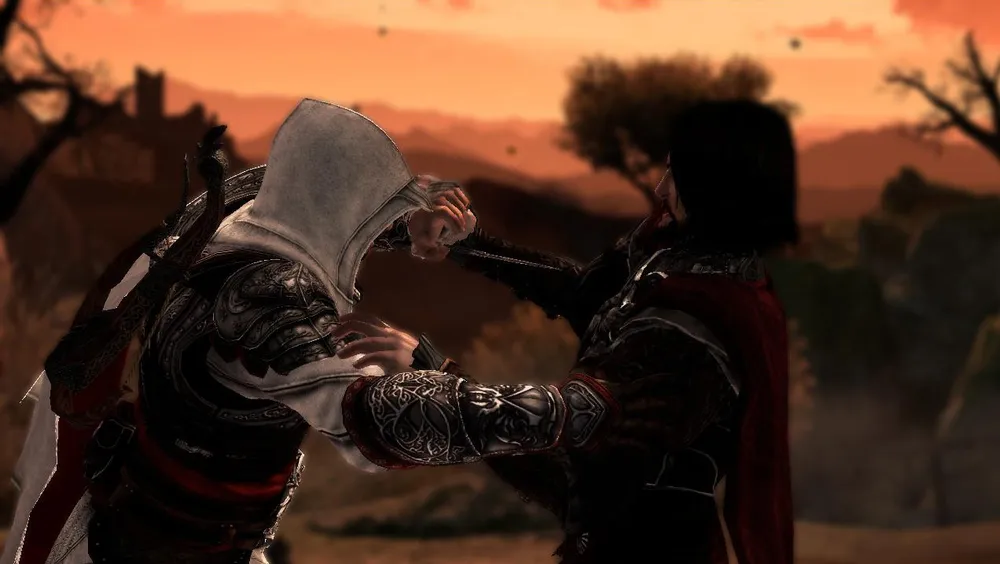
Today’s Assassin’s Creed for Ubisoft is an excellent cash cow, an elite franchise, and a means to keep its stock prices within an acceptable range. The development team works efficiently, the process of creating sequels and continuations is streamlined and turned into an unyielding conveyor belt—rest assured that within a year or so, a fresh installment of the series will be nearly ready. The game’s success can be attributed to several factors: first, the setting; second, the freedom; third, the script, as the Templars and their dark deeds have always been among the interests of many people.
The first Assassin's Creed was a test run. As in, how will players respond to the gameplay of a solo assassin eliminating targets in various ways? Moreover, the action took place in the Middle Ages, and the number of action games featuring castles and knights can be counted on your fingers. You understand, that's enough to keep the project at the top of the bestsellers, even despite the great monotony of its content. The sequel was meant to correct all the original's mistakes and even more—to solidify the series in the gaming market. And it happened: Assassin's Creed 2 turned out to be an excellent game. The story unfolded in Venice, Florence, and a bit in Rome at the end of the fifteenth century, adding to the active characters the famous Leonardo Da Vinci, allowing the protagonist not to drown in water, and at the finale inviting none other than the Pope (Alexander VI, also known as Rodrigo Borgia). Thus, gamers received an excellent, let's say, action-packed story, while developers and the publisher enjoyed significant sales revenues. Everyone is satisfied.
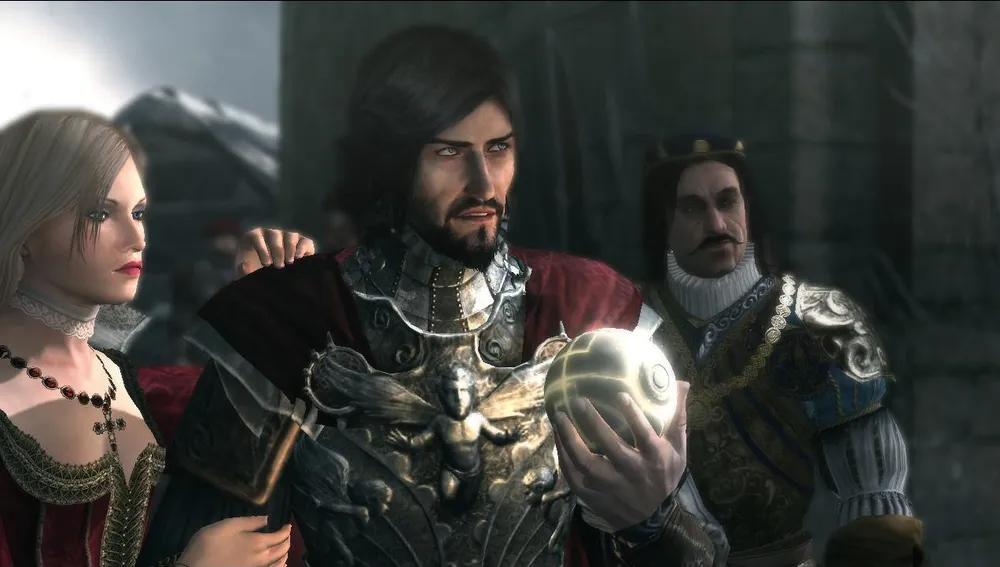
This man killed our uncle. This man is dead.

The action featuring Desmond Miles somewhat resembles the gameplay of Uncharted. And Lucy, Desmond's friend, manages to jump and run in high heels. Amazing.
Uninvited Guests
Rodrigo Borgia will be our main target in “Brotherhood.” You see, at the end of the second part, Ezio Auditore was severely wounded, and this factor seemingly influenced the hero's decision to spare the Pope. The Pope returned, this time with a whole army, destroyed the family nest, and killed uncle Mario. Ezio’s mind was filled with anger and hatred (“I lost my family due to betrayal”), and the assassin decides to head directly to Rome, the very heart of the Templar order surrounding the ruthless Rodrigo Borgia from all sides. The villain almost completely occupied the city, lining his pockets with the incomes of small merchants and various shops. Peaceful citizens live in fear, poverty thrives, and here come the French as well, causing trouble for no apparent reason. The Brotherhood of Assassins decides to take matters into their own hands and overthrow the power of the bearded tyrant.
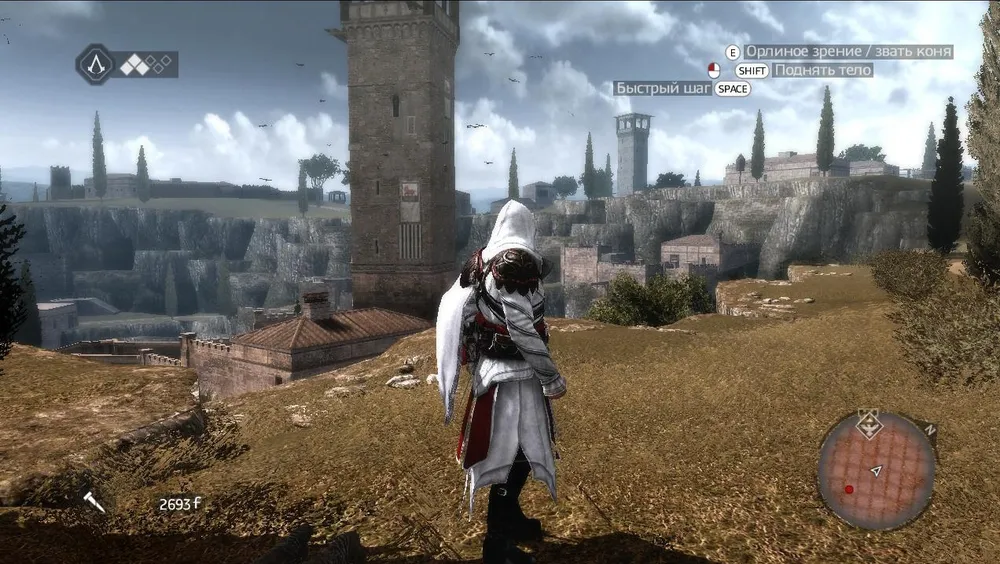
How come the guards don’t pay attention to the dizzyingly cool assassin outfits?
The authors love to introduce innocent (at first glance) girls to Ezio, and this becomes quite apparent within the first hour and a half of gameplay. First, the guy helps an unfamiliar lady drag a crate of fruit, after which she promises to repay the gentleman somehow. That very night, Ezio finds himself in his chambers with an old friend. In the morning, a cannonball crashes into the bedroom, destroying everything in its path, including the young couple’s plans. Half an hour later, the assassin jumps on his horse and rushes towards Rome. Being injured, Ezio loses his balance and falls off the horse. Awakening, he sees before him… you guessed it—a lovely face of a charming girl gently moistening the forehead of the long-suffering macho. To hell with realism, it sets a, so to speak, pace and direction for the game—Rome is ahead, baby, many delightful things lie ahead. Although, no, I must disappoint you a bit—work and flirtation in this case will turn out to be incompatible, and from then on, the assassin will dedicate his time to completing his mission. For the best.

His Majesty - the Coliseum.
A Visit to the Pope
Rome, by the way, is excellently crafted by the developers. Quite frankly, after the brilliant work done on the other locations in Italy, we did not expect anything less. Have you only seen the Pantheon in pictures? Here are the columns of this architectural masterpiece at your feet. Dreaming to be in the stands of the legendary Coliseum? Here it is, completely at your disposal. The Temple of Saturn, the Market of Trajan, the Temple of Vespasian, the Aqueduct of Claudia, Nero's Golden House, and much more… First time hearing about these landmarks of the capital of Italy? Then you have access to a local database containing interesting information about every somewhat significant building, character, or group of people. It should be noted that the crowds on the streets of the city became even denser, and there are even fewer duplicates among them. Richly adorned neighborhoods coexist with openly poor ones, and quiet alleys lie next to vast trading squares. The developers truly managed to convey all the grandeur and dignity of Rome, thanks to which the first twenty minutes spent in the city, the player simply admires the detailed architecture and beautiful views.
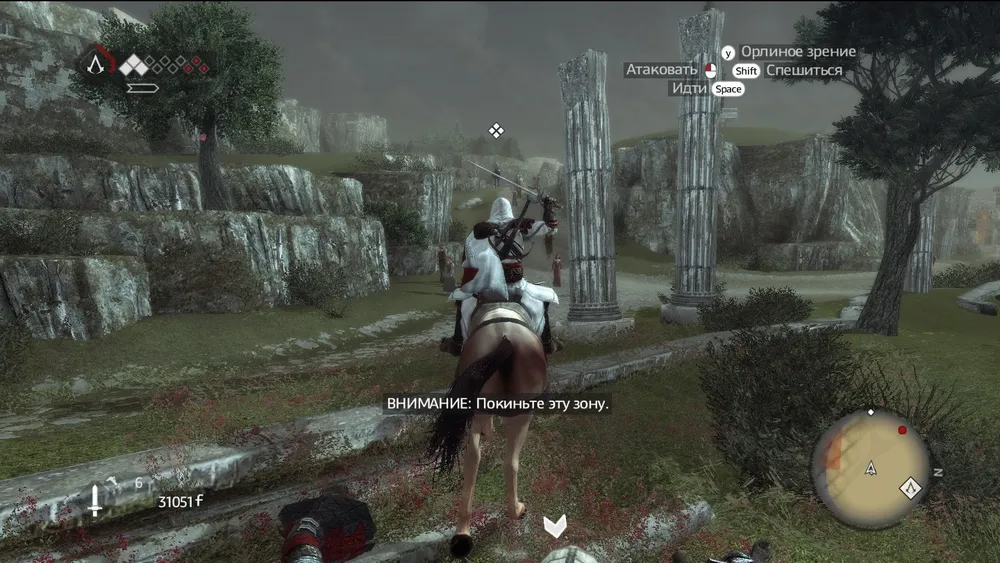
Horses are now a full-fledged mode of transport, which can be saddled at almost any moment. If only a steed were nearby.
First Things First...
Admiring Rome is undoubtedly important, but it’s time to start working on tasks. Almost every task is accompanied by a small dialogue, and this is where the first shortcoming of the developers is discovered. The conversations Ezio has with old and new acquaintances are at times blatantly silly, chaotic, and illogical. Here’s one of the dialogues with Niccolò Machiavelli (a thinker of that era, leader of the assassins in Rome)—while Niccolò is discussing the further plan of action with Ezio, a typical urban thief rushes by and skillfully swipes some money from the protagonist. Our interlocutor advises us to catch the scoundrel and reclaim our belongings. When we meet Niccolò again, the conversation continues:
- Did you take the money from our friend?
- Yes.
- A small victory.
- If we unite, there will be even more victories.
Either Ezio tried to quickly shift the focus towards the common struggle for freedom and justice, or it’s simply foolishness on the part of the dialog authors. The conversations between characters do not withstand any criticism; everything devolves into banal and utterly inappropriate jokes. Fortunately, exceptions can be found among the dialogues, but the “literary” component cannot be described as one of the strengths of Brotherhood.
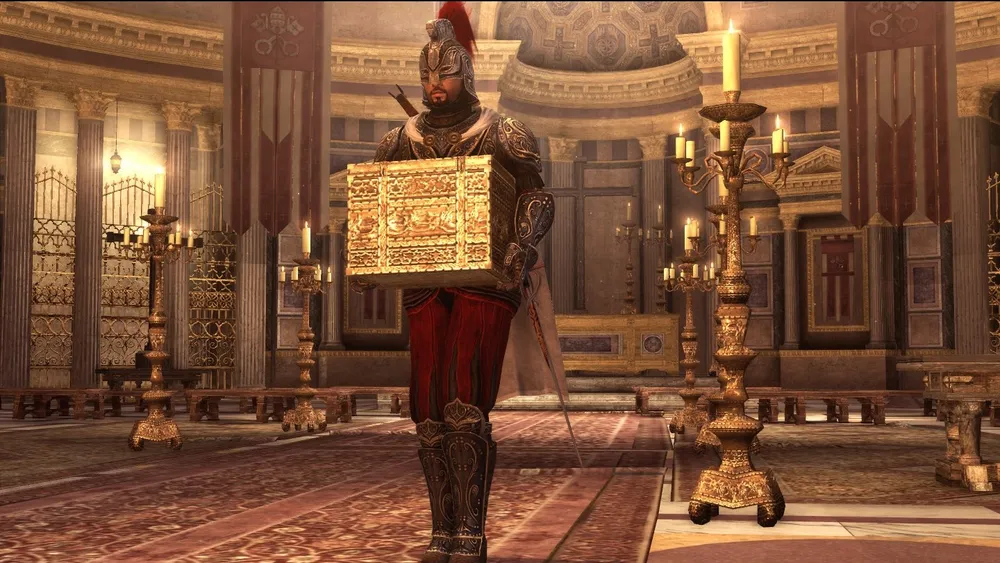
Not by kills alone do we live.
In principle, the same could be said about the gameplay. Some initial missions are blatantly frightening and make you uneasy, but over time, the gameplay, like the story, picks up speed and truly engages the player. The authors constantly change not only the battle locations but also the overall pace of the game. Here, you need to stealthily track a specific person; there, initiate a massacre; and here—secure the support of your brotherhood (the title of the new Assassin’s Creed in Russian translates to “Brotherhood of Blood”). One of the main innovations of the series should be noted—Ezio can purchase and maintain various local properties with his hard-earned money, which means that every twenty minutes or so, a certain sum will drip into our pocket. If the building is located in enemy territory, however, some attention must be paid to the local authorities. Specifically—eliminate the leader and set fire to the tower. Thus, aside from moving along the storyline, we are essentially rebuilding the entire economic system in Rome. To our liking, of course.
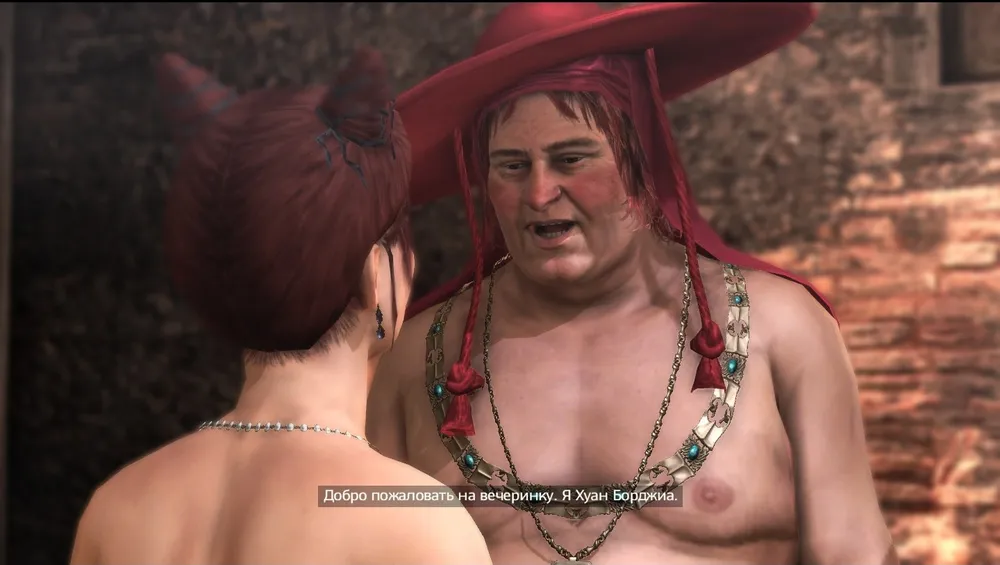
We will also encounter such, um, colorful characters.
Computer Painting
Assassin's Creed is not only “freedom” and “scope,” but also “magnificence.” The series engine—Anvil—is continuously upgraded and improved, making each new game from Ubisoft Montreal a standard of the appearance of action projects. I’ve already written about the crafting of Rome, but besides the city, there are characters, residents, and other types of objects. And although the simple gawkers on the streets cannot compare with the plot characters with whom Ezio will have direct contact, nonetheless, one cannot ignore the work of designers and programmers on secondary figures. Multiplayer characters are also intricately detailed to almost the maximum, and let me remind you, there are sixteen of them. Animation is a bit less impressive: sometimes the hero’s cloak resembles cardboard, and Roman horses don’t behave as realistically as their counterparts from the American plains of Red Dead Redemption. The magnificent overall view is complemented by a new quality of the lighting system and shadow work.

I got pushed. Nice view.
One After Another
The multiplayer of Brotherhood resembles the online mode from Dead Space 2 in something. Not in modes or gameplay, but in purpose. You’ve completed the storyline, gained a wealth of new emotions and impressions, but there remains a desire to play Assassin's Creed again. There is no wish to return to Rome with Rodrigo Borgia and his henchmen, but to connect in an appealing multiplayer session—now that’s palpable. Honestly, I must say: Brotherhood fulfills its mission a hundred percent. Moreover, here it’s just a test, an experiment, and I’m confident that in the full third part of the series, the authors will develop the idea of such a network mode even further.
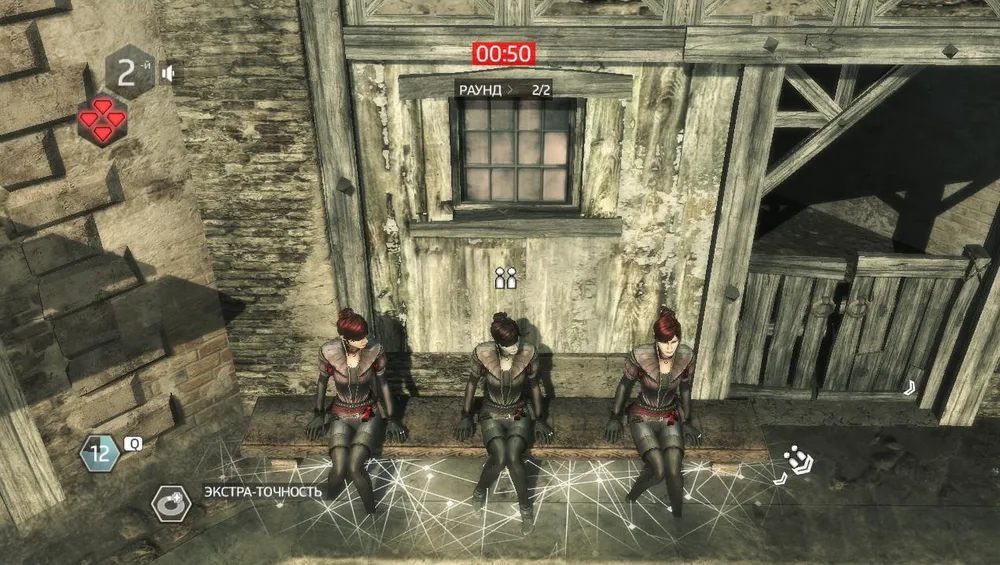
And just try to guess from the outside who of these three I really am.
For now, we have sixteen character classes at our disposal. Fourteen of them are available to everyone, while two are exclusive to DVD box or collector’s edition owners. Essentially, playing as each separate character is somewhat uniform; the ways of killing enemies, to be precise, the animation of “fatalities” differ. A courtesan, for example, skillfully wields her fan, slitting throats, while a heavy knight prefers to simply stab his foe with his finely sharpened sword. In any case, the local director tries to present death or killing from the most striking angle. In the editor, you can customize a profile (and there can be several) to your liking. For instance, taking special abilities such as “smoke bomb throw” and “disguise” (changing the character for ten seconds). Such profiles can be numerous and can be changed during breaks when the character, so to speak, “respawns.”
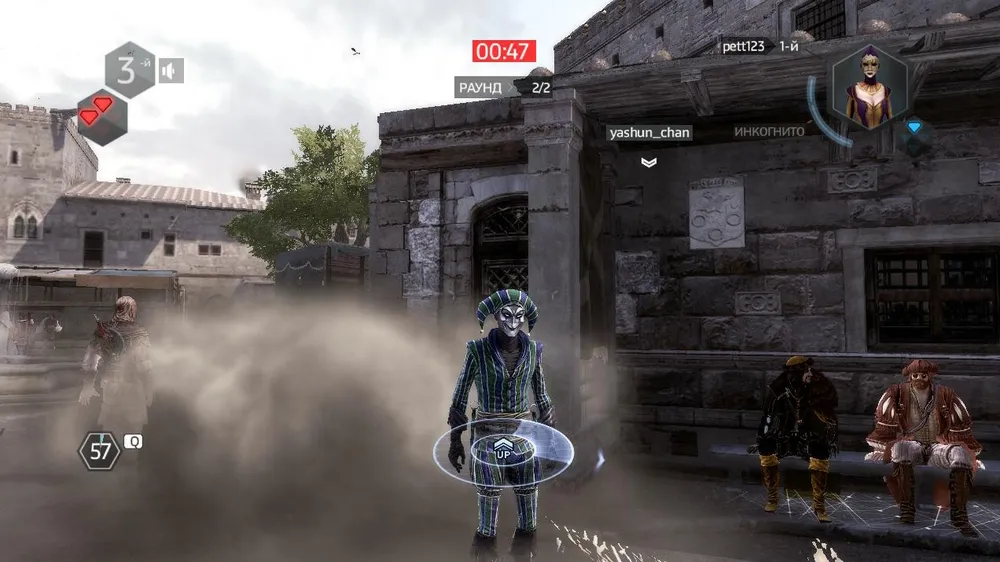
The smoke screen can easily disable several opponents, giving you a chance for escape.
The gameplay is fundamentally very simple. Let’s take, for example, the “recon” mode designed for six or eight players. Each one’s task is to track a specific target (you will be given the character's avatar as well as his approximate location) and kill them in the most spectacular way possible, as points will be awarded for kills, which must exceed those of your opponents by the end of the round. For victory, of course. The problem lies in the fact that while you are striving to track your target, your character is under exactly the same threat as your victim. You are simultaneously both the hunter and the hunted, which gives entirely new emotions from the game. You must be on guard every second, watch your surroundings, move stealthily, and blend into the crowd. In short, don’t give any signs of a real player. You are a simple game model placed by the developers on this map for crowd creation purposes. And it’s not as simple as it may seem at first glance.
The second mode I wanted to highlight is “Hunt.” Eight players are divided into two teams. In the first round, one team plays the hunters, while the other plays the victims. The assassins must complete as many contracts as possible in the offered five minutes to score the maximum possible points. This, of course, allows no errors or miscalculations. Because while the hunters are trying to identify members of the other team, the victims can leisurely earn points. For example, by standing next to the nearest NPC and portraying that very NPC, your team will earn some points, albeit a small amount. By changing from a static character to a mobile one, joining a “walking” group of computer dummies. Escaping will also be rewarded with certain points, but the true delight is to stun the killer (pressing shift). This is easier with the ability “smoke bomb”: while your enemy has lost concentration, it’s the perfect time to hit them with a blow to the “soup.”
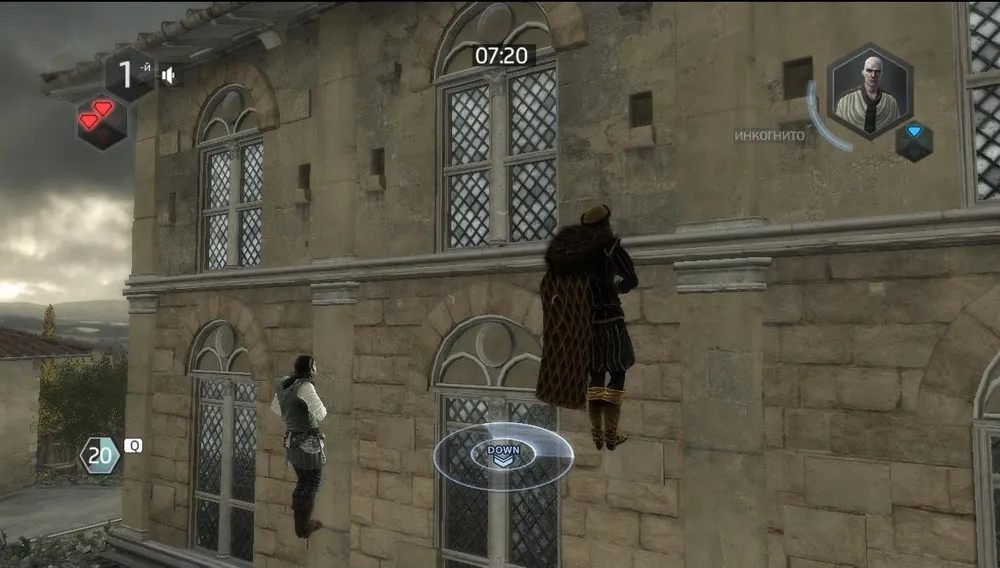
Let’s pretend that no one sees us.
Other modes, such as capture the chest or “escort,” don’t captivate as much, as they distract from the main interest—tracking and, directly, killing. Nonetheless, this is purely my, um, subjective opinion as the author, who, I should mention, probably just hasn’t spent enough time in these modes. I note that I spent about ten hours in the multiplayer of Brotherhood. You can judge the level of its appeal.
Looking Ahead
Assassin’s Creed: Brotherhood was released exactly as we expected. An emphasis on the epic narrative, a multitude of cutscenes, magnificent Rome in single player, and incredibly engaging gameplay in multiplayer. In the new Ezio Auditore, you will walk the bloody path of revenge, sowing chaos and fear in the eyes of the enemy. The series has received a correct vector of development; however, Assassin’s Creed 3 should be something completely different. Players are unlikely to accept a third coming of “Ezio,” so Ubisoft Montreal needs to come up with something radically new within the series. Perhaps the authors will make the game world darker, and present the assassin in a different light? Only time will tell.