Andaran atish’an! Or learning to speak Elvish.
The Elvish language, or "Elvish," was nearly lost when Elvenen fell under the oppression of the Tevinter Imperium, and its people were enslaved for over two millennia before the Dragon Age. When the elves migrated to their second homeland, the Dales, they sought to revive their lost language and knowledge, but the Dales also fell after the Church's Exalted March in the early years of the Age of Glory.

Elvish in Dragon Age is significantly fragmented; some words appearing in conversation serve as a working language used for daily life. Dalish elves, self-proclaimed guardians of the elvish language and knowledge, use Elvish more than their flat-eared brethren from Elflands. Living among humans, city elves have managed to preserve only a few old elvish words, the origins of which they have nearly forgotten. For example: "shem" - derived from "shemlen," meaning "quickling," or "fast children" - an old elvish term for the race of humans - and "hahren" - the leader of an Elven society, meaning "Elder" in Elvish.
Elvish Phrases. Gaming Canon.
Andaran atish’an - a formal elvish greeting. Literally: "I am in this city, the city of peace."
Aneth ara: a social or friendly greeting, used more by the Dalish among themselves than with outsiders. Means: "My safe city."
Arlathan: the capital city of Elvenen, the true homeland of the elves, from the phrase "ar lath’an" - "I love the city."
Asha'belannar - Woman of Many Years. This is how the Dalish refer to Flemeth.

A Great and Terrible Asha'belannar
Dareth shiral: Used as a farewell, it means "safe travels."
Elvhenan: City of our people. The name of the elvish civilization before the arrival of humans in Thedas. Can be translated as "Our hearts."
Ma nuvenin: As you wish.
Ma serannas: Thank you.
Elvish Dictionary.
Abelas (ah-BEY-lahs): Regret. Also used as an apology.
Adahl (ah-DAHL): tree.
Adahlen (AH-dah-len): forest.
Alas (AH-lahs): earth, dirt.
An (AHN): city or place.
Annar (AN-ahr): year.
Ar (AHR): personal pronouns: I, me.
Aravel (AHR-ah-vehl): long way.
Arla (AHR-lah): home.
Arlathvhen (ahr-LATH-vehn): gathering of Dalish clans every ten years. Arla: home; Ar: I, me;
Lath: love; Vhen: people, we. The meaning of this term is more connotative than all others.
Asha (AH-sha): woman.
Assan (ah-SAHN): arrow.
Atisha (ah-TEE-shah): peace, peaceful.
Bel (BELL): many.
Bora (BOHR-ah): to throw, to cast away, to release.
Bor'assan (BOHR-ah-sahn): bow.
Da (DAH): few, diminutive prefix.
Dar (DAHR): to be.

The Elder often refers to Merrill Dalish, meaning "child."
Da'len (dah-LEN): child.
Dareth (dah-RETH): safe.
Din (DEEN): no; also used to describe those who have died: one who is no longer present.
Dirth (DEHRTH): to say, to speak.
Dorf (DOHRF): gray.
Durgen (DUHR-jen): stone.
Durgen’len (dur-JEN-len): children of the stone. The elvish name for dwarves.
El (EHL): our.
Elgar (EL-gahr): spirit.
Elvarel (EL-vah-rehl): longer, stronger.
Elvhen (EHL-vehn): "Our people." The elvish name for their race.
Elvhenan: City of our people. The name of the elvish civilization before the arrival of humans in Thedas. Can be translated as "Our hearts."
Emma (EM-mah): my, I.
-en (EHN): suffix indicating plural.
Ena (eh-NAH): to appear, to arise.
Enasal (EHN-ah-sahl): to repeat.
Enansal (en-AHN-sahl): a gift or blessing.
Era (EH-rah): history, tale, dream.
Falon (fah-LOHN): friend.
Felas (FAY-lahs): slowly.
Fen (FEHN): wolf.
Halam (hah-LAHM): end, finished.
Hahren (hah-REHN): elder. Used as a mark of respect among the Dalish, but more specifically refers to the leader of city elves in Elven society.

Elders are the most revered people.
Halamshiral (hah-LAHM-sheer-AHL): End of the path. Also the name of the capital of the elves' second homeland in the Dales.
Hamin (hah-MEEN): to rest, to relax. Disassembling: "mi": blade; "in": inside. 'Sword in sheath'?
Harel (hah-REHL): terrible, frightening, causing fear.
Him (HEEM): to become.
In (EEN): with or inside, to dwell.
Inan (ee-NAHN): eyes. Literally: "inner place" or "habitat" - i.e., windows to the soul.
Ir (EER): very, more.
Isala (ee-SAH-lah): in necessity.
Lath (LAHTH): love.
Len (LEHN): child.

Merrill calls Hawke Lethallan, thereby showing her affection for him.
Lethallin; Lethallan (leth-ah-LEEN; leth-ah-LAHN): Commonly used to refer to one with whom one is familiar. Lethallin - for men, lethallan - for women. Similar to "cousin" or "clanmate," since "lin" means blood.
Lin (LEEN): blood.
Ma (MAH): you.
Mahvir (mah-VEER): tomorrow.
Mamae (mah-MAY): mother.
Mana (MAH-nah): distant past, long time.
Melana (meh-LAH-nah): time.
Melava (meh-LAH-vah): time passed, past time.
Mi (MEE): blade.
Na (NAH): your.
Nan (NAHN): revenge.
Nehn (NEN): joy.
Numin (NOO-min): cry, tears.
Nuvenin (noo-VAY-nin): to want, to need.
Reth (REHTH): safety.
Revas (RAY-vahs): freedom.
Sa (SAH): one.
Sahlin (sah-LEEN): now, at this moment.
Samahl (sah-MAHL): laughter, giggle.
Sa'vunin (sah-VOO-neen): one day.
Serannas (SEHR-ah-nahs): gratitude, appreciation.
Seth (SEHTH): thin, sparse.
Setheneran (SEH-thehn-ERR-ahn): Land of Wandering Dreams. A place where the veil thins. Literally: "Thin place of wandering dreams."
Shem (SHEHM): quick, fast.
Shemlen (SHEHM-lehn): Literally "fast children." The elvish name for the human race. It continues to be used as slang among city elves ("Shems") although its meaning has nearly been lost.
Shiral (shee-RAHL): journey.
Souveri (soo-VEH-ree): fatigue.
Su (soo): to happen.
Sulahn (soo-LAHN): to sing.
Suledin (soo-leh-DEEN): patience.
Sulevin (soo-leh-VEEN): some.
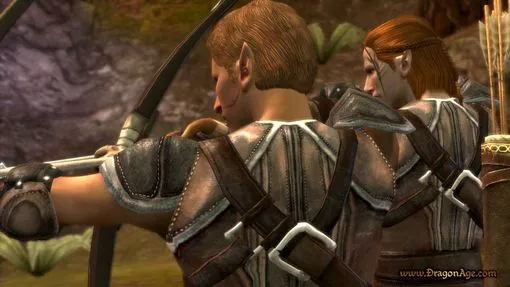
Shemlen - a word that is still in use. It is used by both Dalish and flat-eared people.
Tan (TAHN): three.
Then (THEN): to wake up, to warn.
Tu (tooh): to do, to cause.
U (ooh): alone.
Uth (OOTH): long, forever, infinite, eternal.
Uthenera (ooth-en-ERR-ah): Wandering in dreams. Uthenera - the name of the ancient custom of the immortal elves who "slept" when weary of life. Literally: "Eternal sleep in reality."
Vallas (VALL-ahs): written.
Vallaslin (vahl-ahs-LEEN): Writing in blood. The art of tattooing used by some elves to more vividly demonstrate their worship of the traditional elvish pantheon.
Ven (VEHN): to go.
Vhen (VEHN): "people" or "belonging to elves, clans, elven society."
Vhenadahl (vehn-AH-dahl): tree of the people.
Vhen'alas (vehn-AHL-ahs): the land itself. Literally: "our land."
Vhenan (VEY-nahn): heart.
Vir (VEER): path or trail. Because of the praising poem, it's tempting to translate as "we," although we must take into account the Dalish creed seen on Dalish pages: Vir Assan, Vir Bor'Assan, Vir Adahlen - "Path of the Arrow," "Path of the Bow," and "Path of the Forest," respectively. Thus, in the praising song, the translation is not accurate; in fact, they say "Path of song, joy."
Vunin (VOO-nihn): day.
Building Phrases in Elvish. Examples.

Adahl in Elflands. Another echo of culture.
Affection:
da'assan (dah-ah-SAHN): short arrow.
da'mi (dah-MEE): short blade.
da'vhenan (dah-VEY-nahn): gentle heart.
emm'asha (ehm-AH-shah): my girl.
emma lath (EHM-mah lath): my love.
emma sa'lath (EHM-mah sah-lath): my only love.
emma vhenan (EHM-ma VEY-nahn): my heart.
ma'arlath (MAR-lath): I love you.
ma emma lath (ma EHM-mah lath): you are my love.
vhenan'ara (VEY-nahn-AHR-ah): desire of the heart.
Insults:
elvhen'alas (el-VEHN-ALL-us): dirty elves.
len'alas lath'din (len-ALL-us LATH-deen): dirty, unloved child.
seth'lin (seth-LEEN): liquid blood.
Threats:
Ar'din nuvenin na'din. (ahr-DEEN noo-VHEY-nihn nah-deen): I do not wish to kill you.
Ar tu na'din. (ahr too nah-DEEN): I will kill you.
Ar tu na'lin emma mi. (ahr too nah-LEEN EHM-ma mee): I will see your blood on my blade.
Emma shem'nan. (EHM-mah shem-NAHN): My revenge is swift.
Halam sahlin. (hah-LAHM sah-LEEN): This will end now.
Ma emma harel. (mah EHM-mah hah-REHL): You should be afraid of me.
Ma halam. (mah hah-LAHM): You are finished.
In Uthenera. A Praising Song.
In Elvish.
hahren na melana sahlin
emma ir abelas
souver'inan isala hamin
vhenan him dor'felas
in uthenera na revas
vir sulahn'nehn
vir dirthera
vir samahl la numin
vir lath sa'vunin
How it’s read.
hahrin na melana salin
emma ir abelas
suver'inan isala hamin
venan him dor'felas
in uthenera na revas
vir sulan'nen
vir dirtera
vir samahl la numin
vir lat sa'vunin
Translation.
elder, your time has come
your soul is full of sorrow
rest is needed for weary eyes
the withered heart beats ever slower
freedom - in dream and truth
we sing, rejoicing
we tell tales
we laugh and cry
we love - one more day
Seludin Elvish Song.

Our bard is a songbird.
The Elvish song Seludin plays during the escape from prison in the DLC "Song of Leliana." A song about the enduring and mournful attachment of elves to their lost ancient lands. It is adapted to personal struggles.
Elvish.
Melava Inan enansal
IK SU araval TU elvaral
U abelas НС Эмма
в Элгар SA Вир маны
в ТУ setheneran DIN Эмма НС
планка sulevin
планка araval ЕСА
Arla Вен ТУ Вир mahvir
Мелана "nehn
enasal ИК SA lethalin
Translation.
It was a blessed time
but the long roads are even longer
when inside lonely.
Catch the spirit of ancient times
but do not linger in lands no longer ours.
Be assured in need,
and a path will appear
to the home of tomorrow
and time again
will bring joy, as before.
Deconstructing Elvish.
Many words in Elvish consist of smaller words. For example, "Arlathan" means "the city that I love." Breaking it down, we see: Ar: I or me; Lath: love; and An: place (city). We know this is correct since "lath" was used later in the praising song, with the meaning "love"; "an" is the suffix in the word "Elvhenan," meaning "city of our people," which is a direct continuation of "Elvhen," meaning "our people." By itself, "Ar" becomes a personal pronoun. Thus, many other words, as we see, can be deconstructed into their individual components.
Examples:
"Mamae? Mamae na mara san..": this phrase, panicking, is spoken by a ghostly child. We already know that "mamae" means "mother," and "na" means "your." "Mara" and "san" have different meanings. "Ma" (you) and "ar" (I, me) do not provide us with a key to deciphering. "San" looks like a construction of "sa" and "an," thus - place. Since the boy seems to panic, and we have already guessed that he is looking for something, it is reasonable to assume that this is the essence of his statement. And ultimately we have: "Mother, your [mara] place...", which we can break down as "mara" as "I cannot find" or "where is." Thus, a possible translation: "Mother, I cannot find you..." or "Mother, where is the place (city, settlement)..."

City elves speak Elvish less and less.
"Viran se lan'aan? Ir annala for ros... Nae! Ga rahn s'dael! Ga rahn! Ir emah'la shal! Ir emah'la shal!": this phrase is spoken by the ghost of an elvish woman in the crypt where you find the Juggernaut armor.
The best assumed translation: "How did your people find the way here? This place has been lost for Ages. No! Get away from our tree! Get out! You desecrate my grave! You desecrate my grave!"
"Viran se lan'aan?": we mean that "vir" and "an" mean "path" and "this place," respectively; we have: "the way here." If we assume that "se" is a pronoun (since "lan'aan" is too long for this), then, based on "sa" as "one" and "-en" as plural, we can take "se" as possibly the plural "you." In this case, since this is a question, we can assume that she is asking: "How did your people manage to find the way here?" since that would be a reasonable question. Next, "lan'aan" may mean "how to find." Although, it may also carry a time element, much like the words "melana" (time) and "annar" (year), or another place element, "an."
"Nae! Ga rahn s'dael! Ga rahn!": this is a very complex part. "Nae" can mean "no," but "na" means "your." "s'dael" can be broken down to: "sa" - one; "adahl" - tree; and "el" - our. Putting it all together, the sentence can be translated as, "No! Get away from our tree! Get out!"
"Ir annala for ros..": we know that "ir" means "many," and "annar" means "years," so it's reasonable to assume that "annala" is related to measuring time in years. It might mean "ages." So it starts with "Many years or ages." Joining it all together, we get: "This place has been lost for ages."
"Ir emah'la shal!": "ir" (very). Disassembling "emah'la": "emma" (my); "alas" (dirt, earth); "halam" (end); "shiral" (way) - all these words contain elements suitable for this complex word. One might assume it means "the earth of my end," or "grave." So we have "My grave is very..." something. Perhaps "shal" means sacred or desecrated. Thus - "You desecrate my grave!"
"Dar'Misu; Dar'Misaan": "Dar" means "to be," and both have "mi," and possibly "mi" is "blade," and we know that "su" means "to happen," and "u" means "alone." Thus, "dar'misu" can be roughly translated as "this blade acts alone" or "this sword encounters." "Sa" is "one" and "an" means "place." The best guess: Dar'Misu: "blade acting alone" - daggers, favored weapon of rogues; Dar'Misaan: "sword of one place" - longsword, favored weapon of a defender with sword and shield.
Author's translation.
Thank you for your attention ^^.