
Beta version of Diablo III: "Unearthing the Tristram Secrets"
Hello everyone, my dear friends, I come to you with new insights from my dissection of the beta version. I have played it a good dozen times with three characters, peeked under what seems like every stone, and replayed individual quests in various sequences and variations. After all this, I can tell you: the beta is very multilayered. If you just follow the main storyline, you will miss out on plenty of all the delicacies that Blizzard has put into it. Some of them only become available upon repeated playthroughs, so attentive players will be doubly rewarded. In this article, I want to share with you some of these delicacies that we will see if we step off the main road and pay more attention to our surroundings.
Beware, evil spoilers!
QUESTS
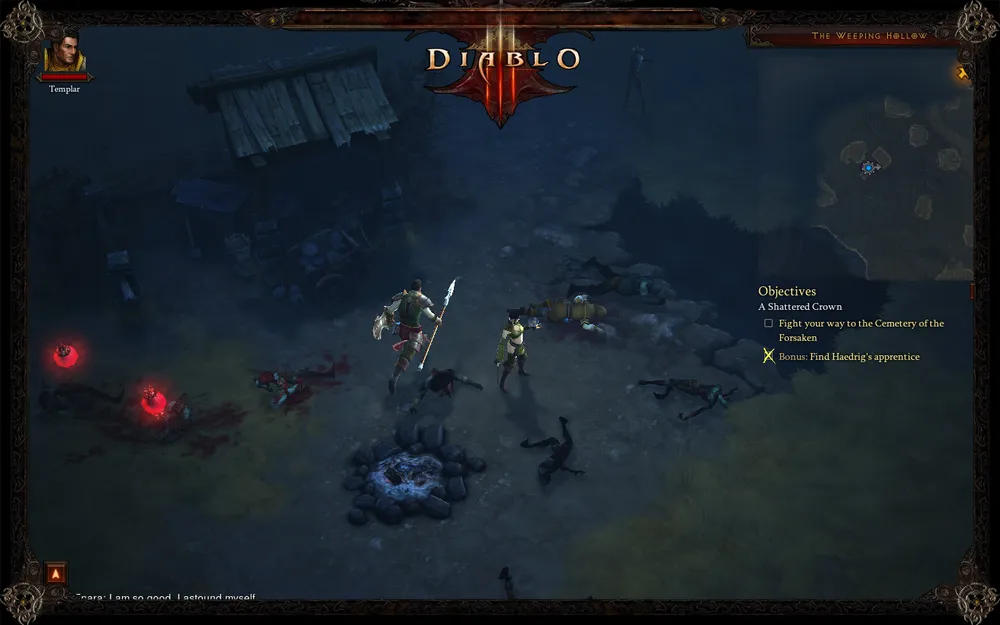
Bonus for those going to the cemetery: a corpse for half the price!
To start with, let me tell you something about the quest system. I have a strong impression that I am playing the first Diablo again: if the main storyline is the same for all heroes, the side quests and in-game elements can appear completely randomly. This is very pleasing on one hand (it's nice to see such references to previous parts of the game) and stressful on the other (fearing to miss some bonus, I have been meticulously combing the already familiar locations, which is somewhat exhausting). Nevertheless, this is an additional incentive to play the game at least a few times: Gyulchatay will not reveal her face right away. We are, however, in no hurry, so don’t rush ahead; look around – and perhaps you will stumble upon interesting and curious things.
Even by following the storyline, you can complete quests a bit differently: besides the main quest, the game offers you bonus side quests. For example, while searching for the boss-Mother, who is holed up in the ruins of Old Tristram [The Old Ruins], you can take down three bonus mothers and receive a reward for it. Or, while completing the quest with the crown of Leoric [Leoric], you can also find traces of the Smith's apprentice, who, unfortunately, was not able to escape. Such bonuses allow you to dive deeper into the game and study it more thoroughly, rather than blindly rushing ahead.

Vessel + bones = a lot of experience for the massacre.
However, even more intriguing than the quest bonuses are the additional quests that you can complete if you deviate from the designated course. For instance, I really enjoyed the randomly generated quest Jar of Souls [Jar of Souls], which can be found in one of the Forsaken Cemetery [Cemetery of the Forsaken] dungeons. The essence of this quest is to hold off the hordes of skeletons attacking you for 1 minute. When the hero activates the Jar of Souls, the exits from the room are locked for 60 seconds, and skeletons begin to rise around you. At first, there are only a few, but by the end, they multiply in almost geometric progression. In this room, it is not difficult to set and break records for mass enemy kills: it is impossible to miss, the undead swarm in tightly, and you can gain a ton of experience by making a long series of kills. It's just a shame that the room with the Jar does not appear in every game.
In that same cemetery, among the same dungeons, you can stumble upon a friendly ghost lady who gives you the quest Matriarch's Bones [The Matriarch's Bones]. Evil ruffians have looted her tomb, and now the undead lady cannot find peace. We need to collect her ashes and take them to her burial place. It's not a difficult task; however, for obvious reasons, I found the quest with the Jar of Souls and survival mode much more enjoyable. I hope there will be more quests like this in the release version: it seemed to me that the beta is somewhat lacking in side quests. However, I suspect it is still too early to judge, and we won't see all the possible content until the release.
REFERENCES

The Tristram fountain. Time has not been kind to it.
Continuing the topic of curiosities, I cannot fail to mention the references to previous parts of the game. Even in the beta, which shows us only a small slice of the world, there were more than enough of these flashbacks. The fan of the series in me regularly received my portion of old-school joys.
For example, I was pleased with the design of the ruins of Old Tristram: although the structure of the city has changed a bit (I suppose twenty years have not passed without impact), it is still very recognizable. In the main square of the city, there is still a fountain, to its right are the remains of Griswold's blacksmith shop (in its ruins, we can find a stash of weapons), and to the left is what remains of the tavern. Adria's [Adria] hut is still standing on the outskirts, and you have to get to it via a river crossing a bridge, just like before. You walk through the streets of the old town and almost in reality recall the first part of the game, albeit with a twist of 3D. Even in [Diablo II](/games?search=Diablo II), Tristram did not evoke such memories, even though its structure was portrayed more accurately there.
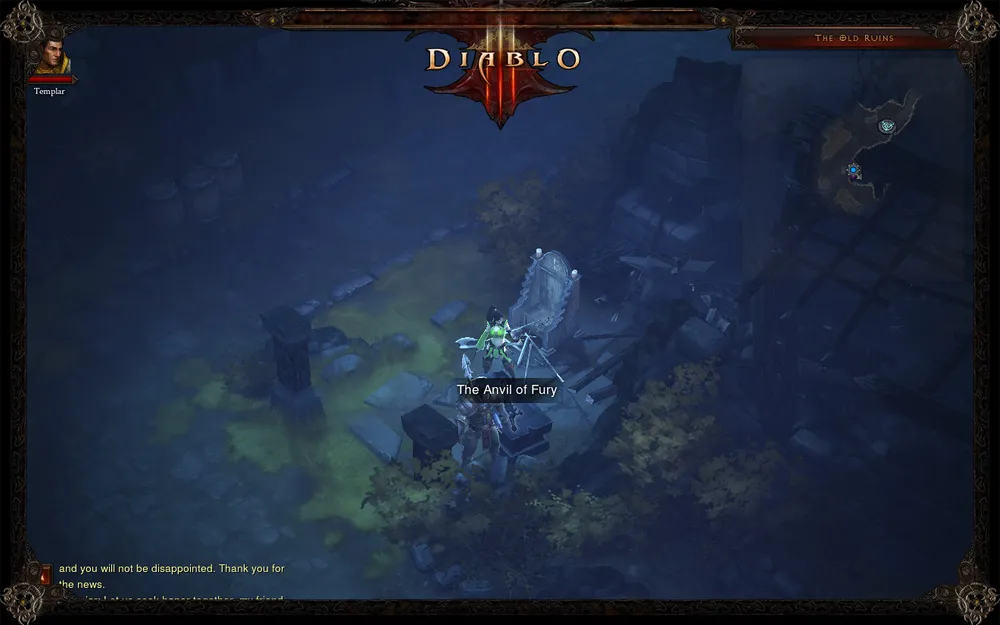
The very Anvil. Not generated in every game.
And the surprises only begin here. An interesting reference to the first part of the game can be found there as well among the ruins (thanks to HiFly for the tip). Occasionally, with certain probability, you can find the Anvil of Fury [Anvil of Fury] in Griswold's old blacksmith shop, on which lies Griswold's Edge [Griswold's Edge], a legendary sword. If you are not in the know, this is a nod from Diablo, where during a quest (it was called Anvil of Fury), the hero had to bring a rune-covered weapon to Griswold from a dungeon. As a sign of gratitude, the blacksmith would present the hero with Griswold's Edge, a unique and quite powerful sword. In the third part, you can expect déjà vu on this topic. Don’t miss the sword; it is probably the first legendary item your hero can obtain.
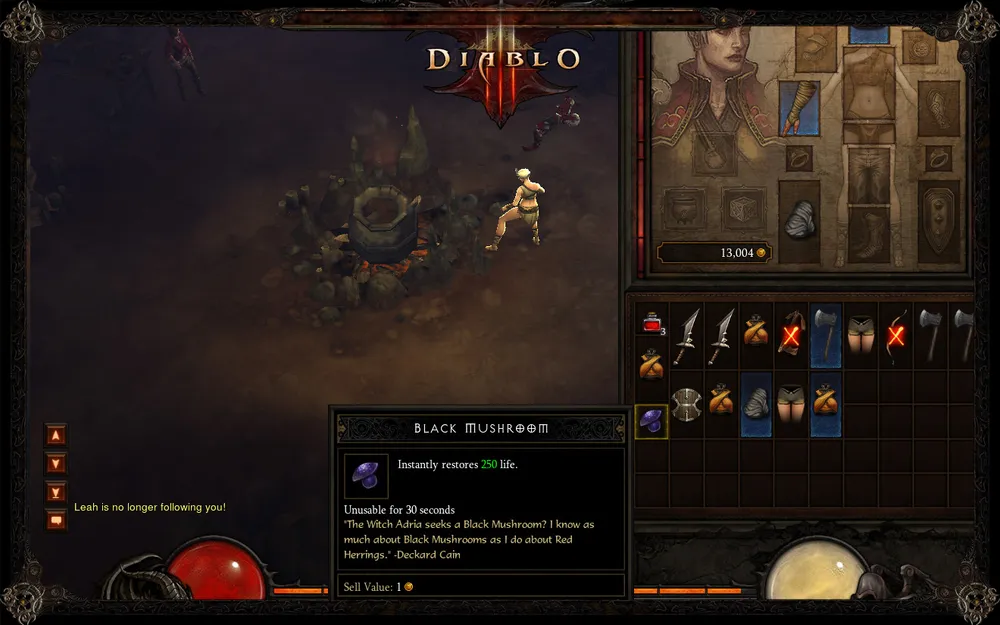
The black mushroom. Truthfully, why is it purple?
Meanwhile, we are heading to Adria's witch hut. I found another reference to the first part of the game right after publishing this article. In the beta version's storyline, we need to descend into a secret lair beneath the witch's hut. Of course, in the center of this mini-grave, there waits a cauldron. Well, with a bit of luck, instead of a regular healing potion, from the cauldron, you might get... Black Mushroom [Black Mushroom]! Fans of the first part may remember that this was the name of one of the side quests, which was given by Adria. The mushroom drops rarely; in all the time, I was lucky to catch it only once; in other cases, we get a regular healing potion.

Welcome to Diablo II!
However, one cannot live on Tristram’s mushrooms alone. Another reference to the past is the dungeon Den of the Fallen [Den of the Fallen]. This is a two-level cave filled with the skeletons of the fallen and their shamans. The wildlife there is mainly scavengers and bats, and on the second level, we are in for a surprise: a zombie boss with minions (at least for me, he generated three times out of three when I found the cave). This location is a reference to the Den of Evil [Den of Evil], where, as we remember, most of the monsters were fallen, and the main boss of the dungeon was Corpsefire [Corpsefire], a unique zombie delegation. Looking at the skeleton monsters evokes a pleasant feeling of nostalgia.
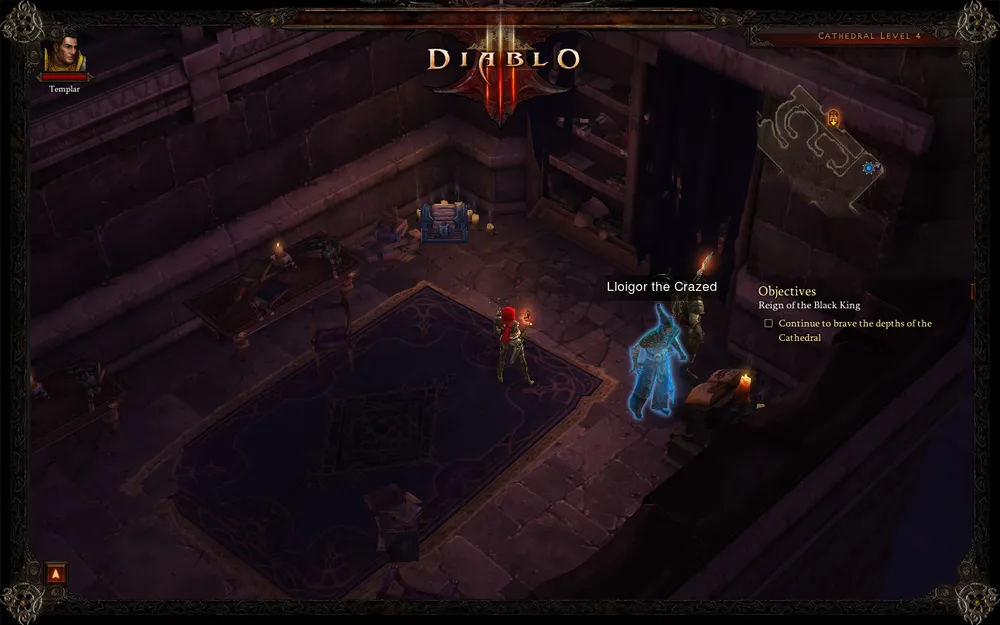
"Don't play with my toys!"
By the way, get ready to feel nostalgic regularly. If the references mentioned above are not enough for you, I suggest another one. On the 4th level of the Cathedral [Cathedral], I encountered a rather curious character - Lloigor the Crazed [Lloigor the Crazed]. This worthy fellow stood in a corner next to a book pedestal and in very aggressive terms asked me not to touch his tome. Sound familiar? Naturally, since the tome was asked not to be touched, I immediately clicked on it. Lloigor got very offended and attacked me. Just like Zhar the Mad [Zhar the Mad]: there was a fellow like that in the first part of the game. He sat in the catacombs and also guarded a bookshelf, for which he ended up being smashed. History repeats itself here: Lloigor ultimately gets a tombstone, and we take the scroll or whatever drops. Again, it may be a trifle, but how nice it is!
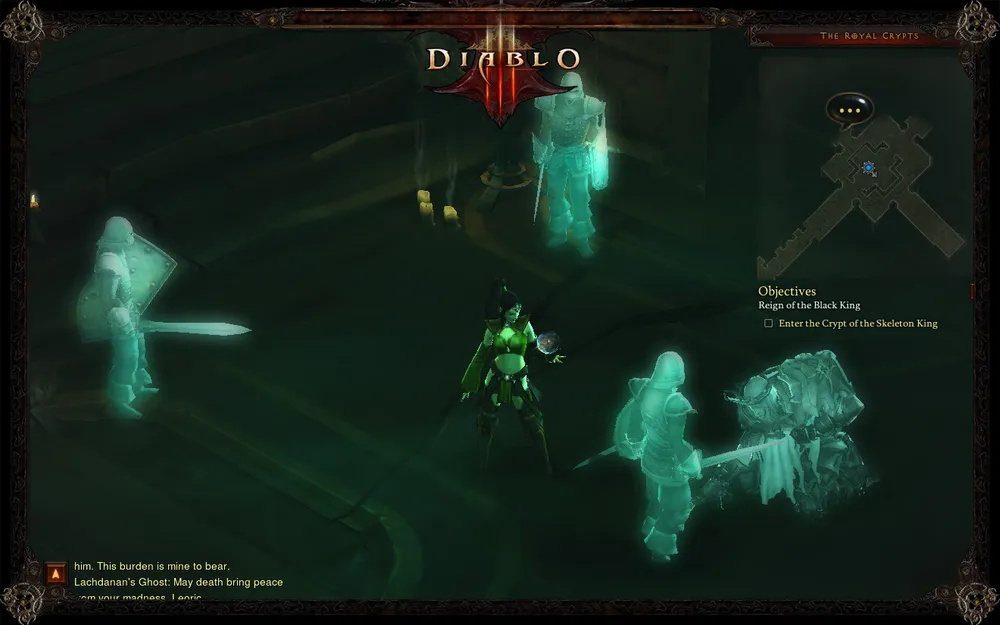
King Leoric dies. For the first time – for now.
Even Leoric, the old tin can, cannot fail to delight. Although in his new incarnation he does not look as minimalist (for the old Leoric, I remind you, had only a sword and a crown, while the new one struts around in full armor), he still delights the player with his signature line:
- Did you dare bring the warmth of life to my grave?
Indeed, I dared! And I will carry it throughout your tomb in spite of you and your skeletons! By the way, a small flashback scene awaits the player at the approaches to Leoric's throne, where we will see the king's demise at the blade of Lachdanan [Lachdanan]. So, watch closely.
JOURNALS
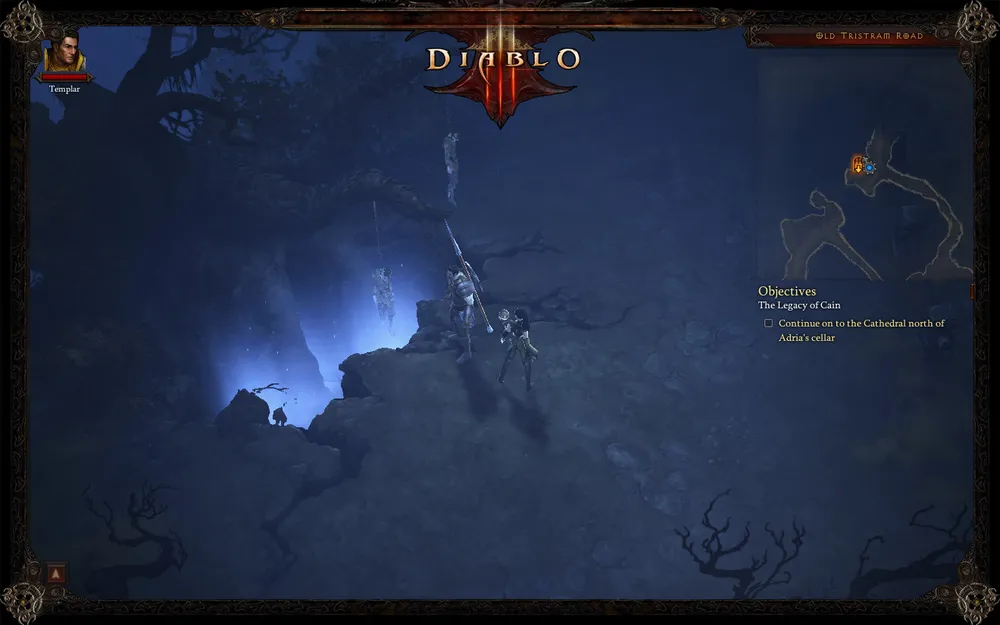
You can only enter this crypt by finding the corresponding journal.
I have already mentioned the journals that tell us about the history of the world. Each journal represents a fragment of someone’s diary, in which a character narrates what is happening. If you think that having completed the game once from start to finish, you have collected all possible journals, I hasten to cool your enthusiasm. Not all of Cain’s, Leah’s and Leoric’s diaries can be obtained during the first playthrough. Sometimes you’ll need to restart the game from the middle to find new fragments of entries. For example, Cain’s old diaries could only be found like that, and locating them directly while breaking into grandpa’s house doesn’t work. The same goes for Leah's diary: if you already have the first part of her entries, in a new playthrough visit her again closer to the middle of the game. The second part of the diary will not keep you waiting. All this says one thing: the first playthrough of the game will give you only a portion of all the hidden goodies in it. Some complained about low replayability? Well, well.
If some journals and diaries are handed to you during subsequent visits to the game, others may not drop at all. And on them, by the way, there may be tied small quests. A prime example is the Traveler's Journal [Traveler's Journal], which can be found on the corpse of a traveler on the Old Tristram Road [Old Tristram Road]. The journal states that this adventurer, in search of treasure, ventured into a cave packed with corpses. When he decided to check their pockets, the corpses began to rise. The traveler was headed to New Tristram to share this information with the locals until something terrible happened. It is not hard to guess how he ended: zombies eagerly dined on his limbs.
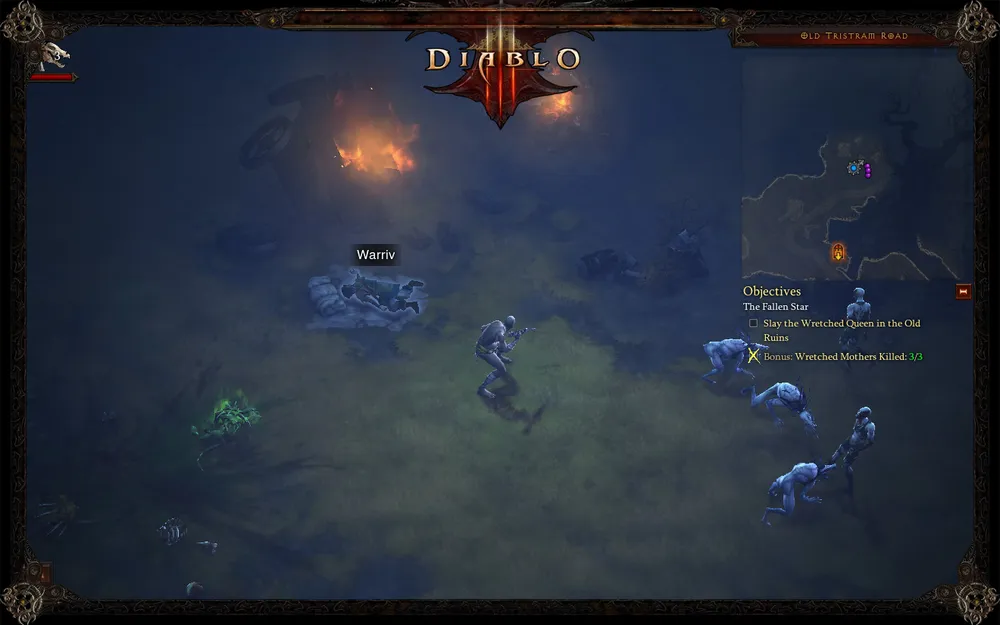
Poor Warriv even met death on the way.
The most interesting thing is that this journal opens the passage to that very grave where our now-dead Indiana Jones was digging in search of loot. In the grave site (which is very small and cramped), a treasure chest and a dozen zombies that guard it will be waiting for you, crawling out from under the ground when they sense the living. That is, you. If the corpse of the traveler with the journal does not appear in the game, the passage to the grave will be closed for you.
Another interesting journal I found was by the Sorcerer, approximately in the same spot where the corpse of the adventurer with the notes usually appears. Only this time it was the poor Warriv [Warriv], a merchant familiar to us from the second part of the game. It was with his caravan that we traveled from Act I to Act II, so the finding was both sad and atmospheric. Apparently, Warriv had just returned to Kanduras, trying to rid himself of the burden of what had happened, but instead found his demise there. This finding emphasizes the atmosphere of despair that prevails in Tristram.
DETAILS
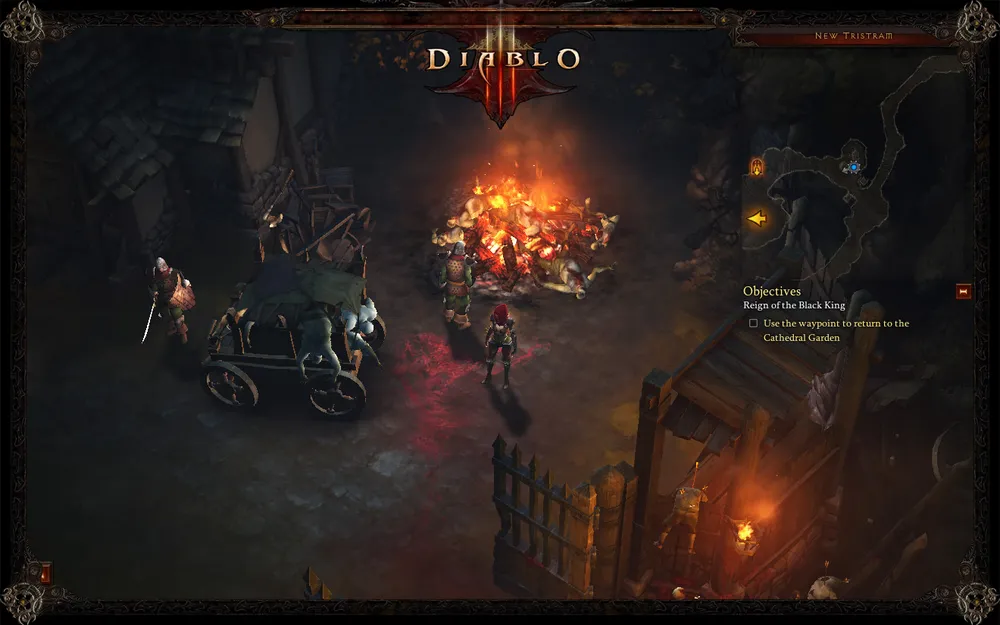
This bonfire is a grim necessity.
The creation of this atmosphere is aided by subtle details, but if you take a closer look, you will discover many sad signs. For example, finding yourself in New Tristram, the first person you meet within the city limits will be a soldier who burns corpses lying in a wagon. It seems that monsters press from not only outside: they breed inside the town as well, and death is certainly not a guarantee of peace. Or, for example, a small underground area, a kind of cellar within the city limits, where infected people are locked up. Perhaps, for the survivors, the only chance for salvation is to send all the ill to this necro-lazaret, but just imagine the horror of those locked up in this cellar with other