
גרסה ביטא של דיабלו III: "חפירות סודות טריסטראם"
שלום לכולם, חברים אהובים, אני מגיע אליכם עם חדשות חדשות לאחר חקירת גרסת הבטא. שיחקתי בה כבר עשר פעמים עם שלושה דמויות, נגעתי בכל אבן והעברתי מחדש משימות בסדרים ובוריאציות שונות. אחרי כל זה, אני יכולה להגיד לכם: הבטא רב-שכבתית מאוד. אם תעברו אותה רק לפי הסיפור, לא תמצאו את כל ה*דברים המשובחים שבליזארד הכניסו לתוכה. חלקם מתגלים רק לאחר מספר מעברים, כך שמשחקן שנ ער להיות מתוגמל פעמיים. במאמר הזה אני רוצה לשתף אתכם בכמה מהדברים המיוחדים הללו, שנראה אם נסטה מהדרך הראשית ונשים לב לסביבתנו.*
זהירות, ספוילרים רעים!
משימות
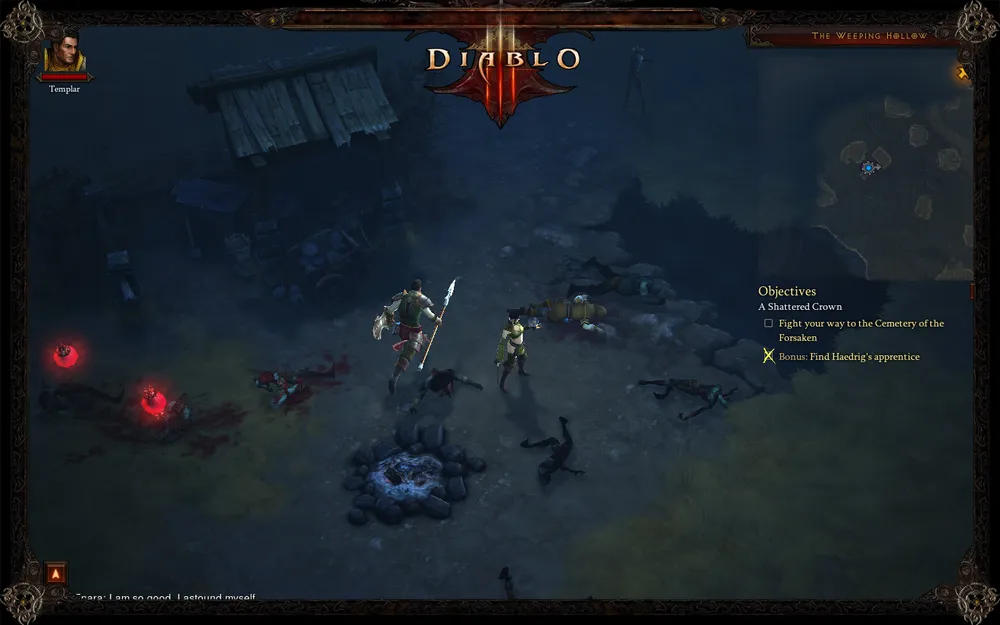
מי שמגיע לבית הקברות מקבל בונוס: גופה فقط במחיר חצי!
ראשית, אשתף אתכם במשהו על מערכת המשימות. יש לי רושם חזק שמדובר שוב במשחק הראשון של Diablo: אם הסיפור המרכזי הוא אחיד עבור כל הגיבורים, אז משימות נוספות ואלמנטים בתוך המשחק עשויים להופיע באופן אקראי. זה מהנה מצד אחד (נחמד לראות אזכורים לחלקים הקודמים של המשחק) ומלחיץ מצד שני (ב fearful that I'll miss any goodies, I rummaged through the familiar locations that I knew by heart, which was somewhat exhausting). Although, this is an additional incentive to play the game at least a few times: Gylchatay won't reveal her face immediately. However, we are not in a hurry, so don't rush ahead, look around - and maybe you'll stumble upon interesting and curious things.
Even by following the storyline, you can complete missions a bit differently: besides the main quest, the game offers you bonus side missions. For example, while searching for the boss-Mother, who is holed up at the Old Tristram Ruins [The Old Ruins], you can take out three extra mothers and receive a bonus for it. Or while completing the quest with Leoric's Crown [Leoric], you can also find the trail of the Blacksmith's apprentice, who unfortunately didn’t manage to survive. Such bonuses allow for a deeper immersion into the game and a more detailed exploration, rather than just mindlessly running forward.

Vessel + bones = lots of experience for the massacre.
However, what’s even more interesting than the quest bonuses are the side missions you can complete if you deviate from the prescribed path. For instance, I really enjoyed the randomly generated Jar of Souls [Jar of Souls] quest, which can be found in one of the dungeons at the Cemetery of the Forsaken [Cemetery of the Forsaken]. Its essence is to hold out against the hordes of skeletons approaching you for 1 minute. When the hero activates the Jar of Souls, the exit doors to the room are locked for 60 seconds, and skeletons begin to rise around. At first, there are only a few, but towards the end, they multiply in practically geometric progression. In this room, it’s not hard to break and beat records for mass killing of enemies: missing is impossible, the undead push in a dense crowd, and you can rack up a ton of experience with a lengthy kill spree. It’s just a pity that the room with the Jar doesn’t appear in every game.
In the same Cemetery among those same dungeons, you can stumble upon a friendly ghost lady who gives you the quest The Matriarch's Bones [The Matriarch's Bones]. Evil hooligans have looted her tomb, and now the undead lady cannot rest in peace. We need to gather her ashes and take them to the burial place. It’s not a complicated quest, but for obvious reasons, I enjoyed the Jar of Souls quest with the survival mode much more. I hope there will be more of such quests in the release version; it seemed to me that the beta was a bit poor in side quests. However, I suspect that it’s too early to judge, and we won’t see all possible content until release.
REFERENCES

The Tristram fountain. The years haven’t been kind to it.
Continuing the topic of curiosities, I must mention the references to the previous parts of the game. Even in the beta, which shows us only a small slice of the world, there were more than enough such flashbacks. The fan in me regularly received its share of old-school pleasures.
For example, a detail that pleased me was the design of the Old Tristram Ruins: although the structure of the town has changed a bit (one must assume that twenty years haven't passed by unnoticed), it is still recognizable. In the main square of the town, the fountain still stands as before, to its right are the remnants of Grizwold's forge (on its ruins, we can find a weapon stash), to its left are what’s left of the tavern. Adria's hut [Adria] still stands on the edge, and you need to reach it through the river by a bridge, just like before. Walking through the streets of the old town, you almost vividly recall the first part of the game, albeit with a 3D twist. Even in [Diablo II](/games?search=Diablo II), Tristram didn't evoke such memories, although its structure was conveyed more accurately there.
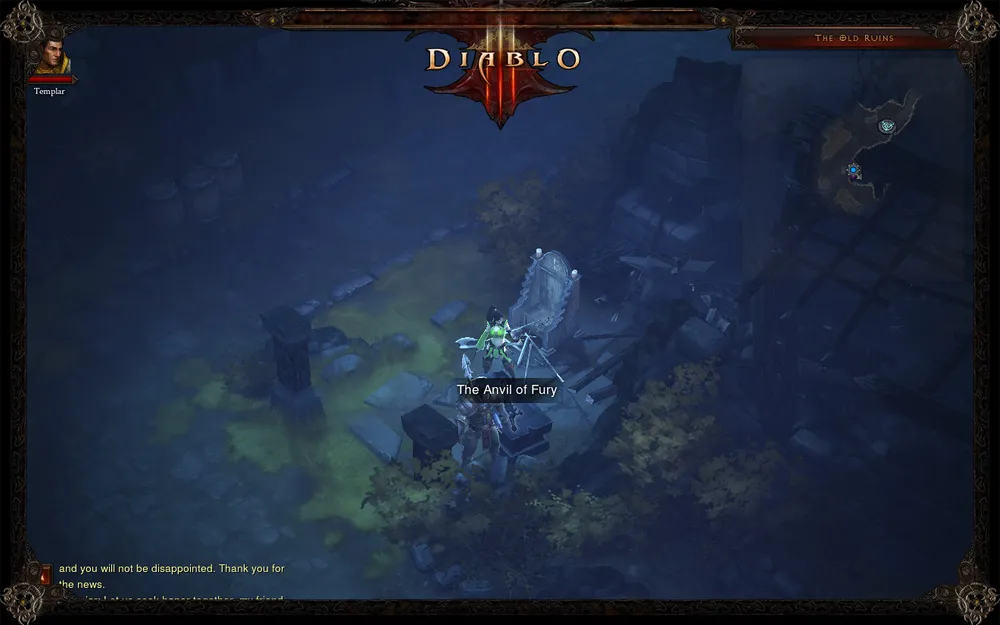
That Anvil. Not generated in every game.
But the surprises are just beginning. An interesting reference to the first part of the game can be found there as well, among the ruins (thanks to HiFly for the tip). Occasionally, with a certain probability, in Grizwold's old forge, you can find the Anvil of Fury [Anvil of Fury], on which rests Grizwold's Edge [Griswold's Edge], a legendary sword. If you’re not aware, this is a nod from Diablo, where during a quest (named The Anvil of Fury), the hero had to bring Grizwold a runed sword from the dungeon. In gratitude, the blacksmith would give the hero Grizwold's Edge, a unique and quite powerful sword. In the third part, you can expect déjà vu on this topic. Don’t miss the sword; this is probably the first legendary item your hero will be able to acquire.
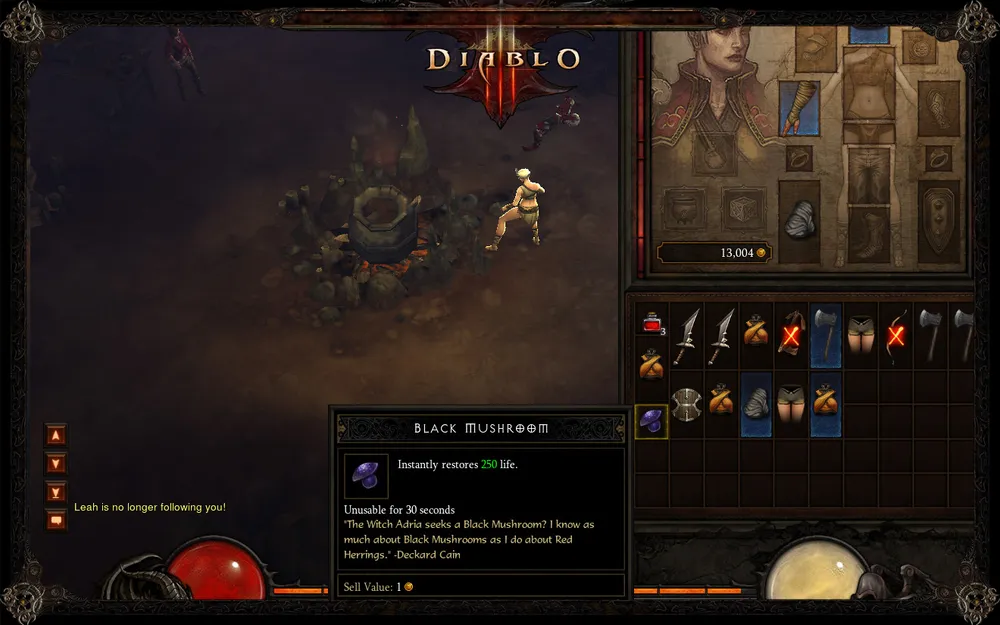
Black mushroom. But why is it purple?
Meanwhile, we're heading to the hut of the witch Adria. I found another reference to the first part of the game after publishing this article. In the story of the beta version, we have to descend into a secret passage under the witch's hut. Naturally, at the center of this mini-cellar, a cauldron awaits us. So, with the right luck, instead of a regular health potion, you’ll get... Black Mushroom [Black Mushroom]! Fans of the first part might recall that this was the name of one of the side quests we had to complete, and it was given by Adria. The mushroom drops rarely; in all my time, I was lucky to catch it just once; in other instances, we get the regular health potion.

Welcome to Diablo II!
However, one cannot live only on Tristram's mushrooms. Another callback to the past is the dungeon Den of the Fallen [Den of the Fallen]. This is a two-level cave, filled with skeletons of the fallen and their shamans. The local wildlife is dominated by scavengers and bats, and on the second level, a surprise awaits us: a zombie boss with minions (at least, it was generated for me three times in a row when I found the cave). This location is a reference to Den of Evil [Den of Evil], where, as we remember, most of the monsters were fallen ones, and the main boss of the dungeon was Corpsefire [Corpsefire], a unique zombie with a delegation. Looking at the skeletons of the monsters, you feel a pleasant wave of nostalgia.
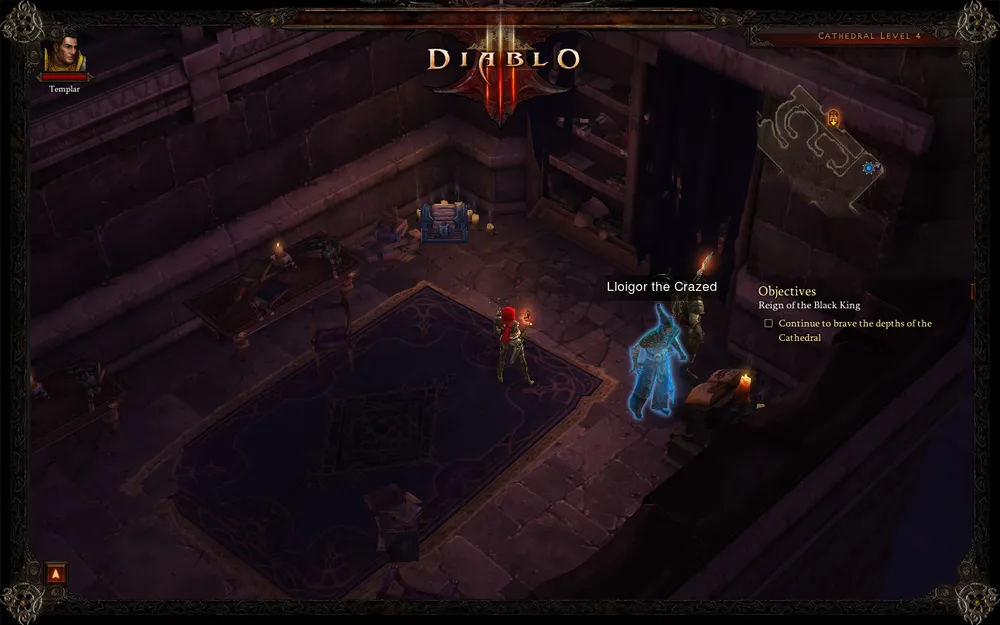
"Don’t play with my toys!"
Get ready, by the way, for regular nostalgia. If the provided references are not enough for you, I offer another one. On the 4th level of the Cathedral [Cathedral], I encountered a rather curious character - Lloigor the Crazed [Lloigor the Crazed]. This worthy fellow stood in the corner next to a book pedestal and in very aggressive terms asked not to touch his tome. Doesn’t that remind you of something? Naturally, since the tome was requested not to be touched, I immediately clicked on it. Lloigor got very offended and attacked me. Just like Zhar the Mad [Zhar the Mad]: there was such a guy in the first part of the game. He sat in the catacombs and also guarded the bookshelf, which resulted in him getting beaten. The story repeats here: Lloigor ultimately gets a gravestone, and the scroll or whatever drops for us to take. Again, it’s a trifle, but what a pleasant one!
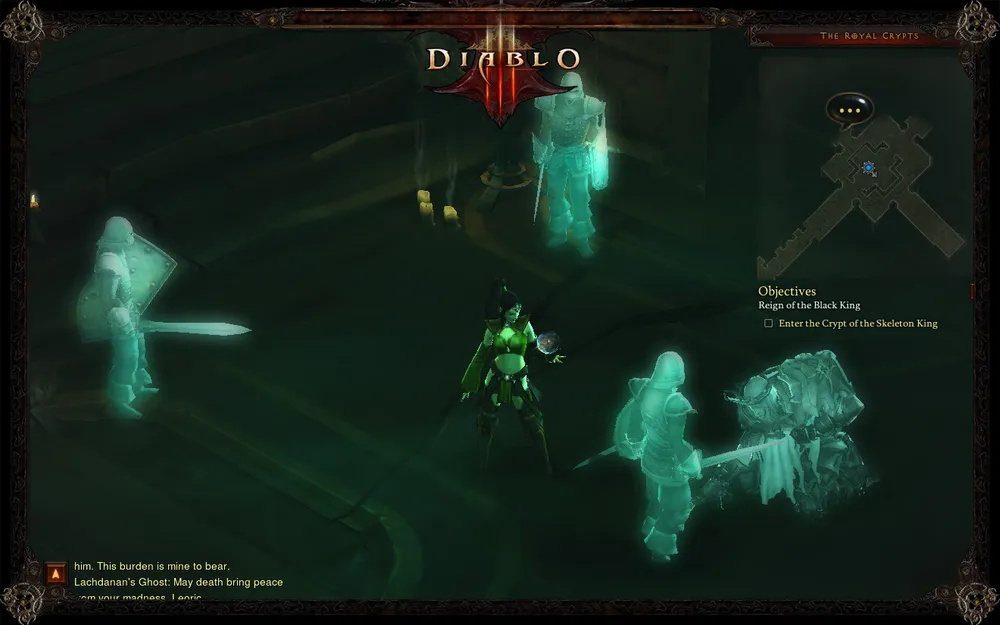
King Leoric is dying. For now - the first time.
Even Leoric, the old tin can, can’t fail to please. Though in his new incarnation, he doesn’t look so minimalist (the old Leoric, remind you, wore only a sword and a crown, while the new one sports a full suit of armor), he still treats the player with his signature line:
- You dare bring the warmth of life into my grave?
Oh, I dare! And I will carry it throughout your tomb out of spite towards you and your skeletons! By the way, a small flashback scene awaits the player at the approach to Leoric's throne, which will show the death of the king by the sword Lachdanan [Lachdanan]. So watch closely.
JOURNALS
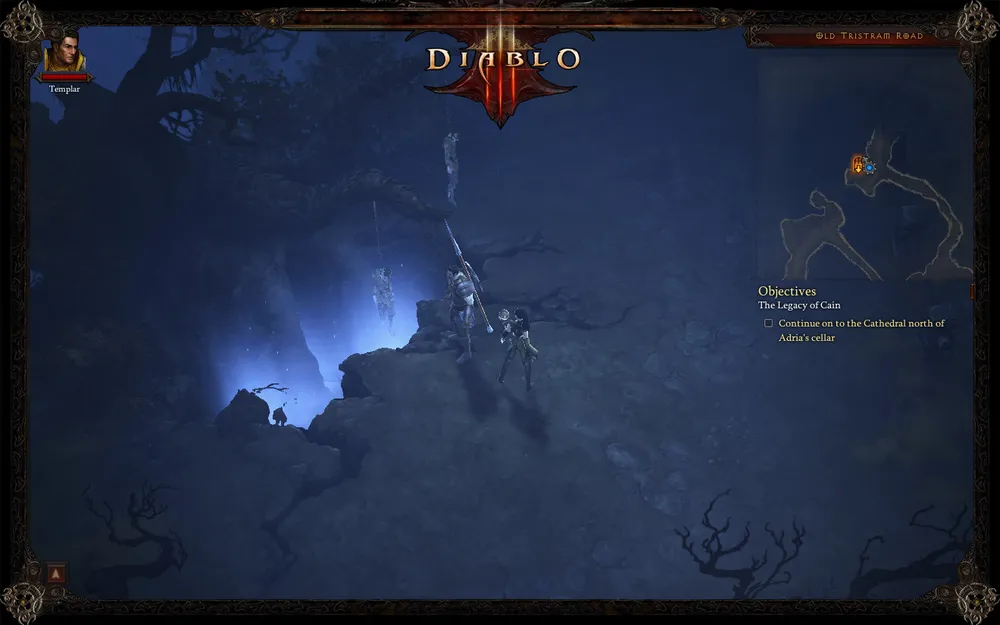
You can enter this tomb only by finding the corresponding journal.
I already told you about the journals that tell us about the history of the world. Each such journal is a fragment of someone’s diary in which a particular character recounts what’s occurring. If you think that after playing the game once through and through, you’ve gained all the possible journals, I must cool your enthusiasm. All of Cain's, Leah's, and Leoric's diaries cannot be found during a single playthrough. Sometimes, you need to restart the game from the middle to find new fragments of entries. For example, the old diaries of Cain can only be found this way, and you cannot simply barge into grandpa’s house to find them. The same goes for Leah's diary: if you already have the first part of her entries, in the new playthrough, visit her again closer to the middle of the game. The second part of the diary won’t keep you waiting. All this indicates that the first playthrough will only give you part of all the goodies hidden within. Did someone complain about low replayability? Oh really.
If some journals and diaries come into your hands during repeat plays, others may not drop at all. And those, mind you, may be tied to small quests. One example is the Traveler's Journal [Traveler's Journal], which can be found on the body of a traveler on the Old Tristram Road [Old Tristram Road]. The journal states that this adventurer, in his search for treasures, ventured into a cave full of corpses. When he attempted to check their pockets, the corpses started to rise. The traveler headed for New Tristram to share this information with the townsfolk until something terrible happened to him. It’s easy to guess what happened to him: the zombies eagerly dined on his limbs.
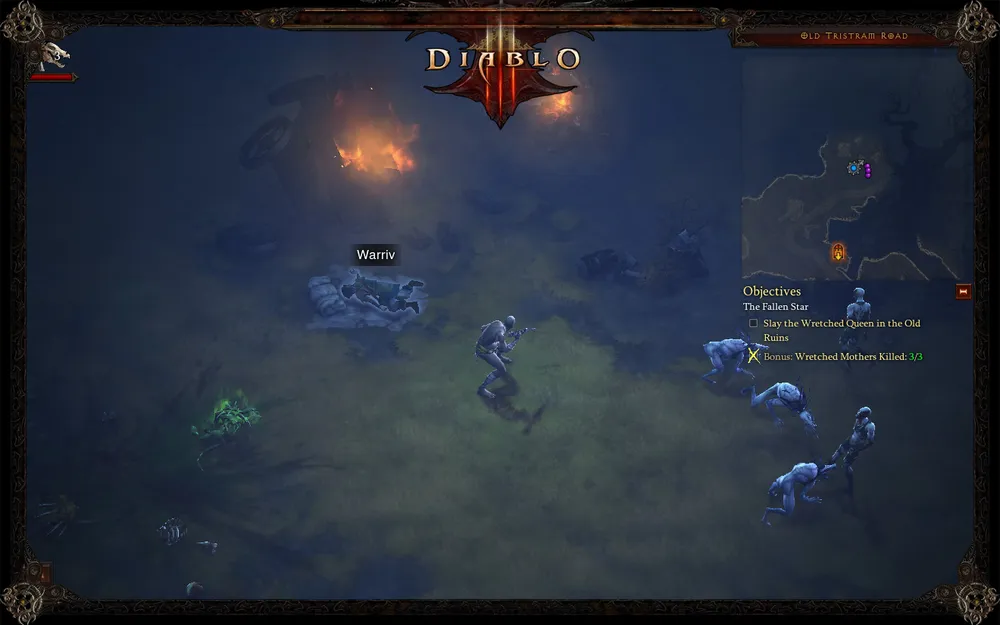
Poor Warriv even met his death on the way.
The most interesting thing is that this journal opens the passage into that very grave where our late Indiana Jones was rummaging for treasure. In the graveyard (which is very small and cramped), you’ll find a treasure chest and a dozen zombies guarding it, rising from the ground when they catch the scent of the living. That is you. If the body of the traveler with the journal didn’t appear in the game, the passage into the graveyard will be closed for you.
Another interesting journal I found as a Sorcerer roughly in the same place where the body of the adventurer with the notes usually appears. But this time, there was the poor Warriv [Warriv], the merchant known to all of us from the second part of the game. It was with his caravan that we traveled from Act I to Act II, so the find was both sad and atmospheric. It turns out Warriv recently returned to Harad, trying to free himself from the burdens of his past misfortunes; however, instead of salvation, he found his demise there. This finding emphasizes the atmosphere of despair that hangs over Tristram.
DETAILS
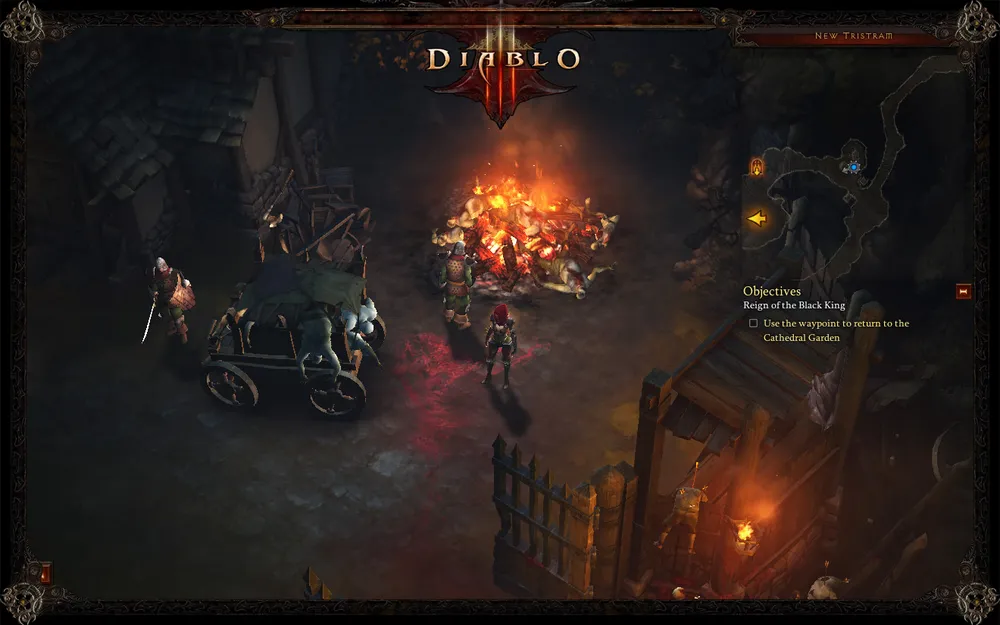
This campfire is a grim necessity.
The creation of this atmosphere works through unnoticed details at first, but if you pay attention, you’ll uncover many sad signs. For instance, upon arrival at New Tristram, the first person you meet in the city limits will be a soldier who burns the corpses lying in the cart. One can only presume that monsters attack not only from outside: they multiply from within the town as well, and death is by no means guaranteed to bring peace. Or, for example, a small dungeon, a sort of cellar within the city limits, where infected people are locked away. Perhaps for the survivors, the only chance for salvation is to send all the sick into this necro-lazaretto; however, imagine the horror of those locked in this cellar along with the other