
Overview of the official "Skyrim" guide by "Bethesda" [translation]
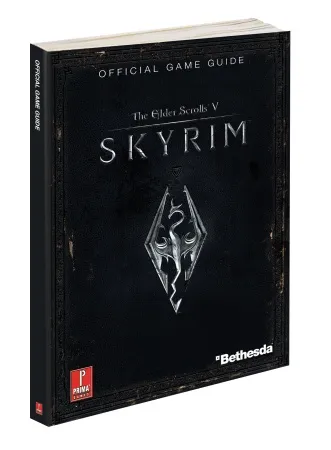
What deserves attention is the official guide to 'Skyrim'
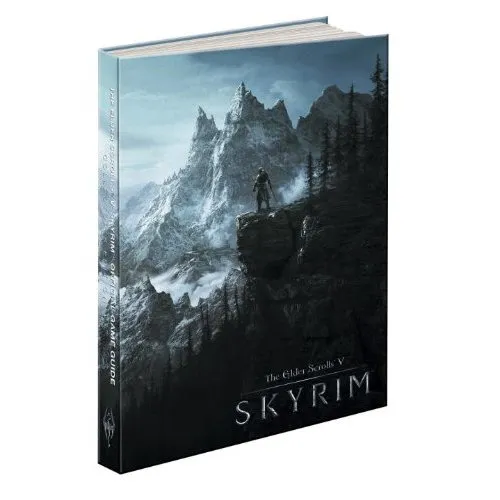
After the release of 'Skyrim,' you will be able to purchase a titanic guide from 'Prima' with six hundred fifty-six full-color pages. One of its authors, David Hodgson, will tell us more about its contents...
Work on the official guide began in early May. I embarked on a long journey across the icy expanses of Skyrim, thinking the task at hand would be similar to writing a guide for 'Fallout 3.' Then I was quietly informed about the 'even more epic' and 'five times bigger' project. Now, five months later, after nearly two thousand person-hours (distributed between me and my co-author, Steve Stratton), several thousand ready-made meals and cups of tea, and with full support from 'Bethesda' and 'Prima,' the book is ready.
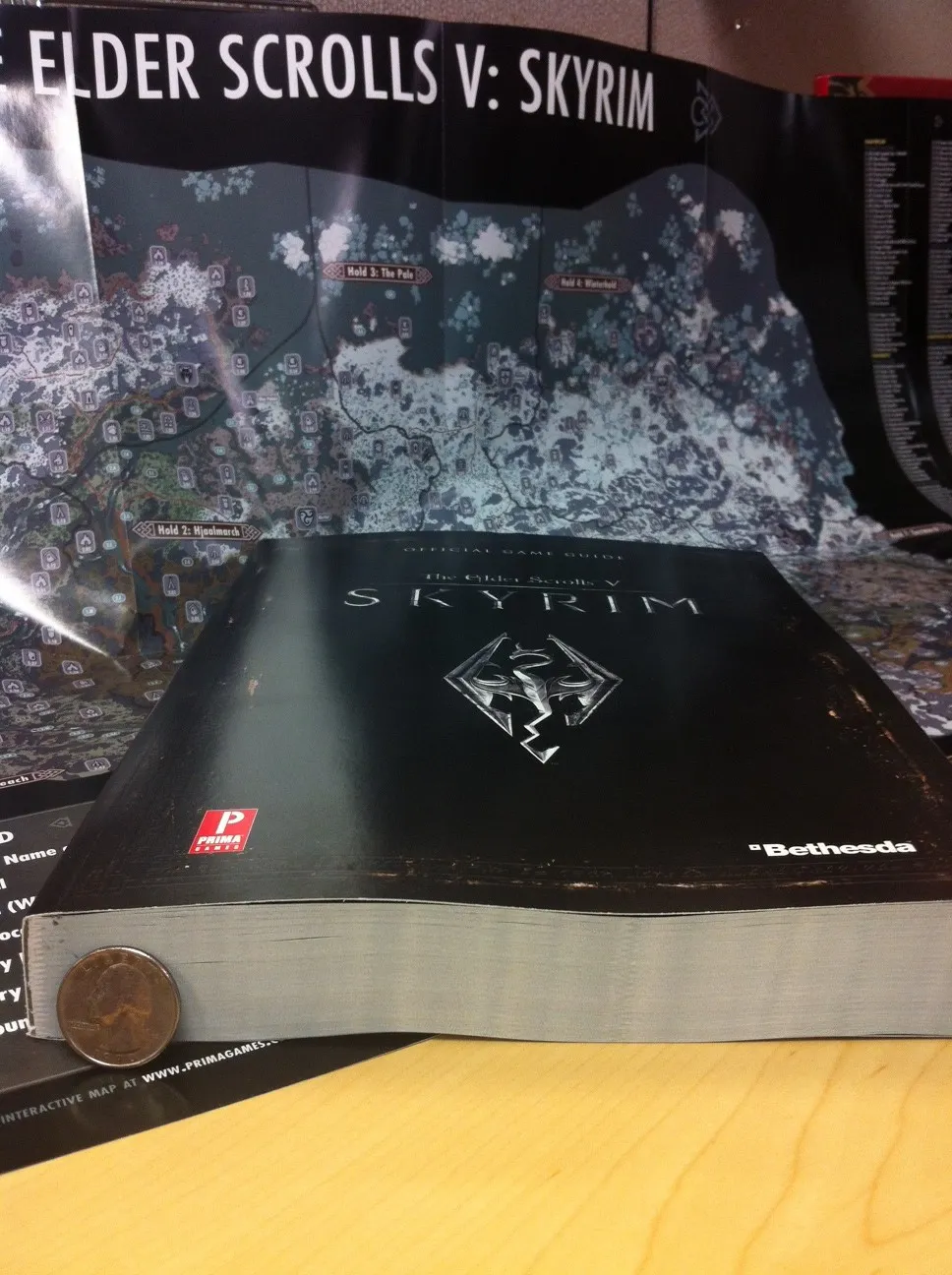
This hefty tome contains 656 pages, approximately 550,000 words, over one hundred fifty maps, and more than a thousand screenshots. It includes an interactive online version with a scalable map (and an iPad app). But more importantly, it is designed to assist players, regardless of their skill level, knowledge of the series, or familiarity with previous games from 'Bethesda.' And here's what it consists of:
1) Training.
Seventy pages following the table of contents and text from the 'Dragonborn Song' in English and Draconic are dedicated to the basics of the game, namely:
1.1) Races, with their advantages and innate abilities. You will discover, for instance, whether a dark elf or a Nord suits your playstyle better.
1.2) Skills and talents. After explaining how each skill increases (including portraits of all Skyrim teachers), the guide meticulously lists all two hundred forty-plus talents for each of the eighteen skills, along with tactical advice for each. There are tips on talent selection, thoroughly tested in both my dirty basement and the pristinely clean offices of 'Bethesda' designers and testers.
1.3) Archetypes. In 'Skyrim,' players are not forced to create a 'mage' or 'warrior.' But if you need advice or help with selecting a race, build, skills, talents, weapons, armor, and companions for your preferred playstyle, we will help you choose an archetype.
2) Further training.
Here, advice is given on defeating enemies both by force and cunning. Descriptions of shouts and Word Walls, as well as abilities and diseases, are provided. After a course on the basics of law in the nine holds of Skyrim, a lengthy guide on crafts follows: essential information on alchemy (finding ingredients and experimenting with their properties), enchanting (imbuing items with magical properties), smithing (crafting and improving items), and 'lower' crafts (cooking, mining, smelting, tanning, and firewood gathering). Want to know the locations (and effects) of all ingredients in the game? Or a list of the strongest potions and poisons? How about the basic materials for crafting ebony armor? Or the fees for firewood gathering? It's all here.
3) More training.
In the final section of training, you will read about the game world. There is information on settlements (like the capitals of holds) and dungeons (for example, tombs of draugr), maps, and a list of all types of puzzles and traps in the game (with solutions and walkthrough tips, of course).
3.1) Interesting locations. Scattered throughout Skyrim (or hidden in dark, damp dungeons) are dolmens, strange shadow signs, and various books. Naturally, the guide provides their locations. Yes, the exact locations of all the books (including 'ordinary' books with stories) ever recorded on parchment.
3.2) Tips. Obtaining the locations of important NPCs across the province, a list of all companions (with portraits, locations, requirements, and specialties, so you can plan ahead), information on horses, carriages, and a list of all services, merchants, crafting stations, and types of trophies in the game. That's it, training is complete.
4) Equipment.
The next thirty-one pages of the guide will definitely please table fans: statistics, more statistics, and even more statistics! All spells, all weapons, all ingredients and items available in 'Skyrim.' In short, if something exists in the game (from soul stones to daedric artifacts and from spell tomes to junk from dungeons), it is also in the tables.
5) Bestiary.
In a sixteen-page bestiary, there are tips on combating all enemies you might encounter in the province, as well as their health, weapons, and loot. If you plan to venture into a vampire lair, it would be wise to compare your level with the vampire level indicated in the bestiary to know what to expect. Want to know what item drops from a spriggan? Check the table! By the way, that's a core root.
Some players can, for instance, compare the damage of a two-handed daedric axe (25 units) to the health of a level twenty-eight night vampire (413 units) to figure out how many times they would need to hit it (16.5 times).
6) Quests.
A considerable portion of the guide (just under three hundred pages) is dedicated to completing all available quests. Due to the 'Radiant Story' system and the developers' sorrowful head, the number of these quests counts in the hundreds (there are no fewer than five hundred types of quests, which is seven times more than the number of quests in 'Fallout 3'). Counting them, finding, taking screenshots, and adding spoiler icons to particularly important quests... that alone took three and a half months.
And it was worth it; all types of quests are described, and a list of all important characters is provided. For example, all thieves from the Thieves Guild are shown, as well as their biographies and their usefulness for the player. The main locations of Skyrim (for example, faction bases) necessary for quest series are provided, plus a list of all possible quests with cute little checkboxes, so one can tick them off upon completion. By the way, such checkboxes are in every table, so players can easily compile a list of desired weapons, quests, and everything else.
Hundreds of quests are categorized (main story, civil war quests, dungeon quests) and by factions (Winterhold College, Dark Brotherhood, or minor groups like the Bard College in Solitude). The 'Quests' chapter concludes with an awe-inspiring list of various goals, services, and random encounters. In short, if it’s in your quest log, it’s in this chapter.
7) Atlas.
Over two hundred pages are dedicated to all important locations in the province. Just like when working on the 'Fallout 3' guide, my co-author spent four months wandering through all three and a half hundred major locations and marking all trophies, merchants, unique weapons, and interesting places. For comparison, in 'Fallout 3,' there were one hundred fifteen major locations. Additionally, the guide lists over two hundred secondary locations that are not marked on in-game maps. Players may stumble upon them or head straight there using our accurate maps.
To create the atlas properly, we filmed the entire world from a height of six meters, and our cartographers spent four months crafting a map of such detail that particularly impressionable individuals might lose their minds. Soon, there will be a separate review of this map (which shows every tree in the game!). We made both a large poster and individual maps of the holds, where random encounters are marked.
All locations, whether a huge hold capital like Markarth, a massive dungeon like Labyrinthia, or a tiny hut like Anisa's cabin, are represented with a screenshot (or several), quest information, trophies, dangers, and even a recommended level for visiting. For particularly challenging areas, such as capitals, detailed maps are provided. Therefore, players can plan a trip anywhere, knowing what to expect and whether to take a quest first. No matter how you use the atlas while playing, you will be digging into it for months.
8) Appendices.
The final part of the tome is dedicated to appendices with all the important tables of trophies, achievements, and rewards (as well as tips on how to obtain them). The Dragon Glossary will allow you to read inscriptions on the Walls of Words, learn dozens of phrases, and translate them into English. In a nine-page index of two thousand entries, you will quickly find a character or quest and the required page. I am personally very pleased that the guide has this index, making searching much easier and more pleasant, and the guide an essential part of the game.
Next time, we will tell you about the largest and most detailed map in the world of computer games. No kidding.
Translation by the author.
Thanks for the materials — Aliel.
Thanks for the proofreading — Soth.
Thanks for the offline post editor — Midest.
Thanks for the support — Sinmara.