
"One Big Glitch" - Preview
**Three** Voices of Expectations Gamer.ru
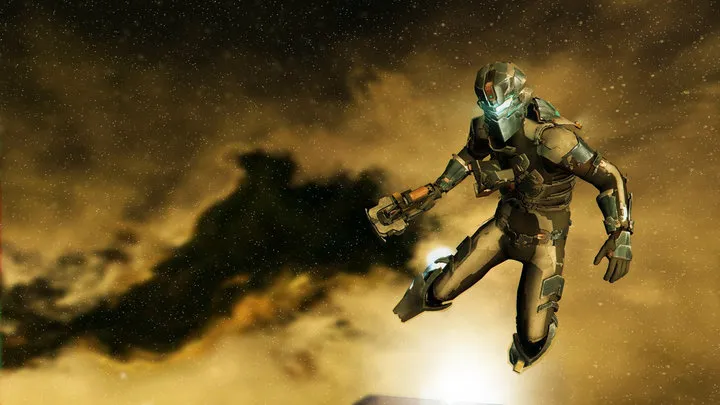
While Electronic Arts showcased its promising projects like Mass Effect 2, SW: The Old Republic, and the continuation of the console shooter Army of Two at last year's EA Winter Showcase, lucky ones deemed worthy by the management, under strict secrecy, admired the first screenshots of the yet-to-be-announced Dead Space 2. They showed a rough demo version, so journalists were warned in advance about potential bugs, crashes, and other unpleasant issues. However, the presentation went in the right direction – satisfied writers, feeling chosen, returned to their countries and began writing extensive preview materials with their impressions.
Time passed, new gameplay screenshots and videos appeared. Over time, it began to feel like we were looking at the same first part, albeit with a slightly altered environment. “What if they slip us the same product, just with the number ‘2’?” gamers fretted, fearing a cruel setup. “Relax,” replied the folks from Visceral Games, “we know what we’re doing.”
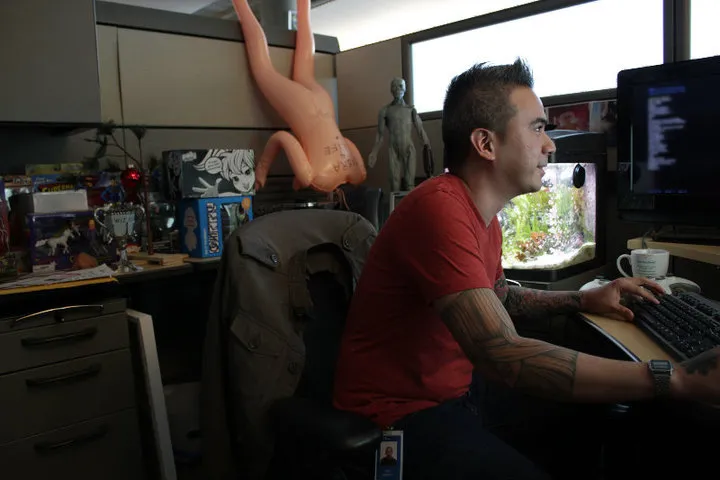
The workplace of the lead interface designer :)
Indeed, the developers from Visceral Games matured, gained invaluable experience, and can be considered “heavyweight” specialists. But in the early days of their existence, as Rait Bagwell (creative director of Dead Space 2) described, “the studio was still trying to figure out how to make big blockbusters.” Talented developers diligently worked on games assigned by the publisher (mostly related to the unstoppable James Bond), but at one point they realized it couldn’t go on like this. “We never had complete creative freedom. And no matter how hard we tried, we couldn't make our own independent game.” Thus, alongside their official work, programmers and designers toiled away at the demo version of their “dream game.” It had to be unequivocally an action game and definitely about space—events on planet Earth had long stopped being of interest to Visceral Games. Ultimately, they decided to set the game on a distant station and follow a couple of unfortunate souls who would need to survive in those (not very favorable) conditions. The name for the project came about naturally – “Dead Space.”
A playable version of Dead Space, already featuring dismemberment, weaponry, and interface, was presented to Electronic Arts in just six months (actually, I’m not sure about the timeline of how DS was presented to the publisher, so I’m lying – author’s note). The “Electronics” liked the game, and the bosses of the largest publisher greenlit the development of a new project under the unique license. Yes, there was risk, but when has EA ever been deterred by that (remember the issues surrounding Crysis)? But as it turned out, they certainly didn't risk in vain. Dead Space became a Hollywood franchise, worthy of being turned into a full-fledged film, let alone creating comics or writing literature (which has long been in existence).
By the way, for the creation of the comics, masters of the craft, the best artists and writers were hired. As Ian Milham, the art director of Dead Space 2, recounted, “Initially, we gather and discuss the project, but for the most part, they do everything themselves.” That’s why the comics based on the first game look graphically different from the original. This is far from a drawback since there was no intention to make the illustrated narratives resemble the video game. The main task was to expand the world created by Visceral Games, and the artists excelled at that. However, I can’t say anything about the animation (Dead Space: Downfall) and the book (Dead Space Martyr), as I’m completely unaware of what happens in them. However, I am very curious to explore this “creativity,” especially the literature, which, unfortunately, will never be translated into our great and mighty. Time to learn English.
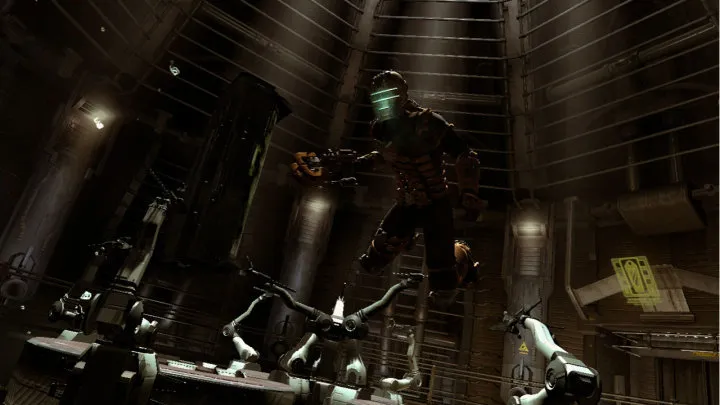
The main character is now free to move freely in space
Thus, we received an excellent horror of modernity: beautiful, atmospheric, and incredibly interesting. And before moving onto the nuances of the sequel, let’s quickly recap the plot of Dead Space.
So, the main protagonist is Isaac Clarke, a silent engineer tasked with fixing issues on the company C.E.C.’s space mining stations. At one unfortunate moment, an SOS signal is received from the large ship “Ishimura” (USG Ishimura), which mines ore from dead planets. In theory, the repair crew specialists planned to fix the equipment faults easily, but in practice, everything turned out to be quite different. In general, it is pointless to retell the further events, because Dead Space belongs to that category of games where the storyline is given almost the highest priority (action, of course, hasn’t been pushed aside). Characters clearly play their roles: some die on time, showing that death is lurking for Isaac, while others gradually reveal their true faces, forcing the main character to go further and closer to the end, as it is exciting to discover what caused the disaster on the “Ishimura,” and whom it is necessary to punish in the end. But at first, the humble and silent engineer performs the tasks of every survivor he encounters, working completely blindly, so to speak, only to later learn about the mysterious artifact and the government conspiracies surrounding this dangerous “thing.”
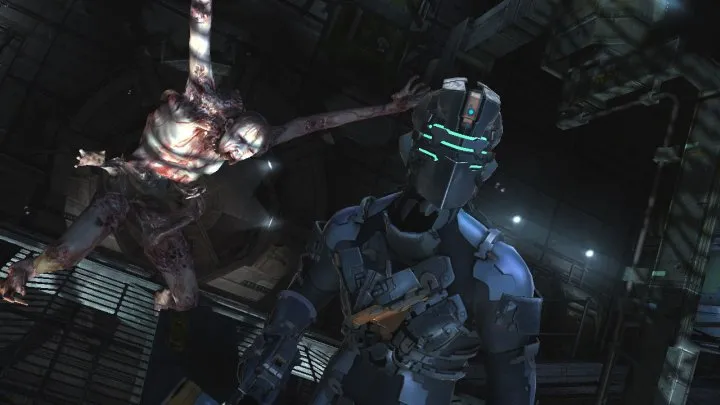
The scenes with monsters suddenly jumping out will be much fewer
Eventually, from a hostage of circumstances, Isaac Clarke transforms into a kind of “meat-grinder detective.” Seasoned by experience from his time on the nightmarish “Ishimura,” he no longer feels fear towards the decaying spawn. Furthermore, the main hero’s character wakes up, and now he is free to talk and express emotions (for most of the game, he will be angry, yelling into the radio, and showing his dissatisfaction). In the first part, you see, he was in shock and simply had nothing to say.
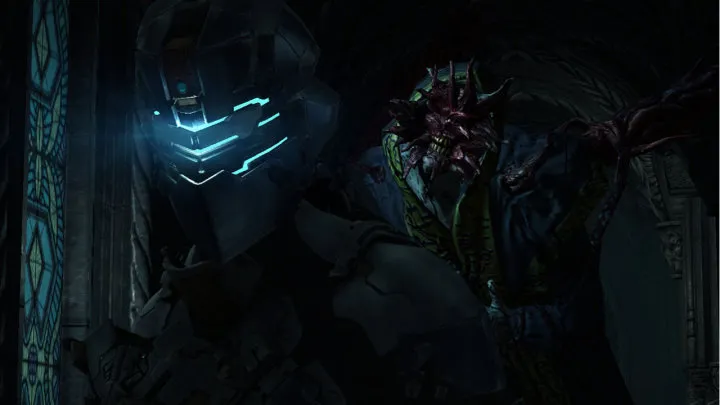
Having improved the image of the central character, the developers didn’t hesitate to upgrade the engineering suit as well. This is not, of course, a miracle of nanotechnology like in Crysis, but it will do for exterminating hordes of necromorphs. Firstly, an extremely useful invention – stasis – is automatically restored, allowing to slow down the enemy for a while. The authors of the game often utilized this ability during E3 2010 when demonstrating gameplay. Stasis, for example, is irreplaceable in combating the little necros, which frequently try to reach Isaac's face. We slow down the creature and with accurate shots take out the vital... uh... organs.
Secondly, telekinesis has also been upgraded. Now it works much faster, raising the overall pace of the game. With a low number of rounds for the machine gun, you can simply lift some particularly heavy object with telekinesis and throw it at the enemy. Other elements of gameplay will also rely on this ability.
Thirdly, in zero-gravity conditions, Isaac will no longer jump from one point to another, thus moving. Instead, he will fly. Yes, yes, the suit has been equipped with mini-engines that allow maneuvering in space. If needed, he can also magnetize himself to the surface. Everything else has largely remained unchanged. “Why change what works well?” they mused at Visceral Games.
*New city, new