Panzer Corps 2 + Spanish Civil War DLC. Game review and the first expansion.
Released in the spring, [Panzer Corps](/games?search=Panzer Corps) 2 is a turn-based strategy game set during World War II, where we traditionally play as the Germans, while other major participants such as the Soviet Union and Allies appear in the DLC. The series is a spiritual successor to the [Panzer General](/games?search=Panzer General) series. The previous game in the series was released in 2011, so what has changed in the new installment?
Transitioned to a 3D engine – Unreal Engine, though I wouldn’t say that this was a necessity. In terms of gameplay, it hasn’t impacted anything. The landscapes have become slightly prettier, but the hardware requirements have significantly increased. Also, gamers began experiencing crashes from time to time (I suspect the engine doesn’t handle AMD hardware well, or the developers didn’t test it sufficiently, as this is the second game on this engine that has crashed seemingly out of nowhere).

Innovations. There’s the ability to customize game difficulty in much more detail. Including randomness of attack results, the number of actions cancellation, fog of war options, turn limits, and so on.

Also, options for higher difficulty modes are available right away, which were previously unlocked only after completing the game on the highest difficulty – Field Marshal. For instance, the “Manstein” difficulty (+5 to enemy stack size) is called “David vs. Goliath,” “Rommel” (income penalty) is now named “Europe with no penny in the pocket,” and “Guderian” (mission completion time is reduced by 5 turns) is dubbed “Race Against Time.” You can create your own army instead of using a pre-set one.
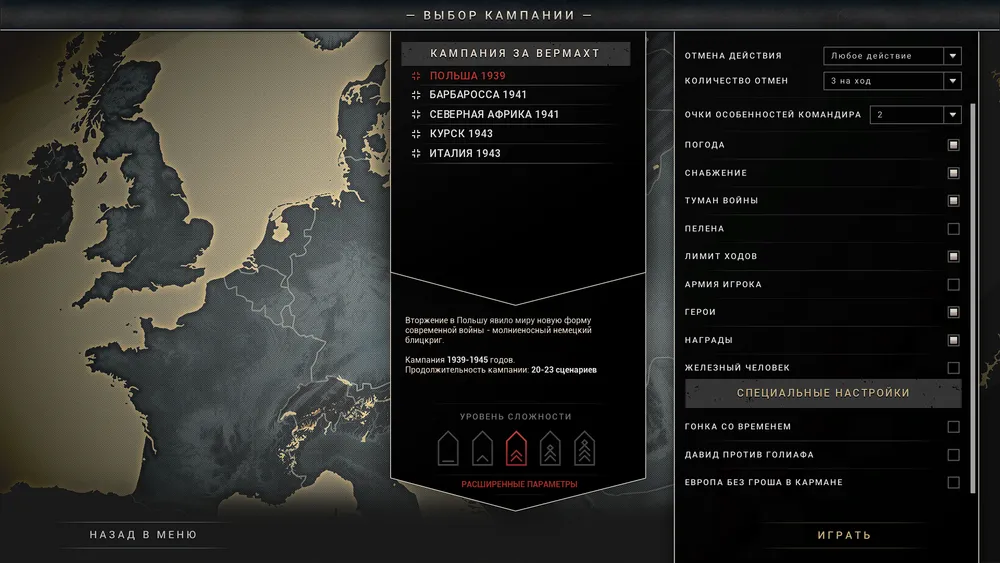
A special feature is the “Commander Ability Points” option. At the start of the game, players can choose commander traits (both positive and negative) that will affect the entire campaign. Positive traits like “Blitzkrieg Master” (tanks move faster and easily cross small rivers) cost points, while negative traits like “Refusal of Artillery” (ban on purchasing artillery; the starting piece remains) add points.

The developers have attempted to balance the player’s army by introducing a “slots” metric. Primarily, this was meant to prevent the dominance of latest model tanks on the battlefield. The more powerful the equipment, the more expensive it is, not just in prestige (“money”), but also in slots. As a preview, I’ll say this was not successful. By the penultimate mission or even a bit earlier, all my tanks became optimal Panthers in my view, while any other vehicles, except for planes, became optimal even before that. The only thing that slots fell short of until the very end of the campaign was a complete upgrade of the aircraft (there was plenty of prestige).
In addition to the traditional balancing of unit stats for each version of the game, the mechanics have also undergone changes. Replenishing ammunition and fuel no longer halts the offensive; it happens automatically at the start of each round (unless, of course, the unit is surrounded).
The “breakthrough” mechanic returned to tanks (after destroying an enemy unit in a single sweep, it gains additional movement points and an attack), which first appeared in the second Panzer General; infantry received a higher “standard size” - unit size has grown to 15, instead of the traditional 10. Additionally, certain types of infantry and cavalry received a “forced march” ability - once every 3 turns, they can increase their speed by 1 for the current round.
Anti-tank guns, both towed and self-propelled, gained the ability to support the fire of nearby allies when they are attacked by armored targets (tanks, self-propelled guns, armored vehicles). The coverage radius for anti-aircraft guns has increased. In PC-1, they covered a radius of 1 cell, now they cover the maximum range – up to 3 cells. Some anti-aircraft guns can switch to a “direct fire” mode to attack enemy tanks or cover allies. The downside is that the more powerful the anti-aircraft gun, the worse it performs against frontline aviation: tactical bombers and fighters, but it’s better at covering strategic assets and tanks (in the appropriate mode).
Artillery has de facto been divided into “tactical” and “strategic,” although it all remains in one category. Tactical artillery has a small range (1-3 cells), causes little or medium damage to unarmored targets, is almost useless against tanks, but supports neighboring units with fire during infantry assaults and has a large ammunition reserve (6+ shells). Strategic artillery has an extended range (4-5 cells), deals good damage to unarmored targets and small damage to tanks, does not support allies with fire during infantry assaults, and has a small ammunition reserve (usually 4-5 shells); especially heavy artillery has a “counter-battery fire” property.
Armored vehicles now enhance the damage dealt by nearby allies (recon boosts shooting accuracy). Fighters and tactical bombers perform worse if they have to fly long distances. Reconnaissance aircraft appeared, working just like armored vehicles, with the only difference being that the bonus is granted only for attacking targets directly beneath them.
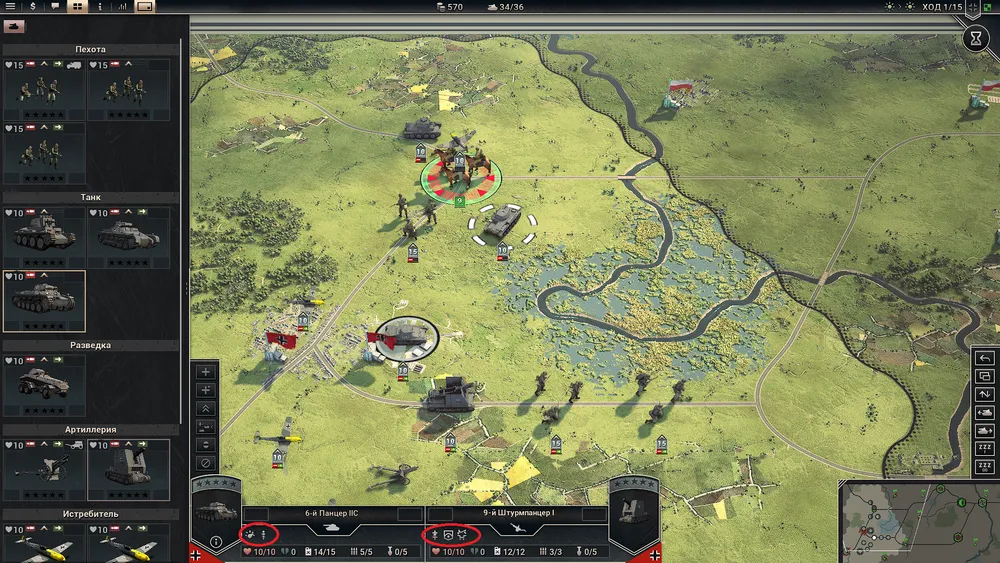
Finally, all unit capabilities have not only ceased to be hidden, but have also been moved to the main information panel of the unit, with a tooltip popping up upon hovering. In short, the interface has been quite well improved.
A new encirclement mechanic has been introduced. If the enemy is not located in a strategic city and is at least one cell away from the edge of the map, they can be surrounded. Encirclement is not necessarily literal – occupying all cells around the “victim.” It can be arranged such that a large number of units are cooked within the kettle. The main condition is that the surrounded units should not have access to the edge of the map or the nearest strategic city. When calculating encirclement, not only the physical positioning of units is considered but also their “zones of influence” - a radius of one cell around each. So, two units two cells apart create a solid front line of 6 cells. Units that find themselves surrounded begin to incur “sanitary losses” (part of the unit stops fighting), lose fuel and ammunition (to a minimum of 1 ammunition), and cannot be replenished. Usually, encirclement as a tactical maneuver is employed quite rarely since there is often no time to wait for the enemy to weaken. However, in cases where encirclement is possible, the next tactical maneuver can speed up the process: unit division – a new mechanic for the series. Before movement or attack begins, any unit can be divided into two identical halves; the divided half occupies the nearest cell; unification is possible either immediately - before the unit’s movement starts, or in the next turn. With the special general skill “Flexible Command,” one can divide and unite almost any time. This division is also handy for finishing off the enemy or for creating additional support (the larger the crowd gathered around the enemy, the greater the damage that can be dealt - seemingly, it becomes harder for the opponent to defend).
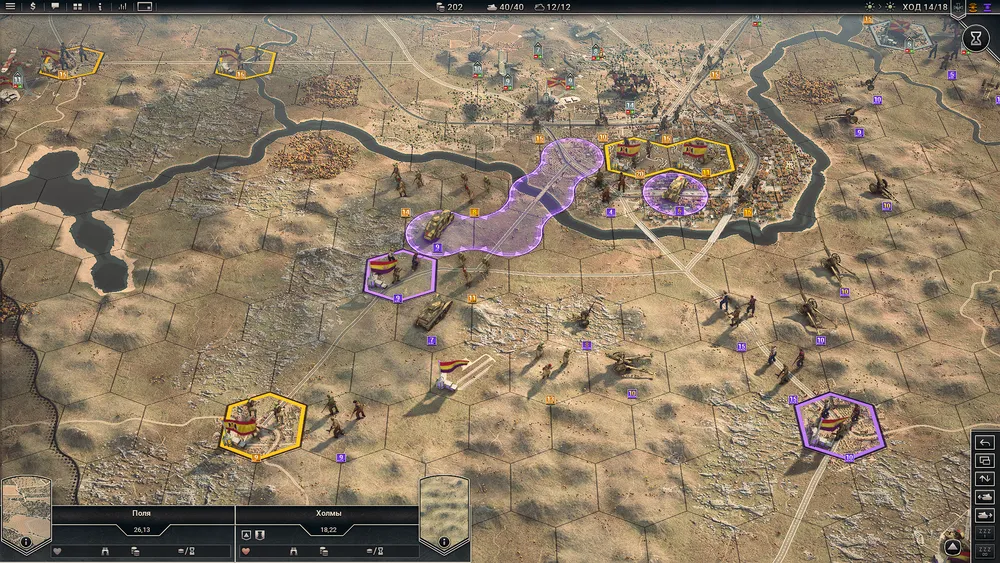
Purple indicates hints about encirclement threats
What else has changed? The maps have become smaller and more intimate. Aircraft now return to their “home” airfields at the end of the turn, and if those are captured, they return to the nearest one that they can reach. If there are no airfields, they crash. The “home” airfield can be changed, sacrificing a turn for the flight.

Yellow highlights the airfields to which a flight can be made
And here we encounter one of the disadvantages of the concept. Aircraft can be deployed around the airfield within a cell radius. Often, it’s just one cell that determines whether the aircraft will reach its target or not. Now we have the situation: different planes have different operational ranges. For example, the least “long-range” can no longer reach the enemy; we move it to the new airfield, while another can still reach, but only if at the end of the turn it returns to the position of the one that moved (1-2 cells closer to the frontline). Instead of returning it to its previous position on the airfield, it could have been repositioned to the place of the relocated aircraft, but that doesn’t happen. And even if you manually move it to another point on the airfield, the game won’t remember that and will return it to its starting position at the beginning of the turn. Furthermore, the specific place of the aircraft on the new airfield is chosen by AI. It may happen that the aircraft takes a position further from the frontline when the intention was the opposite.
Now the speed of mission completion affects the income from it. Previously, players often aimed to capture as many secondary villages as possible to gain additional income and delay completion to obtain maximum “daily” prestige. Now, this is no longer necessary. The final reward decreases with each turn, but the reward for capturing villages is automatically added after victory, even if no settlements were captured throughout the mission. In other words, it has become more beneficial to complete the mission very quickly.
The faceless heroes from PC-1 with their +1/2/3 to attack/defense have been replaced by prominent officers - “leaders” with much more varied characteristics.
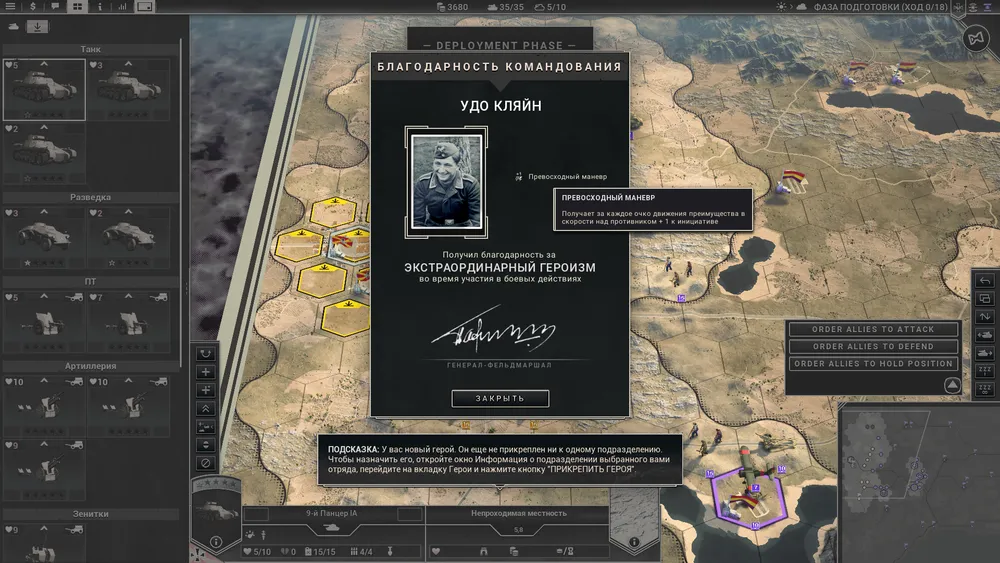
For example, instead of perishing, the unit remains with a single point or the target freezes for 1 round after being attacked, or some suppressions (temporary removal of part of the unit) turn into kills, etc. Now they are not bound to a specific unit and can be easily assigned (before mission commencement) to different units. Each unit can have 3 leaders. At the start of the game, players can choose the trait “Killer Team,” which grants three leaders at the beginning. Of course, not all leaders are equally useful. To avoid “cheating” by players obtaining good characteristics for the leaders, they are generated at the start of the campaign and do not change with saves/loading. Some players restart the campaign multiple times until the “Killer Team” includes leaders they want.
Surrounded troops surrender if they sustain significant losses and have nowhere to retreat. This is not new, as it was already present in PC-1. However, in PC-2, a new game mechanic is associated with this – captured enemy equipment is added to the trophy pool, and once at least 10 identical units of equipment are gathered, they can be brought into service. However, reinforcements will also be drawn from the trophy pool, and if that equipment is not present, it will be unavailable.

More innovations: starting from the very first mission, players can choose one of two scenarios – attack directions. Previously, this only occurred in key moments; for example, in 1940, it was possible to continue fighting in Europe or move to North Africa. The missions differ in character; usually, one aims to break through a deeply echeloned defense, while the other focuses on a rapid flanking maneuver – a Blitzkrieg, so to speak. The choice does not affect the course of the campaign.
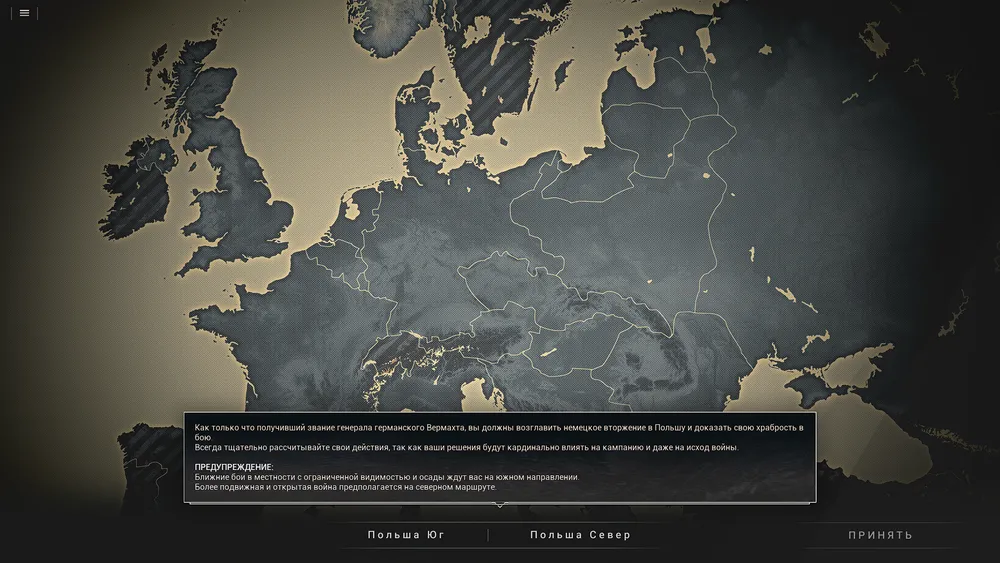
Unfortunately, here we encounter a “masterpiece” of game design. I fought in Africa, completing all missions while fulfilling additional conditions. And what happened next? After yet another victory, I awaited the transition to the fantastic part of the campaign – the assault on Cairo. It turned out that to transition, I needed to “pay” 10,000 prestige. A significant amount, but not astronomical. At that moment, I didn’t have it, and had to restart Africa (5 or 6 missions). Not only is this illogical – you win, complete all additional conditions, but here you are asked for “money” to transition to a new branch, and this was not mentioned anywhere, such a behavior from the game was in no way predictable. If you don’t pay, you remain in a realistic campaign leading to subsequent capitulation, regardless of successes in defense.
Additional objectives have appeared in missions, for example – sinking the British fleet, with additional prestige awarded for completion, which sometimes simplifies progression in subsequent missions (sunk the fleet – the British left France).
Overall, the game is an organic development of the series, without any revolution in gameplay. At the same time, existing drawbacks prevent it from being called completely successful. The first major drawback I already mentioned – the new graphics and high hardware requirements. This is associated with another unpleasant feature of visual design. Now it’s very difficult to distinguish between a fighter and a tactical bomber. A “crutch” comes to the rescue - different camouflage for different aviation classes, fortunately, this can be changed “without leaving the cashier.” Nonetheless, even camouflage doesn’t always help, as the models, if the camera is slightly moved to the side, merge into one.
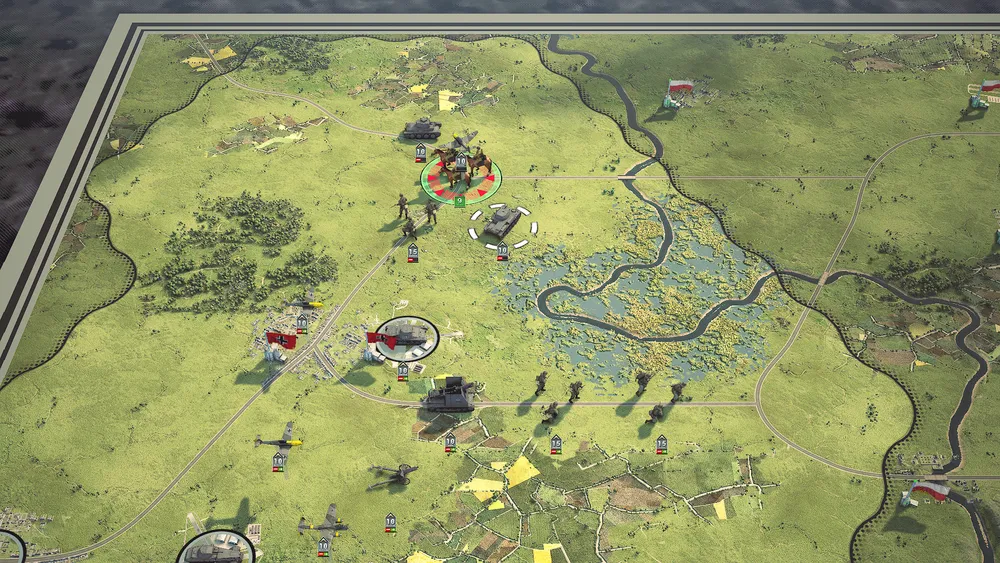
"Fun" - find the bomber
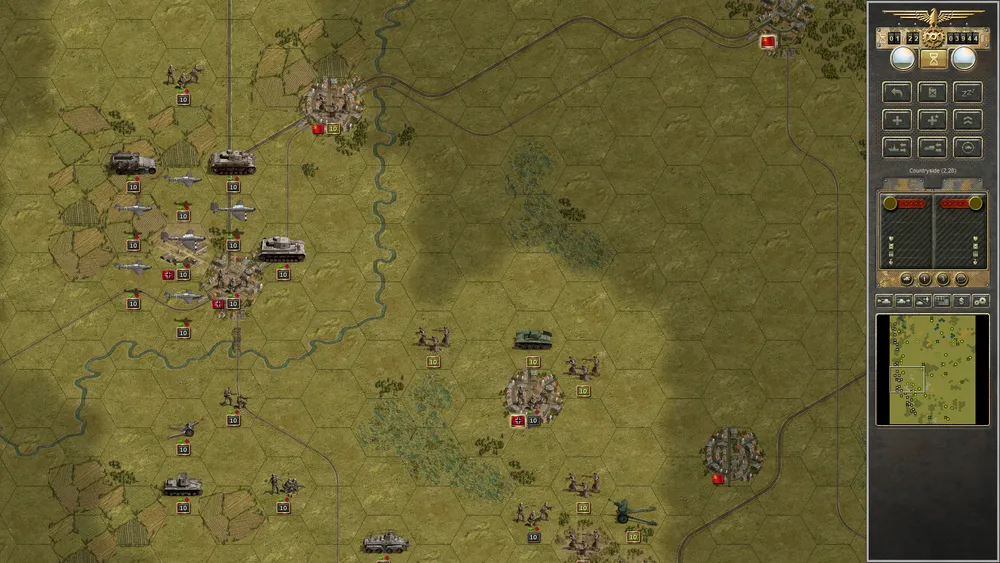
Screenshot from the previous game in the series - everything is simple and clear.
Moving on. Absolutely dumb AI. I believe this is the worst AI in the series. It clumsily moves tanks into rivers, incurring heavy defensive penalties. It makes little attempt to finish off crippled units, repeatedly throwing tanks against units protected by powerful AT, and while I understand that everyone makes mistakes, 1-2 times this might still be acceptable, but doing it for 5-6 rounds straight – this is completely out of the question. It doesn’t even try to attack reactive artillery (only occasionally bombarding), which typically has only two charges, one of which is usually already used in my turn. This emboldens players to behave recklessly, disregarding their protection. Fighters, instead of covering bombers or trying to clear the skies of enemy aircraft, rush to bomb ground forces, sometimes even ignoring anti-air fire.
In summary, at this stage, the game, to put it mildly, leaves much to be desired.
Now let’s move on to the first expansion, released back in July, “Spanish Civil War.”
I like the Spanish Civil War, which is unjustly underrepresented in wargames. It seems, since the times of Panzer General 2, where it was assigned only one scenario, the theme has not been touched upon further in the series. There were a couple of mods, again for PG-2, but since then a lot of water has flowed.
So, I followed the theme closely and even translated development diaries for the gamer. The developers were generous with promises: they vowed to elevate tactical gameplay to a new level, restore various types of victory (starting with PG-2 and up to PC-1 inclusive, there was a tradition of 3 types of victory: diamond, normal, and tactical; diamond victory granted more prestige and sometimes a prototype of new technology), to tell the story of the SCW as realistically as possible, to enhance the role of infantry in battles, to launch rapid computer strikes into the rear and flanks of inattentive units, to transfer surviving elite enemy units into subsequent missions, and to enact indirect control over allied forces. And one cannot say they have deceived us. Almost everything, except for realism, they implemented. However, expectations diverged significantly from reality, but, as one footballer once said: your expectations are your problems.
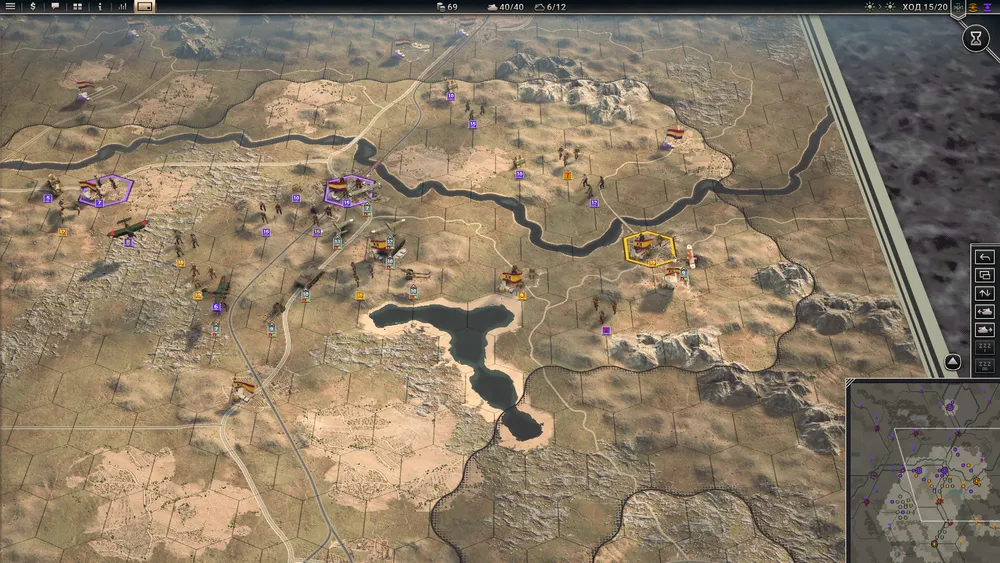
So, what did we end up with? We start in Morocco, as is historically expected. But there is a nuance. Already in July 36 (sic!) right in Morocco, “German troops materialize,” although in reality, the Germans only began assisting the nationalists in August, and until October, help was limited to transporting troops from Africa by transport aircraft. But even that is not all – in the first mission, Gibraltar can be seized. It’s not even guarded! But the most interesting thing is that this has no effect on the political situation. At all. There’s Gibraltar, no Gibraltar – Britain doesn’t care. And this is just the first mission, and already such historical “blunders.” Following that, we encounter: a woman commander among the nationalists – the “right hand” of the caudillo, the appearance of Soviet equipment long before the reality-based timing of deliveries, and so on. I am generally tolerant of some historical inaccuracies, but to go as far as to blatantly disregard historical context from the very first mission – such blatant illogic I have not seen in the series before.
All is understood with historical accuracy, but what about the rest? Various types of victory. Yes, they have been reintroduced, but not really. Instead of taking completion speed into account, they’ve created additional tasks. That’s good too. Now the main task becomes relatively easy to accomplish, whereas completing additional objectives grants rewards – “prestige points.” Every few missions, before starting the next one, a shop “opens,” where players can spend these points on certain armored vehicles or leaders. Sounds great, but there’s a catch: the characteristics of the purchased equipment are not visible, a window with an image pops up and asks – do you want it? I didn’t reach the leader stage. One must wonder what prevents keeping the “shop” “open,” starting from the first appearance? So that players can review available “items” and purchase something before each mission?
Enhancing the role of infantry. Well, yes - during the early period - until powerful tanks emerge, plus there are indeed more infantry on battlefields in Spain than machinery. Overall, up until around 1943, infantry feels fairly stable in the game.
And then begins the horror of game design, compounded by poorly thought out mechanics. Instead of clever flanking and rear strikes, there are “roses” appearing at the edge of the map. Yes, part of the map has now been fenced off in many missions; you cannot cross there, yet enemy units regularly emerge from there. Moreover, the obligatory composition of the unit includes: 2 infantry units, 2 armored units (tanks or tank+armored car), field artillery, AT gun, and anti-aircraft gun. A full course, so to speak. They appear every few turns on cooldown. Do you enjoy this kind of gameplay? I do not. It’s one thing when reinforcements arrive at different times. But the situation where 6-7 units, maximally protected from all attacks, are just dumped onto the battlefield multiple times per mission indicates a lack of balance in both individual maps and the campaign as a whole. Furthermore, at times, the saturation of Republican forces with artillery and armor reaches such levels that one unwittingly begins to consider – are we indeed in Spain? Or has Barbarossa quietly crept upon us?
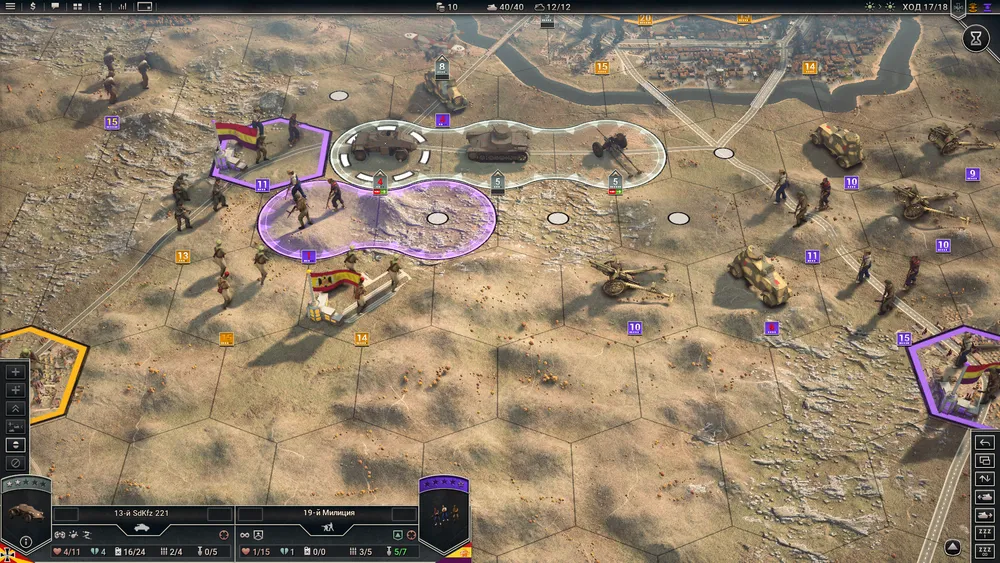
And the cherry on top is the indirect control over allies. In each mission, the core comprises a small number of ground troops, a greater number of aircraft, and… a heap of allied infantry units. The order of turns is: ours, allies, enemies. Allies can only be issued one command across the board: attack, hold position, retreat. Now to the actual scenarios: we’re advancing in one sector while the enemy is counterattacking in another, and artillery has lagged behind infantry in a third. However, there’s only one order for everyone. You cannot manage them yourself.
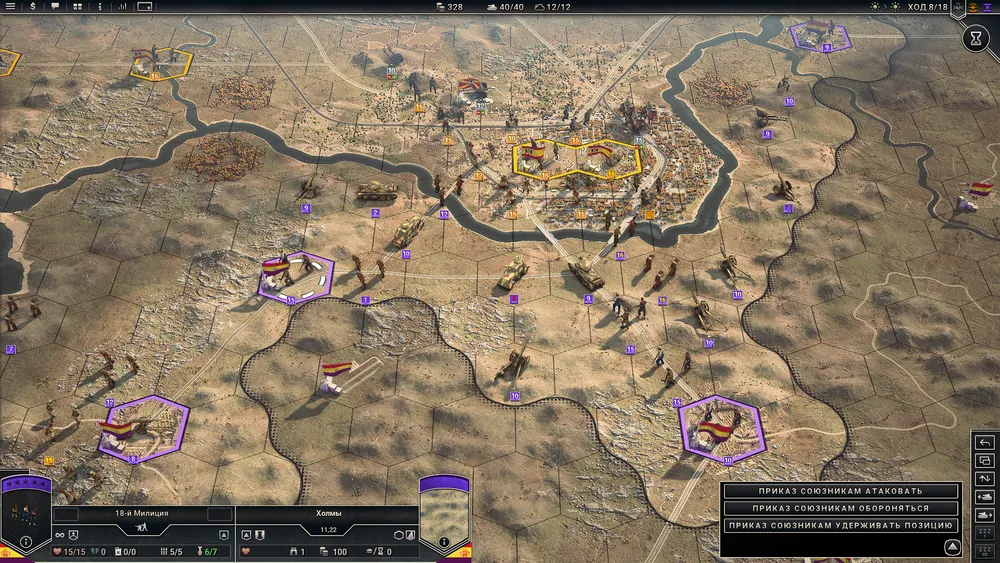
By occupying strategic cities, infantry you do not have remains in them forever. It simply does not move until the end of the mission. A small consolation from developers is the presence of Italian allies that can be hired for missions, but slots are sufficient for only 1-3 units. However, that’s only part of the issue. The real problem arises as the AI replenishes at our expense, preferring to restock “elites,” i.e., the more expensive ones. Thus, considering the large number of units that incur losses, “money” disappears in moments.
In summary, my patience only lasted for the first 5 missions. At one perfect moment, I realized that I had chosen the wrong characteristics for the general and decided to restart the campaign. After playing around with the skills, I discovered that the “attached troops” ability (+50% slots for additional units that don’t carry over from mission to mission) functioned very strangely - I fell into the negative on available slots as soon as I launched the game. In short, this expansion reminds me of the saying: “thud, thud, and into production.” That is, it either wasn’t tested at all or was tested haphazardly. It even reached a point where when the level designer played the current version on the official forum, he said that it should not be like this, it needs simplification, rebalance. I don’t know if they changed anything or not; I have not felt like checking yet.
I also encountered repeated game crashes during battles in Spain. In other words, if anything could be done worse than the main game, it’s all done in this DLC.
But it seems that the “people” have accepted it, and following DLC39, DLC40 is scheduled for release on December 10. Regardless, I currently do not recommend getting involved with this game.