
Preview of "Might and Magic: Heroes 6" Based on the Beta Version
‘Heroes of Might and Magic’ was one of the first games in my life. Throughout their history, I have watched the series evolve, witnessing its highs and lows, catastrophes and brilliant ideas. So, it’s no surprise that when I received a key for the beta version of the sixth installment, I quickly checked how the new developers envision the future of 'Heroes'.
Forward to the Past
Many young players likely wonder why the series has gained a new title – ‘Might and Magic: Heroes’. In fact, it was a pretty logical (yet seriously overdue) decision to unite all games related to this universe under one name. There were ‘Might and Magic’, ‘Heroes of Might and Magic’, ‘Dark Messiah of Might and Magic’… not to get confused is quite the challenge. And if we are going to start changing long-standing traditions, it’s silly to limit ourselves to just one name. Thus, the developers from Black Hole Entertainment presumably reasoned, deciding to rewrite the familiar game mechanics. But let’s take it step by step.
The action of the new game takes place in the already familiar world of Ashan, approximately four hundred years before the events of ‘Heroes of Might and Magic 5’. We will witness the events that lead to the ascension of the Griffin dynasty to the throne of the empire. The story is singular, but we will see it from five points of view corresponding to the main characters of five playable races – humans (Haven), undead (Necropolis), barbarians (Stronghold), demons (Inferno), and the sea folk (Sanctuary). As you can see, even at this early stage of getting acquainted with the game, innovations are noticeable – there are no familiar wizards, woodland folk, or necromancers; instead, the list of castles features the unprecedented Sanctuary.
The developers decided to maintain each side of the conflict in a particular style, which is expressed in the appearance of castles and fighters. Thus, in the design of Necropolis, Sumerian motifs are clearly visible – the castle looks like a stepped pyramid made of black stone, adorned with statues of winged lions, and amidst the fighters lurk lamassu – those very winged lions with human faces from Sumerian mythology, albeit a bit dead. The barbarian army bears traces of Aztec culture – goblins with spiked boomerangs, orcs with bone clubs and feathers sticking out everywhere, parroquet-colored harpies referred to as jaguar warriors, and so on. The Sanctuary is styled in an Eastern theme – nagas with katanas, ice maidens with fans and characteristic kimonos, giant kappa frogs with little lakes on their heads, shark people, and long-whiskered dragon snakes leave no doubt. The humans are the luckiest – they inherited both the troop composition and external appearance almost entirely from the fifth game, only mixing familiar crossbowmen, knights, and other griffins with light elementals and healing maidens capable of even resurrecting the dead. As for the demons – they are demons, full of spikes, horns, claws, hellfire, and stinking smoke.
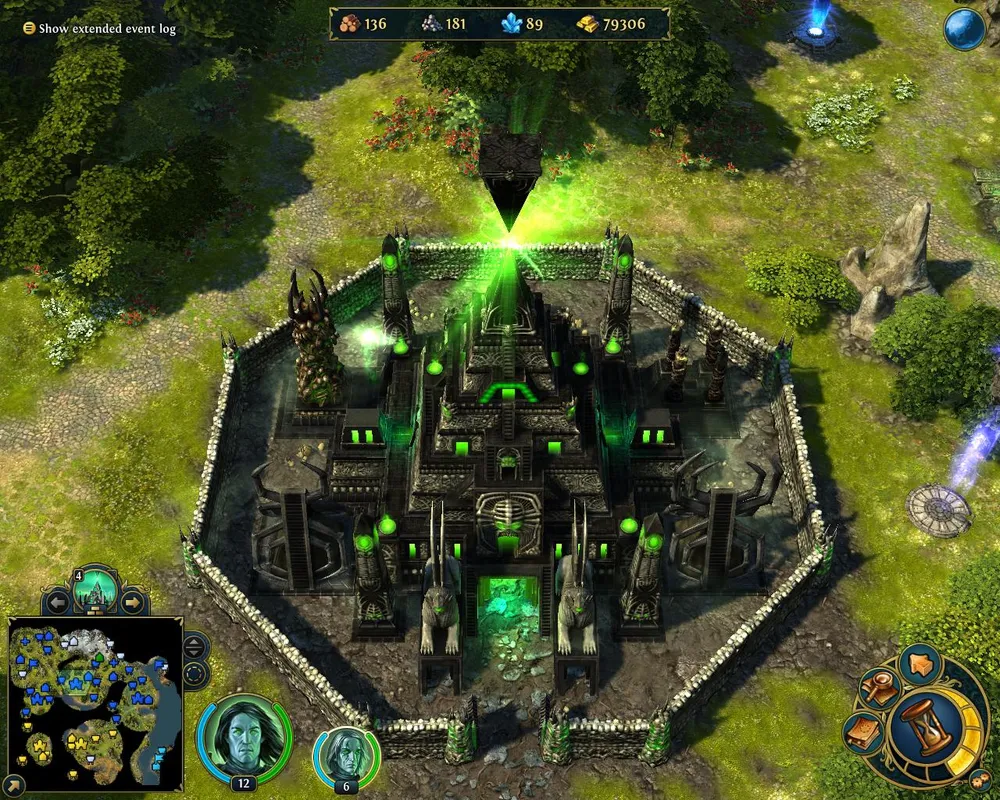
You have to be undead not to be afraid to live in a city overshadowed by a massive pyramid
How successful is this styling? It’s hard to say. Some might like it, others might not. In my opinion, this idea was unsuccessful. Haven and Necropolis look decent, although they also have their flaws – for instance, the light elementals, appearing like naked translucent glowing girls, seem completely out of place among heavy armored knights, puritanically dressed healers, and angels. The undead feature impressive vampires and lamassu, but when it comes to the lich models, someone deserves a beating. Liches throughout the series have always appeared as formidable and majestic undead wizards, which fully reflects their essence – but here they have been turned into something resembling dried mummies with spider legs protruding from their backs, chains hanging all over in a S&M style, and an attack reminiscent of shooting a green hose from a staff. The appearance of the barbarians turned out completely disastrous – goblins with clumsy spiked boomerangs and ogres wearing someone’s skulls on their fists are the least of the problems. However, the completely garish parrot harpies, zebra centaurs, and orcs with feathers sticking out from everywhere killed any desire I had to play as this castle. It’s hard to ruin demons, they have a pretty standard appearance, which is not good and not bad either. Although even they have their personal blemish – one of the new monsters, the queen, looks like a giant bag with a round toothy mouth and fits into the ranks of hellish warriors like a sore thumb, insistently reminding one of contraband from the Zerg. The situation is most complicated with the sea folk of the Sanctuary. Their entire style is well thought out, with no character that doesn't harmonize with the rest of the comrades – the problem is that the castle executed in a Japanese manner simply doesn’t fit into the world of Ashan. Not at all. It looks like an overtly foreign element amidst the otherwise normal European fantasy setting.
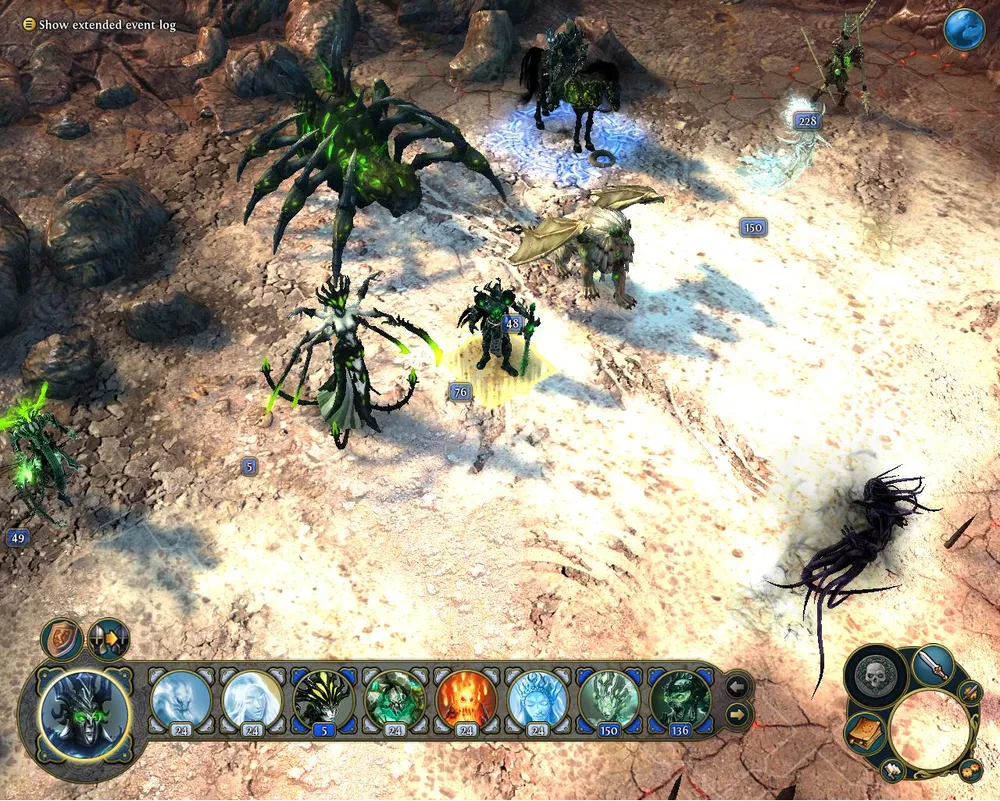
At the necromancers of Ashan, even the catapults look like spiders
Fortunately, the developers didn’t just stop at changing the visual aspect of the conflict sides – they put considerable effort into other aspects of the game as well. While the story in the beta version cannot be assessed, it’s worth delving into the gameplay mechanics.
Heroes of the Magical Sword
There have been so many changes to the gameplay that it is easy to get lost. Only the basic principles remain unchanged – it’s still a turn-based strategy with role-playing elements, globe-spanning journeys, battles led by heroes, resource collection, and castle development. But dig a little deeper, and the differences begin.
Thus, instead of the seven usual resources (gold, wood, stone, mercury, sulfur, gems, and crystals), only four remain (gold, wood, stone, and crystals). This was done to speed up castle development and not to keep players reliant on whether they find a rare resource or not. To achieve this same goal, the building construction in castles has been reorganized – the days of needing to build a tavern to construct a vampire mansion and a mage guild for a lich mausoleum are gone. Now the entire construction process is tied to the level of the main city building – the town hall, which previously only generated daily income. The gold revenue hasn't disappeared, but now what can be constructed in the castle depends on the level of this building. The first level of the town hall grants access to buildings for basic troops, such as skeletons and wraiths, as well as basic auxiliary buildings like taverns and markets. The second level opens up the possibility of raising barracks for elite fighters like liches and vampires, along with advanced buildings like the city portal and artifact market. The third level allows for the construction of the lair for the strongest monster available to this race, as well as the most interesting additional buildings like the improved city portal. A fourth-level town hall can only be in one city, and besides a flowing stream of gold coins, it allows the construction of a unique building in that castle, the creation of which requires the Tear of Ashan. All troops' barracks can be upgraded once, unlocking access to advanced versions of troops and – attention! – increasing the weekly growth of creatures. This is the only way to speed up the accumulation of elite warriors in the castle because building fortifications now only affects the growth of basic first-level creatures, without impacting the second and third.
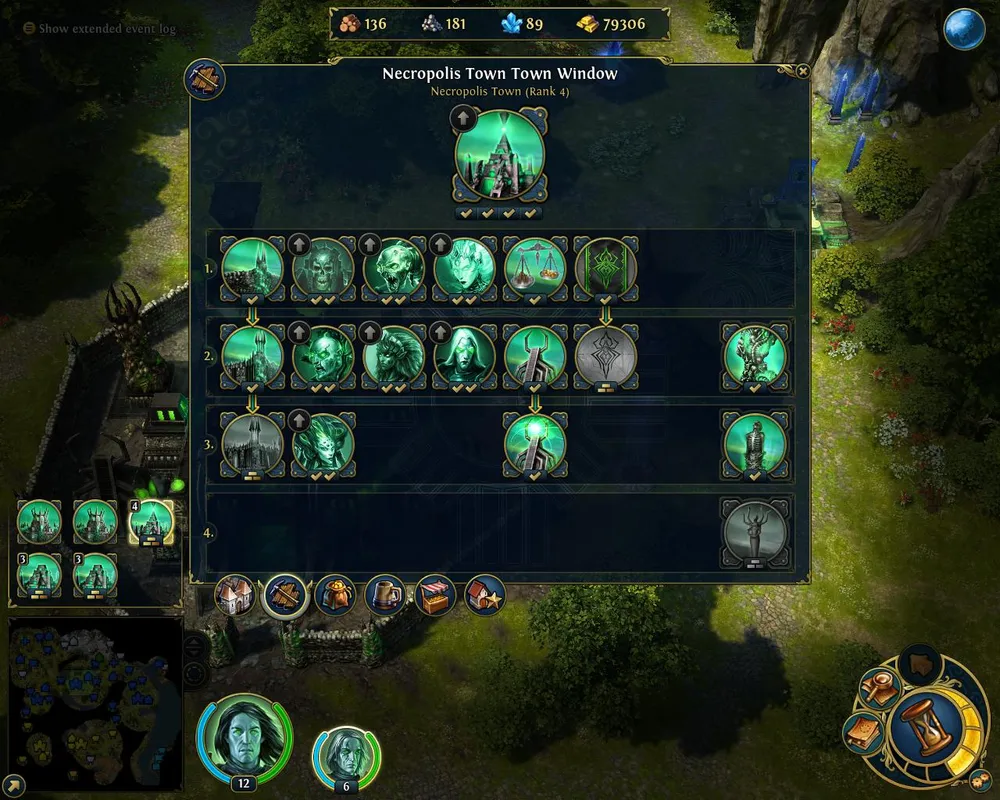
The round icons of buildings in Necropolis look too much like frames for photos on tombstones
This system allows for a rapid acceleration of castle development, as players can build nearly any building in the first week – it's just that for the lair of the mightiest creature, money may usually fall short. However, due to the decrease in the number of resource types for building castles, a restriction is imposed that blinded players by the prospects may not notice immediately – to build all buildings, the same wood and stone are required, and for somewhat advanced constructions, also crystals. Now there is no possibility to save on one resource by going ahead with buildings that require another – either we spend resources on new constructions, or we do not spend and do not build. There is no third option. This encourages the player to wisely choose what they will prioritize for developing the castle. On one hand, this approach is great – players are now limited only by the overall number of resources and can decide in what order they wish to spend them. Should they rush towards the strongest warriors and end up without a basic army or develop steadily from simple to complex, risking facing spearmen against vampires? On the other hand, many are accustomed to the old system, which was well-balanced, and we won't be able to judge the balance of the new one until the game releases. The construction window also looks somewhat scary – the pictures in the round windows are informative but just too… informative. It lacks the beauty and elegance that used to be present, offering bare functionality. But these are just nitpicks; overall, the new system turned out to be very interesting and promising. As a small but very nice detail, I can mention two facts: creatures from lairs captured during travels automatically appear in the list of available hires in the nearest castle, relieving players from tedious weekly reinforcement gathering, and players now have the option, for a nominal fee, to transform captured castles or lairs into castles or lairs of their own race. No more mixed armies!
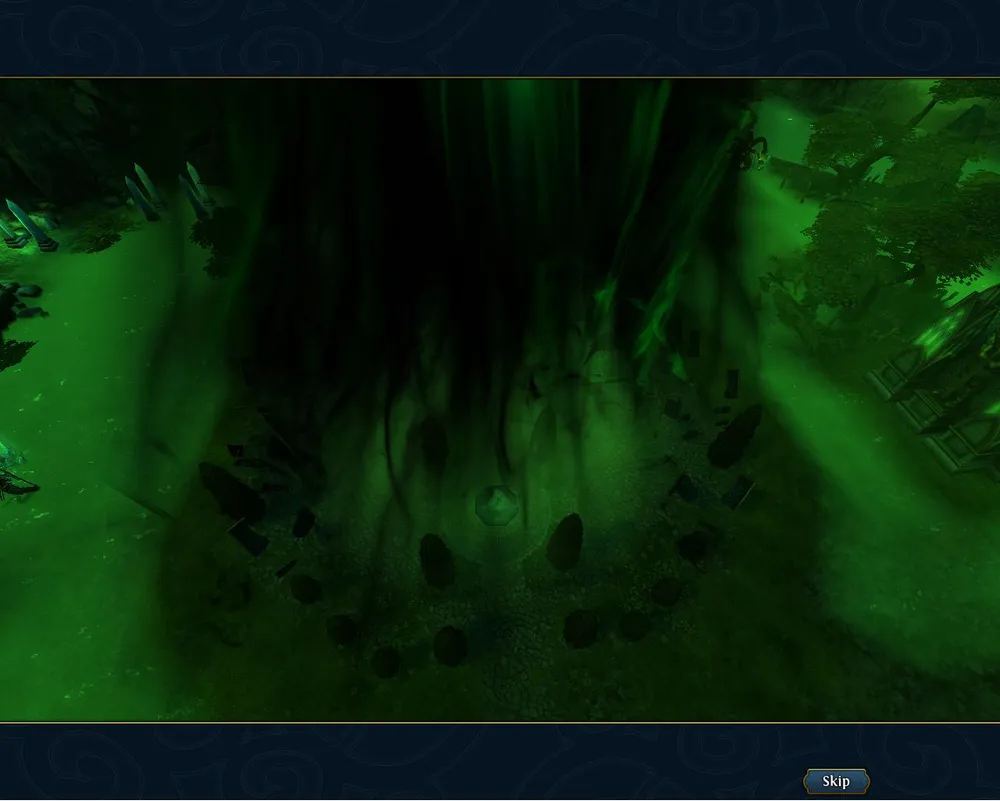
This is merely the transformation of a human castle into a necropolis, not a global cataclysm... well, maybe just a tiny bit
By the way, I mentioned earlier the guilds of wizards. Well, forget about them. Now spells are learned directly by the heroes – like many other features. The hero development system has also undergone significant revision. Previously, upon leveling up, a hero would receive a boost to one randomly chosen attribute and the opportunity to take a new skill or improve an old one – again, from a relatively randomly provided list. Now, heroes of each race, much like in the third installment, are divided into warriors and mages – and upon leveling up, they receive bonuses to all relevant attributes. That is, warriors increase attack and defense, while mages boost spell power, knowledge, and the like. Instead of choosing from a random list of skills, heroes are now simply given points that players can allocate as they see fit.
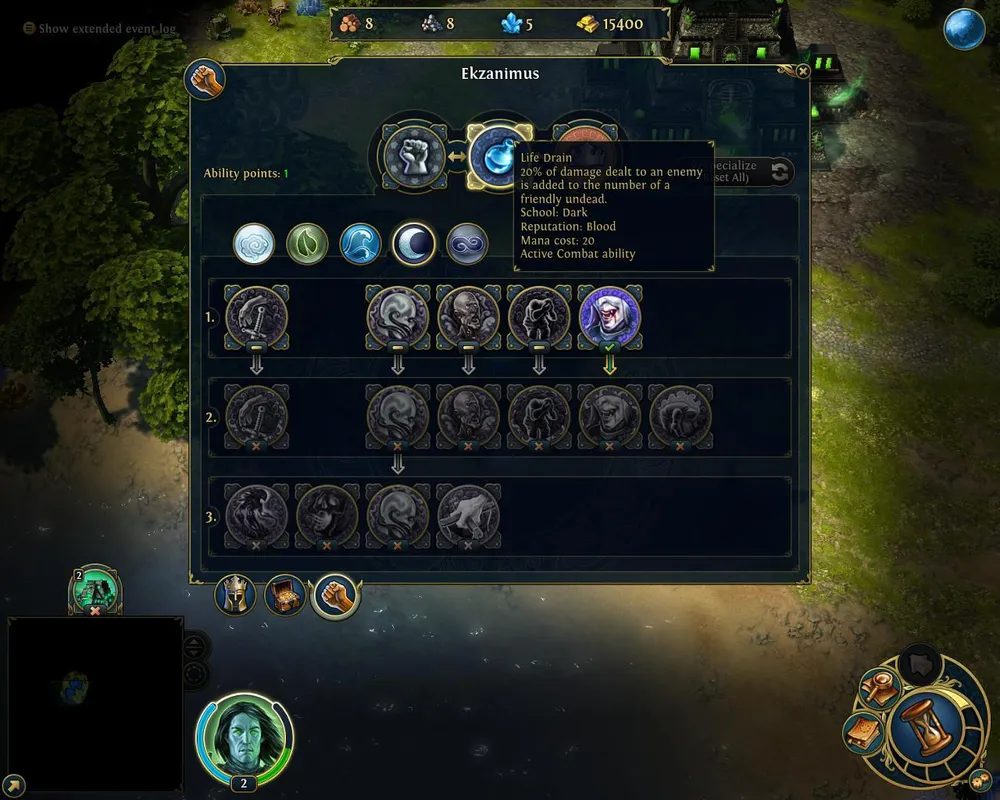
Curses, debuffs... am I a certified necromancer or a village witch?
Skills are divided into combat, magical, and reputation. Depending on the class and race of the hero, the set can vary – the undead, for instance, lack fire and light magic, while humans cannot access dark magic. Combat skills encompass passive enhancements to shooting, attack and defense, movement range and leadership (formerly luck), as well as active battle cries and special maneuvers. Magical skills are divided into schools of magic – fire, water, air, earth, darkness, light, and general magic. Each school contains both spells and skills that enhance all magic of that school at once. In the general magic section, players can expand their mana pool, increase magical power, and learn spells that for some reason didn’t fall into specific schools. All skills are categorized into three levels of difficulty – available from the start, available from level 10 of the hero, and available from level 20. Some high-level skills represent an advancement of simpler ones – for example, the fire arrow at level 10 opens access to the fireball, while at level 20, it grants access to meteor rain. It’s not for nothing that they said that magic in Heroes 6 would be noticeably weakened – now a mighty mage at the thirtieth level, knowing five spells, is not nonsense, but rather a norm. There simply won’t be enough points to take all spells and develop all schools – choices will have to be made about what best fits the gameplay strategy. And indeed, magic in battle can’t be used over and over – every spell requires several rounds for