
Bright Future. Game Review
Trust no one. Question everything.

h+
Humanity has always sought self-improvement. Throughout its existence, people have tried to squeeze every capability from their bodies — both physically and mentally. But can the use of cyber prosthetics be considered an improvement? What defines a person — biology or consciousness? Are we ready for new possibilities?
These and other, to put it mildly, fairly classic questions are what [Deus Ex: Human Revolution](/games?search=Deus Ex: Human Revolution) asks us to ponder — a role-playing game, which is also an action game set in a cyberpunk universe.
The Legacy of the Future
The game is a prequel to [Deus Ex](/games?search=Deus Ex) and takes place roughly twenty-five years before the events of the first part. Consequently, the protagonist will not be JC Denton, but a new hero — Adam Jensen, the head of security at "Sarif Industries" — one of the leading corporations dealing with modifications. After mercenaries attack its laboratories, he sustains serious injuries, resulting in doctors having to turn him into almost a cyborg — prosthetics were installed for his arms and legs, along with eye, brain, and other implants.
As we progress through the game, new facts and details about the attack will be revealed. Omnipotent corporations influencing politics, private security agencies capable of challenging the armies of individual states, mass media presenting information in the light they desire — all of this is here. Mighty players have gathered, which means there is a global conspiracy.
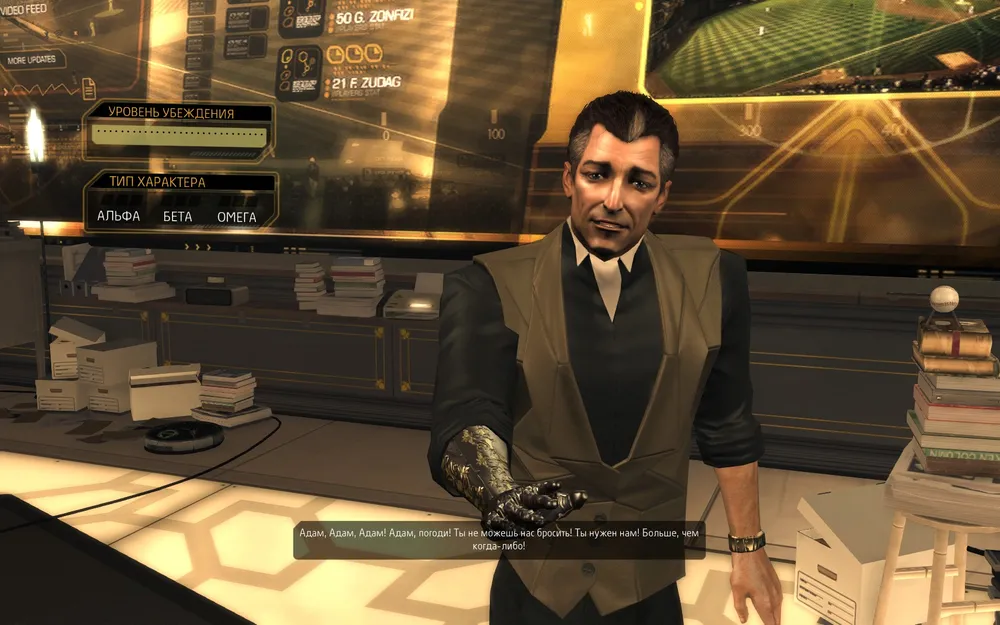
What would Sarif do without us?
The authors reflect on philosophical questions similar to those posed in [Deus Ex](/games?search=Deus Ex) and do so in a reminiscent manner. The ending offers you to choose what resonates more with you; there is no unequivocally good ending. This applies not only to the main story but also to some side quests.
As in the original, some information about the world and the plot is conveyed through emails, books, and conversations. Therefore, a curious player is obliged to comb through the levels thoroughly, hacking everything within reach, interacting with people, and eavesdropping on their conversations. An attentive player may even foresee some plot twists.
The Wealth of Choice
The game is linear, although your actions will have consequences. Not to mention, there are four possible endings. While the order of the story missions is fixed, you are free to choose how to reach your objective and complete the task. And there will often be multiple ways to do so. For instance, how can you access the laboratory? You can accidentally stumble upon a corpse in the ventilation and take its access key, read someone else's email to find out that another key is in the security room, use the ventilation system, or simply take out all the enemies. This sort of choice is nearly everywhere. You can persuade, kill, sneak, and do so through various routes.
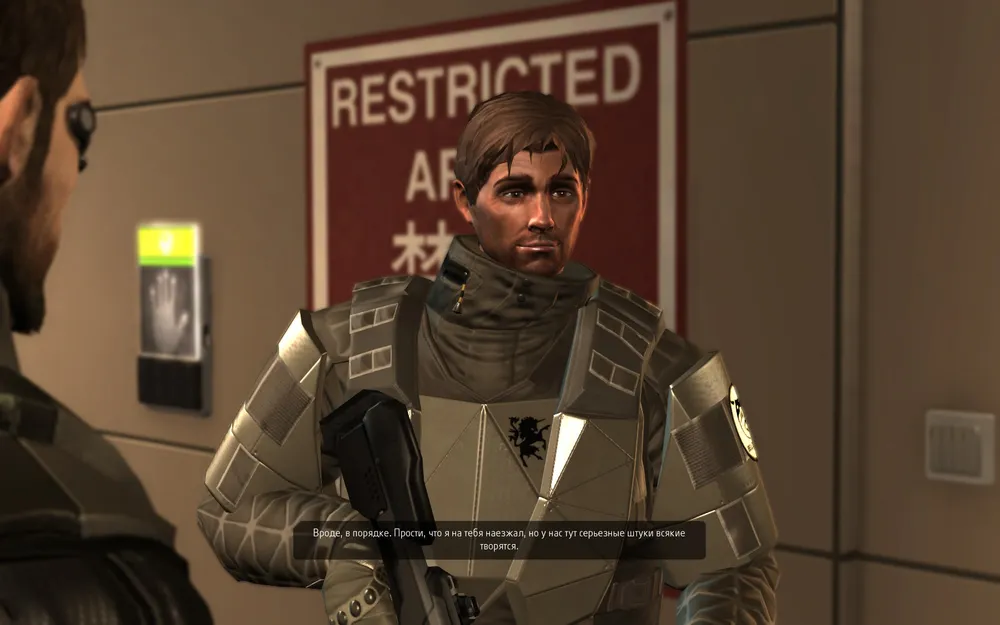
You’ll be apologizing to management for missing me.
The story also offers options. Should you help the thief or report him? Convince him to hand over the item we need or take it by force? The choice is yours. And if things don’t go as planned — do it differently.
But this doesn’t mean the game is easy. Jensen can be killed fairly quickly, despite automatic health regeneration (thanks to the doctors for the relevant implant). Sneaking past a hall patrolled by several mercenaries without raising an alarm is quite a task, especially if you aim to neutralize them all quietly.
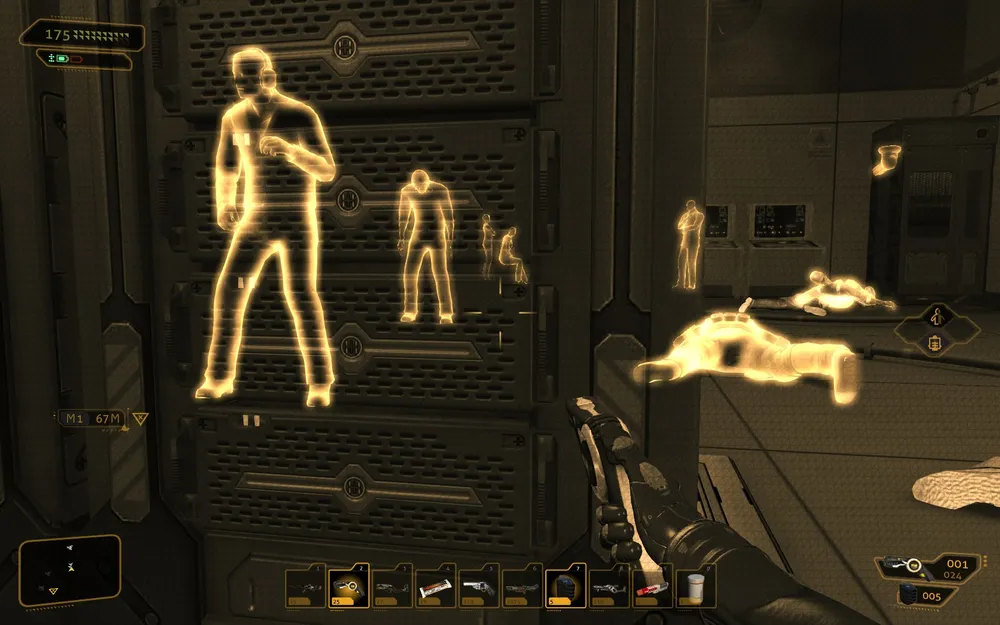
Ah, x-ray vision isn’t good for peeking at girls in the shower. :(
Speaking of augmentations. Adam has had most of his organs replaced, but not all capabilities of cyber prosthetics have been activated. To activate and enhance them, you need "Praxis points," which can either be earned by gaining a certain amount of experience, found in hidden corners, or purchased at PROTHESIS clinics. The choices are, to say the least, pretty good. More than half, if not the overwhelming majority, of modifications can come in handy for different play styles. Although there aren’t many that are absolutely essential.
It's worth mentioning one particular augmentation and its related game aspect. We are, of course, talking about the CASI — computer auto-corrector of social interactions. This implant allows us, during conversations, to determine a person's personality type and tailor our phrases accordingly (what to choose is still up to the player). In particularly challenging cases, a scale is activated, showing the character's willingness to cooperate, along with a brief dossier on the person to understand what to pressure. The verbal battles are quite engaging, largely thanks to the dialogue scenes themselves.
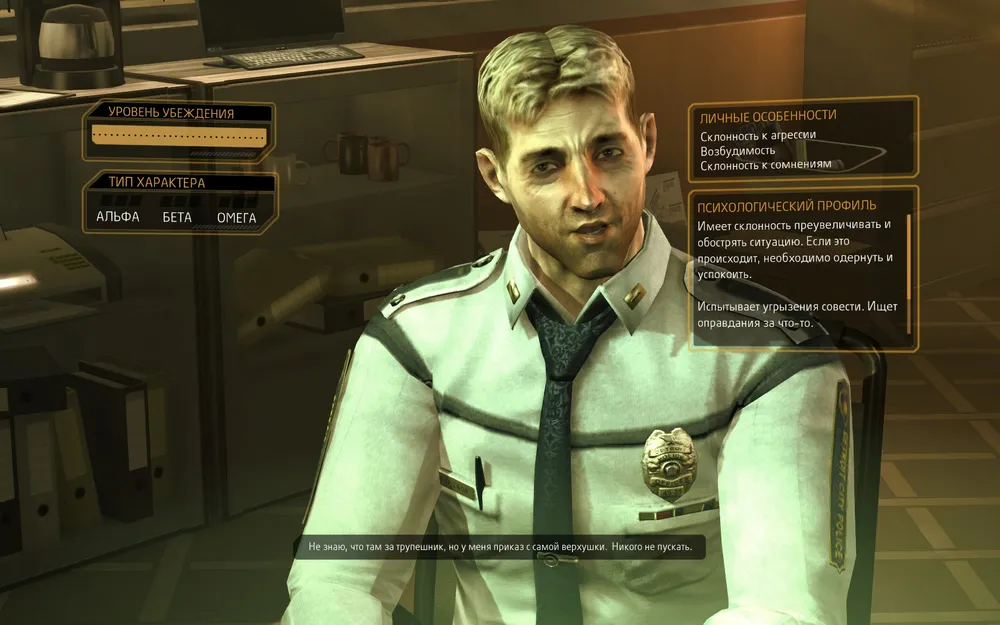
Convincing the unfortunate fellow to help us.
Using some implants consumes energy. One block regenerates automatically, while others can only be refilled using special energy bars. A couple of augmentations can increase the number of blocks and speed up the recharge time for the first.
The weaponry is quite diverse as well: there are sniper rifles, close-combat weapons, several kinds of non-lethal weapons, grenades, mines, and even rocket launchers. Most of them can also be upgraded.
Against this backdrop of diversity, boss battles seem a bit out of place: you will have to kill the villains, and this must be done in a small arena. A stealthy pacifist, however, can hold his own here too.

Profit. Profit. Profit.
Trends of Time
This section of the review is particularly for those who played the original [Deus Ex](/games?search=Deus Ex), as it will discuss the differences between the games. In my opinion, [Deus Ex: Human Revolution](/games?search=Deus Ex: Human Revolution) has improved in every way. I won’t list every change, but these deserve a mention.
Firstly, as mentioned before, health is now restored. But this mostly helps between fights and a little bit in boss battles, because it doesn’t recover instantly and the implant doesn’t activate right away.
Secondly, a cover system has been introduced, and it’s surprisingly well implemented. Simple, clear, and runs smoothly.
Thirdly, there’s a system of instant melee neutralization of enemies, which greatly simplifies life. It’s a controversial innovation, but the beautiful animation strongly favors the new game.
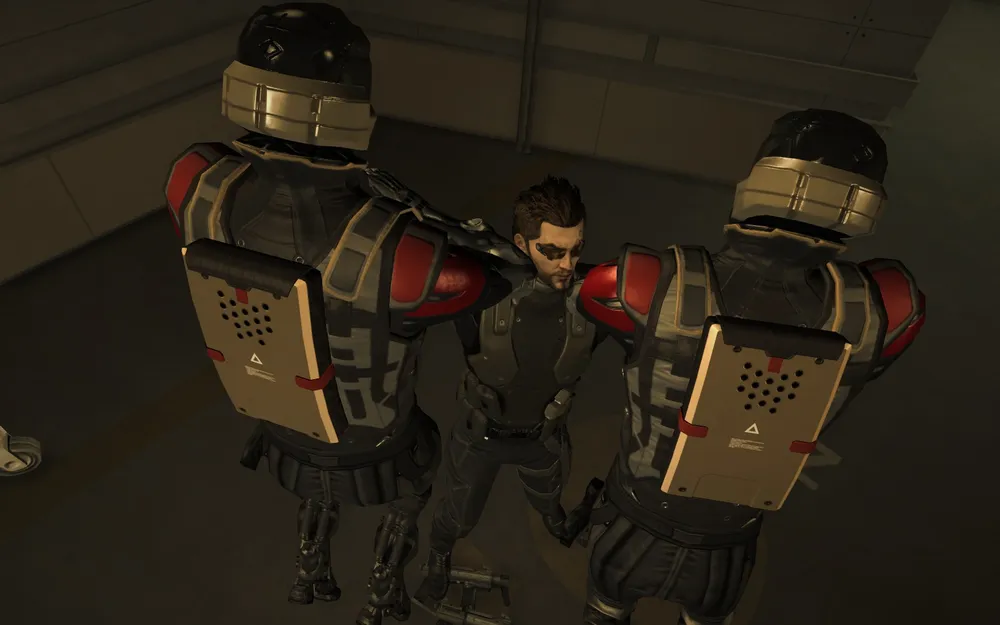
Who called me a glasses-wearer?
Fourthly, I cannot overlook the replacement of the awful crossbow with a fantastic tranquilizer rifle. Now enemies will finally not run in circles for another five seconds, attracting the attention of their comrades, but will quietly drop.
Fifthly, there are mini-games for hacking. A very pleasant addition, and I haven’t even gotten tired of it yet. It’s about time we said goodbye to lockpicks! I won’t miss them.
In general, what I want to say is that all these changes are aimed at keeping the game’s pace from slowing down, as well as enhancing convenience and spectacle.
The Age of Revival
The graphics are pleasant, although the engine is slightly outdated. However, the use of modern image enhancement technologies, support for DX11, and breathtaking visual style (which can be appreciated through the screenshots) compensates quite well for its shortcomings.
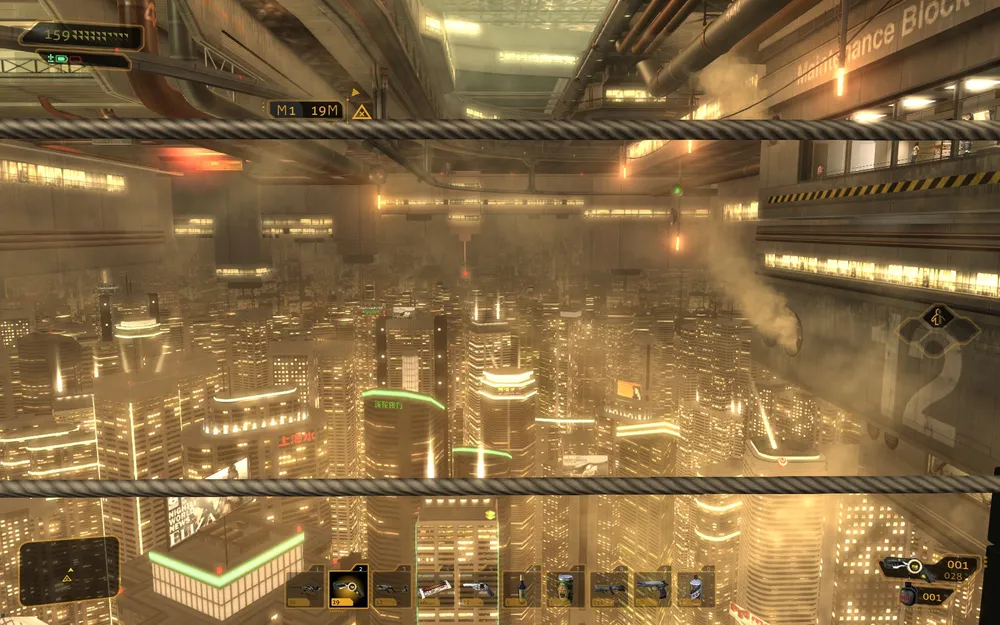
Hensha. The Lower City. Sees no white light.
The style of neo-renaissance suits the game perfectly, and the designers managed admirably to weave it into the game, which has been vividly demonstrated since the very first trailers.
Other technical aspects do not bring down any revelations, but they are executed to a commendable standard. Physics works, the music is unobtrusive and pleasant, and the voice acting is of high quality. Even the localization seems to have turned out quite good.
During my time playing, I encountered only a couple of minor bugs and one larger one — story cutscenes failed to activate a couple of times, and the only fix was to restart the game. A screenshot of one of the minor bugs is attached.
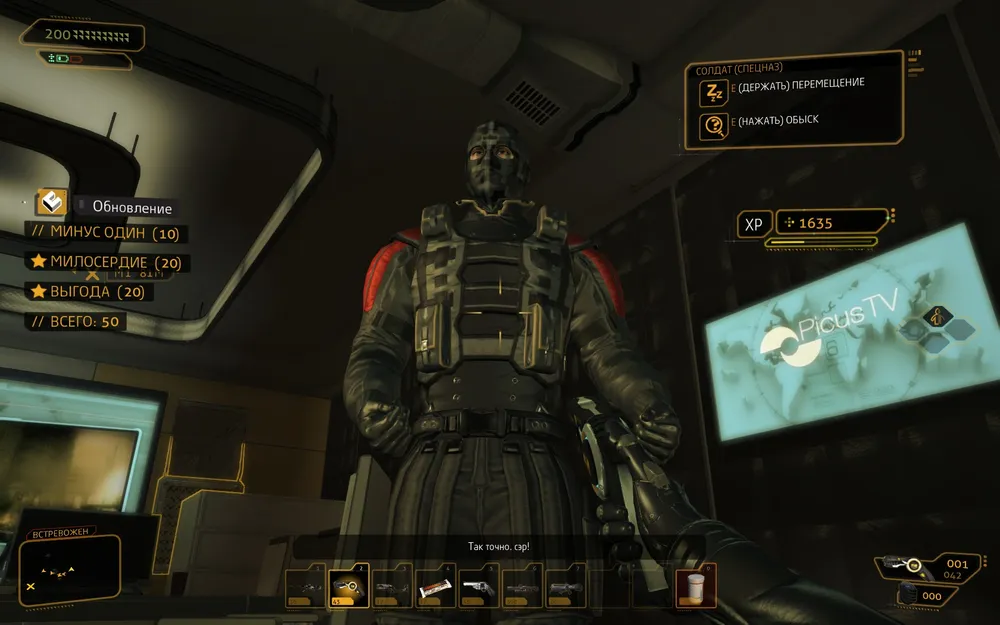
The stunned enemy pretends to be conscious and even responds to the commander.
In summary, the technical execution of the game is inspiring and restores faith in programmers. Well, and the artists and designers deserve a special thank-you.
Conclusion
Essentially, the game closely resembles the original. For those who haven’t played [Deus Ex](/games?search=Deus Ex), it can very well be a revelation, while the rest will be pleased to see that developers can still recreate the atmosphere of old games.
It would have been wonderful if the game matched the level of the original, but... it turned out to be better in every respect. Eidos Montreal took all the good elements from the original, added some of their own, worked on it all, and delivered a game that might well be game of the year. And in this battle for the title, there are some seriously tough competitors. Well, I think I’ll go and try to play the game with another Adam. But one last piece of advice: under no circumstances should you play the game mindlessly, charging in. That will not bring joy. You need to dive into this world headfirst.