
"And the Dawn is Dusty." Game Review
A warm May day in 2002. It was not as simple as it seemed at first glance - it was a day of mass madness for everyone who thinks that RPG is not just anti-tank weaponry. Even the most devoted fans of Gothic, who swore on the disc of that game that they would never betray it, were sneaking into computer game stores, unnoticed, pressed against the grass... The same words could be heard in many languages around the world: "They have returned. The Elder Scrolls".
Half a year later, this mass psychosis reached us. A whole world was lurking on the store shelves, waiting for its warriors and mages, heroes and adventurers, honest thieves and merciless killers...
Welcome or Daedra entrance forbidden

Morrowind would have been the most ordinary role-playing game of those years if not for two small "buts" that determined both the fate of the game and the further development of the series.
So the most important thing in Morrowind is not the plot, not the graphics, and not the sound. The main thing is the world. Each game in the "The Elder Scrolls" series is a small point of contact with a vast universe. Once, the first part, Arena, laid the foundation of the world. Daggerfall showed how vast this world is. Morrowind, however, was supposed to show how deep this world is. It fully justifies its goal.
It’s quite a rare case when a huge universe is born from a computer game. Only Warcraft immediately comes to mind, as you will find no other such discussions, not in terms of strength, but in their diversity.
**Interesting Fact #1:** If anyone conducted a survey asking, "Which game monster is the most annoying?" a significant portion would be attributed to the **cliff racer** - the local pterodactyl. In fact, they ultimately became a true symbol of the game, because you simply cannot forget them.
They are actually rather weak "birds," but there is one problem: there are many of them. They are everywhere! Just walk 10-50 meters around Red Mountain (depending on luck) and you will inevitably run into another one. And then another. And another. And again. And again.
The biggest impression from them is if you play without sound. You walk and your health drops. No one on the left, no one on the right. Empty behind. Out of ignorance, everything can be attributed to glitches, but as soon as the adventurer dies, he will realize that he was being pecked on the head this whole time...
A complete description of the game world would take hundreds and thousands of pages, many of which are still unwritten. Almost any question in the game from the series "How? What? Why?" has a logical answer. Why are there no horses, like in previous games? The smoke from the mountain poisons them. Who do they worship in the Empire? Here’s a book - read it. Why is the climate this way? The map is hanging; take a look! Each of the ten playable races (of which two are beast races, elves and humans of several kinds, and orcs), as well as several non-playable ones, has its own history.
Another merit of the game in this regard is that it not only answers any question within the world but also encourages the player to ask such questions. A part of information is gently presented to the player, igniting curiosity about the complete picture. For example, the player sees a Big Flying Thing that has a very hostile appearance. Right in the middle of the city. If you get closer, you can find out that this is a silt strider - the most common local transport. Some might find this sufficient, while others may inquire about them from a local transport provider, learn about their management methods, and read in books the history of their domestication, discovering during one of the quests how they attempted to study their language...
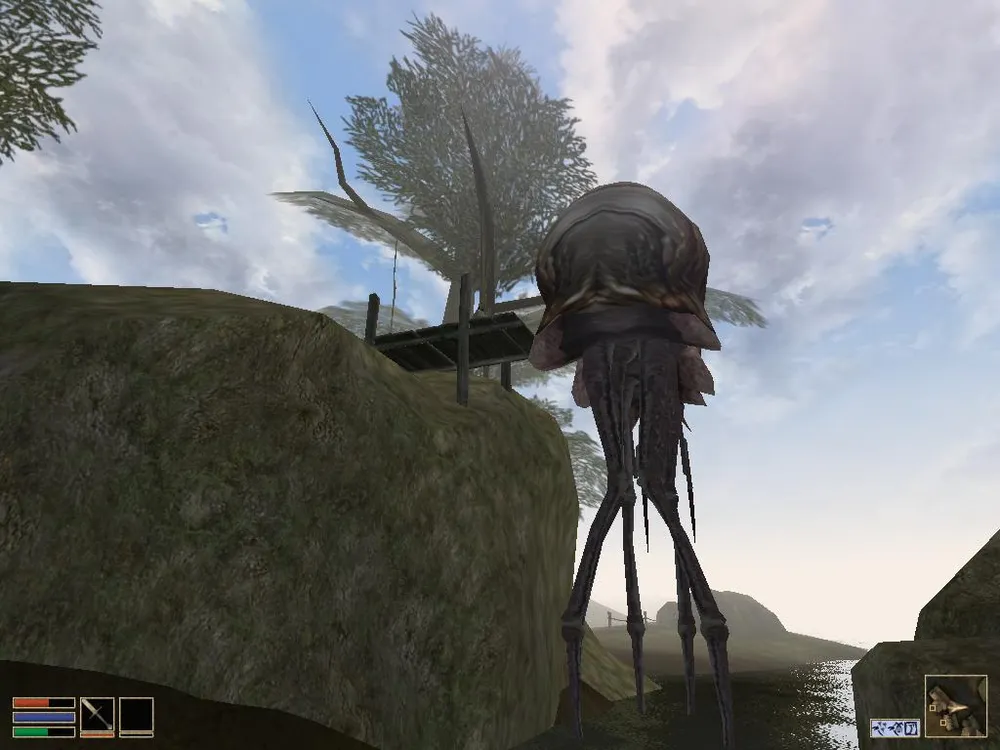
Here it is, the first silt strider we will see.
The game is undoubtedly a paradise for any explorer. But it’s not just the world; the game itself must also be good. Did Morrowind manage to become a good role-playing game?
Speak a word about the poor Plot...
The plot of the game is typical for the series: a former prisoner, after release, joins the Blades. Along the way, it turns out that he is the Chosen One, and so the story goes on in this vein. The defeat of the Great Evil in mass quantities is included in the entertainment program.
Sadly, the main storyline is extremely banal. Even at that time, all those Chosen One_from_prophecies were tiresome, what about "now"?
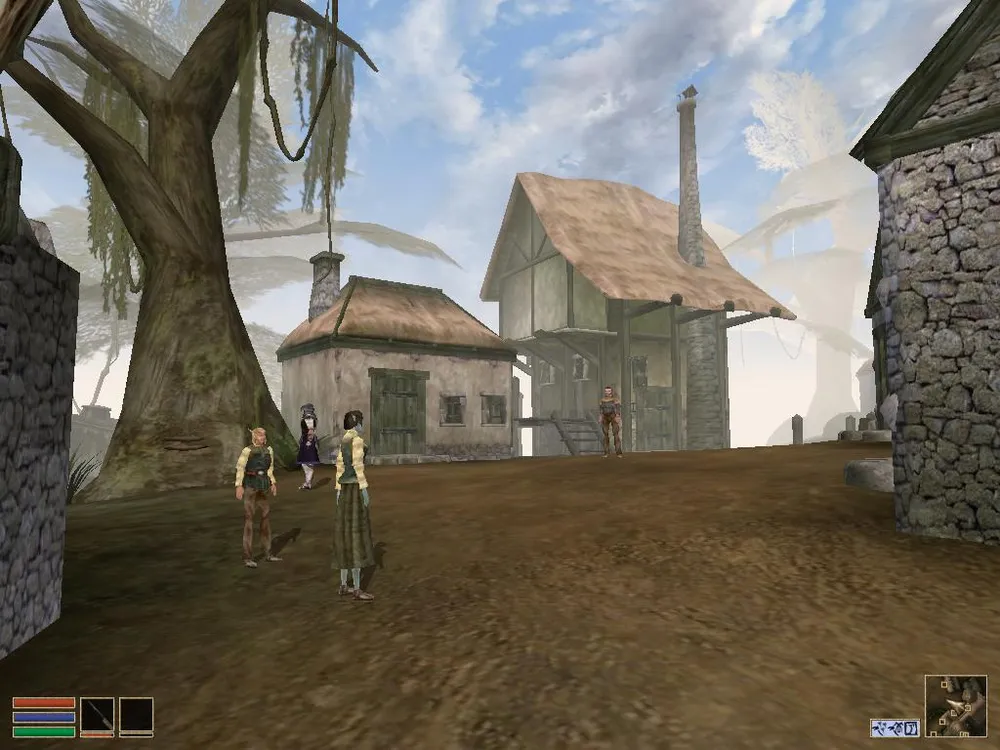
From this modest village - Seyda Neen - our long journey begins...
However, the main storyline is just a drop in the ocean. The game also includes three guilds, the Temple, the Imperial Cult, and the Legion, as well as three Great Houses and three vampire clans, where you can only choose one in a single playthrough. And, of course, side quests in colossal amounts.

So the player will have to visit almost everywhere. Of course, there are standard "kill and deliver" quests, but there are also options like "find out," "reach," "find," and "steal," and sometimes tasks can be completed in a couple of ways - especially in assignments like "deliver an item." How you acquire it is your personal issue, no one else’s concern.
Fortunately, there aren’t so many quests that any town becomes tiresome. Although Balmora and Vivec - the central cities - you will know by heart by a certain point.
Console wars
Morrowind is a turning point in the series. It was with it that the Construction Set appeared, opening up almost limitless opportunities for modification creators. With it, they did everything - from additional weapons to complete graphical overhauls (significantly better, I must note), from new buildings and towns to global mods creating entire islands (sometimes with teams of up to ten people!). For all its merits, Morrowind owes its longevity precisely to modding communities, some of which continue to work on this game to this day.
**Interesting Fact #2:** Developers beam with joy when they talk about facts from their game. The game covers about **10 square miles** (approximately 16 sq. km.), contains around **300 dungeons**, about **30 settlements** of varying degrees of population, **3244 NPCs,** every one of which can be killed - to complete the main quest, you need less than two dozen. In fact, if you’re not concerned with the main storyline, you can kill everyone. More than **700,000 words** in books and dialogues, **217 types of monsters** and - attention! - **all** objects in the game are placed manually using the **Construction Set** (CS).
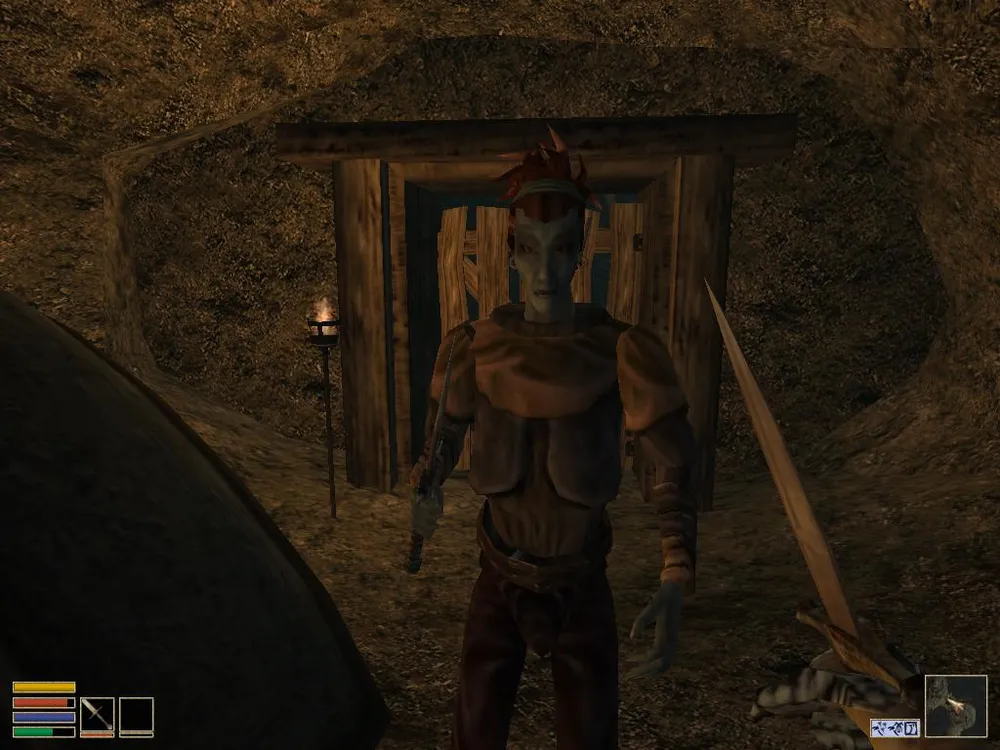
A Spoonful of Tar
Although the territory of the island Vvardenfell, where the action of the game takes place, is many times smaller than the game world of Daggerfall (the previous part of the series), it is still quite large. It’s no wonder that there were some mistakes, miscalculations, and even outright failures.
First of all, bugs. Again, compared to Daggerfall (often referred to as "Buggerfall"), Morrowind has far fewer errors. Nevertheless, crashes, quest "freezing," and other bugs were present. Especially annoying were conflicts with modifications out of the blue.
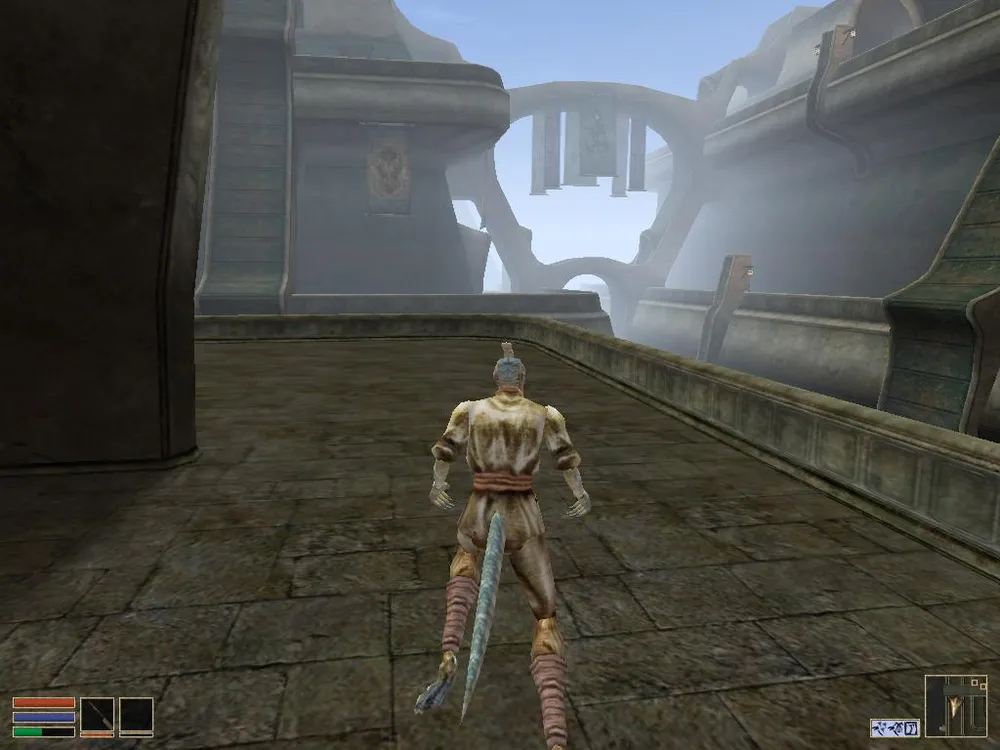
Ah, and there’s also a third-person view. Unfortunately, the animation is disheartening, so it is far less popular than first-person.
The second issue is the role-playing system. The game has "parameters" of the character (agility, speed, intelligence... in general, all the main characteristics), and there are "skills" - blacksmithing, weapon mastery, stealing, etc. All skills affect the parameters, two of which are designated as main upon character creation. If you raised the main parameters' skills by 10 points in total? Then sleep (yes, in the game you could also "sleep" and "wait," thus restoring health, mana, and stamina), gain a new level and increase any three parameters.

And everything would be fine, if not for two problems. First, it was much more beneficial to level up certain skills to around ten units and gain a multiplier for parameters on level up. A paradise for munchkin players. Secondly, the calculation of hit chance in the game was quite inaccurate.
Imagine your hero in a narrow corridor. He has a bow in his hands. And right in the middle of this corridor are enemies, thousands of them! Each occupying half the corridor... Seemingly a paradise for archers? Undoubtedly! But, alas - bang, bang and miss, because your "accuracy" skill is zero whole, zero tenths. The arrow will simply pass through opponents, dealing no damage. More accurately, it will dissolve in them. This is also true for melee weapons, but it doesn’t look as absurd there.

In the "corridors" (read: dungeons) we will most often meet them - various mechanized guards, a legacy of mysteriously vanished dwarves.
However, you know, after Oblivion... all of this looks like manna from heaven in Morrowind. There is not even the damaging oblivion-like adjustment of enemies to the player’s level - on the first level, you can easily run into a level twenty enemy if you wander too far into the wilderness.
**Interesting Fact #3:** Perhaps the most famous easter egg in the game is the Khajiit (cat-like race) **M'aiq the Liar.** He is located on one of the islands of the Shivering Isles. He is into fishing. Very talkative. Very. Especially loves to spin yarns. For example, here’s something he might say: *"Ah... the beauty of exposed forms. These Dunmer are prudes, aren’t they? Of course, there’s an island that can be easily reached, filled with wonderful, exposed, glistening bodies. It only happens during the full moon on M'aiq’s birthday, when it rains and the sea turns red."*
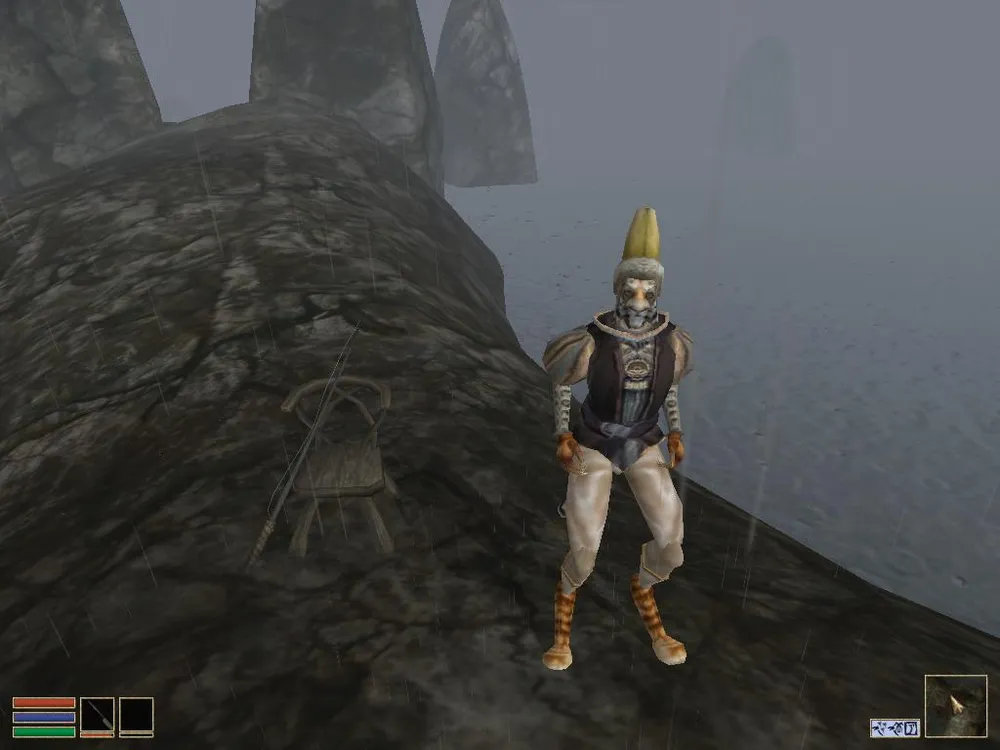
It is also because of him that dozens, if not hundreds, of players climbed the highest trees in the area and jumped on them, then dug into the CS, then jumped again... This is the result of yet another one of his stories: "Dragons? Oh, they are everywhere! Though you need to fly very high to see most of them. Those that stay closer to the ground are very difficult to see, as they are invisible."
M'aiq will later appear in Oblivion. Besides lying to everyone around, he can also tell the truth (he knows a real trading crab), and he can also... try to justify the developers. For instance, in Oblivion, M'aiq says to us: "M'aiq believes that children are our future. But he doesn’t want them to take away our fun." Most likely, this is an attempt to justify the absence of children in both Morrowind and Oblivion (though modders have already solved this issue).
The third noticeable problem is the overall absurdity of what is happening. The main hero can literally climb all the career ladders in all available guilds within a month of gameplay, becoming the "top boss" there, saving the Universe, being the Chosen One, talking to local deities and...

...and still not gain recognition. To everyone, our hero remains as foreign as before, although he has done what objectively should be impossible.
"Drums... you hear them too?"
One cannot mention the sound aspect. Frankly, the battle sounds are not very impressive - strikes, moans sound a bit artificial. Though modders have dug into this as well, I must note.
It’s very hard to pick at the music. Jeremy Soule did an excellent job. A wonderful orchestral arrangement that can be listened to even apart from the game. It fits this world very well. As expected, during battles, it shifts to a faster and more tension-filled one, but remains just as unobtrusive and very fitting - a wonderful addition to a wonderful world.
The world of The Elder Scrolls is truly vast. You can talk about it for a long time, you can listen to it for a long time, but, most importantly, you can play in it for a long time. Even more accurately - live in it for a long time. Very few manage to achieve such a feat. This game undoubtedly deserves a place of honor on the shelf of any RPG lover.