Butthurt Pana
Foreword.
A couple of weeks ago, when I was searching for a topic for my work for the contest, I visited the site sapkowski.su and stumbled upon a mention of an interview that a representative of the Polish branch of Eurogamer had with the author of The Witcher in November. Quickly Googling this interview and using Google Translate (since it was in Polish), I became familiar with the writer's statements, after which I decided to share my findings and thoughts with you. However, I couldn't do it right away, as Google's translation required serious refinement, and when I had already done half the work, it occurred to me that someone had likely already done the translation. And indeed, an article was published on kaermorhen.ru. Still, I decided to finish what I started and publish my post, especially since the gentleman from kaermorhen did the translation not from Polish, but from English, and moreover, rather inaccurately.
For convenience, Sapkowski's words are written in plain text, while all explanations, additions, and other comments are in bold or italic.
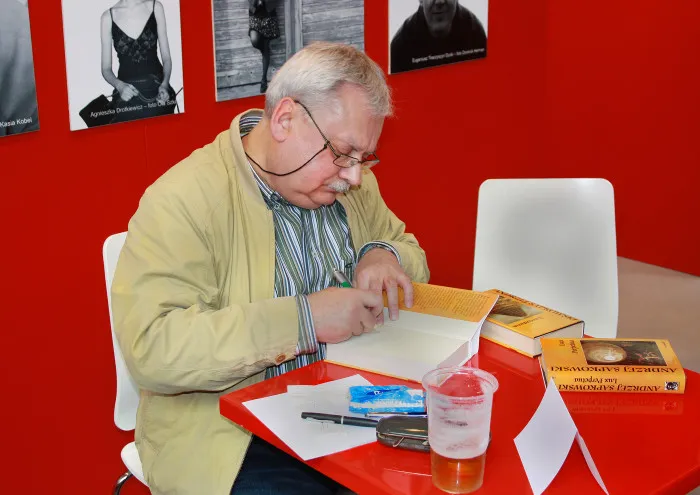
As is known, the cycle about Geralt of Rivia began with the story "The Witcher," which Sapkowski wrote in the autumn of 1986 for a competition in the magazine "Fantastika." No one thought that something belonging to such a trite genre as high fantasy could evoke any interest at all; however, the story took third place, was published in the December issue of the magazine, and soon many readers wanted a continuation. And the author did not keep them waiting.
**
In six years, 12 stories were published, and in 1994 a whole novella was released, starting "The Saga of the Witcher and the Witcher. The last book of this saga, "Lady of the Lake," was published in 1998. Then there were comics based on it, a series, and a film "The Witcher," but we will return to that later. Now we will discuss what the writer spoke about in the interview. And, as you can guess, the main theme of the interview with the Polish gaming magazine was games, primarily the game series (currently a duology) Witcher.
**
During the development of the game, Sapkowski did not collaborate closely with CD Projekt RED. As is known, he did not participate in developing the plot, and he even refused to draw a map for the game. So, the editor of Eurogamer, who conducted the interview, decided to start from afar and simply ask about the gentleman’s attitude toward games in general. And he immediately received a negative answer.
—I don’t play video games; they’re outside my area of interest. To familiarize oneself with a game not for fun but precisely in the sense of getting to know it takes a lot of time, and I don’t have an abundance of it. I can barely carve out some free time for what I enjoy doing. — As for The Witcher, I can only comment on the graphics — I rate it highly. There’s a lot to see. A lot of work went into it.
In general — I have never played video games, neither fantasy nor others. — the writer continued — I occasionally browse gaming magazines and watch programs about games. The graphics and technology can be impressive. I can’t comment on the story. Except to say that in some games, there isn’t one. There’s just fighting and that’s all.
Then a question was posed about the book. More precisely, about the ending of the Saga, which turned out to be rather vague. To which Sapkowski responded:
You don’t understand what happened to Geralt at the end of the book? Do you know why? Because it’s written there that you perceived nothing! And you won’t understand until I write about it; I don’t even know if I want to. — And what about the game? — The game, with all due respect, let’s be frank — does not create an "alternative version of events" and certainly does not continue the plot. It’s just a free adaptation that uses elements of my work, made by other authors.
In the film industry, this is called "based on characters created...", which, by the way, reminds us of who holds the copyright to these characters. The TV series Saint has never been an "alternative version" or "continuation" of the adventures of Simon Templar, a character created and described by Leslie Charteris. And the series Doctor Kilder was not a continuation, just an adaptation featuring a character created by Max Brand.
Adaptations, even though they relate to the story described in the book, cannot claim to be continuations. They can’t add prologues, prequels, epilogues, or sequels for that matter. — the writer states — Perhaps it’s time to clarify things. The Witcher game was made well; its success is quite deserved, and the authors deserve respect and praise. BUT it can’t be considered either a "substitute" or even a "continuation" of the story of the witcher Geralt. Because only the creator of Geralt can tell this story. That is, Andrzej Sapkowski.
Then the "creator of Geralt" spoke about his "cooperation."
My cooperation with CD Projekt, in my opinion, is sufficiently close and encompasses various ways of adapting my work. However, there cannot be any talk of any "continuation of the plot" or the "creation of a full-fledged story" — Sapkowski explains — If we have books and their adaptations into other forms, in this regard, the history can only be in the books. There can be no other connection between the adaptations but this since the adaptations arose based on the books, and without the books, they wouldn’t exist at all.
I realize that today’s times are conditioning us — and it’s scary — to an incredible merging of various formats and their mixing. However, for me, as a writer, to write "in addition" and invent something "complementary" to a game or a comic book is the height of idiocy.
So what, do all games, films, and other "adaptation" mediums stand below books? Can developers not transfer literary fantasy and speculative fiction, at least such deep and "mature" stories as The Witcher into virtual worlds with all modern means available to them?
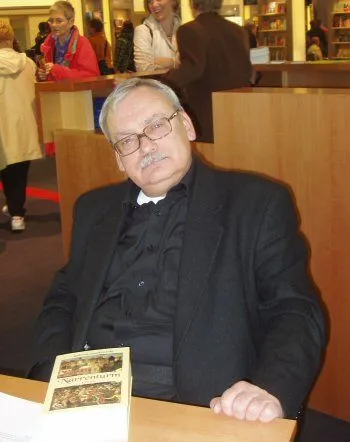
In terms of means for expression, developers are not lacking; the graphics are breathtaking. But what does it mean to "translate it into a virtual world"? - the writer asks — Of course, one can take a book (fantastical or sci-fi), its plot, world, characters as a basis. One can create a visual style based on that book, and add dialogues from it. The visual effect would be stunning overall; players would be satisfied, and someone might even think it’s better than the book and easier to digest — after all, the letters in the book are so small...
Some may never get to the original book; the games might be enough for them. - he believes — But the book is the original; the book is based on the author’s unique talent. "Translating a book into a virtual world" — Ridiculous. It can’t be done.
A rather interesting opinion, considering how well the game Witcher conveys many aspects of the books. And many people like it; 4 million copies sold, after all. And the game’s success undoubtedly raises the popularity of the books.
I believe that the popularity of my books affected the success of the game — Sapkowski explains — In fact, the game borrowed my success because my success far exceeds the game's success. My books were translated into other languages (including English) long before the game’s release.
How interesting, right? After all, according to information on the internet, his books were released in English simultaneously with the game. Moreover, Sapkowski gained real widespread recognition after the release of the series/movie "The Witcher," another "adaptation" of Geralt. It was that film, despite its not-so-high quality, that attracted the attention of fantasy lovers to the Polish writer. Of course, he does not think to admit this.
Long before the game — and this is an indisputable fact — I was already a well-known writer, even in places where translations did not reach. — he says to convince everyone that neither the game nor the film benefited him in any way - Through conventions, the internet, real lovers of fantastic literature are well aware of what is being written where.
Of course, Sapkowski cannot deny the obvious things.
Clearly, I don't want to diminish the role of the game. It is evident that it had a positive impact on interest from foreign publishers and the number of translations. Many gamers, evidently, noted the book only after enjoying the game. Without the game, they wouldn’t have approached it. — and again, not wanting to feel indebted to the developers of the "adaptation," he adds — But, by the way, there was a negative aspect, plainly harmful from the game. - and now he seems as if they owe him something. But to avoid spoiling relationships, he immediately recovers. - Although neither the game nor, God forbid, its creators are guilty.(How interesting is that?)
Some foreign publishers do me a disservice by using graphics from the game in their book layouts, inserting ads for the game into the book and adding ads for the book into the game. - the writer explains — Although I recently praised fantasy lovers, there are some among them who know little and understand nothing. Sometimes, after looking at the cover, they immediately reject the book, considering it a novelization or adaptation of the game; in a word, something secondary relative to the game.
I see, so it’s people like Sapkowski who think that if there’s a game, then it’s garbage.
Here, the interviewer recalled that work is underway on a new book. How will its plot align with the game?
All "alternative ideas" I will absolutely discard. It's easy for me because I don't even know them. Even if I did know, it would be silly and foolish to write something that is in any way related to the game. I have already made it clear that I will never accept ideas or thoughts about "continuing the plot" and "creating full-fledged stories." All of this can only exist in the books.
It would be funny if any ideas or plot lines in the book turned out to be similar to something from the game. After all, both Sapkowski and CD Projekt think in the same direction and draw from the same sources of inspiration. However, most likely, then Sapkowski will claim that the idea was stolen from him.
**
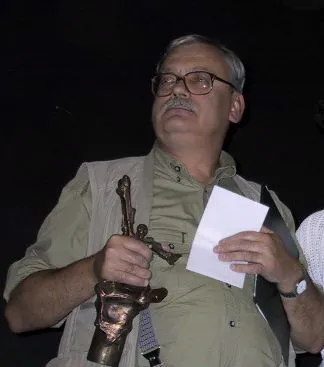
In general, it is worth noting the rather interesting attitude of the gentleman towards "adaptations." He refuses any cooperation, does not correct the plots, nor checks the details. And then, when (in the case of the series and comics) he ends up with a poor adaptation that does not align with the original, he scolds the authors for stupidity and worthlessness. In such a situation, other authors either refuse to have their works adapted at all or take matters into their own hands and do it as they see fit. But not Sapkowski. After the sad results depicted above, he again positions himself with "my house is on the edge," and when, oh miracle, a video game based on his work turns out to be both quality and popular, it triggers a terrible backlash from him. The fact is not jealousy towards the developers; at least not only that.
It’s the contempt, even disdain, he feels towards games, films, and, of course, comics. All of this is just dumb entertainment for fools and nothing more. And suddenly, a GAME turns out to be comparable in quality and depth of elaboration to his works! Moreover, comparable enough that many start to perceive them as one whole and even ask the author if he will write a sequel taking the game into account! The mere thought that the dumb entertainment for fools turned out to be not so dumb (or that many fans of "The Witcher" are fools) horrifies the writer. And he tries by all means to show that he is the only and unique talent that serves as the source of all correct ideas.
**
This viewpoint is particularly striking in light of the fact that in Sapkowski's books there isn’t a single original idea. Everything is borrowed from other books, folklore, history, and so on.
Ah, yes, I almost forgot. In the end, the conversation returned to games. Since the gentleman doesn’t play, but still reviews information on the topic, what does he think? At least about the most famous games. For example, in the fantasy RPG genre, does The Witcher have worthy competitors? Skyrim, for instance?
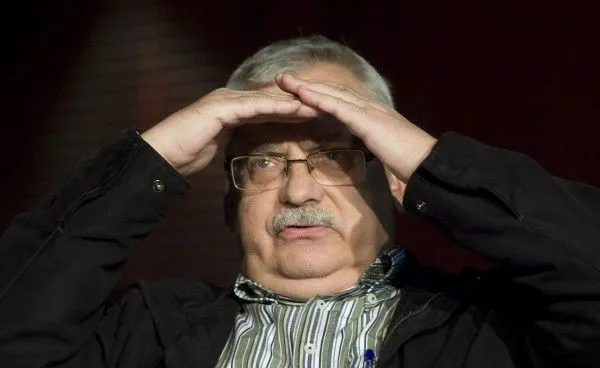
- Eh, Skyrim? Never heard of it.