
The History of Computer Role-Playing Games, Part 6
\[post\]The History of Computer Role-Playing Games, Part 1\[/post\]
[post]The History of Computer Role-Playing Games, Part 2[/post]
[post]The History of Computer Role-Playing Games, Part 3[/post]
[post]The History of Computer Role-Playing Games, Part 4[/post]
[post]The History of Computer Role-Playing Games, Part 5[/post]
Might and Magic: A Beautiful New World
Although we have seen many successful CRPG series over the decades of the genre's existence, the most successful and long-lived have been Ultima, Wizardry, and Might and Magic from New World Computing. Indeed, each of them lasted into the 2000s. However, it sometimes seems that Might and Magic is still overshadowed by its older brothers. Nonetheless, it is a very interesting series that has gifted the genre with several key innovations.
The first part of Might and Magic, subtitled Book I: The Secret of the Inner Sanctum, was a free gift from John Van Caneghem to his wife Micaela. Caneghem wrote almost all the code and drew almost all the game graphics by himself, and then together with his wife and Mark Caldwell founded New World Computing. The game debuted on the Apple II in 1986, and a year later followed ports for C-64, MS-DOS, and Mac. Critics of the time really liked the game, and many even rated it higher than its main competitor (at the time, The Bard’s Tale was just expanding the audience of the genre). The main advantage of the game was considered to be its gigantic world, Varna: there were 55 areas and over 4000 locations available for exploration! Moreover, the game was much more liberal than other CRPGs of the time, allowing players to explore the map as they wished from the very beginning, rather than in a predefined sequence. The Secret of the Inner Sanctum was a first-person game with very pleasant graphics (although without animation).
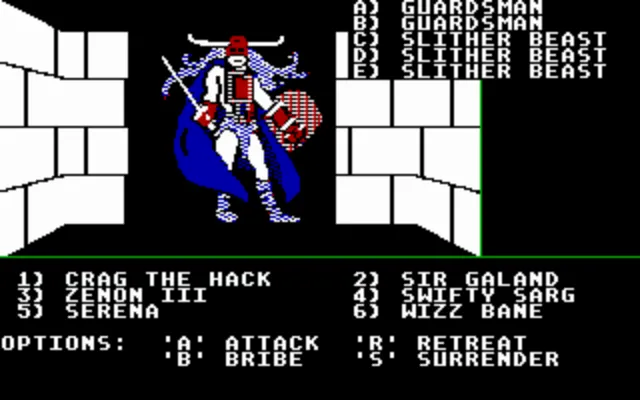
Might and Magic Book I: The Secret of the Inner Sanctum
Might and Magic introduced interesting gameplay elements that would later be borrowed by developers of other games (like Bane of the Cosmic Forge) – for example, the strong influence of the race and gender of the character on gameplay. Thus, the politics of one of Varna's kingdoms has a pronounced anti-male orientation, and a party made up solely of male members would not receive a warm welcome there. The characters' worldview (good, evil, or neutral) influenced which locations the party could visit. Finally, the difficulty of the game was noticeably lower than that of other contemporary representatives of the genre, making it quite popular among players not ready to tackle Wizard's Crown or The Bard's Tale (it is worth noting that in the first released versions of the game, characters began their journey without money and with clubs as weapons, but this drawback was quickly fixed in subsequent releases). Battles were controlled by simple command input, and the monsters were strong enough not to completely wipe out the party of characters. Even if the entire party was killed, players could easily resurrect at the nearest tavern.
A large part of the pleasure of any fantasy game lies in creating the characters that you will take on the journey.
From the manual of Might and Magic.
The plot revolves around six adventurers who must uncover the mystery of the "Inner Sanctum", although their main mission is kept secret from the start of the game, and players had to search for clues throughout Varna. Like in the early games of the Ultima series, players in Might and Magic are greeted with a mix of fantasy and science fiction elements. The game also had an excellent manual with a wire spiral and a map of Varna. Overall, the first Might and Magic made a great impression on players and critics alike.
New World Computing released the sequel to the game, Gates to Another World, in 1988. Although the engine remained largely unchanged, the graphics moved to EGA, and the already large world became even bigger. New features included auto-mapping, new character classes, new spells, and the ability to hire two NPCs in the party. Interestingly, auto-mapping is not available by default: to unlock it, the character must learn the skill "mapping". Like its predecessor, Gates to Another World provided players with full freedom to roam the world (Kron). Along the way, characters learned that Sheltem, the villain from the first part, intends to destroy this world by sending it crashing into the local sun. To complete the game, players would have to travel not only across all of Kron but also through elemental planes and even through time. Players can expect many surprises—such as devices that allow changing the gender of characters! Like earlier games in the Phantasie series from SSI, characters aged and died shortly after reaching the age of 75.
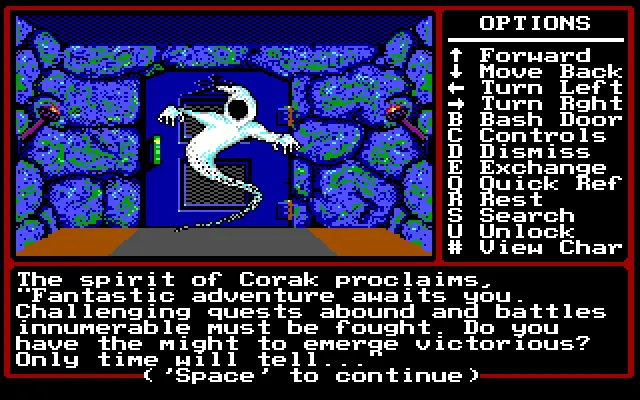
Might and Magic II: Gates to Another World
Might and Magic III: Isles of Terra was released in 1991 and became the first game in the series to use new VGA cards, as well as sound cards. It was also the first Might and Magic game to support the mouse. A couple of pleasant features should be mentioned, such as character portraits reflecting their status and mood (petrification, sleep, etc.), cutscenes, and "life stones". These "life stones" simplified the traditional hit point system by adding a color-coding system—green meant the character was fine, yellow meant they were not quite fine, and red meant their life was winding down (the health of monsters was indicated in the same way). Other improvements included ranged combat, a more liberal saving system, and a checklist for unfinished quests. The final nod toward newcomers was a button that allowed characters to teleport back to the nearest tavern. However, each use of this button cost each character one level of experience.

Might and Magic III: Isles of Terra
With the release of the fourth game, Clouds of Xeen (1992), New World Computing focused solely on MS-DOS, ceasing to port their games to other platforms (although World of Xeen was indeed ported to Macintosh in 1994). Clouds of Xeen and Darkside of Xeen (1993) essentially constitute two parts of one large quest to destroy Sheltem. Both games can be combined into one (World of Xeen), granting access to previously unreachable locations (which constitute a quarter of the game world). Both games made no significant changes to the Isles of Terra engine, but New World Computing made good use of CDs, recording high-quality soundtracks for the games.
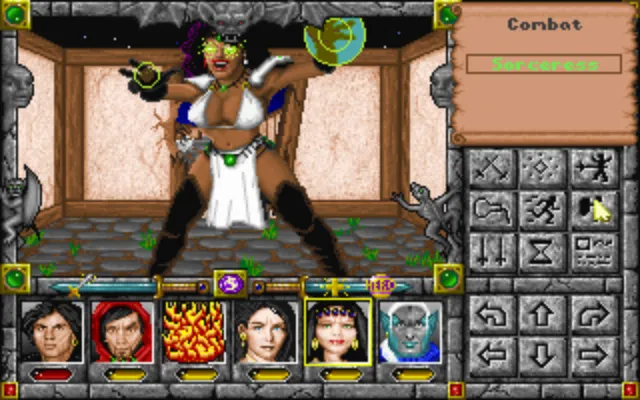
Might and Magic IV: Clouds of Xeen
In 1996, New World Computing was acquired by 3DO and continued to release games in the Might and Magic series (of varying quality) until 2002. In 2003, the rights to the series passed to Ubisoft. The latest game in the series, Might and Magic, Dark Messiah (2006), developed by the French Arkane Studios, is a first-person action game that bears little resemblance to its famous ancestors.
CRPG from Sierra
Sierra On-Line is much better known for its adventures than for its CRPGs, although it owns at least two important series in this genre: Quest for Glory and The Krondor. Both are known for blurring the lines between CRPGs and adventures and were much more focused on story and puzzles than most role-playing games.
The first game in the Quest for Glory series was originally titled Hero's Quest: So You Want to be a Hero and was released on MS-DOS in 1990 (and ported to Amiga and Atari ST the same year). Due to the game's title, Sierra found itself in a difficult position (around the same time, Milton Bradley released a board game titled Hero’s Quest), so it was decided to slightly improve the game and release it in 1992 under the name Quest for Glory. The game resembled typical Sierra adventures (King's Quest, Space Quest) quite heavily but included CRPG elements such as the ability to choose a character class (fighter, wizard, thief) and gradually improve their skills throughout the game. It had a couple of notable innovations—for example, how players solved puzzles depended on the class of character they were playing. Thus, fighters and thieves could climb a tree to retrieve a ring from a bird's nest, while wizards had to use spells for the same purpose. Naturally, the approach to battles varied by class. Wizards and thieves should avoid melee, while fighters could boldly dive into the midst of battle. Combat resembled an almost arcade-like action, where players had to choose the right actions at the right time (for example, attack when the monster is not trying to block). Gameplay changes significantly depending on the character's class, so the replayability of the first Quest for Glory is much higher than that of most adventures and CRPGs. The game is deliberately styled in a satirical manner, often sliding into absurdity. For instance, the local town of Spielburg is ruled by Baron Stefan von Spielburg, and players playing as thieves might try to level up their lockpicking skills by entering the command "pick your nose." This game certainly does not take itself seriously and does not expect that of the player.
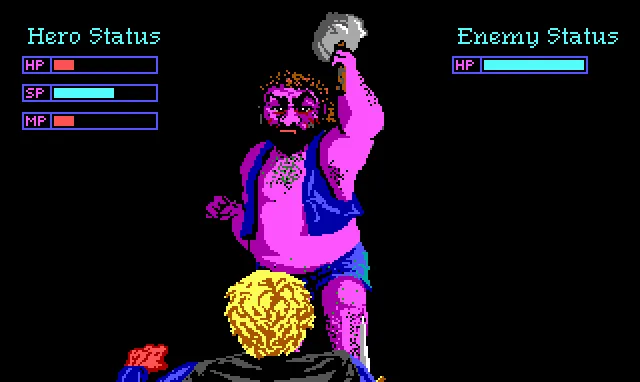
Hero's Quest: So You Want to be a Hero
Hero's Quest was originally controlled via command input from the keyboard, not only in dialogues but in other modes as well. In the rerelease, this system was replaced with an icon-based interface that players could click on with the mouse. Naturally, this "improvement" infuriated some fans who argued that it significantly limited their freedom to interact with the world. Sierra’s response was to release both versions in their Quest for Glory Anthology in 1996. In any case, the game is considered a cult classic and frequently appears on many critics' lists of favorite games.
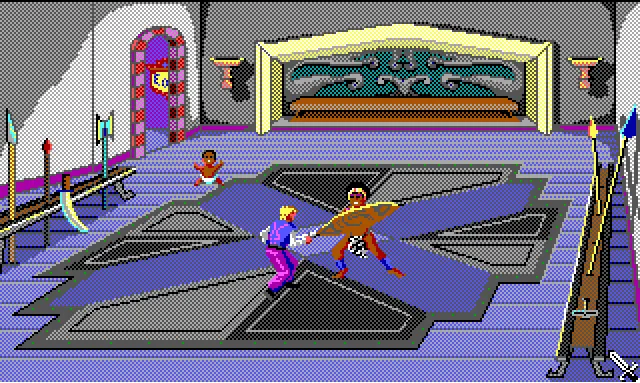
Quest for Glory: Trial by Fire
Sierra released four more games in the Quest for Glory series, starting with Trial by Fire in 1990 and concluding with Dragon Fire in 1998. Trial by Fire debuted a new character class—the paladin, while the third game, Wages of War (1992), marked the shift to 256-color graphics, digital sound effects, and the new icon-based interface mentioned earlier. Additionally, players were granted the ability to roam across the world map, resulting in the inevitable consequence of random battles. It is no surprise that all these changes met with mixed reactions from fans—some call the third part the best in the series, while others call it the worst. The game was criticized for many reasons, primarily for banal puzzles and monotonous battles. The combat system was revamped in the fourth game of the series, Shadows of Darkness, released in 1993. Now, during combat, the game switched to a side view, making battles even more arcade-like. It is also important to note that players had the option to leave the battle to the computer. The game, true to its title, became darker and grimmer than its predecessors. By the way, it was the first game in the series to be voiced by professional actors (the most famous of which is John Rhys-Davies). I will talk about the last game in the series, Dragon Fire, in an upcoming installment.
Dynamix did not simply buy a license, slap character names on random icons, and dub the result a game about "The War of the Gates"! They spent hours talking to me about how they should implement various ideas just to "do it right." The result was supposed to be a game that felt like reading a good adventure novel.
Raymond Feist, from the manual of [Betrayal at Krondor](/games?search=Betrayal at Krondor).
Sierra was also the publisher of the Krondor series, which started in 1993 with the release of [Betrayal at Krondor](/games?search=Betrayal at Krondor) by Dynamix. These games are particularly notable for being set in the world of Midkemia, which Raymond Feist described in his "The War of the Gates." Feist even wrote a novelization of the game. Special features include a turn-based battle system, an experience level-based skill-upgrading system, complex puzzles, and a significant amount of text and cutscenes inspired by Feist's works. Unfortunately, the graphics did not meet even the standards of the time—a sad fact that limited the game's success. Trees and mountains, and almost all other decorations looked overly jagged and angular. The second game, [Betrayal in Antara](/games?search=Betrayal in Antara) (1997), was not based on Feist's works anymore—Sierra temporarily lost the relevant license, and developers had to create a new world—Ramar. The second part also suffers from imperfect graphics, and critics received it rather coldly, although personally, I think it’s quite good. Sierra even made the previous part free, but even this bold commercial move did not save [Betrayal in Antara](/games?search=Betrayal in Antara). The third game, [Return to Krondor](/games?search=Return to Krondor), was released in 1998, and the developers corrected nearly all the mistakes of the previous games. [Return to Krondor](/games?search=Return to Krondor) is considered by fans to be the best game in the series, but we will discuss it another time.
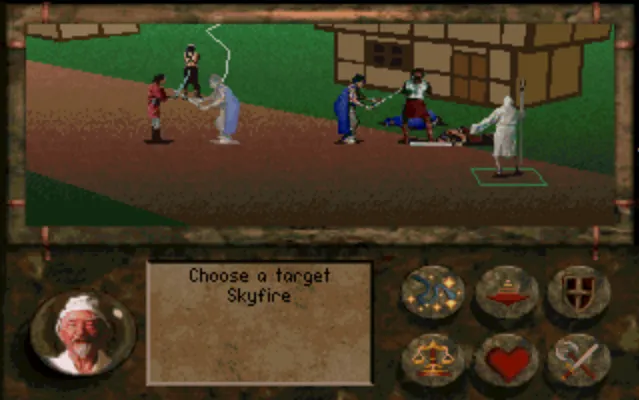
Betrayal at Krondor
Other companies, including SSI, were also experimenting at the time with hybrids of CRPGs and adventure games. Realms of Darkness (1987) is a rather interesting mix of fantasy and science fiction, distinguished by good puzzles. Infocom also experimented with elements of CRPG. Beyond Zork: The Coconut of Quendor (1987) is full of comedic elements, but many adventure game fans turned away from it because of the presence of CRPG elements, even though they supposedly added replayability. Additionally, players became frustrated when they suddenly discovered that their actions had made the game impossible to complete and they now had to start over. For the adventure games of that time, this was standard practice, but it was unacceptable for a game in which character development took many hours.
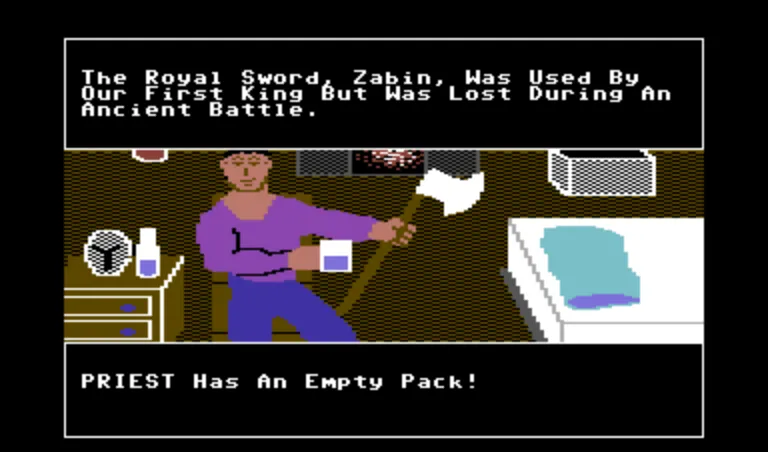
Realms of Darkness
By the way, there has never been a consensus among fans about puzzles and emphasis on story in CRPGs. Do they enhance the gaming experience or, on the contrary, detract from it? In any case, every CRPG has a story, no matter how truncated or clichéd, and the challenge in completing them involves more than just slicing monsters. It is unlikely that players will ever come to a consensus on this matter, but who cares? Personally, I enjoy the variety, so today I may love one type of CRPG, and tomorrow already another!
Other Games of the Golden Age
As you can see, the CRPG genre evolved faster than ever during the Golden Age. Although the most famous and revered role-playing games today would only be released a few years later, by that time (the Platinum Age), the development would gradually start to wane. In just a few years, standalone CRPGs will become much rarer (and thus more expensive for us), and their place will be taken by MMORPGs and other games with "elements" of CRPGs.
Still, before we finish, I must at least mention a few more excellent examples of the genre, even if they are not as well known as those I have already named. In this article, I tried to highlight as many games as possible, and still couldn’t mention all the CRPGs released between 1985 and 1993. Instead, I tried to dedicate more time to the most important (from my subjective point of view, I know) examples of the genre from that era. Undoubtedly, some of my, shall we say, more passionate readers will start screaming in fury about how I forgot to mention some obscure CRPG that they consider a genre standard.

Faery Tale Adventure
There is, for example, Faery Tale Adventure (1987) from MicroIllusion—a game that largely became a precursor to Diablo and Baldur’s Gate. And how could I be so stupid as to mention Alien Fires but say nothing about Drakkhen from Infogrames, Keef the Thief from Electronic Arts, and Legacy of the Ancients? What about Hillsfar, for instance? Where is Times of Lore? Dragon Wars? Age of Adventure? Although this article is dedicated to computer RPGs, isn’t it idiocy to say nothing about console classics like Dragon Warrior, The Legend of Zelda, and Final Fantasy? If I happened to overlook a CRPG that you love more than life itself, please accept my sincere apologies—I tried my best.
However, while I can already feel tons of hatred ready to pour into my inbox, there is one more game I must mention to avoid lynching, and that is Legend of the Red Dragon (that’s it, you can take out your knives). Legend of the Red Dragon (further LoRD), a game that many of us remember from our dial-up childhood, was released by Seth Able Robinson's Robinson Technologies in 1989. LoRD became one of the most famous online games of the BBS era and was popular among those who did not belong to large networks like America Online, GEnie, Portal, or Prodigy, which offered users a wide range of MUDs and even graphical MMORPGs. LoRD and similar games were small due to the limited internet at that time. However, although the game's graphics can be compared to roguelike graphics, its vibrant text and humor made it a very playable RPG that managed to win the hearts of many gamers. Many of us once played around with the waitress Violet and joked with a bard named Seth in the local tavern. Additionally, LoRD lends itself well to various modifications, though not many were created, and any of them are hard to call common. The game was initially available only on Amiga, but the port to MS-DOS did not take long. In 1992, Robinson even released a sequel called New World, which, however, departed significantly from the principles of the first game. The second part is a real-time multiplayer game, more akin to a roguelike. If anyone is suddenly interested in LoRD, I recommend checking out Legend of the Green Dragon, a browser game that pays homage to the classic.
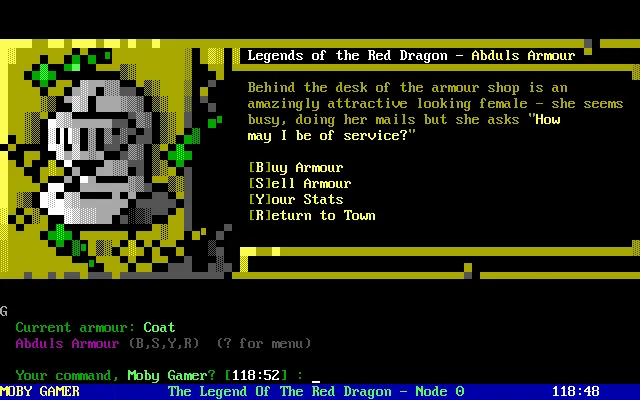
Legend of the Red Dragon
Final Thoughts
Some individuals have been curious (and quite loudly, I must say) about why I chose to call this period the "Golden Age," arguing that everything truly "golden" came either before 1985 or after 1993. Yes, not all, and not even the majority of the games from that period are worthy of reverence; many are just thoughtless clones or absolute rubbish. Some masterpieces of the Golden Age may not be considered original—they are rather successful combinations of elements borrowed from other games. However, in my opinion, between 1985 and 1993, there was an immense outpouring of new games and ideas, and more importantly, innovations in all areas of game development. CRPG developers were forced to reinvent the wheel to keep up with the times and adapt to the demands of new hardware and software. It is astonishing to think about how difficult it was for developers to figure out how to better utilize the mouse, not to mention the new possibilities of graphics and sound. Gamers expected more and more, and only after the Golden Age did developers like BioWare finally manage to consolidate all the successful discoveries of their predecessors and create truly modern CRPGs.
Today, it’s easy to look at The Bard's Tale, Quest of the Avatar, Bane of the Cosmic Forge, The Pool of Radiance, Wasteland, or even Dungeon Master and wonder where all the hype around them came from. Yet it is from these games that the roots of modern CRPGs grow, and gamers playing the latest [Elder Scrolls](/games?search=Elder Scrolls), Diablo, or [Dungeon Siege](/games?search=Dungeon Siege) should take their hats off to Wizard's Crown and Alternate Reality.
In the third part of the article, I will discuss the Platinum Age, featuring beloved titles like [Baldur's Gate](/games?search=Baldur's Gate) and The [Elder Scrolls](/games?search=Elder Scrolls), as well as Diablo, [Planescape: Torment](/games?search=Planescape: Torment), and other masterpieces. See you then!