Dragon Age Overview, especially for Gamer.ru!

Greetings to all readers of the Dragon Age blog. Congratulations to everyone on the long-awaited release of the game, and I want to especially rejoice at the fact that the blog is getting closer to the "Top 10" =)
Now, let's get to the point.
Time for Dragons.
It has been six days since the game settled on my hard drive. Having a hard time tearing myself away from the game, I decided to write a review; I won’t call it a complete review since I haven't finished the game yet, but it is enough for impressions.
The Power of Attraction.
I rarely come across games that I find it very hard to detach myself from; Dragon Age is one of them. Deciding to play for an hour in the evening and "waking up" at 3 a.m. with a desire to keep playing – this has been normal for me lately. There are many games that can initially draw you in quite strongly, but after several hours of gameplay, they fully reveal themselves and become uninteresting. Dragon Age is not one of those games; it genuinely hooks you for a long time, which is undoubtedly a huge advantage in its favor, and I will talk about the rest later.

People and Customs.
Well-developed characters are one of the main strengths of the game. They feel almost alive! You can care about them, argue with them, or follow their lead; you can also just watch how they interact with each other (the dialogues between Alistair and Morrigan alone deserve applause).
For example, Sheila entertained me greatly yesterday when she replied to Wynn's question about future plans with something like – "Perhaps I’ll join the church, become its head, and with the help of huge templar golems enslave the world."

BioWare did an excellent job giving each companion a unique character; some may stand out more brightly against others, but they all have their own personalities, and each has its "skeletons in the closet." Each one requires a specific approach; for instance, helping a simple peasant with a petty problem will likely earn you Wynn's favor and a sarcastic quip from Morrigan. In some moments, you can concede to a disgruntled companion, but you can also try to convince them of the correctness of your decision, thus not losing their respect. The gift system allows you to win over any of your companions by giving them some trinket. Gifts also allow for more significant things; there are a certain number of unique gifts especially valuable for specific companions. By giving a unique item, you can expect not only a significant increase in respect, which will help you gain bonus skills (that add benefits to the main attributes depending on the class of the companion) but also side quests related to the companions’ fate. Talking to companions, trying to learn about their inner world, can take a long time and is always interesting.

Black and White.
The next strengths of the game that must be mentioned are the storyline and its presentation. A colleague of mine who played a bit of Dragon Age told me – "I felt like I was watching a movie." And indeed, the exciting dialogues, vivid character images, beautiful graphics, and good camera work make the game very cinematic during both battles and dialogues. The plot is engaging and keeps you from getting bored, constantly throwing interesting moments your way. Even side quests are mostly quite entertaining and are not just for gaining extra experience and money; they are genuinely interesting to complete. Special mention deserves the remarkably detailed development of the game world, which is astonishing for a game set in a new universe. You can dedicate plenty of time just to studying the history of the world, and besides the history, there is a lot more to discover.

An ongoing need to resolve complex moral dilemmas adds particular interest; a similar system existed in The Witcher, but in my opinion, here it is still more intricate and engaging. Often there is no absolutely right or wrong decision; you have to walk a fine line and choose the lesser evil, guided by your views on good and evil. Many games also force you to make such decisions, but DA sometimes makes you genuinely ponder your actions’ consequences for a long time rather than just clicking with the mouse on the first appealing response option, as a simple choice can often turn out to be the wrong one. I remember I struggled for a long time to decide what to do in the Redcliffe Castle, fearing I might make a mistake, and such moments in the game make it truly lovable.

Sword and Sorcery.
This time, BioWare parted with the familiar D&D and offered us its own role-playing system (there is a separate post regarding this).
You can debate for a long time whether this is the right decision. Old-school gamers lament about the simplified RPG model, while newcomers rejoice at the absence of complex D&D elements. I tend to take a position somewhere in the middle.

The DA role-playing system is a simplified clone of D&D. On the one hand, the DA role system is not as deep as D&D, making it less interesting. On the other hand, it is more understandable and visible (you can see how much damage you deal or how much less you receive without complicated calculations), and personally, I appreciate seeing something somewhat new since D&D has already become a bit tedious (all D&D spells and abilities have been upgraded and tested in other games many times).

Overall, I would say that the role-playing system is successful; don't let the small number of initial races and classes frighten you; specializations and various paths of development provide enough variety and opportunities.
The only thing I strongly disliked was the inability to choose the desired specialization whenever you want. If you want to become, for example, an "Assassin" or a "Blood Mage" at level seven, you have to search for a book or teacher for a long time, often without any clue about where to actually look.

Journalists from one of the publications have already noted the class imbalance. Indeed, in one-on-one combat, some classes are inherently stronger, but the instances where you will have to fight solo are very few, and in a group, all classes are equally useful. I can't say anything definitive about the balance of specializations, as I haven't been through them all, and you can probably only fully assess each during a second playthrough.
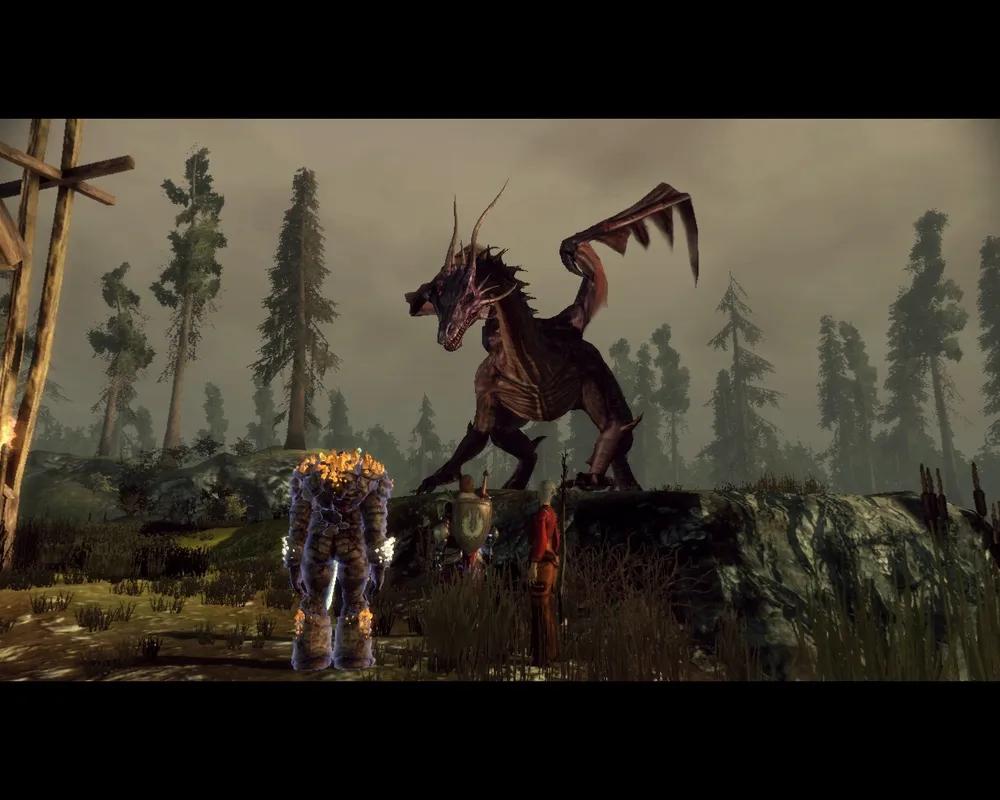
Now, let's talk about the battles themselves. They turned out to be genuinely good! The fights are beautiful, dynamic, interesting, and moderately challenging. Of course, in certain places, a well-equipped and trained group can sweep through enemies, but the game constantly throws opponents at you that you can't just take down easily. To act effectively in such cases, you have to constantly switch between characters and carefully plan each move. I was very pleased with the ability to raise the camera as high as possible and survey the battlefield from a tactical height or zoom in to immerse yourself in the thick of the battle.

Magic deserves a separate mention. When lightning sparkles above the enemies' heads and fireball flames rage around, you can't help but want to pause the game and just admire the beauty of the moment. But magic in DA is interesting not only for its beauty but also for the possibility of combining spells. For example, if you first freeze enemies with a blizzard and then unleash a storm of lightning on them, there is a high chance of instantly shattering the frozen foes and destroying them. There are quite a few combinations, and finding them independently is particularly rewarding.

And Finally, I will say…
I will briefly go over the other components of the game.
The music for the game was composed by the famous composer Inon Zur; although it might not be as memorable as the genius musical theme of Morrowind, it fits harmoniously into the game.
Regarding the voice acting, it's a bit ambiguous; in the original version, the voice acting is superb and as always, far better than in the localization. In the Russian version, you'll have to listen to the already familiar voices of actors who, no matter how hard they try, cannot match the original, although in my opinion, sometimes they do quite well (and sometimes very poorly). This should be supplemented with generally low-quality localization (even by Russian standards); some may consider it a complete failure, while I personally believe that the errors in it are not that critical (they hardly bothered me) and are more of a technical nature (the sound engineer messed up, what can I say?). I hope these mistakes are merely the result of a rushed release and will be corrected later; unfortunately, for many, they created a poor first impression.
The graphics in the game are not top-notch (due to the lengthy development), but everything looks beautiful and harmonious; however, you can evaluate that for yourself with screenshots and videos.
Regarding the game's stability, I can only say one thing – the game has been excellently tested, and I haven't noticed a single bug. Bioware – we stand for quality =)
Conclusion.
BioWare did not disappoint me, creating the best RPG in recent years and a worthy successor to hits like Baldur’s Gate and Neverwinter Nights.
I won’t give the game a score (since the score is for each to decide for themselves) or list pros and cons (I personally didn’t find any significant downsides); I think everything is clear from what I've written =)
P.S
Everything written above is my subjective opinion and may not coincide with yours!