
Review of Dungeons 4
In her quest to eliminate all her benevolent relatives, the evil dark elf Talia accidentally destroys the Great Evil! Now she must escape from the clutches of her well-meaning brother Tristan (preferably by squashing him), take charge of managing the dungeon by assigning growth points to her workers, and resurrect the Great Evil…
Dungeons 4. Wow - four installments! I haven't played the previous three, but I did play [Dungeon Keeper](/games?search=Dungeon Keeper), the spiritual successor to this game. It’s a god simulator where you lead your loyal minions and warriors with your giant hand (that is, your hand) against the forces of good. You define what to build, who to attack, and you punish the offenders while setting traps for the heroes of light that descend into the dungeon. I can hardly imagine how the developers diversified the game in the previous three installments since the latest one can't be fully considered interesting.
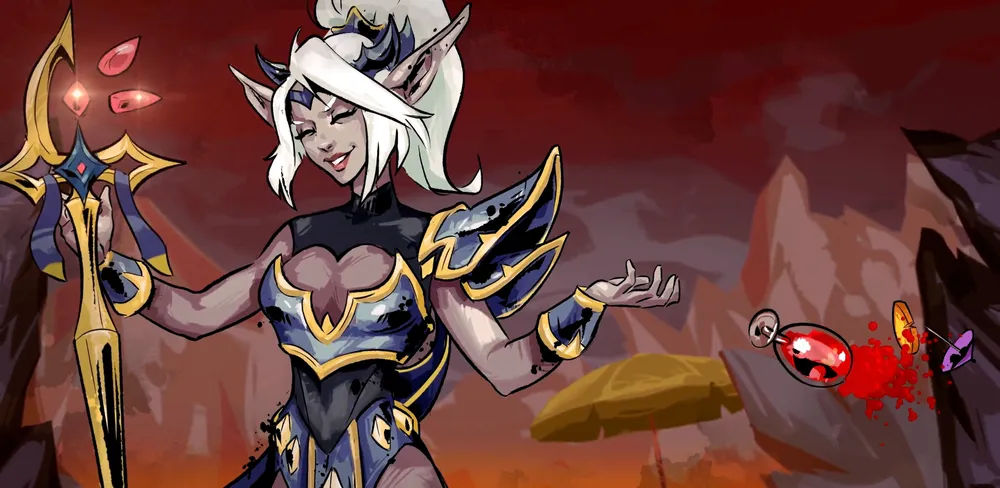
Since Dungeons 4, in terms of style and gameplay, is divided into two levels: the dungeon and the surface, we will also break down our review into two meaningful parts.
The Dungeon Strikes Back
After taking charge of the dungeon, we need to prove that the beautiful and fragile Talia can accomplish something, too.
Construction hasn't changed since [Dungeon Keeper](/games?search=Dungeon Keeper): you clear massive sections of the dungeon from heaps of dirt to build rooms, find resources, or unlock points of interest (new exits to the surface, artifacts, enemy fortifications). In empty rooms, your minions (the local little peasant demons) build rooms where we store resources, recruit new troops, upgrade those troops, etc. - this works like buildings in an RTS. It’s not enough to just lay down a floor for a room; you need to build the corresponding structure inside it and place a minion there to produce resources. For example, after building a workshop, you need to construct a machine inside that will manufacture parts; if you want to generate mana, you need to build a magic tower in the mana storage.
There are several types of resources in the game, among which three are essential to win: gold, mana, and treachery. Undoubtedly, the most important is gold, as it’s needed for everything, plus for the salaries of your warriors. A competent manager never delays payments to workers; otherwise, orcs won't go on a peaceful strike with banners, but will wage war with axes against you. Therefore, the first thing you need at the start of the game is to dig the dungeon in search of a large number of gold veins. Why large? They tend to deplete. Yes, it's possible to extract some gold through spells or find an infinite diamond mine in the dungeon - but it’s small and will provide only a thin trickle of gold, insufficient for building and maintaining a full-fledged army. A good starting capital will allow you to quickly recruit warriors and go on the offensive.
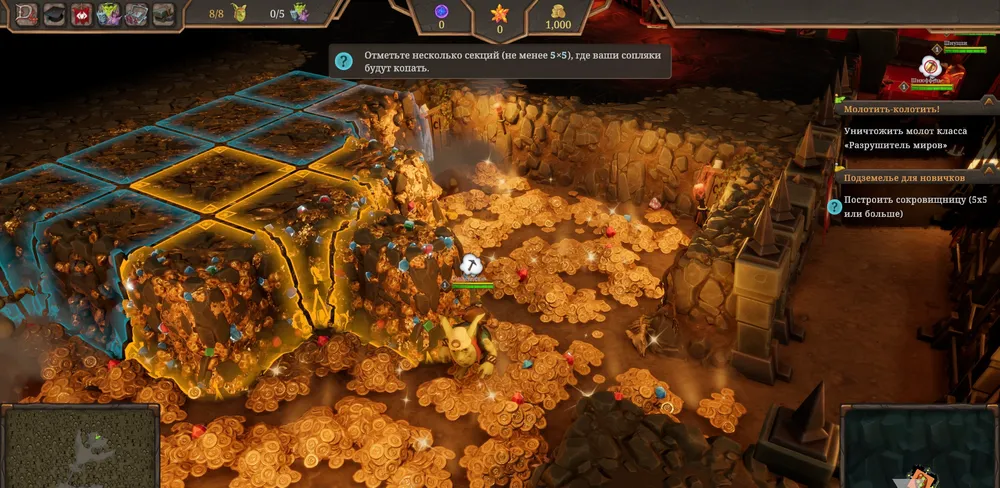
The next important resource is mana. Spells are divided into two tiers (good and awesome) and significantly aid in combat. For particularly heated skirmishes, without some sort of shield or meteor storm, it’s better not to engage. It makes sense to build more mana reservoirs for these purple orbs to accumulate more mana. Spells can also help entertain heroes who have descended into the dungeon if you can’t promptly send your troops to defend. Friendly Fire protects your minions from all direct damage spells.
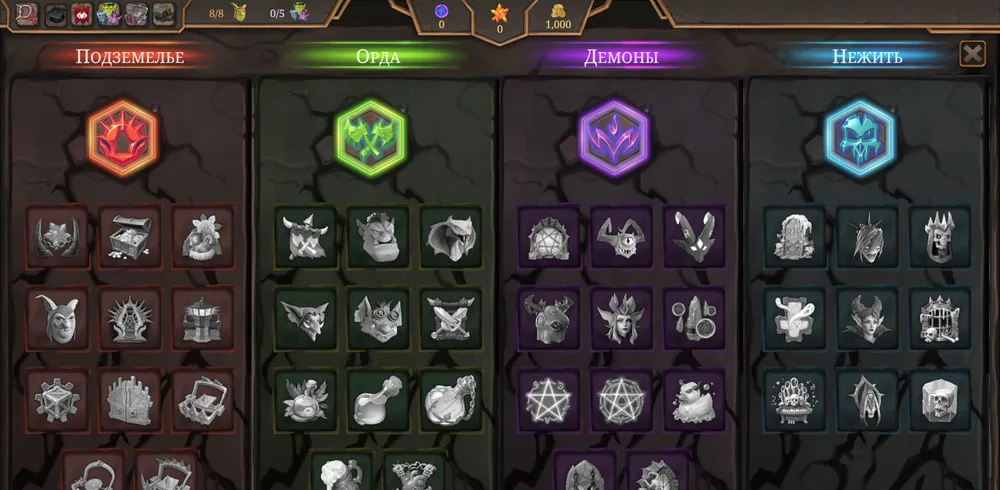
The third important resource is treachery. What is this? These orange... stars? They appear after defeating enemies, destroying their buildings, and completing story quests. They are spent on almost all upgrades. The nuance is that you won't find treachery just lying around in the dungeon, nor does it accumulate automatically. This means that to upgrade the dungeon, you must complete all quests or quickly go into battle. In Dungeons 4, a tech tree exists with four types of upgrades: dungeon and building upgrades, horde, demons, and undead. To unlock spells or new types of troops, you need to spend a certain amount of gold and treachery. Due to the treachery limit, you can't just sit below, hoarding cash and gradually leveling up. I see this as an undeniable plus. From the beginning of the game, choose your tactics and the troops you'll lead into battle, and then gradually continue to improve as battles progress. Dungeons encourages you not to linger below but to take action.
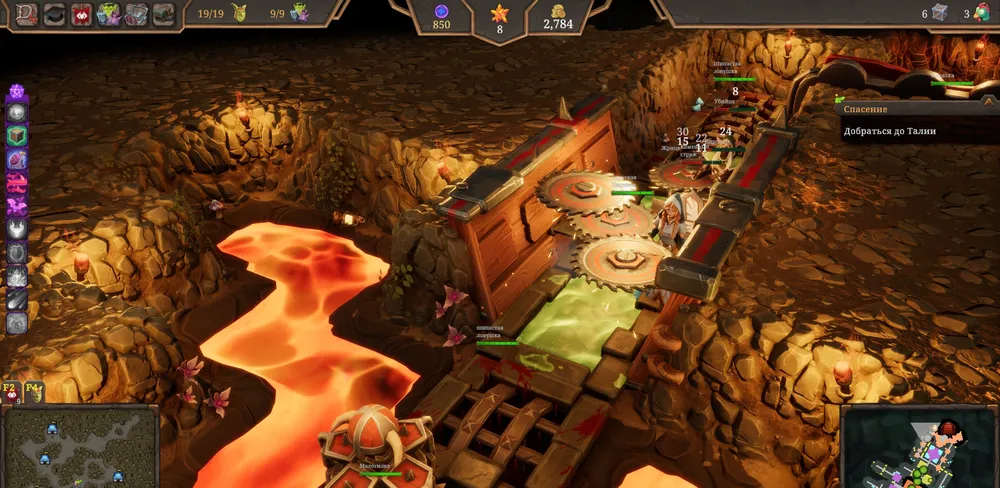
There are also a few secondary resources, including turkeys (needed to feed the warriors) and tools. The main purpose of tools, among other things, is to create traps. You wouldn't be a master of the dungeon if you couldn't properly greet your enemies. Occasionally, light wizards, priests, elves, and other paladins will descend from the surface with the goal of destroying your throne room where the massive heart crystal of the dungeon resides. This heart is very vulnerable, and while you can make it defend itself, it’s better not to let enemies near it. If the heart of the dungeon is destroyed, you will lose. Of course, you can crush enemies using magic or throw entire squads at them with your giant hand. However, you likely won't want to constantly engage in such petty management. Therefore, it’s best to erect traps in narrow passages. Furthermore, you can combine them: place sticky liquid on the ground to slow down progress, and install giant saws on the walls, or use sharp spikes instead of liquid. The longer the traps are, the higher the chance that the light squad won't make it through. It's unfortunate that there aren’t many types of traps, despite the fact that later on more sophisticated mechanisms, like a cannon that shoots minions, will become available (let’s remember). If your dungeon has many passages and lifts, you’ll quickly tire of stretching traps and setting spikes, occasionally experiencing flashbacks to Vietnam. And since plenty of obstacles will need to be placed, as the game progresses, enemy paladins will get tougher. It will lead to several warriors eventually breaking through the traps and quietly attacking your heart. You’ll still need to divert and crush the remaining foes. I’ve even missed notifications about an enemy breaking into the dungeon while engaged in fierce battles above and lost the game. Don’t hesitate to place doors in rooms, especially those leading to the heart - they will delay enemies and allow you to unleash several swarms of bats.
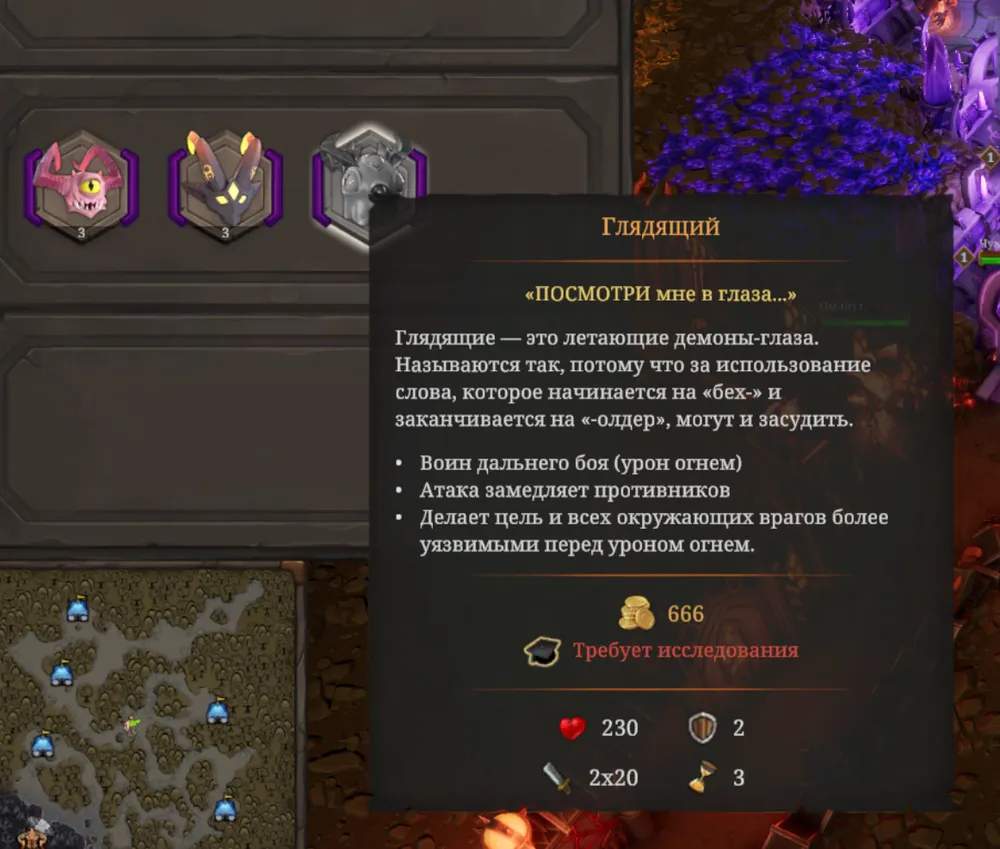
The remaining time in the dungeon is spent fighting. As I mentioned above, we will have three types of warriors: horde, undead, and demons. Each faction has four types of fighters, each with its unique abilities and costs. Everyone requires payment and a designated place in the corresponding room; however, for example, undead do not need to eat. It's hard to say which of these fellows is stronger, but orcs, for example, are the cheapest, and at the start of the game, I usually build them and snakes, who have healing abilities. On the other hand, demons are excellent shooters, and undead can overwhelm with their numbers, thanks to their unique ability to... raise the dead. While your minions are rebuilding the dungeon, your warriors are busy repelling enemies from above, occasionally cleansing the dungeon of neutral spider nests or other creatures. Battles in the dungeon do not have direct control, and if you want your fighters to attack a specific unit, just click on it (right-click). These battles conveniently help raise levels and unlock new abilities. Sometimes you will encounter hostile underground dwarf settlements. To destroy them, you need to break through guard doors, capture rooms, and destroy the heart of the dwarven dungeon - it’s all quite simple, and no tactical tricks are required.

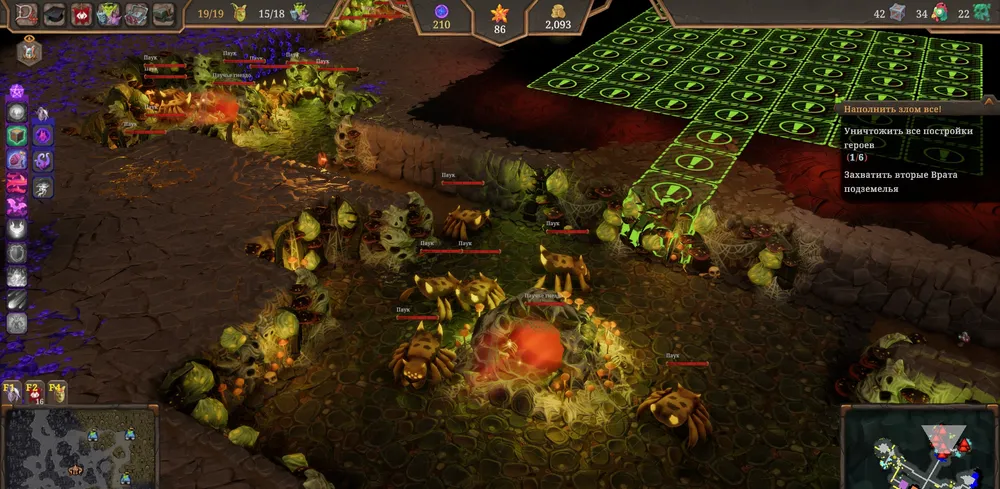
The creators of Dungeons 4 saturated your building grounds with an overabundance of rooms. Various training arenas, rest rooms, and dance floors for the undead (yes) - all of this increases your warriors' strength to some extent and allows them to avoid accumulating stress, but it overly stretches the gameplay. I’m not even mentioning that they clutter the dungeon with the monotony of rooms where one can get lost. Moreover, all these additional constructions are just unnecessary. You can effectively and swiftly handle your squads without the extra upgrades (unless the alchemical shop for orcs comes in handy). Sometimes it annoys me how artificially the underground part of the game is complicated, especially when disgusting mana gluttons appear, which feed on mana and become stronger by the minute. Your weak fighters stand no chance against one large mana glutton, so you must crush them while they’re small. Always make sure to divert attention - and crush or destroy them with magic. You might suddenly discover a second entrance to the dungeon, through which light heroes will flood in. And you’re doomed if you haven’t set traps there beforehand. So be prepared to multitask and continually shift focus back to the dungeon.
Now let’s move to the surface.
Good Guys Are Not Welcome Here
On the surface, we have a pure RTS. As soon as your troops reach the upper world, the game transforms into some sort of Warcraft with the option of direct unit control.
We can select both the entire army and specifically ranged and melee fighters (which can sometimes be convenient). Combat is almost entirely automated, and your warriors use their abilities on their own when they deem it necessary. The exception is your hero, whose skills we apply manually. Talia has only two abilities, so you won’t get confused.
There will be no building or resource gathering (except for the occasional treachery and tools) up above. What are we fighting for under this heavenly star? Primarily to destroy enemy settlements, where they churn out endless troops that assault your dungeon. Then, for treachery points, experience, and to fulfill mission objectives. Sometimes ordinary enemy squads are guarded by shooting towers - here, ranged troops will come in handy, as they deal good damage to buildings, or goblin bombers. Occasionally, we will need to eliminate a raid boss - an especially strong good creature that’s better tackled with a well-prepared army; otherwise, you’ll lose this army. While undead and demons may resurrect later (if you have enough money and treachery points), horde units die permanently – hence their low cost. Once things get tight on the surface, or a disaster strikes (such as killer rain), Talia can quickly teleport all nearby warriors back to the dungeon. You can do something similar with a portal spell.
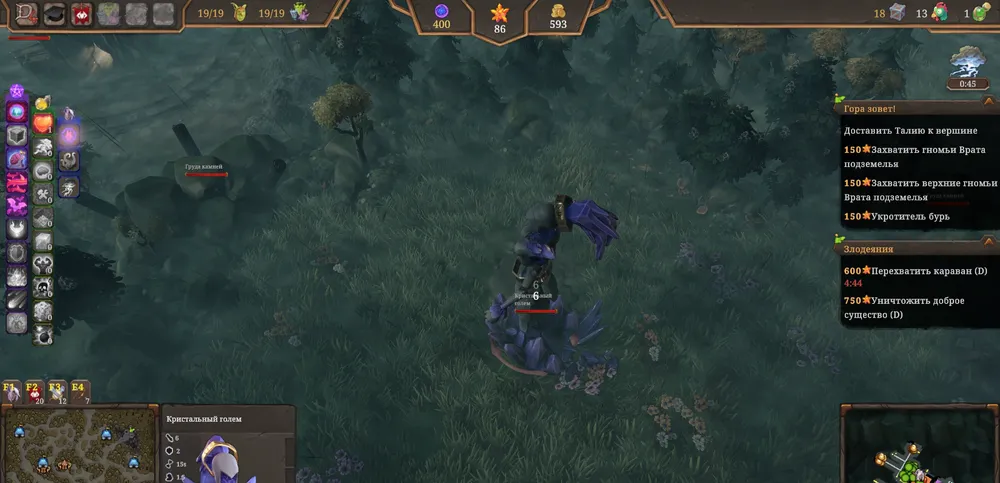
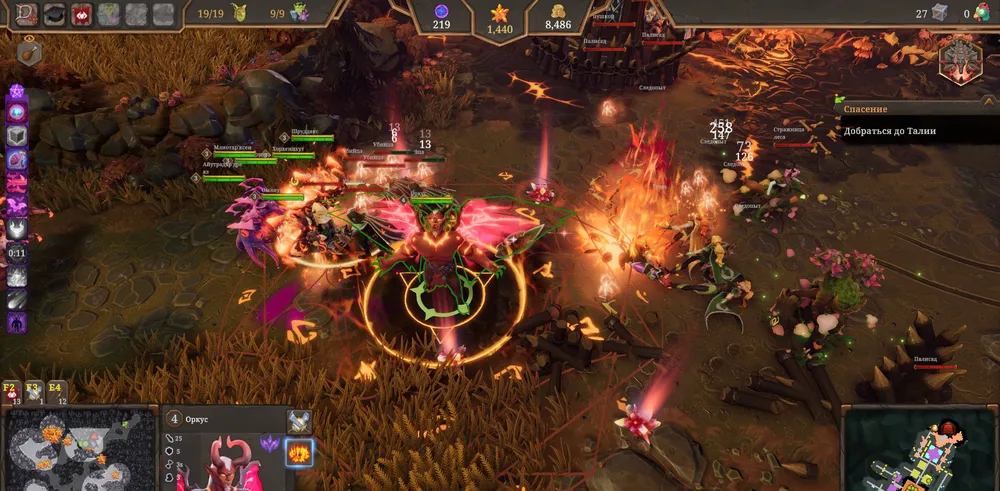
All the action on the surface felt to me like an unnecessary part of the game that’s imposed on us. Possessing a sparse set of mechanics, this real-time strategy, artificially implanted in Dungeons 4, quickly becomes dull. Most often, a wall-to-wall fight turns into a mess of chaotic effects that you observe without much enjoyment. You don’t need to apply any tactical tricks – just “right-click” on enemies, “red smash, green heal,” occasionally cast spells to consolidate effects, and that’s it. You won't face any difficulty. The developers were aware of this, so they complicated the surface gameplay with intriguing mechanics, such as: destroy a certain number of settlements, intercept caravans from various corners of the map, navigate through forest mazes in search of a passage, etc. And while you meander through the top with boredom in hopes of completing the mission quickly, various nuisances occur in the dungeon, forcing you to divert from your primary tasks.
A Crooked Mirror
Dungeons 4 is permeated with humor. It oozes from every corner and drips onto your head. From the very beginning of the game, you sense touches of “petrosianism” everywhere: in dialogues, in in-game descriptions, in cutscenes done as static images. I won’t argue, some of the gems and remarks will surely bring a smile or chuckle (especially regarding building or monster descriptions), but the developers clearly lack the sense of when to stop. As a result, we receive endless cringeworthy dialogues with forced humor that constantly flash across the top of the screen. At first, you read, fearing to miss a plot message or important dialogue, but then you realize it’s just a monotonous collection of humorous phrases and statements that soon become unamusing. Moreover, this “potrosyanstvo” is crammed everywhere it can fit.
Visually, the game is pleasant, a classic project on UNITY. I prefer the dungeon design more because, above, Dungeons 4 looks like a boring fantasy RTS. As I've mentioned, there's a noticeable overkill with effects because when several groups start fighting, the entire screen is flooded with acidic colors, and you can’t see a thing.
The controls are simple and intuitive - there shouldn't be any problems there. I also didn’t encounter any bugs or crashes during gameplay. The game sharply lacks auto-saving. While you attack the surface, you might forget and miss a treacherous attack on the heart of the dungeon, and having to replay almost the entire mission is very painful and tedious.
I realized that Dungeons 4 will be highly appreciated by children up to ten years old due to its cartoonish graphics, bright effects, and specific humor that will undoubtedly appeal to young gamers. For me, however, it wasn't too interesting. The part of the game played on the surface is dull and quickly becomes monotonous. The dungeon building and management are better, but due to the limited mechanics and variety, this part also quickly gets old - ultimately, you'll still end up with one or two approaches to complete the game. Even sandbox missions won’t remedy the situation; conversely, at least the campaign has some central plot to follow. Perhaps it would have been better to add a turn-based mode on the surface, akin to [Divinity: Original Sin](/games?search=Divinity: Original Sin), but simplified, to genuinely introduce depth into Dungeons 4.
In its current form, the project about dungeon management will let you burn a few evenings in a week, but soon you'll be eager to see what Dungeons 5 has in store.