
The Lack of Unity in Assassin’s Creed: Unity
More translations to the god of translations and more Assassin’s Creed to the god of Assassin’s Creed! I continue to familiarize myself and introduce you to the articles by Stanislav Kostyuk, senior game designer at Ubisoft, dedicated to one of my favorite (let's not hide it) franchises. The material on 'Unity' was previously published in Russian; however, the author himself acknowledged that translation was not entirely successful. Therefore, I decided to make another attempt to convey to the Russian-speaking reader a rather interesting, as I believe, analysis of a game that, although not flawless, certainly did not deserve the torrents of bile (or even worse) spilled on it by various haters. And yes, I am doing this not out of revenge, but for the sake of fairness (those who found the reference to one of the following videos in the preface – undoubtedly, you are smart and clever).
Author: Stanislav Kostyuk,
senior game designer Ubisoft
The Lack of Unity in [Assassin’s Creed: Unity](/games?search=Assassin’s Creed: Unity)
I have mentioned the topic of the coherence of the gaming experience with respect to the Assassin’s Creed series games before, discussing successful examples – 'Brotherhood' and 'Black Flag' – and less successful ones – 'Revelations'. However, this time I would like to talk about a game where coherence is absent by any meaning of the word, and neither the removal of any elements nor their refinement is able to rectify the existing situation.
As an example of such a game, I could mention [Assassin’s Creed: Rogue](/games?search=Assassin’s Creed: Rogue), where 'Templar' and 'Assassin' tricks are combined with varying degrees of success, resulting in something incomprehensible. Or [Assassin’s Creed III](/games?search=Assassin’s Creed III) – an ambitious project in words, but in reality turned out to be a collection of underdeveloped and unsuccessful mechanics. But this time, we will not be talking about them, but about [Assassin’s Creed: Unity](/games?search=Assassin’s Creed: Unity).
In my opinion, this game does not deserve the bad reputation it has gained. Yes, its release was overshadowed by technical problems; nevertheless, it features several moments that can deliver enjoyment. Unfortunately, the coherence of the gaming experience is not one of them.
In one of my previous posts, I tried to understand what makes 'Brotherhood' such a great open-world game. Each of its elements has certain flaws and rough edges by itself, but when combined, they create something remarkable. With 'Unity', everything turned out to be the exact opposite. Individually, each of its elements seems appropriate, but when connected, they produce the impression of something incongruous. Able to provide enjoyment, yet still incongruous.
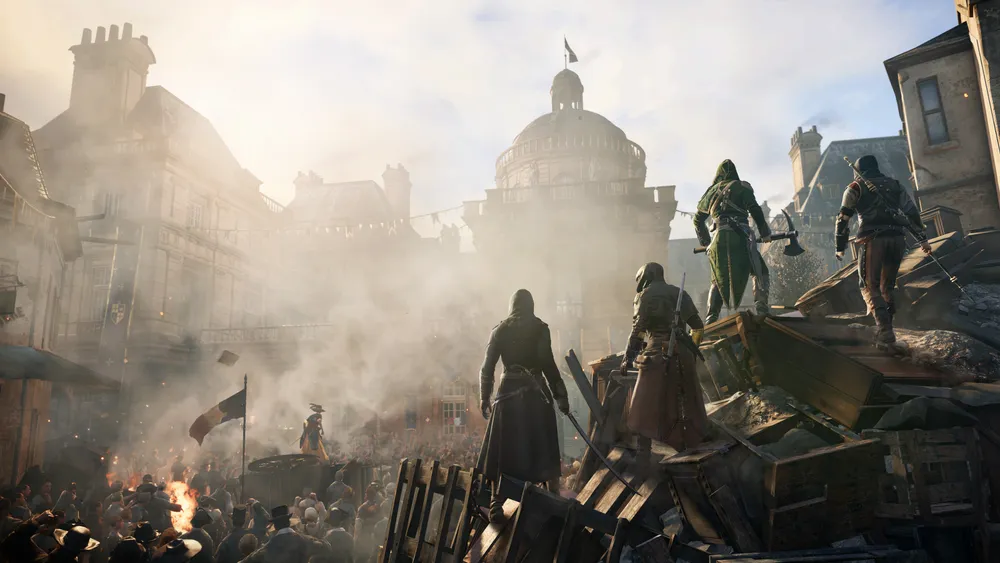
To start, let's list the elements of Unity that succeeded.
Key gameplay mechanics. They are implemented better here than in any of the other parts of the series. The combat system does not turn you into a super killer. It requires tactical thinking, precision of movement, and crowd control. Stealth is executed properly; the developers managed to find a golden mean between unmanageable stupidity and excessive cleverness of enemies (sometimes, however, they have problems with doors when the protagonist hides around the corner). The parkour system is the best in the series (it's better even than in 'Syndicate', as unsafe jumps are blocked in the latter).
The design of main missions is very good, especially the missions involving boss eliminations. The latter consist of well-thought-out and meticulously crafted 'sandboxes'. They can be completed several times and still reveal something new. Considering the number of main missions, the story overall turned out to be remarkable, with many interesting nuances and moments.
The design of side missions, in general, is also good. Special mention should be made of cooperative storyline missions and heists [tasks from the category of 'Gain'. – Note from translator.]. Since they can be completed alone or with friends, they provide a stunning gaming experience.
The elaborate customization system allows you to equip your character according to your play style.
The economic system is arguably the only one in the series that maintains a proper balance between passive income and quest rewards, so there is no surplus of money closer to the end of the game. [I categorically disagree with Stanislav here. By the end of the campaign, even if you neglect a significant amount of side missions and activities, Arno will have enough money to seriously risk becoming a millionaire. – Note from translator.]
Paris looks just amazing. Honestly, no other Assassin’s Creed game features as many crowds as 'Unity'.
So, let's take a look at the provided list. Gameplay systems and mechanics, missions – everything is thoughtfully crafted... Now, let's discuss why the game that housed them in general turned out to be far from perfection.
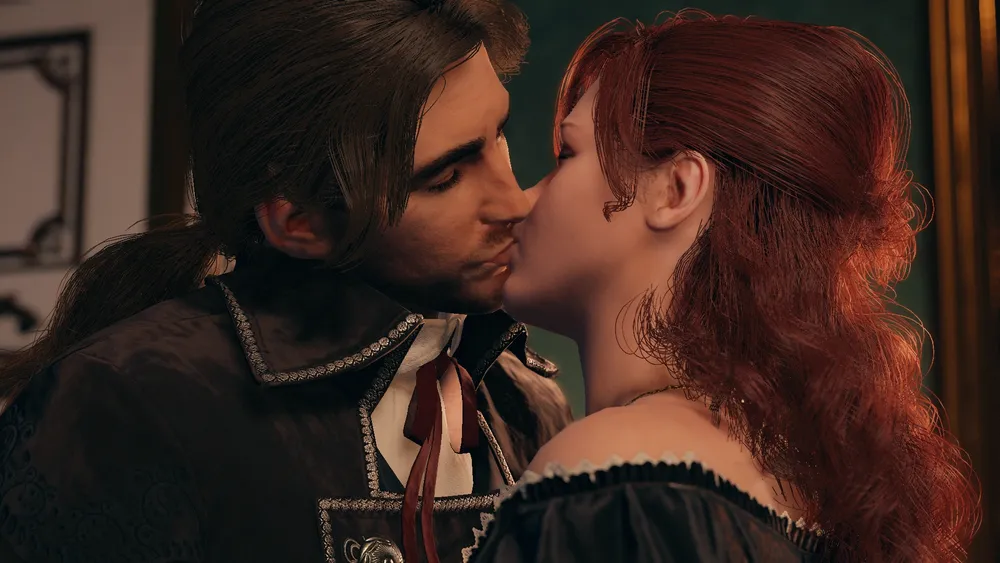
The main storyline of Unity is dedicated to Arno, while the French Revolution serves merely as historical décor against which the main character's story unfolds. I believe the developers attempted to avoid critical comments similar to those made towards [Assassin’s Creed III](/games?search=Assassin’s Creed III): that there are too many real historical events in the main campaign. However, by avoiding one extreme, the creators of 'Unity' seemed to have fallen into the other; as a result, during missions like the 'September Massacres', you do not receive any historical context regarding what and why is happening around.
Conversely, the side quests from the so-called 'Parisian Stories' are entirely dedicated to the French Revolution. In every second mission, if not in every single one, you encounter one or two new historical figures. There are SO MANY historical characters that at some point you become indifferent to who is who and why you are doing what you are doing. Moreover, the game does not provide clear indication of which time period any given mission relates to. It has happened more than once that I started a task that was supposed to chronologically precede those I had already completed. Almost none of the characters in the main storyline are involved in the side missions; if they are involved, it further does not contribute to their better development. Well, Napoleon was the most unfortunate, as he had the honor of becoming the key actor in a side quest about the most ridiculous love triangle in history.
There are also investigation tasks in the game. They are indeed cool and all that, yet it is completely unclear why Arno is engaged in them at all. There are also random assassin club tasks, most of which are assigned to us by the Assassin Council. Yet for the entire duration of the game, if we exclude a few episodes within the main missions, we do not interact with the Council in any way, making the aforementioned tasks appear as if they do not belong to the game. The collaborative 'Gain' tasks resemble Animus simulations, and time anomalies [Helix breaks. – Note from translator.] are cool, but have absolutely no relation to either Arno or the French Revolution.

And yet, the greatest dissonance for me comes from missions for cooperative play – the most significant part of the game after the main storyline. So (caution, the following contains narrative spoilers for Unity), in January 1793, Arno is expelled from the Assassin Brotherhood. He leaves Paris, moves to Versailles, and starts drinking excessively. He only returns to the capital in June 1794. Nevertheless, 75% of cooperative missions, where we play as Arno, happen between January 1793 and June 1794. In one of them, even a captured assassin calls Arno by name.
The way players are represented in cooperative missions also poorly aligns with the rest of the game. During their completion, the character of each player appears on their own screen as the model of Arno, which I believe is the proper approach for narrative games with an open world. However, all other team members are rendered on that player's screen as random nameless assassins.
When I first saw the Unity trailer shown at E3 2014 and learned about the seamless cooperative mode in an open world, I mistakenly assumed that other players would be represented as characters from the main storyline. Indeed, you interact with these people during the single-player campaign and undertake various Brotherhood assignments together in cooperative missions. The result would be that not only would you complete them with friends, but Arno would as well. This would better connect the main and side stories. [Unfortunately, nothing like that happened.]
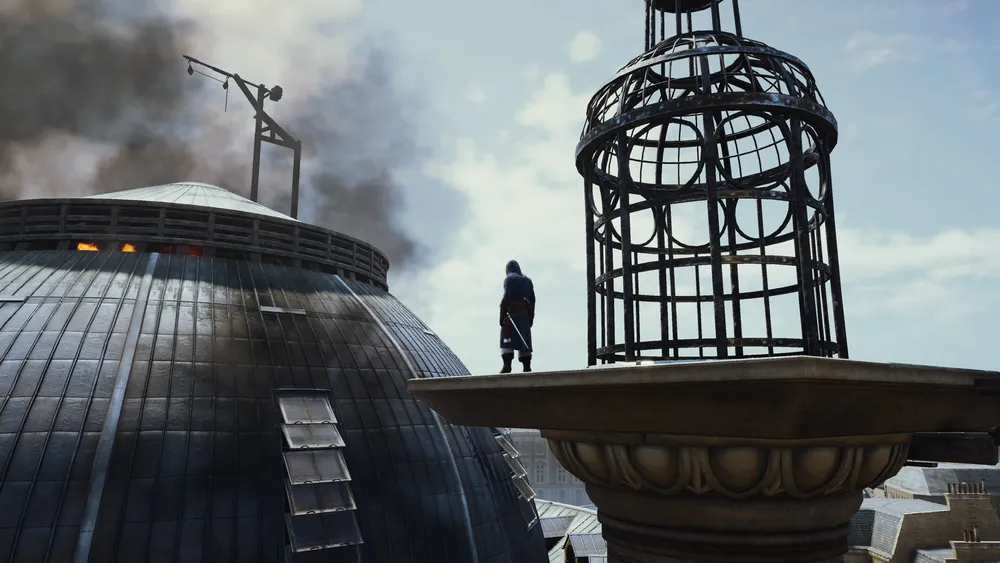
If gameplay and mechanics are generally implemented at a decent level in Unity, one could blame the lack of unity in the gaming experience on the narrative, which failed to provide proper links between the elements. However, I do not consider this position to be correct. Narrative and gameplay do not exist on their own; they are interconnected and complement one another.
Earlier, in a post dedicated to Revelations where I wrote about how the removal of [unnecessary] elements from a game can positively affect the gaming experience, I want to talk about the importance of maintaining balance between removing and adding elements to the game overall: both to its narrative component and to its gameplay component.
Making changes to the story being told or removing gameplay elements that do not align with it will not make [Assassin’s Creed: Unity](/games?search=Assassin’s Creed: Unity) a great game. It needs to be rebuilt from scratch while constantly asking oneself: how and why does a specific element contribute to the realization of the overall idea.
Perhaps it would have been better to forgo the café 'Theater', our personal base, so that Arno as a character would show more interest in what is happening around him within the main storyline. Maybe it would have been better to reduce the number of historical characters in side missions while making them more tightly interconnected from a narrative point of view. However, this would require introducing additional gameplay mechanics to ensure these missions are completed in the correct sequence.
Everything I’ve said applies not only to grand concepts but also to small details. Take, for example, this cutscene.
For those unfamiliar with Unity, it may seem that this is the very first leap of faith that Arno makes in the game. The same is mentioned in the title of the video. However, that’s not true. The leap of faith is not only available from the very beginning of the game (although, in my opinion, this should not have been the case, and it would have been better to block it until the escape from the Bastille to give that particular scene greater significance). The initial Versailles sequence includes a mandatory tutorial on how to perform it. This is a very strange game design decision, as the introductory chapter is the most fitting moment to teach a player controlled descent, as this skill will be useful later for performing the leap of faith.
Of course, for long-time Assassin’s Creed fans, there is nothing new in the leap of faith, but Unity was conceived as a project meant to attract new players to the series. The first leap of faith is a special, pivotal, significant event. And that is how it is presented in that cutscene. However, gameplay and mission design spoil the entire impression. You reach that moment, and Arno says, 'This is impossible.' But you, as a player, have already made several leaps of faith by that point and therefore know that it is possible. It would have been better to allow Arno to climb walls and race across rooftops right from the beginning, as this is a key gameplay mechanic and also aligns with his reckless character, while also blocking the leap of faith until it gains special significance. This would have ensured coherence between gameplay and narrative.
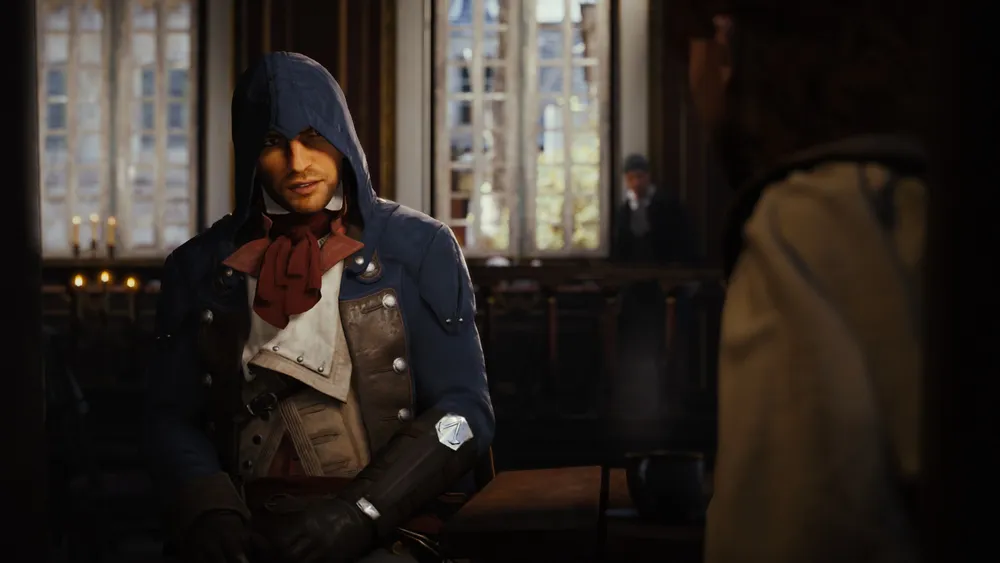
In conclusion, I would like to share what stayed with me the most from this game. It is the short side quest 'Marianna Returns Home'. It revolves around an imaginary character, who does not appear anywhere else, and whose name I could not even recall until I googled the mission's title. Nevertheless, this story has been on my mind for two years.
In this mission, we meet Marianna, practicing with a sword near some shed. Arno asks the girl what she is doing, and she tells the story of how her parents were executed based on a false report, and the home where her family lived was taken away, and now she trains in the hope of one day getting it back. So what do we do as Arno? We help her train, and then together we go to her home and deal with the extremists who have taken shelter there. The mission ends with a touching scene in which Marianna reminisces about memories connected to that place in one way or another.
Why did this mission resonate with me so much? Because it is not about some historical nonsense like royal treasures or documents that eventually became widely known, or a seer, who knows who will kill her (by the way, why should we believe her at all?). It is a simple story about an ordinary person who we help to find a little peace amid the chaos that surrounds. And that is truly very human.
Original article: The Disunity of Assassin’s Creed: Unity
I’ll also leave here links to translations (mine and others) of other articles by Stanislav Kostyuk dedicated to the games in the Assassin's Creed series.