
Preview from the magazine 'EDGE' [translation]
A Look at Skyrim
First Steps in the Epic World of "The Elder Scrolls V"
Before us looms a mountain known as the Throat of the World. It is immense — snow-covered slopes, mist-wreathed peaks, and black claws of rock so high that they cannot be comprehended at a glance. The mountain feels inhospitable, dangerous, and cold — just looking at it from the pastoral valley sends chills through you, as you sense the howling wind and the oppressive mass of ice blocking the path to the summit. Our journey is seven thousand steps through barren ravines and treacherous ridges, buffeted by every wind. And finally reaching our goal, we will meet the Greybeards and learn from them the powerful words of the dragon language.
This feeling has always been yearned for by the long-running series of open-world role-playing games from "Bethesda", both in its narrative — a prophecy of dragon awakenings threatens the fairy-tale empire of Tamriel — and in the basic principles of gameplay. The previous game in the series, "Oblivion", focused on mechanics: the main plot did not hook many players, and the lackluster voice acting along with clunky animations were the final nails in its coffin, but this rarely mattered to players who were having fun within the game world.
This game world has only become better and more impressive in the continuation of the series, but now the world-building and quests are worthy of it. In the rich mountainous landscape of Skyrim, the touch of an artist is evident — it feels as if it was created just for you. "Oblivion" was vast, but "Skyrim" became epic.
Whatever race and gender you choose when creating your character, your role in "Skyrim" is one of great importance — you are the Dragonborn, a hero destined to confront the scaly monsters that have begun to crawl out of caves in the north of Tamriel. But destiny does not fall upon you from the very start: just like in "Oblivion" and "Morrowind", the main hero of "Skyrim" begins his journey in a damp dungeon. The reason for his imprisonment is left to the player's imagination. After escaping execution (this part of the game, "Bethesda" currently does not want to show), you step out into the green valleys nestled at the foot of the Throat of the World.
The local sights catch the eye for two reasons: firstly, they are aesthetically pleasing — the warm green hues of the surrounding environment gradually yield to the ominous cold shadows of the mountains, and secondly, they showcase the improved engine that allowed for the lush vegetation at the foot of the mountains as well as the massive cliffs themselves.
— We rewrote the renderer of the engine, — said creative director Todd Howard, leading the character to explore a fern swaying in the gentle breeze. — Shadows are now full. The pathfinding mechanics, artificial intelligence, quest system, dialogue system, interface, and animation system have also been rewritten.
Past "Bethesda" games were criticized for unnatural jerky movements of characters; this is now fixed — switching to third-person view, Howard demonstrated his hero's rugged back smoothly traversing slopes and other obstacles and truly integrated into the world. According to Howard, "Bethesda" wanted "Skyrim" to look on par with any other third-person game, if the player ever felt the need to choose that mode. Howard himself, however, prefers the first-person view, so at the next segment we were unable to appreciate the delights of the improved mode. Nevertheless, an encounter with the suicidally brave bandit allowed us to assess the new "two-handed" combat system.
— We added two-handedness relatively late, — Howard stated. — It wasn't in our plans, but then it seemed like a completely natural addition.
Howard quickly assigned functions to the hero's left and right hands. The menu he summoned is a favorites list, but if you need to dig through lists of spells, shields, or swords, that will take a little time too. The interface developers performed a real miracle — as you dive deeper into the menu, black canvases roll across the screen, and each item is immediately showcased in three-dimensional form. The same applies to spells — sparks of magical energy form colorful spheres.
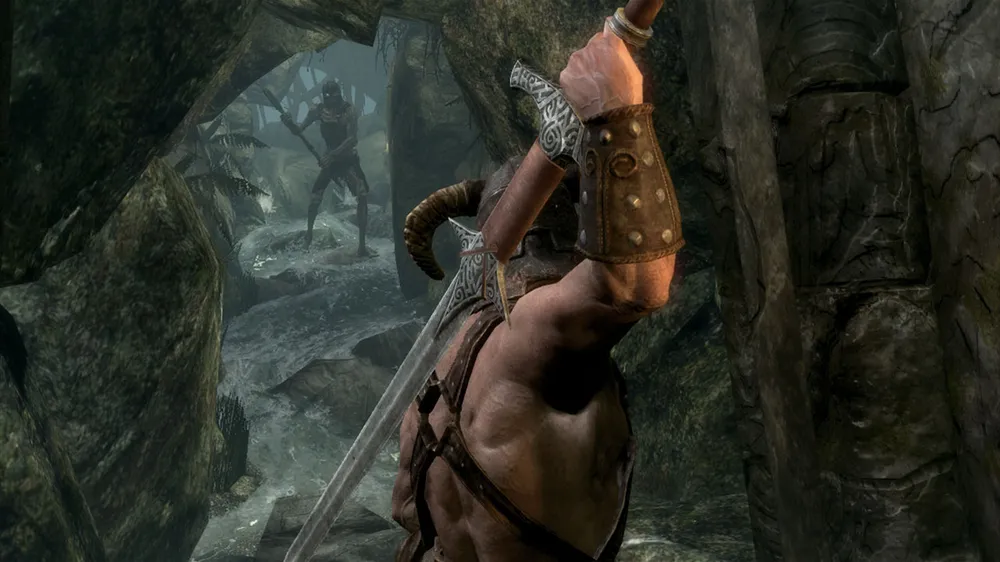
With a shield in one hand and a sword in the other, Howard prepares to defend himself. The direction of movement influences the action, meaning you can manipulate the angle of attack. The battle is extremely active, the sword's impact against the shield feels sharper than in "Oblivion", and the clash of shields causes fighters to stand still, while successful blows stain the blade with blood. Howard retreats, selecting a healing spell for both hands, which doubles its effectiveness. An energy sphere slips from the hero's fingers. Later, Howard told us that different spells cannot currently be combined, but nothing stops you from using them — as he did, replacing one of the "Heal" spells with "Frost", which slows the enemy and damages them. Howard approaches the foe and performs a finisher attack, depending on the position of both fighters, grabbing the bandit by the throat and plunging the blade into his stomach.
As the bandit's corpse falls to the ground, Howard takes a breather to show us the revamped skill system. In "Oblivion", there was an intuitive mechanism — the more you engaged in something, the better you became at it. "Skyrim" uses the same principle but devoid of the elements that made leveling up in "Oblivion" unclear.
— In "Oblivion", you had eight attributes and twenty-one skills, — Howard said. — Now there are eighteen skills and three attributes: magic, health, and stamina. We noticed that all eight attributes were responsible for something. In "Oblivion", you would increase your intelligence to raise your mana pool and cast more spells. Thus, all attributes boiled down to increasing those three parameters. That's why they are gone. Now, if you want to increase your mana pool, you simply level up your magic.
Gone are the skills that "Bethesda" deemed unhelpful to roleplay. Acrobatics and athletics have been tossed out since these skills should be innate. As Howard put it, "Who would want to roleplay a character that can't run?" Fortunately, this also means that players no longer have to jump throughout the game to level up those skills faster — although we will all miss the old good Tabsie Catman and his wonderful ability to leap out of levels in "Oblivion". The relationship between skills and attributes has now become clearer.
— Every skill affects the level, — Howard said. — You will notice that every time I level up any skill, the bar of my level increases. This allows for a change in the direction of development: you leveled up magic for ten levels and then suddenly found a great sword and started using that instead.
At the same time, the talent system reliant on skills (one awarded per level) gives players the chance to endow their character with special abilities. Talents significantly enhance the hero's skills, and oftentimes this is immediately noticeable: for example, archer talents may allow you to slow down time or zoom in while aiming. The display of talent trees is practically perfect — informative and beautiful constellations. Each skill has its own sign (this is a further development of the sign system from "Oblivion"), and in this constellation, new stars light up with every chosen talent.
— I believe the concept of "The Elder Scrolls" is built on the ability to create your character and do anything you want in a large world, — Howard told us after the presentation. — Size is needed, not to the extent of hundreds of hours of gameplay, but enough to give the player the chance to do what they want. Even if you quit the game after twenty hours, those twenty hours will be yours. I think this is a hallmark of the series.
The ability to choose your character's abilities goes hand-in-hand with the ability to choose where to go and what to do. While Skyrim is roughly the size of Cyrodiil, the realism has noticeably increased. Everything that other characters do, you can do too, explained Howard, standing next to a lumber mill in the town of Riverwood, where a worker stacks wood into piles. Work is also part of the local economy. Destroy the lumber mill, and wooden products, like arrows, will become a scarce commodity. However, it is still unclear to what degree a financial crisis can be driven in the province.

— An economy in a game is always a great idea. On paper, — said Howard. — Here we have lumber mills, mines, and smelters — they influence weaponry. There are farms affecting food and alchemical ingredients. Everything works, but we haven’t found the optimal ratio yet.
Howard leaves the lumber mill and strikes up a conversation with a local resident who mentioned a robbery at a shop nearby. Finally moving away from the conventions of its role-playing games, "Bethesda" removed the camera's close-up to the NPC's wooden face in dialogues. Now, you can end a conversation at any moment simply by turning away from the interlocutor. Less convincingly, there’s progress in the dialogues themselves: Howard, prompted, enters the shop and overhears a dispute between its owner and his sister about how best to pursue the robbers. Not the pinnacle of creation, of course, but not the quiet horror from "Oblivion" with its pompous drama.
— Actors have become more experienced over time, — Howard commented. — They have more games under their belts, they now understand that this is not an exchange of lines, but "You’re going to read a bunch of response options now." We now work more frequently with voice acting in Hollywood. Ultimately, it all comes down to time and money, so we spend increasingly more of both. Earlier, we had problems with space; working on "Oblivion", we barely managed to fit everything on the disc, but since then everything has changed; compression technologies have improved. So now we are limited not so much by space, but by the time required for voice acting. And that really is a problem… did you know that games are released in five major languages? The time needed to record everything in English, French, German, Italian, and Spanish is colossal.
One of the issues in "Oblivion" was that dialogues in such a lively world were not always believable; the same can sometimes be said for "Skyrim". While the shop owner's sister led us through the town, telling us about a family heirloom in the form of a claw stolen by the robbers hiding in Bleak Falls Barrow, locals would interject their greetings, completely drowning her out.
The rare hiccup in believability is compensated by the size and intricacy of the game world. As Howard made his way to the mountains where the robbers were hiding, a giant passed by leisurely; many creatures have their own business in the larger world, and they couldn't care less about the player. A troll that thought otherwise was quickly incinerated and chopped into pieces by Howard. The two orc sentinels guarding the watchtower in the snow were aggressive as well. Howard demonstrated Alteration magic, causing one of the orcs to attack his comrade and then killing the victor with a bow.
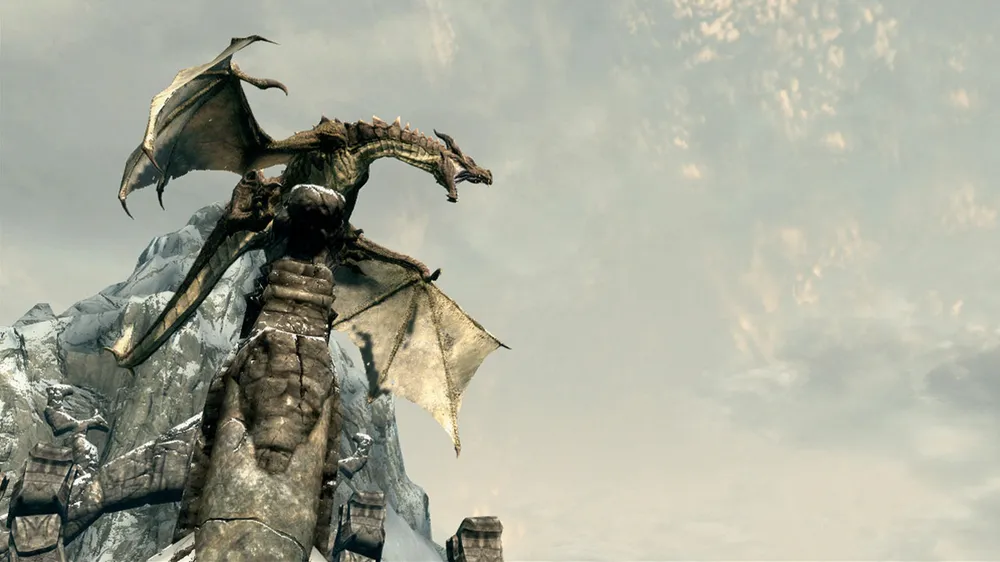
Howard climbs higher, now surrounded by cliffs covered with a thick layer of generated snow. Finally, he reaches a plateau surrounded by stone pillars resembling ribs; at its far end is the entrance to a barrow. But Howard is not alone — the flapping of membranous wings warns of a dragon approaching, circling above the mountains. Howard dashed toward the entrance to the barrow, but the beast dove straight onto the steps into the safe darkness of the dungeon, erupting flames from its mouth.
— Mother... — murmured Howard. Although an encounter with a dragon in this spot is inevitable, it is not scripted. Dragons are akin to random bosses that appear at key plot moments or in random locations, pulling the player back onto the path of the main quest.
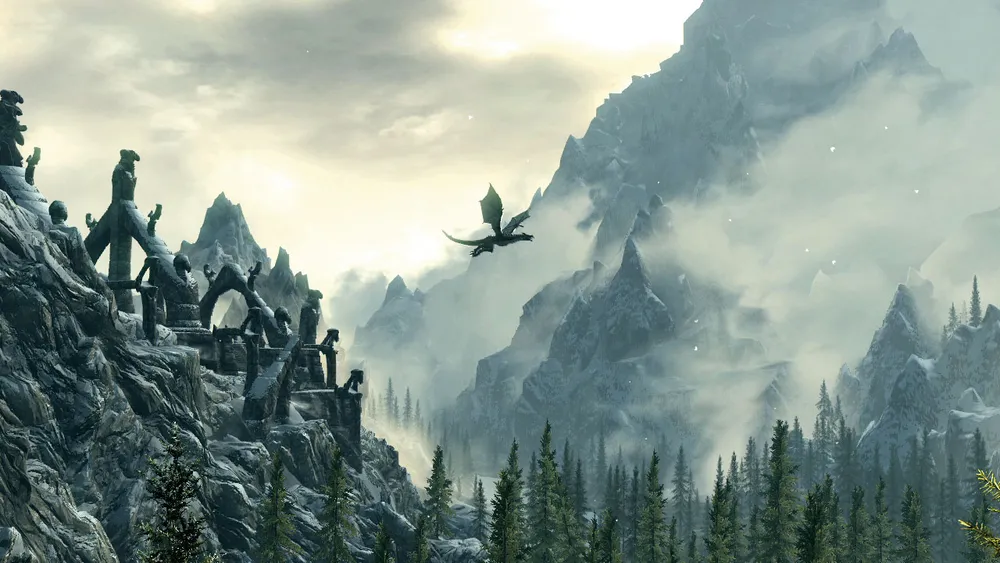
— We can calculate how long it’s been since you last encountered a dragon, track your level and your actions — perhaps it's time to throw a dragon at you! — Howard later explained the workings of "Radiant AI". — One of the designers created a random encounter with three dragons flying near this town. It was conceived as a beautiful scene, but the dragons decided to do a bit differently. They noticed me and put on a show. I was like, "Who did this?!". But then I decided to give myself a chance — I ran into the mountains to shake them off my tail. And sometimes it worked. I felt like Frodo in the swamp from "The Two Towers" — nothing like this has ever been in games. Terrifying, really. Nevertheless, I told the designer to scrap that encounter. Three dragons is overkill.
Indeed, even one dragon gave Howard a lot of trouble — he barely managed to outsmart the creature and slip down the stairs into the loading screen of the safe barrow. Inside it was dark, with only a faint light at the entrance pulling the stone structures from the darkness, differing from Daedric shrines and the fairytale settings of "Oblivion". This is the land of the Nords, the first humans, and their architecture is clearly inspired by Vikings. It's rough, stern, and, most importantly, sharply distinct from other dungeons you have visited.
— The principle of world creation hasn’t changed since "Terminator: Future Shock", — Howard said, describing the process of creating environments from pre-developed sets. — We simply improve the technology, make the environments come alive, and add details. It’s also easier to make modifications this way. The game has several types of caves: moss-covered and vegetated, icy caves (those underground dungeons in glaciers), imperial forts… five or six total sets and many variants for each. In "Oblivion", dungeons were made by artists, and there were only two level designers, if not just one. It turned out alright, but the dungeons lacked individuality. So we expanded the design team, and now we have one hundred and twenty dungeons and over a hundred interesting locations on the surface. There will be puzzles, varied settings, and a brisk pace. We try not to make mazes.
Delving into the dungeon, we see how a stream of water, bubbling between mossy stones in the barrow, helps guide the player. At the entrance, the flickering light of torches pulls the player's attention, and as Howard crawls past stone columns supporting the rock above, he overhears a conversation between two robbers standing by a fire, discussing the fate of their comrades who ventured into the depths of the barrow.
— In "Fallout 3" there were several stages of alarm and danger, — Howard says, creeping closer to the enemies and drawing his bow. — Here too there are these stages, but opponents do not switch between them instantaneously. The eye icon, replacing the pupil from "Oblivion", shows the player that enemies are switching between stages, and the stealth skill determines how quickly this happens. We give the player time to realize that they are doing something wrong, such as crawling into a lit area.
Howard pierces the throat of one robber with an arrow. His companion turns around and draws her sword. "I definitely heard something," she muses. Howard quickly satisfies her curiosity with an arrow and descends down the winding passage, killing a third robber with a close-range shot along the way.
Had Howard not killed him, the robber would have had a rough time anyway — he would have been chopped by a trap-puzzle in the next hall, providing a prompt to players on how not to solve it. It is simply solved by matching symbols via rotating blocks, but "Bethesda" is clearly trying to give the dungeons more individuality so that they differ not just by monster sets.
Of course, there were plenty of monsters too — in this case, they were draugr, the undead Nords that unceremoniously emerged from their graves within the walls of the barrow. Howard handled this problem by stunning the draugr with "Circle of Protection" and frying them with "Chain Lightning", finally switching to paired lightning to deliver a powerful blow. The fireball from the rest either toasted or threw them into the abyss. A huge spider did not survive the ice rune — a magical trap that explodes in an ice cloud, slowing the victim and dealing damage.
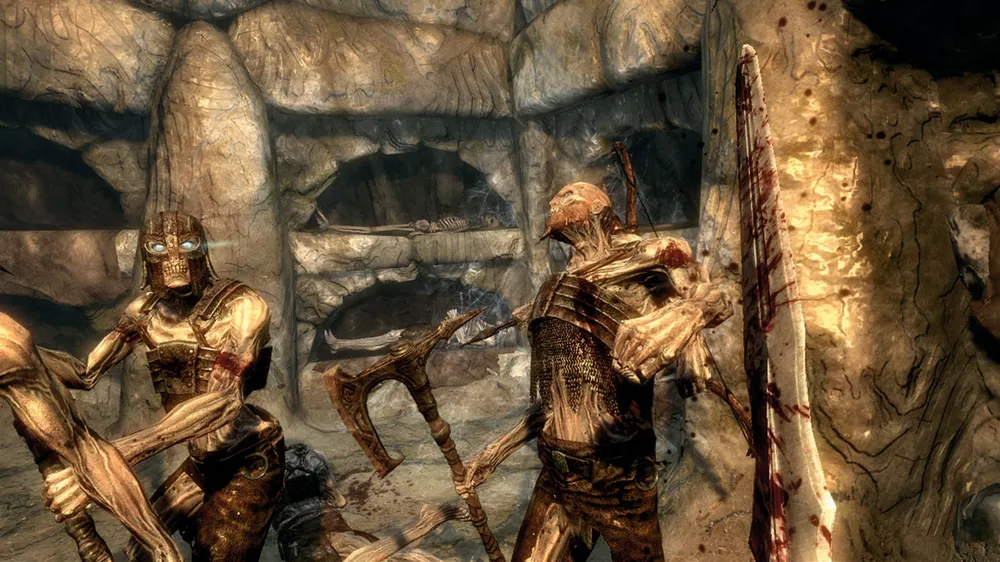
As it turned out, the spider was keeping Arvel the Swift, the last surviving robber, as a snack, binding him to the nearest passage. Suddenly, in a soft voice, the robber pleaded for the player to free him, promising to give the stolen claw, which he claimed could unlock a hidden treasure within this very barrow. Howard cut the web and freed the robber, who immediately scampered off, still proud of his possession of the claw. After a brief chase on the first straight section of the dungeon, Arvel received an arrow in the back. After retrieving the golden claw, Howard set out to test Arvel's claim and tackle another symbol-matching puzzle. However, now the solution was engraved on the claw, so the player needed to examine the item in their inventory.
Matching the symbols, Howard used the claw as a key, making his way up a steep staircase into a massive hall with pillars of light and waterfalls. At its center stands the Wall of Words, where players learn shouts. Shouts serve as a compliment to regular spells and do not rely on mana. Howard showed us the shout "Unrelenting Force" — a powerful gust of wind that stops or knocks down enemies. The wall of words just discovered allowed him to learn a shout that slows time. Soon we saw it in action: when he was attacked by a dragon priest along with an ice golem, Howard used this shout to manage to deal damage.
However, once he dealt with the priest, Howard had to face the master — outside, the dragon attempting to prevent us from entering the barrow was still circling. Howard cast a fireball in the trajectory of the beast's flight to draw its attention. The battle turned out long and mesmerizing — the dragon soared in the skies while Howard attempted to knock it down with a series of fireballs. When the dragon landed, preparing to unleash a torrent of flames, Todd slowed time and dodged to the side, hitting it with a mace. It tried to take off again, but Howard scorched it with lightning. The corpse crashed to the ground, breaking bones under its weight and disintegrating into sparks as Howard absorbed the dragon's soul, utilizing the power of the Dragonborn.
The demonstration lasted about an hour. In terms of time spent in "Oblivion", this is about one two-hundredth of the total playtime. Of course, only a small fraction of this time was taken by the main quest — the monotonous meat grinder of the gates of Oblivion clearly lost out to side quests and endless jumps. "Bethesda" is trying very hard not to repeat the same mistake.
— Overall, a good storyline that compels you to follow it and draws you in still needs to be written, — Howard stated. — Dragons are convenient because you can whisk them back and forth, so the story can catch up to you anywhere. We don't want to boil everything down to: "Well, you won't progress in the game until you do this and this." The learning of shouts is organically woven into the main quest, so you will immediately understand that completing it is necessary not just for the plot but also for strengthening your character. In "Oblivion" and "Fallout 3" there was no such reason. Here you see shouts, you realize they are cool and make you stronger, so you will go do the main quest.
But here’s another question to ponder: will the new game in the series have fewer bugs?
— I think we've addressed that, — Howard replied. — In "Fallout 3", compared to "Oblivion", there were many fewer bugs, we've learned how to test games. Sometimes you are surprised by some things that can't be caught during testing because players have access to so much. But we can now test a lot of things we couldn't before. So, I personally have no doubt that there will be fewer bugs.
In any case, it is clear that "Bethesda" games are appealing enough that many shortcomings seem insignificant, because the game has a lively and rich world sprinkled with a dramatic, intricate, and branching plot, with a promising combat system that is easy to customize to your liking, developing your own unique play style. In all these respects, "Skyrim" may astonish players more than any other game this year. If all prophecies are fulfilled, "Bethesda" will create a game that becomes legendary.
Translation by the author.
Thanks for the material — Eversleeping.
Thanks for the proofreading — Kavem.
Thanks for the support — Sinmara.