
The Psychology of Fanboyism
I translated this article quite some time ago for a resource where it was never meant to appear. But eventually, I thought it would be a shame for it to go to waste, and I decided to post it here. In defense of the governor and the readers, I can say that, although the controversy that gave rise to this article has long since played out (thankfully!), its essence is quite different. And the issue raised in it is unfortunately still relevant today.
Surely there is nothing wrong with not liking [Modern Warfare 3](/games?search=Modern Warfare 3). You can dislike anything, and there is nothing bad about that.
Still, there is a big difference between rational criticism and what is currently happening on Metacritic.
Metacritic, if you didn't know, is a site where you can find the average ratings of various entertainment products, including games. Over the years it has existed, the site has gained considerable influence in the computer gaming industry. Shares of game publishers can significantly drop or rise based on ratings on Metacritic. This year, for instance, investors were spooked by the rating for Homefront: its average score was 72 out of 100; THQ's shares fell by 21 percent on the very day of release, long before the first sales data arrived. Some publishers even claimed to use the ratings on Metacritic to determine whether developers deserve additional rewards, preemptively including a desired rating clause in their contracts.
However, Metacritic differs from sites like GameRankings in that users can also submit their ratings. User ratings do not affect the overall score (which is derived from critic reviews), but they are considered and form a separate ranking.
The user rating system, however, is not without its shortcomings. At the time of writing this article, the user rating for [Modern Warfare 3](/games?search=Modern Warfare 3) was (on a scale of 10) 3.2 points for the Xbox 360 version, 2.8 for the PS3, and 2.0 for the PC. Critics' average scores (on a 100-point scale) are 89, 88, and 81 respectively.

This is not exactly a common situation.
The point here is not that [Modern Warfare 3](/games?search=Modern Warfare 3) provokes negative reactions from some. Gamers are entitled to dislike any game, including [Modern Warfare 3](/games?search=Modern Warfare 3). The essence lies in the vast number of gamers who were so dissatisfied with the game that they gave it 0 out of 10 points.
Dr. Daniel King is a research fellow in the psychology department at the University of Adelaide in South Australia. King was happy to help us understand what is happening here. He read several user reviews of [Modern Warfare 3](/games?search=Modern Warfare 3) on Metacritic.
"So many zeros!" exclaimed King. And he is right.
"A quick glance at the content of these reviews showed that the main complaint from players was the lack of innovation and, in general, new content compared to previous games in the series," he continues. "People do not necessarily claim that the game is worthy of a 'zero' in itself, but express very strong dissatisfaction with the fact that the game has become an annual series that changes very little with each new installment. I am a gamer myself, and I understand the reason for these complaints. For your hard-earned dollars, you hope to get something worthwhile, especially in Australia – and from these reviews, it's clear that a significant number of players believe that all originality, novelty, and so forth have disappeared from the 'Call of Duty' franchise [Call of Duty](/games?search=Call of Duty)."
Many Metacritic users have turned the site's ten-point scale into a two-point one: "I love this game! 10!" and "Awful! Zero!" Users are not required to state why they rated the game as they did. Honesty, balance, and reliability take a backseat while those bothered by a single flaw in the game rate it 0 out of 10. Analyzing these predictable and thoughtless ratings makes little sense. Does a zero truly help other buyers make a decision? If [Modern Warfare 3](/games?search=Modern Warfare 3) is only worthy of this score, then what would you rate Superman 64? Lower? Why? This is not objective criticism – this is protest.
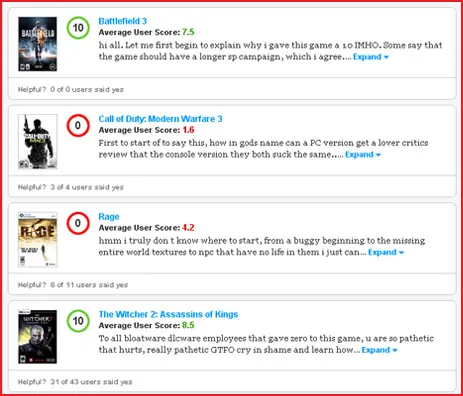
Seriously, dude? Is there nothing for you between those extremes?
"I think it's fair to say that many user reviews are merely empty angry outbursts," says King. "Many lack certain criteria and systematicity. Many consist of just a couple of words: 'I love this game' or 'I hate this game and Activision for their greed.' They do not go beyond ordinary emotions, whether it be elation or disappointment over buying a game so similar to its predecessors."
"Such emotion-based reviews usually fall into two categories – highest and lowest ratings because expressing our feelings in numbers is very difficult. For many people, this is not exactly a smooth process. We either experience anger or joy from a game, or we do not. I’m not saying there aren’t good reviews on Metacritic – there are, but they easily get drowned in a sea of bipolar ratings."
"Moreover, I suspect that not everyone wants games to be rated objectively. Emotion-driven individuals tend only to make emotional arguments. For such people, it is difficult to view a more objective analysis of a game, and again it either does not appeal to them at all, or it bores them."
Hint: The quality of a game does not depend on your feelings about the publisher.
King recently discovered something similar while conducting an experiment to determine how video games affect sleep. Part of the experiment consisted of participants first rating a game emotionally (i.e., characterizing it with words like 'boring,' 'fun,' etc.), and then giving it a score on a ten-point scale.
"This is not the main part of our research; we were primarily interested in aspects of sleep, but it was also interesting to observe how people break down emotional impressions and translate them into numbers. It gave us some insights into how people usually evaluate games," says King. "For example, some participants quickly finished the game saying: 'This sucks.' Then they would launch into disgruntled monologues about that part of the game where they got stuck or about the enemies that they claimed were too tough."
"Then we gave them a form where they had to rate the game on parameters such as overall fun, boredom, and the like, and they had to sit down and think things through. Ratings varied – for instance, the same game received a 7 on the fun scale and a 9 on the disappointment scale – and the earlier emotional rating of 'this sucks' ultimately did not align with the one given as a result of objective systematic reflection. The result of long, targeted contemplation ultimately becomes a more balanced rating than that given as a result of instant emotional judgments. Special criteria for evaluation could be introduced on Metacritic, but users are unlikely to support such an idea, and the fun would no longer be the same."
Metacritic tightened its rules to stop 'review bombing' in August 2010 by introducing mandatory registration (before that, you only needed a unique email to submit a rating), but the system can still be abused. And it is not just about typical trolling, although that remains a key factor.
Many Metacritic users don't think about rating games as they believe they should be rated: they just want to affect the average score. If such a user sees that the average score is higher than what they think the game deserves, they give it a zero to influence that very average score more strongly.
However, there could be another situation. It's either thumbs up or down, with no middle ground. Look at the ratings for LittleBigPlanet on Metacritic. 4556 ratings from users, and only 55 of them are average. Just 55 out of 4556 gave the game a five or six out of ten.

This black-and-white way of thinking completely undermines honest and fair evaluations, whether they are negative or positive. How can we expect an ordinary consumer to overcome irresponsibility and childlike tendencies towards hyperbole and objectively discuss the merits and shortcomings of any game?
A shamefully high percentage of trolls only exacerbates the problem. It is shameful to see how many gamers have been drawn into the marketing war between [Modern Warfare 3](/games?search=Modern Warfare 3) and [Battlefield 3](/games?search=Battlefield 3). Of course, we know about the animosity each camp feels towards the respective game, but the efforts with which it is expressed are still astonishing. It saddens, for example, the number of profiles that show their owners are also involved in the confrontation.
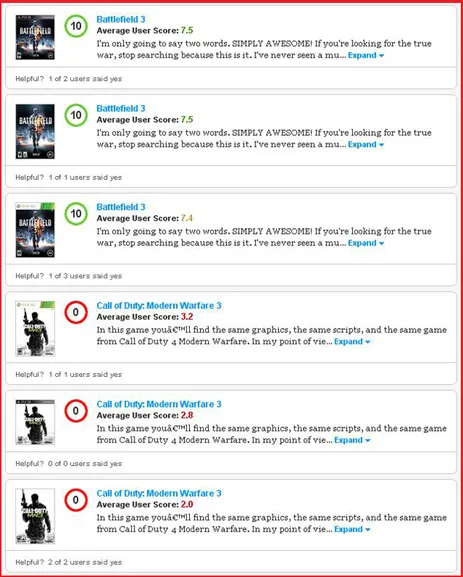
Not so unusual as one might hope.
This Metacritic user not only finds life in the same world as [Modern Warfare 3](/games?search=Modern Warfare 3) tough – they made sure to give the game a zero on all platforms. They also made sure the whole world knows where their bread is buttered. [Battlefield 3](/games?search=Battlefield 3)? 10. [Modern Warfare 3](/games?search=Modern Warfare 3)? Zero. This simply does not make sense. Of course, you may prefer one game over another, but operating with absolute ratings is not worthy of an adult person.
There is only one explanation for such one-sided thinking.
"In social psychology, there is a term called 'group bias,'" says King. "The essence is that people evaluate a given item based on their affiliation with a certain group. Group bias is a common phenomenon among hardcore gamers."
"Some people become very attached to certain games, especially if they have spent a lot of time on the game... and thus, they start to view this game as a factor upon which the group they identify with is based. Giving a lower rating to a rival game is to demonstrate the superiority of one's group and game and ensure that the opposing viewpoint does not endanger the interests of the player’s group."
Unfortunately, arguing with some people is very difficult. It’s challenging to convince a gamer who is convinced that [Battlefield 3](/games?search=Battlefield 3) is perfect and [Modern Warfare 3](/games?search=Modern Warfare 3) is unworthy of even a single point (and vice versa) that they are being subjective.
"Clinical psychologists often view the human mind as a combination of rational and emotional thought processes," explains King. "Rational thinking is based on objective facts, logical and reasoned arguments. An opinion based on rational thinking is easy to shift by presenting the person with new information. An opinion based on emotional thinking is much harder to change. It is based on feelings, instincts, intuition, or inner sensations."
"Many people evaluate video games from the perspective of emotional thinking. And this makes sense, as games are a form of art. Because some gamers are so emotionally tied to video games in general and to a particular series in particular, it becomes hard for rational thinking to prevail over feeling. When a person sees a new [Call of Duty](/games?search=Call of Duty) that does not meet expectations, their feelings begin to influence their behavior. And they vent their anger on Metacritic. Anyone who requests justification also gets it."
What the creative director and co-founder of Sledgehammer Games, Glen Schofield, tweeted about the user rating seeming suspiciously low, should not be surprising. It is hardly shocking that absurdly low ratings prompted a developer team representative to comment on it.
Notably, he asked fans for help. It was interesting to see a developer of one of the world’s leading entertainment brands paying attention to something as trivial as user ratings on Metacritic.
All this user hostility on Metacritic is not exactly a new phenomenon – games like [Dragon Age II](/games?search=Dragon Age II) and LittleBigPlanet have already faced it. Supergiant Games and Signal Studios found themselves in a similar situation a few months ago when the average user ratings for Bastion and Toy Soldiers: Cold War plummeted overnight. Developers also asked fans for help, which resulted in a slight increase in the average scores of both games, but ultimately Metacritic's administration intervened, discovering a wave of sudden zeros, and the extra ratings were deleted.
We reached out to Sledgehammer and Activision for comments, but were told that their busy work schedule would not allow them to comment.
For small studios, such sabotage can be particularly harmful, but for [Modern Warfare 3](/games?search=Modern Warfare 3) and its creators, it is not a problem at all. Activision claims that 6.5 million copies of [Modern Warfare 3](/games?search=Modern Warfare 3) were sold within the first 24 hours – making it the most successful launch of any product in video game history. And this is only considering the US and the UK – Europe, Australia, and other parts of the world weren't even taken into account.
User reviews can indeed serve as a great addition to professional journalists' reviews. They can provide extra information that professionals may sometimes overlook while catering to a wider audience. Unfortunately, until gamers grow up, wild fanboyism and deception will cast a shadow over useful and objective criticism.
"Most people on the internet are automatically considered equal in their privileges," says King. "Anyone who critiques just to criticize has the same freedom of voice as someone who argues their opinion, or a spambot, or a person whimsically inserting a picture of Picard’s facepalm."
It’s a gigantic wall of noise and shouting, and sometimes it’s really hard to make sense of anything.
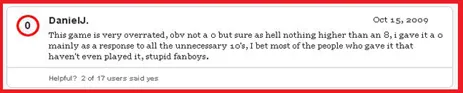
So what? Zero? Eight? If the game deserves an eight, then rate it!
Big Rigs: Over the Road Racing is a 2003 truck racing game considered the worst game of all time. It has the lowest average rating of any game on Metacritic (as well as on GameRankings). Yet some ironic tens among user ratings raised its average score to 4.1, which at the time of writing was almost twice as high as the rating for [Modern Warfare 3](/games?search=Modern Warfare 3) across all platforms. Big Rigs was a stillborn game: it featured no sound at all, you could drive through any object, and the AI of competitors was nonexistent (they simply did not start).
I repeat, you are not obligated to love [Modern Warfare 3](/games?search=Modern Warfare 3). But consider how this looks to an unsuspecting observer.
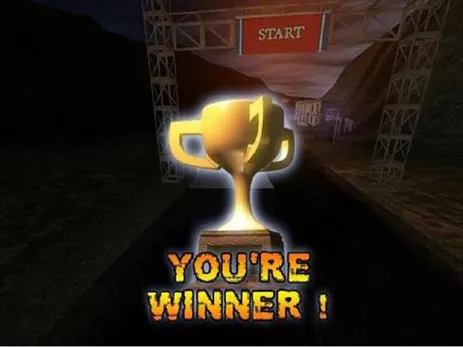
"It’s better than [Modern Warfare 3](/games?search=Modern Warfare 3)!" some say.
"On a site where people can freely and uncontrollably give a game any rating for any reason, there will always be issues with quality control," says King. "You do not need special rights to publish your opinion, nor do you have to go through screenings before publication, and so forth. I’m not saying similar measures should be introduced on Metacritic, but reviews should always be approached with a healthy dose of skepticism if they appear on open resources like Metacritic."