
Review of From Dust
Populous, Dungeon Keeper, Black & White – these games were not just strategies; they allowed players to feel like true gods. Different from one another, they were united in one thing: no other genre allowed one to reach such heights, to gain such power and control over the game world. However, all these great series share another, much less pleasant quality – they are no longer around. All attempts to create something similar under a different guise have so far completely failed. Therefore, as a long-time fan of god simulators, I couldn't overlook [From Dust](/games?search=From Dust), whose developers claim to have been inspired by the ideas from Populous and promised to give players power over the forces of nature.
This Crazy, Crazy World
The game begins with natives in loincloths and creepy masks sitting in a circle, playing musical instruments to form a glowing orb of energy from a black sphere hanging in the air – this is called the "Breath." Meet us. With this glowing orb, we will interact with the surrounding world and help the tribe that created us. As these lovely guys, who never take off their masks, believe, everything in the world has Breath, and if you master the Breath of an object, you will have power over it. They use musical instruments to try to change the surrounding world – and they do it quite well. But let's go in order.
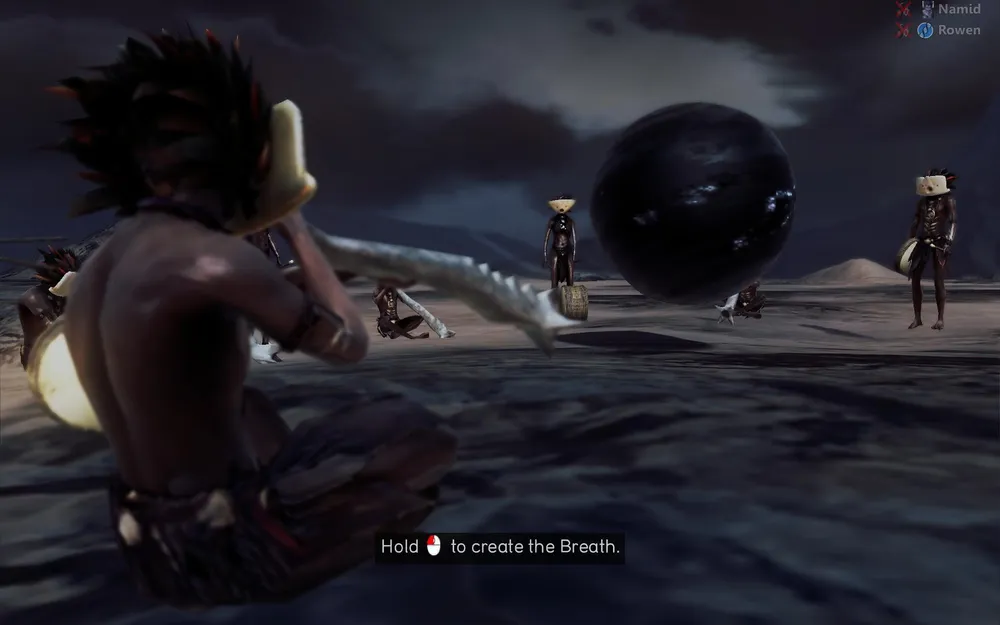
From this rather gloomy sphere, our alter ego will be born now.
After creating the Breath of their tribe, the unfortunate natives hand their fate over to us and remove themselves. We need to guide them through almost lifeless islands through mysterious gates to the promised land – or its analogue. The only ones hindering us in this noble endeavor are not hostile tribes or unimaginable monsters, but the surrounding world itself. The developers of [From Dust](/games?search=From Dust) have done a colossal job and were able to create an engine that accurately simulates natural processes. Rivers gradually erode the shores, hills melt away, spreading to the sides, waves rush over the ground, lava ignites trees in its path and cools to stone upon contact with water. Without our help, these unfortunate natives cannot overcome fire, water, and lava on their way to their goal.
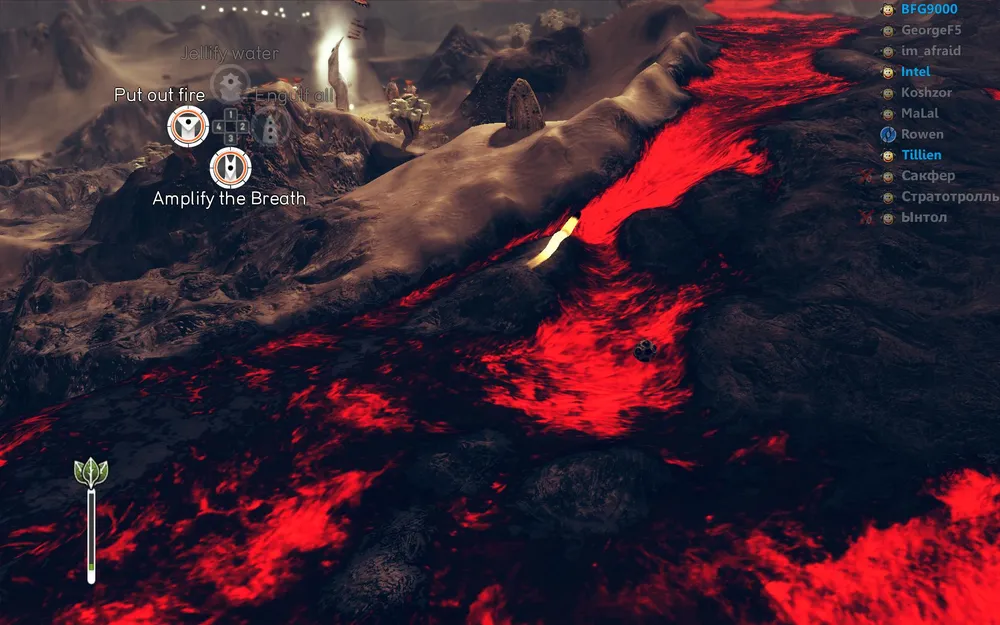
The landscape of apocalypse.
Speaking of goals. The game maps, usually representing islands of land divided by water or lava, are scattered with points of interest – totems, relics, and gates. The gates are straightforward – our wards must go through them after all tasks in this level are completed. The rest is more interesting.
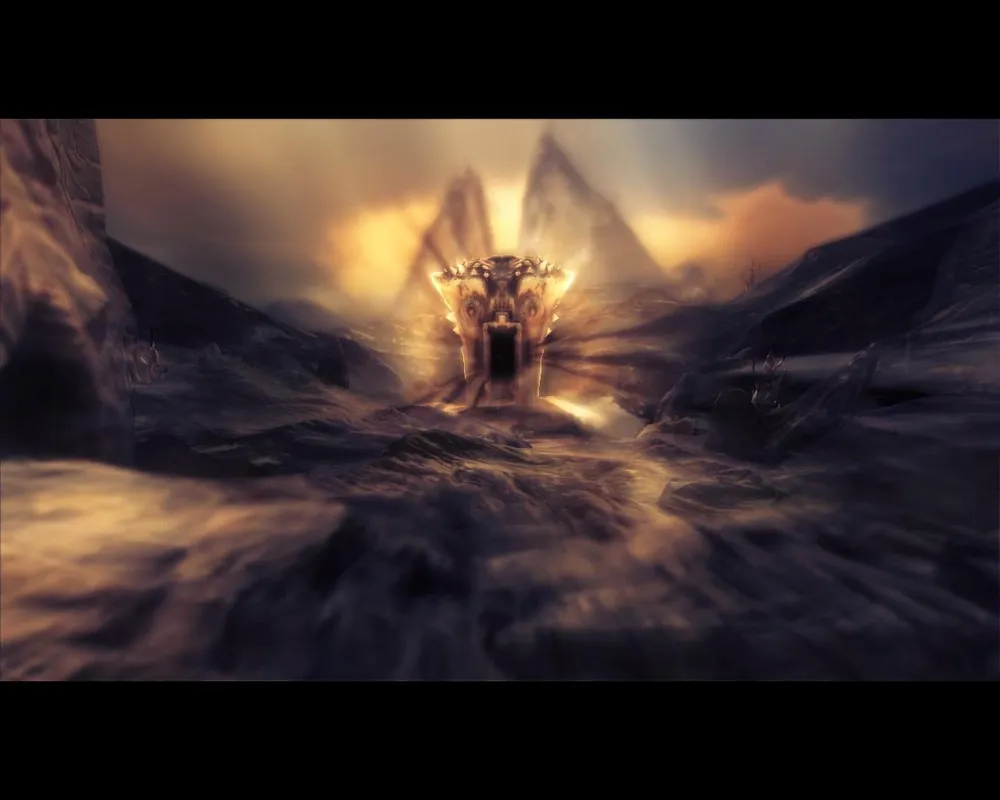
The journey begins!
Relics picked up by the natives provide either information about the world – absolutely useless in gameplay mechanics, but simply interesting to understand what is happening – or some useful skill. In the second case, it's not enough just to find the relic; it must also be brought to the nearest village.
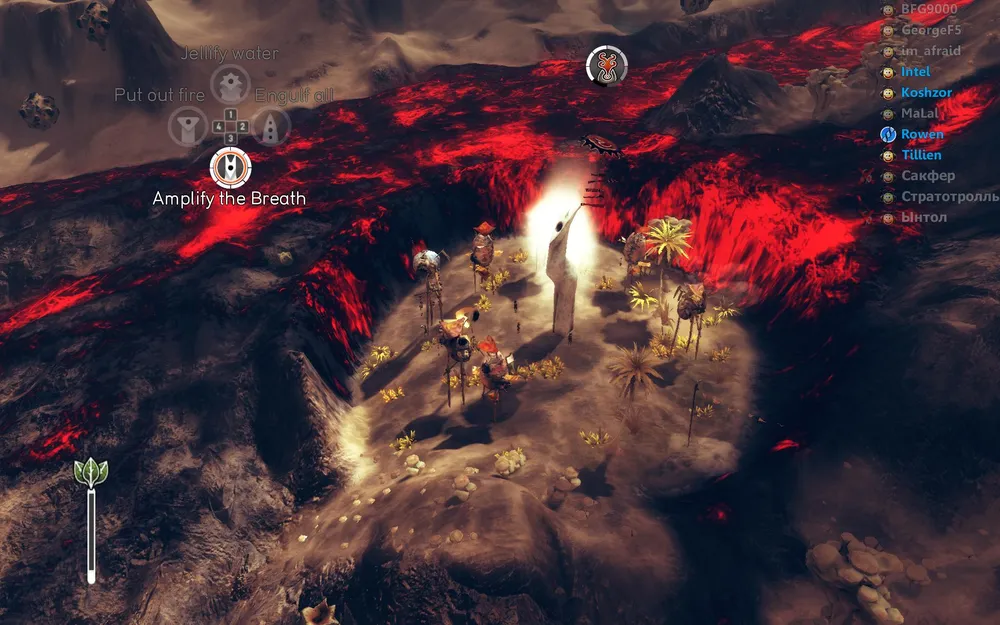
A village surrounded by lava – no moat needed.
The totems represent the centers of local civilization. Once the natives reach an unclaimed totem, they will erect a village around it (in a rather original way – simply by playing on pipes and drums, after which buildings literally grow from the ground). Villages are important because they allow us not to pay too much attention to whether any natives have perished – cozy homes can always bear new ones. Furthermore, settled natives plant trees and shrubs around villages, which prevents soil erosion and attracts animals. Each totem enhances the Breath, giving us new powers (depending on the level), but more on that later. Finally, the villagers are no longer entirely defenseless against the forces of nature – after discovering a certain relic on the level, village shamans will be able to protect their tribesmen from tsunamis and lava.
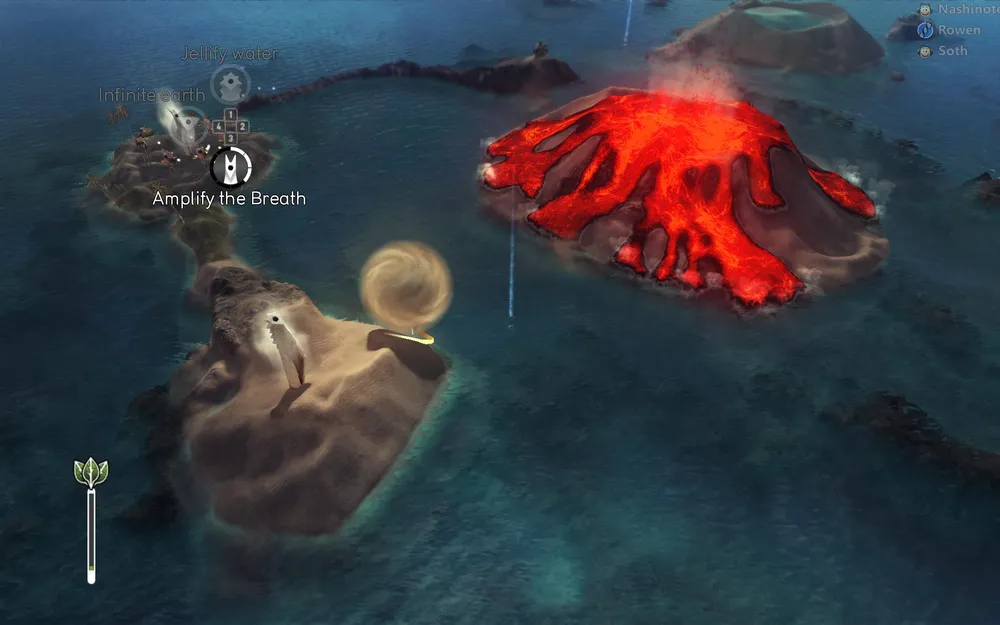
God-shovel in the process of transporting a ball of earth.
But the main role in gameplay is still played by the Breath under our control. Initially, we can only lift soil, water, or lava into the air, collecting it into a nicely looking orb. Accordingly, we can also pour it where we need it, raising hills or creating ponds. This skill is necessary to, for example, create a bridge or let the natives run across the bottom of a river from which we are pumping water at that moment. As we progress through the campaign, we will gain new abilities – like extinguishing all fires on the map at once or evaporating all water, temporarily turning the Breath into a black hole that sucks in unlimited soil/water/lava and sends them who knows where, and so on. All of this is needed not just for fun but to solve gameplay puzzles.
Prehistoric Lemmings
Unfortunately, these puzzles do not indulge in variety. In fact, all campaign missions boil down to one goal – to guide the natives from point A to point B without them dying. As if we're playing some sort of lemmings, but the lemmings we got are incredibly dumb – sometimes they don't even see the kindly created road, stubbornly wanting to walk straight through a waterfall or a river of lava. The constantly changing landscape of the levels posed an almost unsolvable task for programmers – organizing a normal pathfinding algorithm in such conditions is practically impossible. They did all they could, but sometimes very unpleasant situations arise when one wants to bury their stupid subjects in lava and then water, just to make sure they can't get out from under a rock monolith.
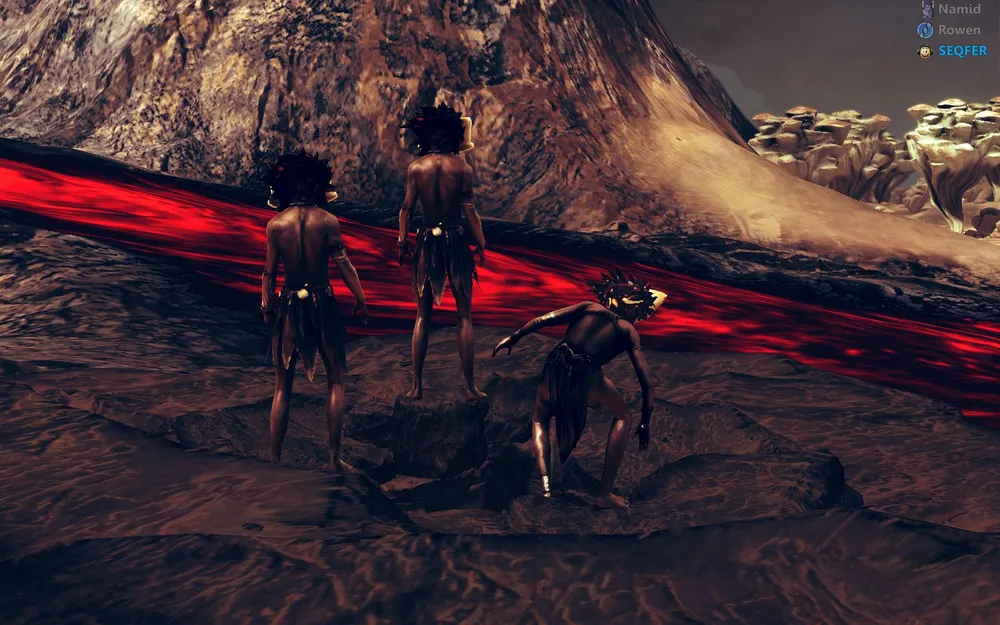
"And I said that at the turn you should have gone the other way! And you said, 'Mordor sounds cool!'
But the stupidity of the natives is not the most unpleasant aspect. Worse is the monotony. Throughout two dozen missions, we will engage in the same thing, just in different settings. That is, digging and pouring, pouring and digging. Digging soil, digging lava, hauling water… It turns out to be some sort of god-shovel simulator. "What can you do? I can dig. What else? I can not dig" – this phrase best characterizes the gameplay of [From Dust](/games?search=From Dust). And this is the most disappointing aspect because the developers have truly created a masterpiece engine and managed to breathe life into the presented world. Unfortunately, there is simply no room for an interesting gameplay in it. One can admire the majestic nature – beautiful waterfalls, formidable volcanoes, majestic and deadly tsunamis, verdant palm forests, devastated by fire, and sandy dunes, slowly eroded by the sea – for a long time. But unfortunately, there is practically nothing else to do in [From Dust](/games?search=From Dust).
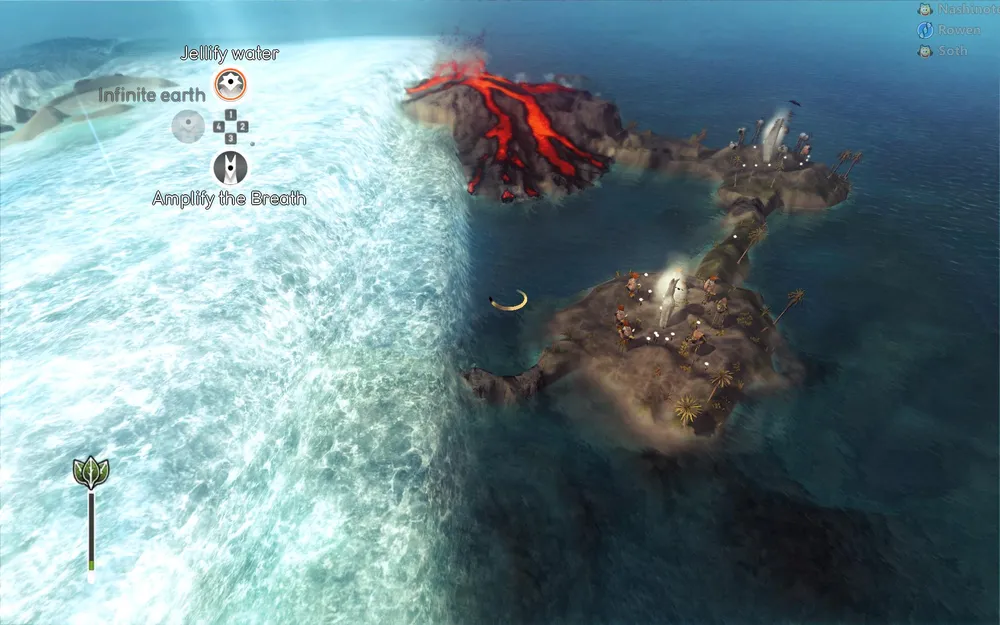
The beauty of the game is sometimes simply indescribable.
Apparently, the developers realized this, trying to diversify the monotonous campaign with two interesting ideas – a set of small challenge scenarios that require solving some task in a short time, and a "sandbox" mode that opens up after completing all story missions, where one can freely engage with the game world without worrying about various tasks. However, it can't be said that this significantly fixes the situation – challenges are undoubtedly fun (for example, one requires saving three villages from a forest fire without being able to use anything but lava), but they can keep a player occupied for no more than a couple of days at most. To reach the sandbox where one can truly feel like a god, rather than a supernatural spade, one must complete two dozen campaign missions – not everyone can manage that since the gameplay becomes tedious already by the fifth mission.
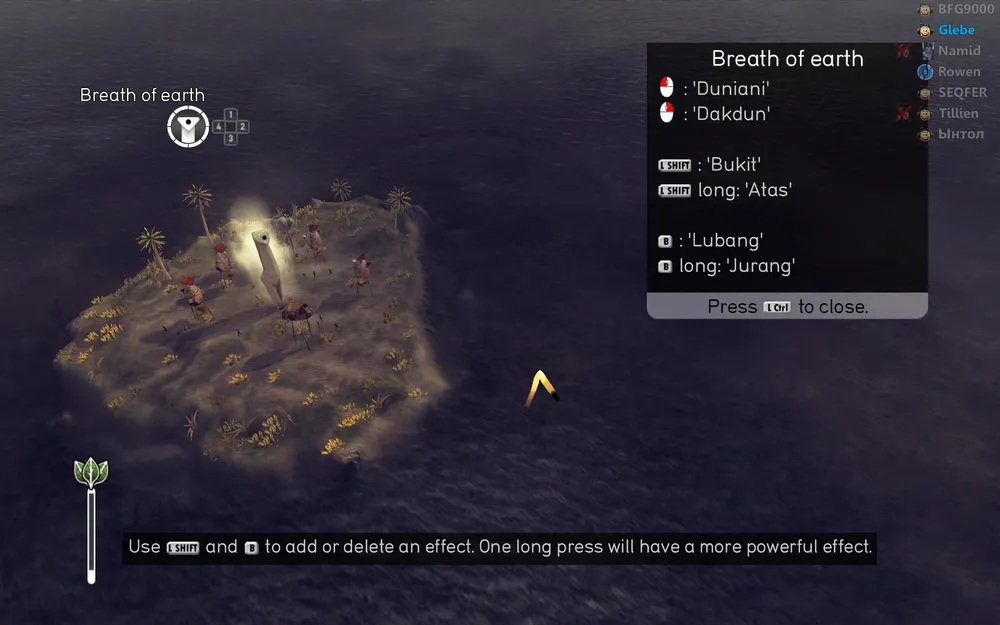
In sandbox mode, this island can easily become an entire continent.
As a result, it is very difficult for me to assess what has become of [From Dust](/games?search=From Dust). On the one hand, it's an incredibly detailed, stunningly beautiful, and truly vibrant world with its own style and atmosphere. On the other hand – a tedious and monotonous gameplay that hardly changes throughout the entire game. In my opinion, playing [From Dust](/games?search=From Dust) is definitely worth it – if only for the aesthetic pleasure derived from the local nature, but completing the campaign only makes sense for fans of simple puzzles or those who want to reach a fully-fledged "sandbox" at the end.