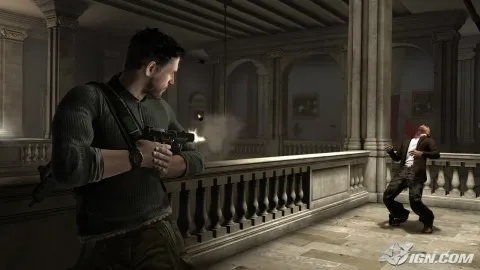
Splinter Cell Conviction - preview from IGN
This is my first large translation, so please be lenient.
Two years ago, Ubisoft announced Splinter Cell: Conviction. Then, like a spy, the game vanished. Well, Fisher is back, and this time he's brought his boom stick.
Forget what you knew about Conviction—only the technology remains from previous efforts. All other aspects of the game have been rethought and remade. In fact, you can forget what we once knew about Splinter Cell. Conviction promises to be a true evolution of the series. While the game is based on the core principles of Splinter Cell, Ubisoft has changed the gameplay beyond recognition.
Sam Fisher’s daughter was killed at the beginning of Double Agent, and now he has completely freed himself from the control of the government agency Third Echelon to find those responsible.
Now Sam is independent; there is no voice in his ear directing him or forcing him to play by the rules. As a result, Sam acts more intensely and brutally than you are used to. It’s not about the blood (though there is plenty of it)—the brutality in Conviction is a byproduct of the new gameplay mechanics.
In most spy games, stealth is generally imposed on you. You hide because you are forced to, because your character is damn vulnerable outside the shadows. In Splinter Cell, this often resulted in gameplay built on trial and error, becoming slow and tedious at times.
Conviction has thrown out the old stealth system. Sam Fisher is a hunter, clearly stronger than his prey. He sneaks in the shadows, waiting for the right moment, and strikes with monstrous agility and ferocity.
Jack Bauer from the TV show "24" showcased most of the gameplay changes in Conviction. In "24," Bauer often uses stealth to infiltrate a building. When he sees enemies, he tags them, holds his breath, jumps out of cover, and takes down opponents in seconds.
And if a terrorist has the necessary information, Bauer is not afraid to use force to extract it. This is the new, utterly fearless Sam Fisher.
Splinter Cell Conviction is based on a new system called Mark and Execute. At any time, Fisher can mark targets. These can be enemies, light sources, traps, or explosives.
The number of targets that can be marked simultaneously depends on the weapon in Sam’s hands. After marking, a red or white marker appears over the target, depending on whether Sam can hit it. If the marker is red, you just have to press the execute button, and Sam will jump out of cover and eliminate the enemies. Guaranteed.
If the target is behind an obstacle, and the marker fades, pressing the button will make Sam draw his weapon but not fire. This way, the player still controls the process while not being forced to pull the trigger manually for every enemy.
Sam's AI is programmed to determine the priority of the marks for maximum damage. For example, if you mark a chandelier hanging over terrorists and then another terrorist standing nearby, Sam will first shoot the chandelier, as this will result in more deaths and distract the enemies.
Then, if the other target is still alive, Sam will take him down as well.
The AI promises to be smart enough to make decisions worthy of Sam Fisher. For instance, you mark two lights and a terrorist. The first shot will go for the light, as this gives Sam an advantage not just over the marked enemy, but over all others in the area. Typically after this, he will shoot the second light, but if the enemy suddenly turns and starts shooting, Sam will immediately switch priorities and attack the opponent.
One of Ubisoft's main reasons for introducing Mark and Execute comes from previous Splinter Cell games. In the past, Sam would hide in the shadows, peek out, slowly aim at the first enemy, and shoot. Then he would have to switch aim to the next enemy and shoot again. This required some skill, but it also created a slow hero and gameplay that was more methodical than intuitive.
The demo shown at E3 demonstrated that there are rare situations where Sam relies solely on Mark and Execute. There are too many enemies around to try to take them out in one go.
You have to use some strategy to identify the most dangerous enemies to take out first. My concern was that with Mark and Execute, no skills from previous games in the series would be needed. When I saw the system in action, I can say that Mark and Execute requires a somewhat different type of skills than earlier Splinter Cell games.
One of the other new elements adds more strategy to Mark and Execute. Each weapon has its own properties. With a pistol, you can mark two targets, while with a machine gun (?!-translator's note) a few more. With a shotgun, the red marker will show even through walls and doors. With a pistol, you would have to break down the door before executing the second part of Mark and Execute.
Mark and Execute is undoubtedly the most significant change, but hardly the only one. Stealth aspects have also been revamped. In most stealth games, the character moves slowly in the shadows, praying to remain unseen. In previous Splinter Cell games, there were visibility and noise sensors to create a complex matrix for stealth. But this is the new Sam Fisher. He moves as fast and silently as a panther. The sensors have also gone the way of the past.
If Sam is hidden in the shadows, the screen desaturates. Only enemies and interactive objects remain colored. Additionally, to enhance the effect, the edges of the screen darken. When Sam becomes visible, the picture regains its color. This is an important change, as Conviction promises to be a more intense game than its predecessors. You will no longer waste time determining your visibility by instruments. Now you will never confuse when the character is in shadow and when he is not.
Ubisoft wants to show that Sam Fisher has nothing to lose, and he has too little time to waste. This means a higher pace of play, but it also means that he doesn’t care about the trail of corpses left behind. For Sam, this is the end of the road. He just needs to complete his last mission. Tomorrow won’t come, so there’s no point in hiding from prying eyes or hiding bodies.
And rightly so—no more dragging bodies away from the light.
However, being in the shadows doesn’t mean you can act with impunity. If you sit in the shadows illuminated by gunfire, enemies may detect where you are hiding. But perhaps that’s just what you want? There’s another new gameplay element to help confuse enemies. The Last Known Position, as the name suggests, refers to the spot where you were last seen by an enemy and is represented as a white silhouette of Sam.
Now you will know exactly where the enemy is focused and can use this to your advantage, setting traps or flanking the foes. In the early levels, where you have to deal with low-level "thugs," this feature should help significantly. Early enemies promise to be quite predictable, which promises a lot of fun. However, as you progress, the skill level of opponents will rise, throwing you new challenges (eventually, you will have to face the Third Echelon's special units). If you appear in the line of sight of such a fighter, your white silhouette will flash, as if saying "well done." And then a grenade rolls under the silhouette. More savvy enemies will check windows and shine flashlights into vents.
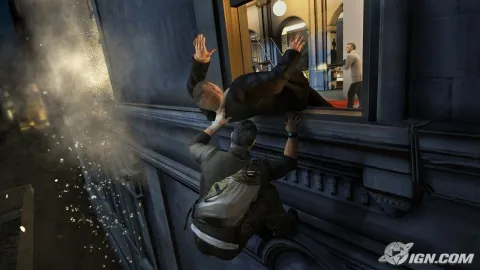
Ubisoft doesn't want dead ends to occur. There’s always a way out. You can jump out of a window (or throw an enemy through it and follow), climb a rock or wall. Sam may not have as much pepper as in his younger years, but he is as athletic as ever. He swiftly (and quietly) skims into the shadows, vaults across bars faster than the Prince of Persia, and closes in on enemies like a predator. This is part of Ubisoft's new approach to stealth—Sam continuously dives into the shadows and jumps out, and he doesn’t need to linger too long in a dark corner.
To create a more brutal Fisher, Ubisoft had to come up with something regarding his close combat abilities. In addition to elbow strikes and knife fighting, Sam has learned something new. He now masters Krav Maga, the official self-defense system of the Israeli army. It is a blend of martial arts and philosophy where the end justifies the means. It’s fast, effective, and shockingly brutal. Hand-to-hand combat is as quick as the Mark and Execute system is for shooting. And it’s controlled with a single button.
Sam breaks arms, smashes faces, and leaves defeated opponents on the ground—all in one breath. It looks stunning. Many animations have not yet been added to the game, so in the demo shown at E3, we only saw part of them. You cannot directly control Sam’s actions while dispatching with an enemy, but you can modify his attack by selecting the direction of the blow. The chosen direction allows you to indicate where to throw the opponent or against which piece of environment to strike him. In the demo, there was a moment when Fisher grabbed an enemy by the wrist, twisted his arm, and slammed his face into the wall. He collapsed to the ground, leaving a bloody spot where his nose smashed against the brick.
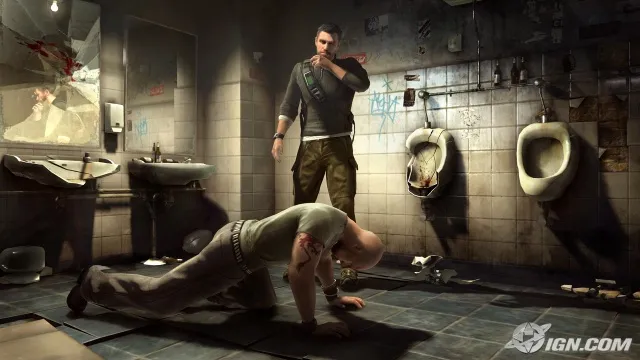
The increased physicality opens up new opportunities for interrogations. Some enemies can be thrown around in an attempt to extract the information you need. The demo dramatically begins with such a moment—Sam throws a thug into a urinal. And the moment the thug is disarmed, everything is in your hands. You can throw him into a stall, smash his head against a mirror, punch him against the sink—whatever you like. And he will talk. You can’t accidentally kill an enemy during an interrogation—he won’t die until he spills the beans. Just keep hitting him until he talks. Sounds fun.
These are the gameplay changes I have seen up to this point. But there is another aspect of Splinter Cell Conviction that I haven’t mentioned. The developers have created a unique image projection system. Overall, it looks like the image is projected from a projector behind a broken "fourth wall." The image appears as if it is on a canvas screen, and sometimes it ripples with the movements of the "fabric."
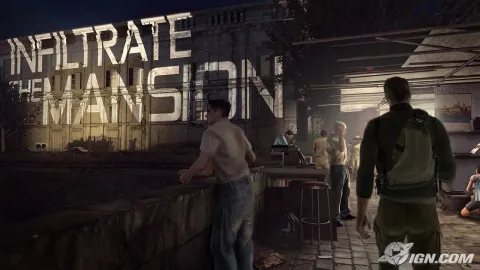
What’s interesting about this? Well, as you remember, Sam is a lone wolf; no one directs him (you) with hints in his ear. So this projection technology is used to display mission objectives. In the E3 demo shown, Sam needs to infiltrate a mansion to find Kobin, the man who killed his daughter. As he walks down the street, Fisher can see a prompt saying "infiltrate the mansion" projected right onto the wall of the house he needs. Inside the mansion, on a glass partition, he can see the prompt "Find Sarah's killer." The locations you visit will be marked by projections of their names on some piece of the environment. To top it off, flashbacks and key scenes will look as if they are being played like movies on a wall. It’s really impressive, you need to see it for yourself to understand. Fortunately, we have videos demonstrating this new technology.
I was not surprised when Ubisoft delayed Splinter Cell Conviction two years ago—what I saw back then didn’t seem particularly gripping to me. The technology was excellent, but the gameplay was nothing outstanding. I am glad that Ubisoft made this tough decision because the new Conviction is a very promising project. The visual design is superb, and the hand-to-hand combat is astonishing. Although I saw many games at E3, now Splinter Cell Conviction is the most anticipated game of the year for me.