Todd Howard on Skyrim
Yes-yes, another story from Todd Howard about Skyrim. Lately, Bethesda has been eager to share information - just keep translating and posting. The material is taken from the site nowgamer.com, thanks to Condottiere for the tip.
About the Dragonborn title.
The Dragonborn is born with the soul of a dragon. I don't want to explain too much - you know, midi-chlorians (laughs) - but it’s worth mentioning that there have been Dragonborns in previous TES games. You won’t be the first.
About the Shout system.
As for the Shout system - if you shout at all, you can't do it for long. It doesn’t matter what shout you use - each has a cooldown period. And if you think, "Well, why not use a stronger shout then," I’ll tell you - because you can’t. You can use weaker shouts, but they won’t be as effective as you’d expect.
Originally, we planned to allow players to combine shouts using dragon words themselves, but the system turned out to be too complicated, so the game takes care of this aspect. There will be about two dozen shouts in the game, each consisting of three words, allowing for the collection of more than 60 words.
About skill development.
Each skill affects character growth in levels. They have become sort of XP for us. The higher your skill level, the faster you progress using it, so you’ll be using highly developed skills more often.
I found that most people (regardless of what game they play), when they find a better weapon, say to themselves: "I guess I'll use this one - it deals the most damage." Perks are very important, and they also have levels; we are still thinking about how many levels there should be. Some perks might even have two levels instead of one.
About changing play styles.
After some time, however, these people may find other things and want to change their development direction. For example, you're playing a level 10 character focused entirely on magic, and suddenly you find an epic sword. When you start using it, your sword skill will increase. It will slightly affect your level growth, but as you progress, it will impact it more and more.
When I play, I feel that it’s best to focus on one play style, but it is so easy to combine them that you’re unlikely to resist experimenting. For example, with dual-wielding. We added it relatively late; we initially didn't plan for it, but the system fit organically into the game, and we can’t help but experiment with styles.
About the very beginning of the game.
We deliberately don't give the character any past. In Elder Scrolls IV you started in prison, and even if you wanted to think of yourself as the good guy, that was definitely a mistake. So at the beginning of our new game, you cross the border of Skyrim and end up in captivity of imperial guards. We won’t say why. However, the initial phase won’t take long.
About the Radiant Story system.
We used this system in Fallout 3. We wrote it using our scripting language for random enemy encounters. These encounters were generated as you explored the Wastes based on your actions. It was a big, rough script: if something happens, then it happens, and so on. We thought and decided to organize everything. To build a system where we see what the player is doing, and when they take a quest, we give them conditions. We thought we had come up with the coolest thing in the Universe, and we wrote all our quests this way... but it didn't work. Ironically, Radiant Story tells terrible stories because the player guesses everything in advance. So now all quests in our game are written by hand. We want to tell you a couple of truly good stories, but some of their elements may very well be random.
Radiant Story in action. Example.
For example, you enter a town, and in Oblivion and Fallout 3, a typical quest would be: you meet a guy whose child needs to be rescued from a dungeon. Everything is very static. We know the guy. We know his child. We know the dungeon. In Skyrim, designers first write dialogue for the quest and then set its parameters. So who needs to be saved? We can say it's a specific character or just a child of some townsfolk.
Thus, the engine will check the town, find the child, send them to a nearby dungeon you haven’t yet visited. One of the things in our games we've always struggled with was control: we couldn’t control our games. Many players experience them excellently, but others do not perceive them the way we wanted; but now we can manage this a little better. And we know how to take advantage of this.
About mixed quests.
There are quests in the game that we call "mixed": for example, you come to a town and want to make friends. Then the system will generate a simple quest for you and run it through the Radiant Story system. In the case of more complicated quests, we can't say for sure who it will choose. Let's say we need an enemy for a quest - this role could be played by the nearest character to the player who hates them.
Take, for example, the quest we’ve shown earlier. If Lucan dies for some reason, the system will make his sister the quest giver and shop owner. In terms of dialogue, it’s pretty tough to make all this work, but relationships and common locations help us make it all fit.

About level caps.
There is no level cap. That is, mathematically, there is some kind of limitation on level growth, but we don’t set it intentionally. We’re trying to balance the game in this regard - to speed up leveling. In Oblivion and Fallout 3, we estimated that a player would level up to about 25 during the play, whereas here we’re aiming for the 50th.
We simply accelerated everything. Leveling won’t take up much time. There are so many perks in the game - and powers you’ll gain through them - that we wanted to make the process faster. However, the more you play, the more it slows down. I think the mathematical limit to leveling is about 70 levels.
About character creation.
When creating a character, the only thing you will be allowed to choose is appearance. Well, and of course, the race, each of which has certain advantages. After that, you will start playing. We want to minimize the number of decisions you make just before the start of the game.
About the size of the world.
The size of the world in Skyrim is about the same as in the previous game, but the difference is that there are many mountains that force us to take different paths. They take up a lot of space, and it will take some time to go around them, so the player will feel that the world is larger.
As for the environment - it’s diverse. Our pine forests and mountains coexist with grassy tundra, autumn woods, volcanic tundra, and a large glacier. There are six or seven unique zones in the game, and they are very different. In Oblivion and Fallout 3, the differences between the zones were, too, but less noticeable.

About how Radiant Story guides world exploration.
With our system, we don’t try to manually direct you anywhere. Just watch out not to take quests you’ve already completed. The game goes just as it did before, and we still slightly push you to complete necessary goals, but for this, we use the compass.
About the world economy.
We are still figuring out the economic system. On paper, everything looks great, but in the game, it turns out differently. We have mines that influence (help upgrade? - translator's note) weapons, farms that produce food, and affect alchemy. Everything works, but we still haven't quite balanced it all. And we’re still working on it.
About world leveling.
The world leveling system surrounding the player is similar to what was in Fallout 3. In Oblivion, we accelerated it too much, and in the end, it turned out pretty badly - the world leveled up faster than the player. We have a couple of ways to show players in advance that they're entering a dangerous zone, such as in the mountains. But we want to do something more.
Most players, in a situation where they enter an area that is still too dangerous for them, bash their heads against the walls but push on - they’re not wimps to turn back! So we will give these players a couple of ways to traverse such areas, if they want to.
About transportation and rideable animals.
We have boats, but you won't be able to swim them yourself. As for horses and other animals - that is something we want to implement, but that’s where the issues arise. But we definitely do not want to get rid of them. We just want them to be an element of gameplay, not mere decorations. Horses have come a long way with our game series, and we want them to be well-implemented in the new game. As long as we manage that, if something goes wrong - we’ll remove them altogether.
About the new skill tree.
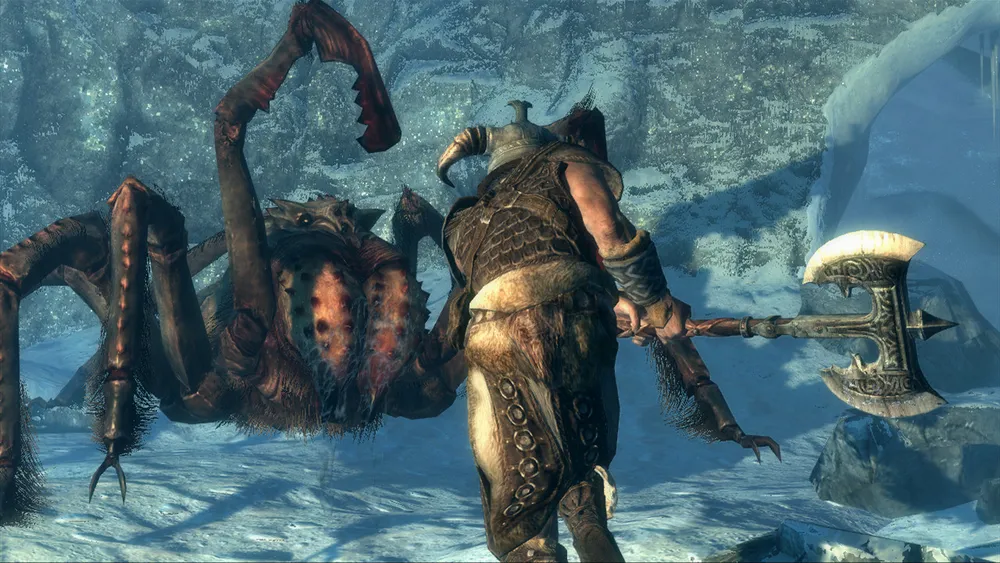
With the skill tree, I wanted to move away from sheets that resemble Excel spreadsheets. I wanted to make everything simpler: the player looks to the right - and sees their weapons, looks to the left - sees their spells, looks up - sees character stats. That’s how it all began. In previous games in the series, there were constellations under which your character was born, and we liked them, so they will return in the new part. One of our artists, Mark Tear, found a way to visually implement this.
About creating the game world.
The paradigm we build our worlds on hasn’t changed since the days of Terminator: Future Shock. We gather everything in pieces, but now we do it better. Everything fits into the game much more organically, and we completely redesigned the caves. Some are completely overgrown, others filled with moss and fog, and we also have very cool icy caves. In them, you feel like you’ve crawled inside a glacier. Imperial forts, of course, haven’t gone anywhere either.
In Oblivion, creating dungeons, aside from artists, was done by only 2 or 3 people. As a result, the dungeons played fine, but they turned out completely faceless. So we increased our dungeon designer staff to 8-9 people, and now, according to the latest counts, our game has 140 dungeons and over 100 other points of interest, as we call them. That’s actually quite a lot!
About how many dragons there will be.
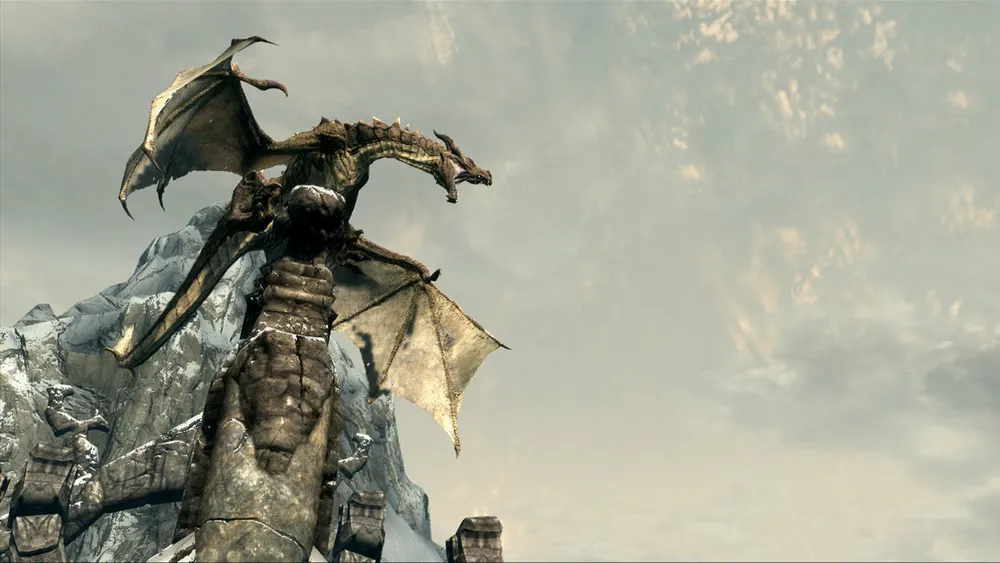
There isn't a specific number of dragons in the game. From the very beginning of development, we’ve been very conservative about dragons, and now, after two years of creation, they can do anything. Like other creatures, they can appear randomly. Recently, one of our designers placed three of them near each other, and when all three saw me, it was quite a spectacle! I was only thinking one thing: who the heck did this?!
I ran to the mountains and tried to hide from them, feeling like Frodo in the swamp in that scene from "The Two Towers." It was really scary. But I managed to escape. Three is indeed a lot for one encounter. But as I mentioned, there’s no set number of dragons in the game - they periodically appear in the world, and this process is regulated by the Radiant Story system.
The system looks at how much time has passed since your last dragon encounter, what your level is, and estimates whether it’s time to introduce you to another one. Of course, we have special (story-related, obviously - translator's note) dragons as well. It is also worth noting that dragons can talk and do so while breathing fire. Some even speak English. But I won't say more about that.
About interacting with the game world.
We have a couple of people on our team responsible for "world interaction," or random events. For example, you drop a sword, the game sees that as an event (thanks to Radiant Story), and if someone nearby likes you, that person might pick up the sword and return it to you.
Once I dropped a sword just to see how the system works, and a passerby picked it up and gave it back to me with the words: "Here you go!". Our guys also made it so that when wolves hunt, they hunt in packs. If they kill, for example, a mammoth - we’ll talk more about this at E3 - they will stay around its body for a while.
About how many cities there will be.
We have five large cities, and each of them is truly unique. Some of them were shown in the trailer. Additionally, Skyrim is divided into 9 holds. A hold is similar to a county, each having its own ruler.
About interacting with NPCs.
We found that most players, when talking to characters, don’t want to miss anything, and sometimes, as a result, click through all dialogue options until they hear everything the NPC has to say. In this case, players learn the backstory, but most of them just feel that they’ll miss something if they don’t click on all the lines.
So now we’ve made dialogues more natural. As you walk through the game world, dialogues become sort of a sound environment, and you are unlikely to miss anything. I usually go through the entire dialogue because I don’t want to miss anything, but sometimes I just click through them faster and faster.
About testing the game and fixing bugs from Oblivion.
We can never guarantee that a player won’t get into a problematic situation. I think our experience working on all platforms allows us to fix bugs much better, but still, it's a game people play for 500 hours, and it becomes a real testing nightmare for us. But even if we play the game for 500 hours, we can’t say for sure that someone else will do the same. We are getting better and better at this, learning from our mistakes and acknowledging that there are things that need thorough testing.
In Oblivion, there’s a bug - a door with a timer animation that, if you played for 500 hours after opening it, wouldn’t open anymore, and it completely broke the game. How do you account for that? But we still haven’t come up with anything better than testing, so we take every variable and make them work for 500 hours.
About character attributes and their increase.
In addition to skills, you have 3 main attributes: magic, health, and stamina. In Oblivion, there were 8 attributes and 21 skills. Now there are 18 skills, and only three attributes.
So when someone says, "You took an attribute away from me!" I respond, "Which one do you need?" Intelligence increases magic - well, now you can directly raise magic. We reduced character attributes to three so you can simply raise them when you gain a new level.
About the new game engine.
We have been using Gamebryo for a long time. It’s not exactly an engine; it’s more of a renderer. In Fallout 3 and Oblivion, we didn’t draw all the graphics ourselves. Now we draw everything. And that gives us a lot more freedom if we suddenly want to change something.
For example, if we’ve finished all the work and want to create a new spell effect, we can do much more with it. We use a lot of third-party software - Havok, for example, which I personally like a lot - but we are trying to find a solution for everything. And in the end, it will be better if we write this solution ourselves.
About voice actors.
It's even better than in Oblivion. At one time, we doubted that Liam Neeson would agree to voice the hero's father in Fallout 3, but he said "yes." Perhaps we are lucky that our series of games is so famous - actors are much more willing to work with us. Although, in fact, games in the collective consciousness now mean so much that actors voice them not just for the money but because it’s cool. After all, everyone plays them, and everyone likes them.