
The History of Computer Role-Playing Games, Part 7
Film, part seven - here's where you can eat,
Because I haven't seen the previous six.
V. Vysotsky
\[post\]The History of Computer Role-Playing Games, Part 1\[/post\]
[post]The History of Computer Role-Playing Games, Part 2[/post]
[post]The History of Computer Role-Playing Games, Part 3[/post]
[post]The History of Computer Role-Playing Games, Part 4[/post]
[post]The History of Computer Role-Playing Games, Part 5[/post]
[post]The History of Computer Role-Playing Games, Part 6[/post]
Welcome, brave seeker of adventure, to the third and final of my articles on the history of our beloved genre – computer role-playing games (CRPG for short). If you haven’t encountered them before, I suggest you first read the article about the early years of the genre, which tells the dark history of its origins and the series that birthed it, as well as the Golden Age that lasted from 1983 to 1993 and became the peak in the genre’s development.
Hundreds of games and dozens of series emerged during that time, and some of them have survived to the Platinum and New Ages. The Golden Age was a time of classics such as Pool of Radiance (1988) and Phantasie (1985) from SSI, [The Bard's Tale](/games?search=The Bard's Tale) (1985) and Wasteland (1988) from Interplay, and many other innovative games like Hero's Quest (1989) from Sierra and Star Saga (1987) from Masterplay. Without knowledge of all these early CRPGs, one might share the common misconception that Diablo, [Neverwinter Nights](/games?search=Neverwinter Nights), and Oblivion just appeared out of nowhere.
CRPGs are a natural and logical extension of the tabletop role-playing game genre. The need to envision monsters and moss-covered mazes is countered by computer games that offer a true feast of unearthly life – thanks to ever-evolving graphics and sound. Die-hard tabletop fans may grumble that the real magic of the game is now lost; but for the rest of us, CRPGs have become the embodiment of our brightest dreams – or, more frequently, nightmares.
Scott A. May, Compute! magazine, January 1994.
In truth, all these games can trace their lineage back to the Golden Age games, which, in turn, descended from the games of the late seventies. Although throughout the history of video games, chatter along the lines of “Yes, since the days of Akalabeth we've come a long way!” has occurred more than once, in some sense we haven’t even taken a couple of modest steps.
Of course, there have been incredible changes in graphics, sound, interfaces, and so on, but almost everything we love in modern CRPGs was already present in Dungeons of Daggorath by DynaMicro and Tunnels of Doom by Texas Instruments (both games released in 1982). Moreover, some subsequent games, many critics consider as steps backward. For instance, while Dungeon Master gifted the genre with 3D graphics and real-time gameplay as early as 1987, many developers continued to release hit turn-based 2D CRPGs well into the 90s. Even today, many believe that ASCII or ANSI games like Rogue remain unmatched exemplars of the genre because attractive graphics and intricate plots merely distract from what keeps us playing CRPGs.
Overall, instead of viewing the history of CRPGs as a straight line that begins in utter rubbish and gradually frees itself from that rubbish, I see it as a treasure-filled dungeon with monsters. Though from one point you can reach any other, the journey will never be direct – and you’ll never know what awaits around the corner. So let’s hope you didn’t forget to bring along your old chatty Lilarcor!
In my humble opinion, the games that truly represent the best of the genre emerged during a period I call the Platinum Age, which began in 1996 with the release of three very important games - Ultima Underworld: The Stygian Abyss from Origin (which, however, was released in 1992), Diablo from Blizzard, and [Elder Scrolls](/games?search=Elder Scrolls): Daggerfall. Other peak points of the genre during that time were Fallout (1997) from Interplay, [Planescape: Torment](/games?search=Planescape: Torment) (1999) from Black Isle, Baldur’s Gate (1998) and Baldur’s Gate II (2000) from BioWare, Arcanum (2001) from Troika Games, and [Wizardry 8](/games?search=Wizardry 8) (2001) from Sir-Tech.
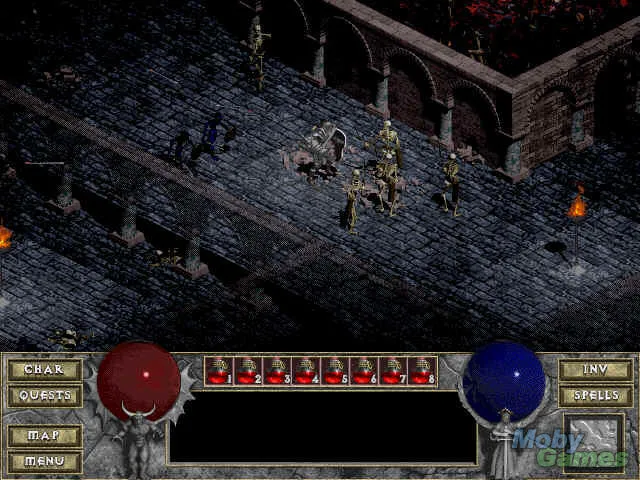
This time marked the zenith of single-player CRPGs, and to be honest, I doubt that Baldur’s Gate II will ever be surpassed. Even in some of these games, the availability of multiplayer modes already signaled the end of the good old CRPGs as we loved them. By the end of the Platinum Age, MMORPGs had taken over the market, and, at least in my opinion, the future of CRPGs grew darker than the darkest fantasies of Lord British.
But not all that glitters is platinum. It was during the early nineties that a plethora of unfinished games with raw code began to emerge, especially on DOS and Windows. Many games that could have been impressive were doomed from the start due to a multitude of bugs that frustrated players and drew outright disdain from critics.
The simplest explanation for such a dominance of bugs in that time was the industry-wide shift in development methods. Instead of lone programmers or small groups, programming began to engage larger teams of specialists, each working on a single aspect, which were then pieced together. While this process sometimes went smoothly, more often than not, not all those pieces turned out to be compatible, and searching for bugs in such vast chunks of code resembled searching for that proverbial needle in a haystack.
Another issue developers faced back then was the lack of universal standards among sound and video card manufacturers. Developers had to customize their code to comply with a dozen different standards or risk that gamers wouldn't vote with their wallets. Today, of course, it's relatively easy to download a patch and fix any bugs, but back then, as you can imagine, most gamers were offline.
The period I termed the New Age began in 2002 with the release of [Neverwinter Nights](/games?search=Neverwinter Nights) from BioWare, followed by games like [Dungeon Siege](/games?search=Dungeon Siege) and The Temple of Elemental Evil. While these games sold far better than their predecessors, their developers seemed to be looking back rather than forward, and I still worry about the masses of CRPG fans who transitioned to MMORPGs at that time. I do not consider these games representatives of the same genre. Why? I'll explain at the end of the article.
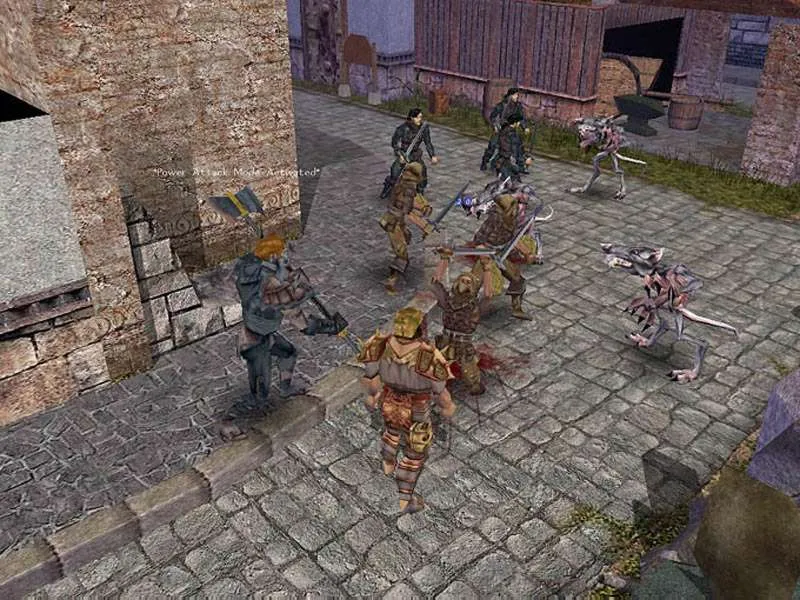
[Neverwinter Nights](/games?search=Neverwinter Nights)
Up to this point, I’ve tried to simplify my narrative by leaving out MUDs and MMORPGs, which also trace their lineage from CRPGs. Again, I’ll explain everything shortly.
But let’s directly return to the topic of conversation and go back to 1992 when Origin released Ultima Underworld: The Stygian Abyss, a groundbreaking game that showcased new impressive possibilities in game development and set the course for many followers.
On the Path to the Platinum Age
In the early nineties, the world saw many CRPGs from various developers, many of whom today are virtually unknown. While DOS (and later Windows) would soon dominate the computer game market, both Atari ST and Commodore Amiga were thriving at the time.
CRPGs of that period, though polished, were actually quite derivative and not particularly innovative. However, some managed to achieve cult status.
A thousand years ago, hidden deep in the beautiful forests southeast of Liramion, there existed a small village called Forkbrook. Its inhabitants were light-haired and good-hearted people; they lived by fishing, hunting, and trading with the nearest city that lay two days' journey to the west. In this village lived a little boy named Tar.
From the manual Amberstar.
Some of these early nineties games can be attributed to developers from Germany. One of them, Amberstar from the Germans at Thalion, boasted good graphics, auto-mapping, and a vast world to explore. In general, everything looked promising, but even the magnificent soundtrack by Johan Hippel couldn't help the game win over the American audience. The sequel, Ambermoon, was released only in Germany, and the third part (the series was planned as a trilogy) never saw the light of day. Regardless, Amberstar is considered one of the best RPGs for Amiga.
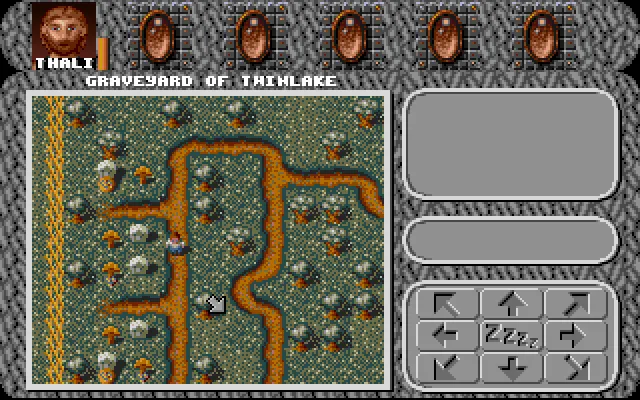
Amberstar
In 1992, Sir-Tech released the English translation of [Realms of Arkania](/games?search=Realms of Arkania): Blade of Destiny, another successful German game based on the role-playing system Das Schwarze Auge ([The Dark Eye](/games?search=The Dark Eye)). In Germany, [The Dark Eye](/games?search=The Dark Eye) was a strong competitor to Dungeons & Dragons itself and offered players a viable alternative to TSR's rules. An enjoyable innovation of the game was the susceptibility of characters to various negative effects, such as fear of death or a hot temper, which directly impacted gameplay.
The game was quite successful, and two sequels were released following the first part, Star Trail (1994) and Shadows Over Riva (1996). Both sequels were released only on DOS, although the first part also graced the Amiga and Atari ST. The final game was released on the then-emerging popular CD and boasted SVGA graphics, but all the games in the series switched between 3D first-person perspective during exploration and isometric view during combat. The turn-based battle system of these games required considerable tactical skill from the player (a reminder of the