
Complete translation of IGN's interview with Todd Howard
In 2011, many big games are released, but few can compare to TES V: Skyrim. I mean not only in terms of popularity but also in terms of size, literally. Bethesda's flagship role-playing series has always offered vast fantasy worlds to explore. You could rush through the main quests and advance the story as quickly as possible, or you could simply wander the world, hunting deer, exploring deep dungeons, and occasionally throwing fireballs at innocent NPCs just to see their reaction.
To learn what’s new in Skyrim and what lessons the development team took from The Elder Scrolls IV: Oblivion and Fallout 3, IGN asked Todd Howard a few questions. And, of course, we didn’t forget about unicorns.
IGN: Before we get into the game itself, could you give a brief overview of what’s happening in the TES universe before the events of Skyrim? Based on what we know now, it seems that a lot of the events from the previous games were setting us up for this.
Todd Howard: We didn’t plan for such serious setup for Skyrim; rather, we assume that these events happened, and some of them were indeed important, especially those that occurred in "Oblivion." They all add to the existing lore that you will see in any of our games. After the events of the fourth installment, the Empire as we knew it slowly begins to crumble, and this is one of the core elements of the storyline conflict in Skyrim. But we want each game to stand alone, so the events of the new game take place, give or take, 200 years after the events of TES IV.
IGN: When did development start, and what is the size of the team? When was it decided that the new technology for Skyrim should be built entirely in-house at Bethesda Game Studios?
Todd Howard: The team comprises about 100 people. Early steps towards the game began during the development of Fallout 3, but the real work only started after the release of that game (emphasized for those who constantly shout, "Skyrim has been in development for 5 years!!!111" - translator's note), when our technical staff began working on new technology for Skyrim.
We have always utilized many of our own developments together with other programs we liked. After Fallout 3’s release, we made a pretty substantial list of what we wanted to improve in the existing technology. We redid rendering, lighting, shadows, animation, character faces, tree leaves, mountains, scripts, the interface, and much more. Once we wrapped up all that, it became clear that the resulting technology was new enough to warrant its own name, The Creation Engine. The same goes for our editor, The Creation Kit. They form a unified technology.
Some of this, like shadows, mountains, and animation, you will notice as a player, while things like the in-game scripting work and pathfinding you might not notice. A quick glance at the editor may suggest that it behaves exactly like old versions; but it does much more and does it better. However, we didn’t change everything just for the sake of change. We still use the .nif file format because it has worked excellently with everything we’ve done, and it's well-known to modders. We still use third-party software, like Havok. This time not just the physics engine but the animation system too, Havok Behavior. Thanks to this, the game looks and plays very differently. However, the overall paradigm by which we build our enormous worlds hasn’t changed much; we just want everything to look better and run more smoothly.
IGN: How familiar will the structure of Skyrim be for fans of the previous installments? Will it again be an open world where we can choose to do the main quests or spend hours exploring and doing side quests? Can you roughly say how much content will be in the new game compared to the fourth installment?
Todd Howard: The structure of Skyrim will resemble the structure of the other games in the series, yes. When it comes to such large games, comparing sizes is tricky, but the size of the world and the amount of content in Skyrim is approximately on par with what was in Oblivion. I say "approximately" because the scale always changes a bit, and things like mountains change your perception of the surrounding world, just as they affect the time it takes to get somewhere. The exploration here plays out a bit differently.
IGN: What methods will be available for traveling through the world? Will there be fast travel, and if so, will it be implemented the same way as in the previous game? What about horse riding? Other methods of travel, like silt striders from Morrowind?
Todd Howard: If you’ve already visited a location, you can fast travel back to that location. We also have a teleportation system that allows you to reach places you haven’t been before, so in the end, it’s a blend.
IGN: Will the auto-leveling system from Oblivion, which raised the level of enemies simultaneously with the player’s level, return to the game? If not, will there be a modified version, and what inspired the changes?
Todd Howard: This system has been present in some form in all our games, from Arena to Fallout 3. Such a system is somewhat essential in games like these (a debatable point - the translator’s opinion), the question is how and when to use it. I agree that it didn’t always work in Oblivion. I think we corrected that in Fallout 3, so "Skyrim" works on a similar scheme. We want there to be mountains and valleys where you encounter genuinely challenging opponents, while in other places, you feel truly powerful. The goal is to convey to the player, without blocking any areas: "this place is too tough for you, come back later."
IGN: Dragons seem to be important for progressing the plot in Skyrim. Can you say approximately how many dragons will be in the game? Are encounters with them limited to plot points, or can players engage in battles with dragons whenever they want? What do they gain by winning these battles?
Todd Howard: Honestly, I don’t know how many there will be. Some will appear by script at certain times, some will appear completely randomly. We haven’t settled on an exact number yet, and it depends, among other things, on how you play the game. When I played Skyrim last week, I was attacked by three dragons at once, and I assure you that’s a bit much for one battle. I think the minimum number of dragons is around a dozen, and the maximum exceeds that number by a long shot. Theoretically, the number could reach infinity, since we place them all over the world alongside other monsters. Initially, we were somewhat conservative about including dragons in the project, but it turned out wonderfully, and we want to dedicate a significant amount of gameplay time to them. By defeating a dragon, the player absorbs its soul, and that’s all I can say at the moment.
IGN: A somewhat unusual question: will there be puzzle elements in battles with dragons? For example, will the ability to defeat certain dragons appear only after unlocking new shouts or other abilities? Will some dragons only show up in the world after the player defeats others? What attack styles will the dragons possess?
Todd Howard: I don’t want to spoil things or go into detail, but there are several types of dragons in the game, they have different powers, and they use the same shouts as the player.
IGN: Regarding the melee combat system - how has it changed in Skyrim compared to other games in the series? From what we’ve seen in the released video, it appears that there will be finishing moves and weapon strikes will feel more impactful. What’s hidden here? What aspects of combat are of primary importance to you?
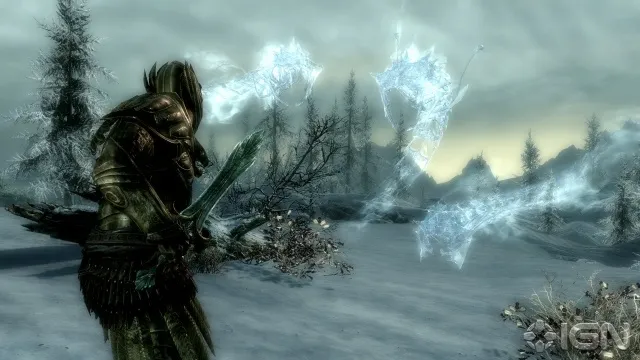
Todd Howard: From a gameplay perspective, we wanted to slow the pace a bit and give the player more choices in the game based on what they are using - a shield and sword, two-handed weapons, or dual swords. You can also hit enemies with your shield to stun them. The balance lies in creating openings in enemy defenses and then taking advantage of them. You can also use a strong attack by holding the button. This drains stamina but allows you to deal increased damage and, again, stun the enemy.
Another side of the combat system is how it looks. We not only want combat to play differently, we want every action, from swings to finishing off enemies, to feel different. They should be interesting at a base level. Finishing moves occur randomly when you kill an enemy with a specific strike. Ultimately, no matter what we do, the most substantive part of the gameplay is combat, and there will be plenty of it. Simple tasks like killing enemies need a lot of attention, even if it’s just "the wolf gets hit in the head with a mace."
IGN: How is the dialogue system evolving in the game? What have you learned from player feedback on its performance in Oblivion, and will there be persuasion methods similar to those in Oblivion?
Todd Howard: The main change is that dialogues now occur in real-time. The game doesn’t pause, the camera doesn’t lock on the interlocutor; it’s just another way to interact with the game world. We wanted to eliminate the feeling of transitioning into a separate "mode". Dialogues are even presented as a simple list of things you can ask about, appearing next to the cursor. We are also creating characters that can’t be asked about certain topics, but who will reply with some line upon interaction with them. Subsequent interactions will be perceived as a "tell me more" line. This way, we can create quick dialogues with the player, and it will really help fill the game world.
IGN: It has been shown that you can use weapons and spells simultaneously. Can you tell us what prompted the switch to this system, and also talk about the new possibilities it provides?
Todd Howard: In our opinion, a character is best defined by what they do, rather than by their skill list or the choices made by the player in the initial menu of the game, and showing this has been the main goal of The Elder Scrolls series for a long time. Using gamepad triggers or mouse buttons to let them perform the role of your hands is a pretty elegant solution. In-game, all of this feels entirely natural. It began with our desire to give players a better experience with magic, making it feel closer to melee combat by allowing the player to use both hands simultaneously to do things or providing a more interesting choice. We added the dual-wielding system to the game rather late, as soon as we saw how great it was to grab whatever you wanted in each hand. Additionally, it forces the player to make choices. You can’t take everything at once. And understanding which combination best suits your play style is immensely enjoyable. When I play, I often switch between different styles.
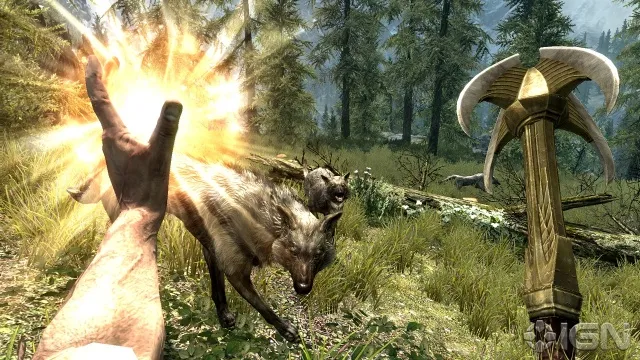
IGN: Will there be a possibility to create custom spells in the game? What about enchanting items?
Todd Howard: Every archetype (presumably referring to the conditional "character classes" - translator's note) in the game has crafting options. Magical crafting is essentially Enchantment, allowing you to create magical items and alter their properties.
IGN: How will the skill leveling and leveling up be implemented in the game? What decisions will need to be made when leveling up, and what will you need to do to achieve that leveling? Is the skill improvement system based on frequent use still in place? Will all the skills from the previous game be used in Skyrim, or have there been changes in this regard?
Todd Howard: Skill leveling works like in Oblivion - the more you use a skill, the higher it gets. The skill list is also similar to what was used before, but it has been modified in accordance with the current gameplay. The difference lies in how you gain experience levels. All your skills affect this process. The higher the skill value, the closer it brings you to a new level. It's a self-balancing system rewarding you for using well-trained skills. It will force you to focus. Skill leveling has become our equivalent of experience points for leveling up. The higher your level, the more is needed. When you level up, you choose which of the primary attributes to increase, and then you choose a perk. Perks are quite powerful, and they determine who your character will be to a greater extent than the skills. Each skill has its own "perk tree." Perks range from the ability to deal increased damage with certain weapons to entirely unique things like special moves, disarming, and critical hits.
IGN: How does the dragon shout system work? How does one learn new shouts and what are their effects? Is learning new shouts critically important for completing the game or is it a useful but optional addition?
Todd Howard: Shouts are based on certain words from the dragon language, which, when used together, allow for magical attacks. Words can be learned during gameplay by finding them on ancient carvings or being taught them (presumably by some sort of teachers - translator's note). All of this is part of the ancient culture of Skyrim. For creating a shout, you can use up to three different dragon words. Some are essential for completion, while others simply make the player stronger.
IGN: Compared to Oblivion, will we see roughly the same number of armor sets and weapon types in Skyrim, or will it differ? Will there be new armor sets that we haven’t seen before, and what influenced their design and appearance?
Todd Howard: Of course, there is more of all this in the new game, but I haven’t counted them precisely. Many things from previous installments will return, but even the most basic ones, like iron armor, will receive designs and appearances suitable for the overall mood of the game and the Skyrim environment. When creating designs, we assume that all basic items were crafted in Skyrim, while exotic items, like elven ones, were made somewhere else.
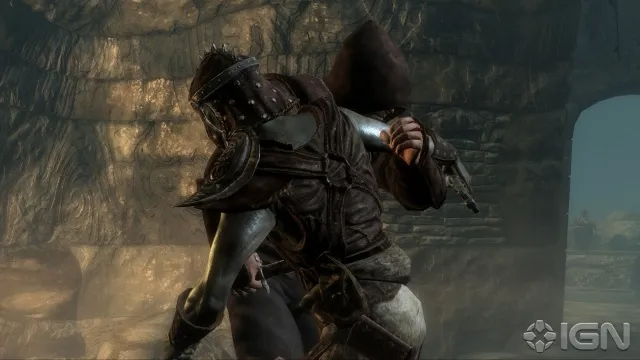
IGN: Will the game feature both first-person and third-person views? If so, are they both created as equal and fully realized gameplay modes?
Todd Howard: Yes, both views are available. The third-person view, with the new animation system, is better than ever, and people seem to really enjoy playing in that mode, admiring their character. However, Skyrim is primarily designed as a first-person game. The third-person perspective is an addition, and some tasks, like picking up items and conversing, are always harder to do in that perspective. Some people on the team believe that fighting is better with the third-person view because it gives a better view of the surroundings. I, however, usually play in the first-person view unless I’m running in the wild and want to appreciate the scenery.
IGN: I know you get asked this question a lot, but I can’t help but ask: will there be multiplayer or co-op in the game, or will The Elder Scrolls remain a purely single-player experience?
Todd Howard: Most often, we are asked to make dragons and multiplayer. We made dragons this time! We are always looking at multiplayer, tossing around ideas, but it never reaches implementation. Not that we don’t like multiplayer. I think there are ways to make it quite fun, but in the end, their implementation would distract us from creating the best single-player game we can make.
IGN: Can you say definitively that the release date of 11.11.11 is final for all platforms?
Todd Howard: As much as it can be. We’re not worried about the date; we’re just working as hard as we can to fit all the planned features into the game.
IGN: Are versions for all platforms being developed directly at Bethesda Game Studios?
Todd Howard: Yes, it was the same with Fallout 3.
IGN: Will the PC version support DirectX 11?
Todd Howard: Yes, but I think the main question here is whether we will utilize all the latest advantages of DX11? The answer is: "No." We are trying to make the graphics consistent across all platforms.
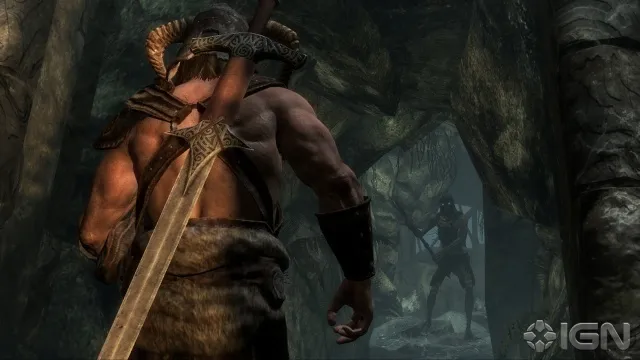
IGN: And finally - a couple of silly questions. Will there be a unicorn in the game?
Todd Howard: In the DLC. For a hundred bucks.
IGN: Will players be able to fly on dragons in Skyrim?
Todd Howard: Not in the sense you mean.
IGN: Can you levitate?
Todd Howard: Ah, that's already in another DLC. For three hundred dollars.
Original interview and source of screenshots.
Translation - mine.